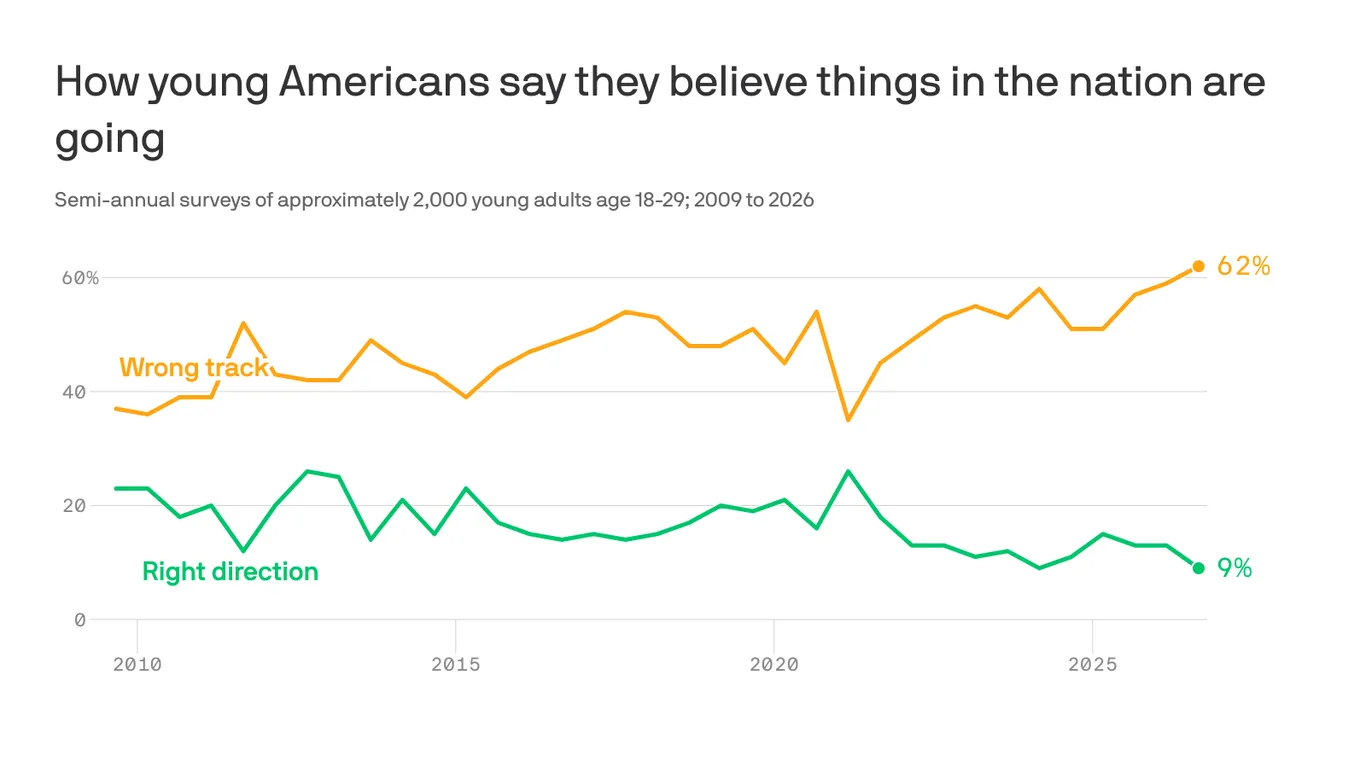
数据来源:哈佛青年民调,2026年秋季;图表:Emily Peck/Axios根据最新发布的哈佛青年民调,计划在下个月国会中期选举中投票的美国30岁以下成年人中,近三分之二表示,他们的主要动机是反对特朗普总统及其政策。
Data: Harvard Youth Poll, Fall 2026; Chart: Emily Peck/Axios Nearly two in three U.S. adults younger than 30 who plan to vote in next month's congressional midterm elections say their main motivation is to oppose President Trump and his policies, according to a newly released Harvard Youth Poll The big picture:
大局: 77%的受访者不认可总统对经济的处理,其中包括约一半的年轻共和党人。仅有9%的人认为美国正朝着正确的方向发展——这是该民调历史上的最低水平。
Seventy-seven percent of respondents disapprove of the president's handling of the economy, including about half of young Republicans. And just 9% say the U.S. is headed in the right direction — the lowest in the survey's history.
重要性:经济民粹主义正在驱动情绪,同时还有对战争、人工智能、亿万富翁、驱逐战术、社会政策和腐败的担忧。大多数受访者支持全民医保、财富税以及禁止国会议员炒股。
Why it matters: Economic populism is driving emotions, along with concerns about war, AI, billionaires, deportation tactics, social policies and corruption. Majorities of respondents support Medicare for All, a wealth tax and bans on congressional stock trading.
关注点:仅有三分之一的18至29岁美国人表示他们肯定会去投票——较2022年表示肯定会投票的40%大幅下降。值得注意的是,这一下降主要由共和党人驱动。
What we're watching: Just one in three Americans ages 18-29 say they'll definitely vote — a substantial drop from 40% who said so in 2022. Notably, most of that drop is driven by Republicans.
- 仅34%的共和党受访者表示肯定会去投票,低于46%;50%的年轻民主党人表示肯定会去投票,基本持平。仅22%的独立人士表示肯定会去投票,低于26%。
• Only 34% of Republican respondents said they'll definitely vote, down from 46%; 50% of young Democrats say they'll definitely vote, essentially unchanged. Just 22% of independents they'll definitely vote, down from 26%.
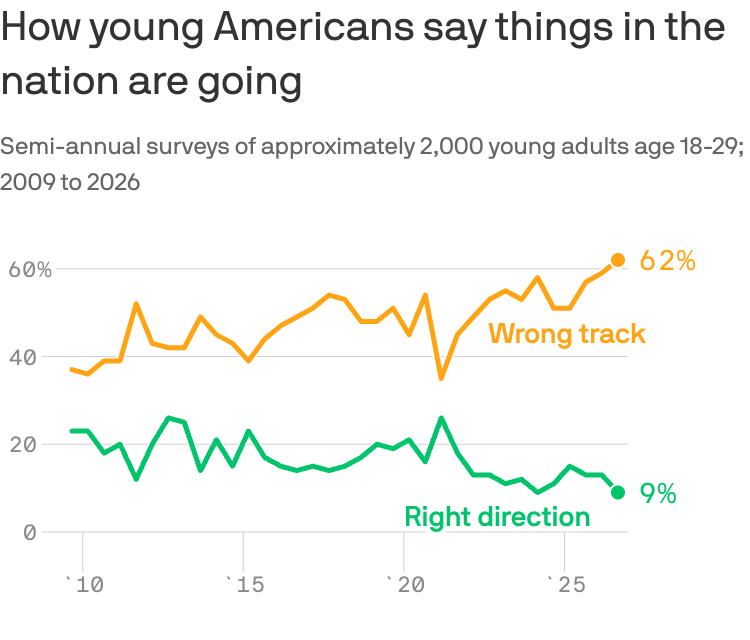
聚焦:年轻人认为对其长期财务安全构成严重威胁的因素榜首是:物价上涨和生活成本(79%),其次是大企业的权力(68%)和贸易战(68%)。
Zoom in: Topping the list of what young people consider serious threats to their long-term financial security: rising prices and the cost of living (79%), followed by the power of large corporations (68%) and trade wars (68%).
- 近半数受访者表示,他们的家庭难以维持生计,或仅能靠有限的财务保障勉强度日。
• Nearly half said their household is struggling to make ends meet or getting by with limited financial security.
数字解读: 63%的人表示,他们对美国众议院或参议院的投票将是为了反对特朗普,而14%表示受支持总统的动机驱使,17%表示总统不是考量因素。
By the numbers: 63% say their votes for U.S. House or Senate will be cast in opposition to Trump, while 14% say they're motivated by support of the president and 17% say he's not a factor.
- 三分之二的受访者不认可民主党在国会的表现;74%不认可国会共和党人的表现。
• Two-thirds disapprove of the job Democrats are doing in Congress; 74% disapprove of congressional Republicans' performance.
惊人数据:在这次民意调查的历史上,首次出现这样的情况:认为自己的生活状况会比父母差(27%)的年轻人比例略高于认为自己的生活状况会比父母好(25%)的年轻人比例。
Stunning stats: For the first time in the poll's history, the share of young adults who said they expect to be worse off than their parents (27%) slightly exceeded the share who said they expect to be better off (25%).
- 这一差异仍在调查的误差范围内,但长期来看这一趋势确实非常显著。2021年秋季时,有39%的年轻人认为自己的生活状况会比父母好,而只有17%的年轻人认为自己的生活状况会比父母差。
• The difference was within the poll's margin of error, but the longer-term trend is striking. In fall 2021, 39% expected to be better off than their parents, while just 17% expected to be worse off.
- 哈佛大学首次提出这个问题是在2003年,当时仅针对大学生进行调查,当时有74%的受访者认为自己的生活状况会比父母好;而在最近的这次调查中,这一比例下降到了28%。
• When Harvard first asked the question, only to college students, in 2003, 74% believed they'd be better off than their parents. In this recent poll only 28% believed it.
- 当被问及对美国未来的态度(是更乐观还是更悲观)时,表示担忧的受访者(69%)是表示乐观的受访者(26%)的两倍多。
• When asked if they're more hopeful or fearful about America's future, fear (69%) outweighs hope (26%) by more than two to one.
“在成年初期,年轻人应该能够看到通过努力工作实现稳定生活的途径,关键问题是这个承诺是否仍然成立,”哈佛大学肯尼迪学院政治研究所的民意调查主任约翰·德拉·沃尔佩(John Della Volpe)在周三与记者的电话会议上说道。
"At the beginning of adulthood, younger people should be able to see a path from hard work to a secure life, and the big question is whether that promise still holds," John Della Volpe, director of polling at Harvard Kennedy School's Institute of Politics, said in a conference call with reporters Wednesday.