马德莱恩·皮特 2026年10月22日 随着法国的抗议活动持续进行,在出现新的警察暴力指控后,法国警察正受到审视。这支警力拥有的装备比欧洲大多数警察部队都多。
Madelaine Pitt October 22, 2026 As protests continue in France, the French police are under scrutiny after new allegations of police brutality. The force has a bigger arsenal than most in Europe.
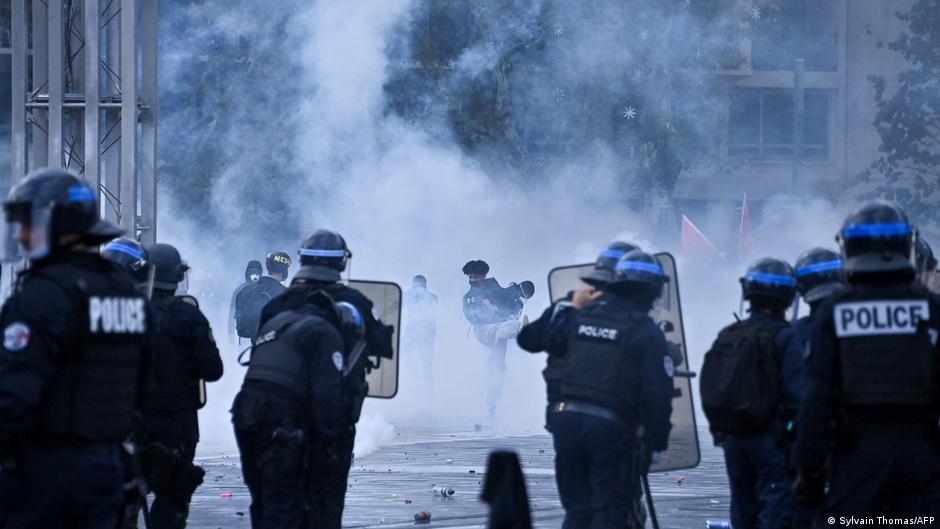
法国警察对抗议者使用了催泪瓦斯、橡皮子弹和震爆弹。一段视频显示,警察将一名男子打倒在地,随后把他拖走,当时他已失去意识。另一段视频显示,一名警察从背后抓住一名年轻男子,似乎并无挑衅,并掐着脖子将他拖走。还有一段视频显示,一名年轻女子被扭着手臂拖走,痛苦地尖叫。这些视频无法得到独立核实。
The French police has used tear gas, rubber bullets and stun grenades against protestors protests grips France One video shows the police beating a man to the floor then dragging him away unconscious. Another shows an officer grabbing a young man from behind, seemingly unprovoked, and dragging him by the neck. Another shows a young woman being hauled off with a twisted arm, screaming in pain. These videos could not be independently verified.
法国警察再次招致人权组织的批评,不仅因为他们的手段,还因为他们使用震爆弹和橡皮子弹。法国拥有欧洲装备最精良的警察部队之一。在过去几周的学生抗议中,数名青少年因此遭受改变一生的伤害:一人手被炸掉,一人一只眼睛失明,另一人下巴被打断。
The French police have drawn renewed criticism from rights groups not only because of their methods but also because of their use of stun grenades and rubber bullets. France has one of the most heavily armed police forces in Europe. During the student protests of the past weeks, several teenagers sustained life-changing injuries as a result: One had a hand blown off, one was blinded in one eye, another had his jaw broken.
法国的抗议活动愈演愈烈。周六,超过50万人走上法国街头,其中大多数人和平抗议,批评公共部门削减开支和生活成本危机,并支持学生要求改善教室条件。
France's protests grow More than half a million people took to the streets in France on Saturday, most of whom protested peacefully, criticizing public sector cuts, the cost-of-living crisis and supporting students' demands for better conditions in classrooms.
暴乱者趁机纵火焚烧建筑、抢劫商店并向警察投掷物品,给警员和其他应急服务人员造成了困难局面。
Rioters took advantage, burning buildings, looting stores and lobbing projectiles at the police, creating a difficult situation for the officers and other emergency services.
周末的抗议活动之前,高中生已举行了一系列抗议,他们封锁教学楼,谴责教师短缺,并要求修缮破败的基础设施。本周末还将举行更多抗议活动,法国政府表示甚至将部署军队。
The protests over the weekend followed a series of protests by high-school students who barricaded school buildings to denounce a shortage of teachers and demand repairs to crumbling infrastructure. More protests will be happening this weekend, with the French government saying it will even deploy military forces.
法国警察使用的一些工具在其他国家被禁止或很少使用。为战争制造的武器?
Some tools used by the French police are banned or rarely used in other countries Weapons made for war?
法国警察的武器库比大多数欧洲国家都庞大。例如,警员使用所谓的LBD-40,这是一种发射橡皮子弹的枪械。
The French police have a bigger arsenal than most European countries. For instance, officers use the so-called LBD-40, a type of gun used to fire rubber bullets.
许多国家,如英国和德国,大多不允许在抗议活动中使用橡皮子弹。在一些欧洲国家,如西班牙,有时会使用橡皮子弹,但造成的伤害比法国少。
Many countries, like the UK and Germany, mostly do not allow the use of rubber bullets in protests. In some European countries, like Spain, they are sometimes used but cause fewer injuries than in France.
巴黎南大学犯罪学副教授阿纳斯塔西娅·楚卡拉对德国之声表示:“这不是法国独有的做法。但有指导原则。必须保持一定距离。即使你试图遵守指导原则,人们也可能移动,然后突然之间就可能失去一只眼睛。所以这极其危险。”法国警察经常使用催泪瓦斯,欧洲许多其他国家的警察也是如此。在战争中,根据《化学武器公约》等协议,催泪瓦斯的使用实际上是被禁止的。
"It is not a French specificity. But there are guidelines. There must be a certain distance," Anastassia Tsoukala, an associate professor of criminology at the University of Paris-Sud, told DW. "Even if you try to respect the guidelines, people may move and then all of a sudden they may lose one eye. So it's extremely dangerous." Police in France routinely use tear gas, as do police in many other countries in Europe.
使法国警察与其他警队区别开来的是其对震爆弹的使用。楚卡拉说:“这些手榴弹含有大量爆炸性物质。所以从这个角度来看,法国是独一无二的。”
In warfare, its use is actually forbidden under agreements like the Chemical Weapons Convention. What makes the French police stand out from other forces is its use of stun grenades "These grenades contain a high level of explosive substances. So from this point of view, France is unique," said Tsoukala.
内政部长洛朗·努内兹坚称警察使用的武器是“非致命性的”。然而,法国警方使用的一些装备被法国自己的国内安全法典归类为“战争物资”。法国:学生为何走上街头 观看此视频,以及法国警察:欧盟中“最残暴”的?
Minister of the Interior Laurent Nunez insists that weapons used by the police are "non-lethal." However, some of the equipment used by the force is classified by France's own internal security code as " war material France: Why students are taking to the streets To view this video , and French police: the 'most brutal' in the EU?
在抗议活动中造成伤害后,警方对这些武器的使用再次受到批评。那名失去一只眼睛功能的少年疑似被LBD-40发射的橡皮子弹近距离击中。
The police's use of these weapons has received renewed criticism after it resulted in injuries during the protests. The teenager who lost use of an eye is suspected of being hit at close range with a rubber bullet from an LBD-40.
罗什说:“当我们审视人群控制时,很明显,如果我们以示威者或人群成员的死亡人数来衡量警察的残暴程度,如果我们还以致残案件的数量来衡量,法国警察是整个欧盟中最残暴的。”他强调需要从政治背景出发来理解法国警方的装备及其使用方式。
"When we look at crowd control, it is clear that if we measure police brutality by the number of deaths amongst demonstrators or members of the crowd, and if we also measure it by the number of cases of maiming, the French police are the most brutal in the whole of the European Union," says Roche. He points to the political context to understand the French police's equipment and how it is used today.
“警方装备的配备完全由政治当局决定,”这位警察专家说道,“当防暴盾(LBD)首次被引入法国警方时,它们原本是用于打击有组织犯罪等任务的。如今,这些武器也被用于控制人群。这反映了法国政界对于如何应对政治抗议活动的看法发生了变化。”
"The political authorities are free to decide on the police's equipment," the police expert says. "When LBDs were introduced into the [French] police force, they were intended for units like anti-organized crime units. This is the same weapon that is today used for crowd control.
法国警方与其他国家的警方在应对方式上存在显著差异:例如,德国警方通常会尽量避免事态升级。
It gives an idea of how the way in which politicians in France think we can or should deal with political protest has evolved."
罗什(Roche)将2023年德国吕策拉特(Lützerath)发生的抗议活动与同年法国圣索利纳(Sainte-Soline)发生的抗议活动进行了对比。在吕策拉特,虽然动用了警犬,双方都有人员受伤,但重伤者数量较少;而在圣索利纳,军队被派往现场,警方大量使用了防暴盾和手榴弹,导致多名警察和示威者受伤,其中两名抗议者陷入昏迷。
Confrontation vs. de-escalation Another difference between the French police and forces elsewhere is the methods. German police for example, are supposed to try to avoid escalation. Roche compares how protestors were moved in Lützerath, Germany, in 2023 to the more aggressive methods in Sainte-Soline, France, in 2023. Both places saw environmental protests. "In Lützerath, dogs were used, there were some injuries but far fewer seriously injured people on both sides.
在德国吕策拉特,警方在逮捕抗议者时使用的武力远小于法国类似抗议活动中的武力强度。
In Sainte-Soline, the military police was sent in and used LBDs and grenades intensively. There were serious injuries amongst both police officers and demonstrators.
根据联合国制定的国际标准,执法人员使用武力“应属于例外情况”,且仅限于“预防犯罪”或“合法逮捕”的情形。任何使用武力的行为都必须遵循“比例原则”,即所使用的武力必须严格控制在实现目标所需的范围内。
Two protestors were left in a coma." Police arrested protesters in the German town of Lützerath, but with less force than at similar protests in France When can police officers use force? According to international standards set by the United Nations use of force by officers of the law "should be exceptional," in the case of "prevention of crime" or "lawful arrest."
法国内政部长努涅斯(Núñez)在电台采访中坚称,在当前的抗议活动中,法国警方在很大程度上遵守了这一原则,而这一原则也明确写入了法国法律之中。
Any use of force should follow a principle of "proportionality," which means no more than necessary to achieve its objective. French Interior Minister Nunez has insisted in radio interviews that officers have largely respected this principle, which is also enshrined in French law, during the current protests.
然而,人权组织国际特赦组织将警方对当前抗议活动的反应描述为“过度使用武力”,并呼吁法国当局“履行其人权义务”。法国人权联盟也谴责了对高中生抗议活动的“暴力镇压”行为。
However, rights group Amnesty International describes the police response to the current protests as "disproportionate" and calls upon French authorities to "act upon their human rights obligations." The French branch of the League of Human Rights condemns the "violent repression" of the high school protest movement.
德国之声(DW)联系了两个警察工会及法国内政部寻求评论,但在本文发表前,双方均未作出回应。
DW contacted two police unions and the French Interior Ministry for comment, but none responded before time of publication.
“控制所有这些不同的抗议群体非常困难,”内政部长努涅斯周二在马赛表示,“警方表现非常出色,多起犯罪行为都因他们的努力而得以预防。”不过,专家们对警方的行为持批评态度。
"It was very complicated to contain all the different groups," Interior Minister Nunez said in Marseille on Tuesday. "The police did a great job and there were a great number of crimes that were prevented thanks to their commitment." Experts are critical of the police's actions.
“公共秩序必须服从于人类的生命与安全,”楚卡拉指出,“作为一名法学家,我认为这是一个不可妥协的原则。”与英国和丹麦相比,法国的警察体系缺乏独立监督机制——法国警方仅有名为IGPN(国家警察总监察局)的内部监督机构,该机构仅在出现问题时才会展开调查。据IGPN称,自抗议活动开始以来,他们已至少立案40起相关案件。
"Public order is subordinated to human life and safety," Tsoukala said. "As a jurist I should say that this is a non-negotiable value." Less oversight than in the UK and Denmark The French police have no independent watchdog, only an internal division called the IGPN (General Inspectorate of the National Police) that can investigate when problems occur. The IGPN says it has opened at least 40 cases since the beginning of the latest protests.
英国和丹麦等国在处理类似事件时设有独立的监督机构。不过,楚卡拉批评整个欧洲在处理警察暴力行为时普遍存在执法不严、缺乏透明度的问题:“这些涉警暴力事件要么被宣告无罪,要么仅受到极其轻微的处罚;恐怕这已经成为欧洲处理此类案件的标准做法了。”
Countries like the UK and Denmark investigate incidents differently, with independent watchdogs. However, Tsoukala criticizes leniency and a lack of transparency across Europe when incidents with the police occur. "They are acquitted or they receive extremely light penalties," she said. "And I'm afraid this is the standard method to deal with police brutality cases across Europe."