硅谷主导人工智能政治的雄心已演变成一场内斗。距离中期选举还有一周,根据CNBC对截至10月20日联邦选举委员会备案文件的分析,主张加快AI发展、实施更轻度且更统一规则的政治团体在国会大选中已花费约800万美元,超过了主张加强安全防护、给予各州更多监管空间的团体约690万美元的支出。
Silicon Valley's bid to dominate artificial intelligence politics has devolved into a fight with itself. With one week until the midterm election, political groups favoring faster AI development and lighter, more uniform rules have spent roughly $8 million in general-election congressional races, besting groups pushing for stronger safeguards and more room for states to regulate that have spent about $6.9 million, according to a CNBC analysis of Federal Election Commission filings through Oct. 20.
在佛罗里达州第25国会选区,这种分裂演变成了一场直接对决。在初选期间,Leading the Future(引领未来)旗下的超级政治行动委员会Think Big(宏思)花费31万美元支持民主党人贾里德·莫斯科维茨,该选区在佛罗里达州为2026年大选重新划分国会选区地图后发生了变化。另一方,主张更严格安全护栏和州级监管权的超级政治行动委员会Defending Our Values(捍卫我们的价值观)投入近85.7万美元助推共和党人斯科特·辛格,并额外花费74万美元阻止辛格的一名初选对手当选。如今,莫斯科维茨和辛格在大选中正面交锋。
In Florida's 25th Congressional District, that split has produced a direct face-off. During the primary, Think Big, an affiliate of Leading the Future, the main super PAC network pushing faster AI development and lighter regulation, spent $310,000 supporting Democrat Jared Moskowitz, whose district changed after Florida redrew its congressional map ahead of the 2026 election. On the other side, Defending Our Values, a super PAC favoring stricter safety guardrails and state-level authority, dropped almost $857,000 to boost Republican Scott Singer and an additional $740,000 to keep one of his primary opponents from being elected. Now, Moskowitz and Singer face off in the general election.
这是硅谷试图打造统一AI政治机器却四分五裂的一个缩影。双方都支持AI创新,也都认同需要护栏,但他们在支持哪些候选人——以及哪些候选人最符合其偏好的部署速度、监管触角范围和州权平衡——的问题上依然陷入代价高昂的拉锯战。
It's a microcosm of the breakdown in Silicon Valley's bid to build a unified AI political machine. Both sides favor AI innovation and agree on the need for guardrails, but they remain locked in a costly tug-of-war over which candidates to back — and which will best align with their preferred deployment speed, regulatory reach and balance of state power.
选出更多盟友可能让任一阵营在下届国会制定AI政策时占据优势,但这场内斗也有削弱硅谷政治影响力的风险。
Electing more allies could give either camp an edge in shaping AI policy in the next Congress, even as the feud risks weakening Silicon Valley's clout.
“每个人都支持某种形式的监管。只是在争论监管多少的问题,”非党派组织政治问责中心总裁兼联合创始人、前参议院银行委员会首席调查员布鲁斯·弗里德说。“资金从四面八方涌入,只为掌握主导权,决定事态走向。”CNBC 梳理了与各阵营立场一致的联邦委员会,并统计了它们根据联邦选举委员会(FEC)申报的、用于支持或反对国会候选人的独立支出。该分析不包括州级竞选和非营利倡导组织的支出。
"Everyone supports some form of regulation. It's just a debate about how much," said Bruce Freed, president and co-founder of the nonpartisan Center for Political Accountability and a former chief investigator for the Senate banking committee. "Money is flowing in all directions to be in the driver's seat of what happens." CNBC identified federal committees aligned with each camp and totaled their FEC-reported independent expenditures supporting or opposing congressional candidates. The analysis excludes state races and nonprofit advocacy spending.
加密货币剧本 这原本不在计划之中。范本是加密货币。根据联邦选举委员会备案文件,由 Coinbase(币安)、Ripple(瑞波)和 Andreessen Horowitz(安德森·霍洛维茨)资助的 Fairshake 及其关联的亲加密货币超级政治行动委员会(超级 PAC),在 2024 年选举周期中花费了超过 1.3 亿美元。据加密货币出版物 CoinDesk 统计,其支持的候选人在 58 场竞选中赢得了 53 场,胜率高达 91%。
The crypto playbook This was not the plan. The model was cryptocurrency. Fairshake and its affiliated pro-crypto super PACs, backed by Coinbase, Ripple and Andreessen Horowitz, spent more than $130 million during the 2024 election cycle, according to FEC filings. Candidates it supported won 53 of 58 races, a 91% success rate, according to crypto publication CoinDesk.
AI 投资者注意到了这一点。2025 年 8 月,Leading the Future 正式启动,获得了包括 Andreessen Horowitz、OpenAI 总裁格雷格·布罗克曼及其妻子安娜、Perplexity 和 Palantir 联合创始人乔·朗斯代尔在内的科技大佬承诺的超过 1 亿美元资金。
AI investors took note. In August 2025, Leading the Future launched with more than $100 million in commitments from tech heavyweights including Andreessen Horowitz, OpenAI President Greg Brockman and his wife, Anna, and Perplexity and Palantir co-founder Joe Lonsdale.
该网络由曾在上一选举周期为 Fairshake 工作的乔什·弗拉斯托共同领导,旗下部署了一个民主党超级 PAC“Think Big”和一个共和党超级 PAC“American Mission”,以支持主张加快 AI 发展、反对各州法规碎片化的候选人。
Co-led by Josh Vlasto, who worked for Fairshake last election cycle, the network deployed a Democratic PAC, Think Big, and a Republican PAC, American Mission, to support candidates aligned with faster AI development and opposition to a patchwork of state regulations.
信息很明确:支持 AI 的议程,否则就要面临数百万美元被用来对付你的风险。
The message was clear: Back AI's agenda or risk millions being spent against you.
“AI 行业去年宣布,他们将复制加密货币行业的剧本,挥舞着巨额资金杀入战局,以此恐吓立法者屈服,”倡导加强对大型科技公司和 AI 监管的非营利监督组织“科技监督项目”创始人兼执行主任萨查·霍沃斯说。
"The AI industry announced last year that they were going to rerun the crypto industry playbook by coming in swinging with oodles of money in order to bully lawmakers into submission," said Sacha Haworth, founder and executive director of the Tech Oversight Project, a nonprofit watchdog that advocates for stronger regulation of Big Tech and AI.
起初,这套策略奏效了。在3月该周期首批重要的初选中,美国使命重金支持的三名候选人——得克萨斯州的杰西卡·斯坦曼、得克萨斯州的克里斯·戈伯和北卡罗来纳州的劳里·巴克豪特——在共和党初选中获胜,根据联邦选举委员会(FEC)的备案文件,该组织为每人提供了超过50万美元的支持。
At first, it worked. In the cycle's first major primaries in March, three candidates heavily backed by American Mission — Jessica Steinmann in Texas, Chris Gober in Texas and Laurie Buckhout in North Carolina — won their Republican contests after the group spent more than $500,000 supporting each, according to FEC filings.
但一个竞争对手的基础设施已经在形成。Anthropic公司在2月向“公众优先行动”承诺提供2000万美元,又在7月追加2000万美元,为“护栏派”提供了一位主要的财政后盾。Anthropic表示,其资金仅限用于政策和公众教育,不能用于资助候选人选举。尽管如此,与“公众优先行动”有关联、资金来源独立的超级政治行动委员会(Super PAC)已花费数百万美元推进类似优先事项。
But a rival infrastructure was already taking shape. Anthropic committed $20 million to Public First Action in February and another $20 million in July, giving the safeguards camp a major financial backer. Anthropic says its money is restricted to policy and public education and cannot fund candidate elections. Still, separately funded super PACs tied to Public First Action have spent millions advancing similar priorities.
这场冲突在纽约第12国会选区的民主党初选中公开爆发。根据FEC备案文件,“宏图智库”花费830万美元,试图击败州众议员亚历克斯·博雷斯,后者起草了重要的州级人工智能安全立法。Anthropic支持的“就业与民主政治行动委员会”投入约1500万美元支持他,盟友安全团体又花费数百万美元,据CNBC分析。
The clash burst into view in New York’s 12th District Democratic primary. Think Big spent $8.3 million, according to FEC filings, trying to defeat state Assemblymember Alex Bores, who authored major state AI safety legislation. The Anthropic-backed Jobs and Democracy PAC countered with about $15 million to support him, while allied safety groups spent millions more, according CNBC's analysis.
据该分析,“宏图智库”与“就业与民主”合计花费2330万美元,约占两派全国初选支出的40%。
Think Big and Jobs and Democracy spent a combined $23.3 million, about 40% of the two camps' primary spending nationwide, according to the analysis.
博雷斯最终以39%对35%败给迈卡·拉舍,使“宏图智库”取得了一场战术性胜利。
Bores ultimately lost to Micah Lasher, 39% to 35%, giving Think Big a tactical victory.
“他们帮助点燃了一把火,这把火现在正助燃中期选举中的大量反弹,”霍沃思说。“这场竞争表明,针对‘安全优先’候选人的支出现在可能引发来自行业内部的反击。” 资金放缓 这场斗争已延续至大选,但支出速度大幅放缓。
"They helped light a flame under the backlash that's now fueling so much of the midterm elections," Haworth said. "The race showed that spending against safety-first candidates could now trigger a counterattack from within the industry itself." The money slows The fight has carried into the general election, but the pace of spending plummeted.
根据CNBC对联邦选举委员会(FEC)文件的分析,以安全防护为重点的团体今年秋季花费了82.5万美元,反对两名在初选期间受益于“引领未来”(Leading the Future)相关支出的共和党人。仅这两场竞选就占到了安全防护阵营大选反对支出的六分之一以上。
Safeguards-focused groups have spent $825,000 this fall opposing two Republicans who benefited from Leading the Future-aligned spending during the primaries, according to CNBC's analysis of FEC filings. The two races alone account for more than one-sixth of the safeguards camp's general-election opposition spending.
根据FEC文件,“护栏联盟”(Guardrails Alliance)报告称,分别花费41.25万美元反对亚利桑那州共和党众议院候选人杰伊·菲利(Jay Feely)和蒙大拿州共和党众议院候选人亚伦·弗林特(Aaron Flint),这两人在初选期间均受益于“引领未来”相关支出。该联盟还报告称,花费约41.2万美元反对加利福尼亚州民主党籍众议员吉米·戈麦斯(Jimmy Gomez),据CNBC分析,“引领未来”曾背书戈麦斯,但未报告为支持他而进行的支出。
Guardrails Alliance reported spending $412,500 apiece, according to FEC filings, against Republican House candidates Jay Feely in Arizona and Aaron Flint in Montana, both of whom benefited from Leading the Future-aligned spending in their primaries. It also reported about $412,000 against Democratic Rep. Jimmy Gomez in California, whom Leading the Future endorsed but did not report spending to support, according to CNBC's analysis.
霍沃斯(Haworth)表示:“大型AI团体仍然相信,他们的资金可以帮助影响选举,即使只是11月的几场选举。”然而,自初选以来,AI竞选资金的整体流向已有所放缓。
"The big AI groups still believe that their money can help influence elections even if it's just a couple in November," Haworth said. Yet the overall flow of AI campaign money has slowed since the primaries.
“引领未来”网络报告称,在初选中进行了约2600万美元的独立支出,而在大选竞选中约为800万美元。以安全防护为重点的团体报告称,在初选中支出约3210万美元,在大选竞选中约为690万美元。这些团体还报告了约550万美元的决选和特别选举支出。
Leading the Future's network reported roughly $26 million in primary independent expenditures, compared with about $8 million in general-election races. Safeguards-focused groups reported about $32.1 million in primary spending and $6.9 million in general-election contests. The groups reported another roughly $5.5 million in runoff and special-election spending.
根据CNBC的分析,合计来看,他们本周期在联邦候选人身上花费的约7850万美元中,约74%用于初选竞选。
Combined, about 74% of the roughly $78.5 million they have spent on federal candidates this cycle went toward primary races, according to CNBC's analysis.
部分下降反映了11月具有竞争力的竞选范围缩小。但这种放缓与AI成为一种更难推销的政治议题的时间点重合。
Some of that decline reflects the smaller universe of competitive November races. But the slowdown has coincided with AI becoming a more difficult political sell.
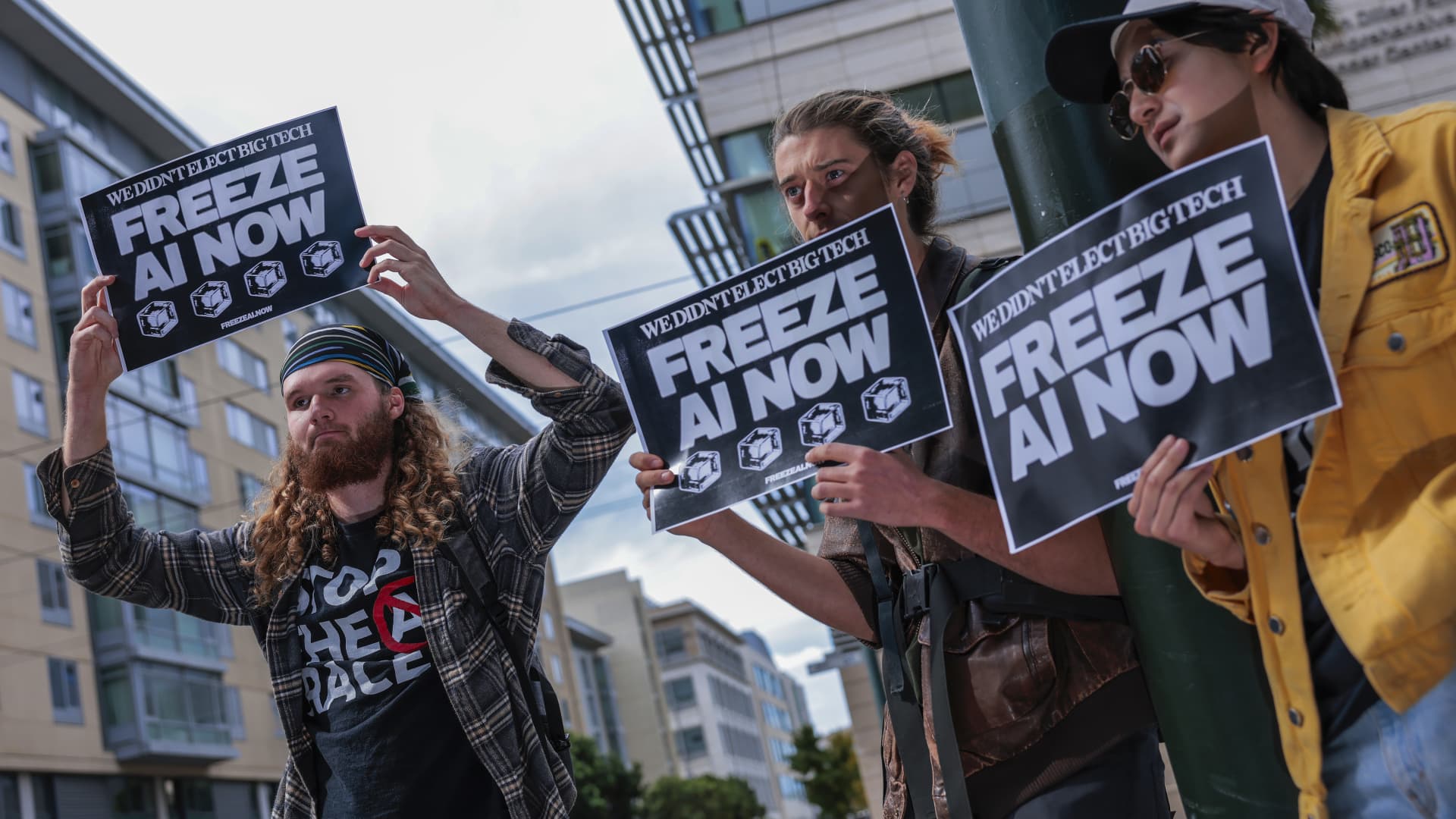
CNBC最新的全美经济调查发现,52%的登记选民表示,公司应暂停先进AI的开发,直到国会通过监管法规;32%的人倾向于继续推进。63%的人表示,他们会反对在距离家中10英里范围内建设AI数据中心。
A new CNBC All-America Economic Survey found 52% of registered voters said companies should pause development of advanced AI until Congress passes regulations, compared with 32% who favored moving ahead. Sixty-three percent said they would oppose an AI data center within 10 miles of their home.
“就目前评估风险与回报而言,反弹实在太大了,”政治问责中心的弗里德说。
“When evaluating risk versus reward right now, the backlash is just too big,” said Freed, of the Center for Political Accountability.
“人工智能高管和团体在初选中投入巨资,因此他们很可能在大多数选战中实现了既定目标。到了这个阶段,缩减投入并没有真正的坏处,”弗里德说。一些主要捐助者则走得更远。
“AI executives and groups spent heavily in the primaries, so they likely achieved what they set out to do in most races. At this point, there's no real downside to scaling back,” Freed said. Some major donors have gone further.
布罗克曼夫妇向“引领未来”组织捐赠了2500万美元。但据Semafor报道,在OpenAI员工对该组织策略提出反对之际,OpenAI首席战略官在内部承认,公司正在遭受“声誉损失”。
The Brockmans gave $25 million to Leading the Future. But amid objections from OpenAI employees to the group's tactics, OpenAI's chief strategy officer acknowledged internally that the company was taking "reputational hits," according to Semafor.
据《纽约时报》报道,布罗克曼夫妇后来放弃了再捐2500万美元的计划。
The Brockmans later abandoned plans for another $25 million contribution, according to The New York Times.
Meta也已撤退。根据美国国税局和州政府文件,其资助的政治团体今年夏天退还了2500万美元——其中2200万美元来自推动人工智能的“美国技术卓越项目”,300万美元来自其加州业务。这些退款使其原计划6500万美元的州级政治投入削减了近40%,降至约4000万美元。《纽约时报》最先报道了这些退款。
Meta has retreated as well. Political groups it funded returned $25 million this summer — $22 million from the AI-promoting American Technology Excellence Project and $3 million from its California operation — according to IRS and state filings. The refunds cut its planned $65 million state-level political push by nearly 40%, to about $40 million. The Times first reported the refunds.
“显然有些东西行不通,”OpenAI首席执行官萨姆·奥尔特曼本月早些时候对Politico表示。“我不认为把钱花在政治上就能让人们对此感觉更好。”
"Something's clearly not working," OpenAI CEO Sam Altman told Politico earlier this month. "I don't think spending money on politics is what's going to make people feel better about it."