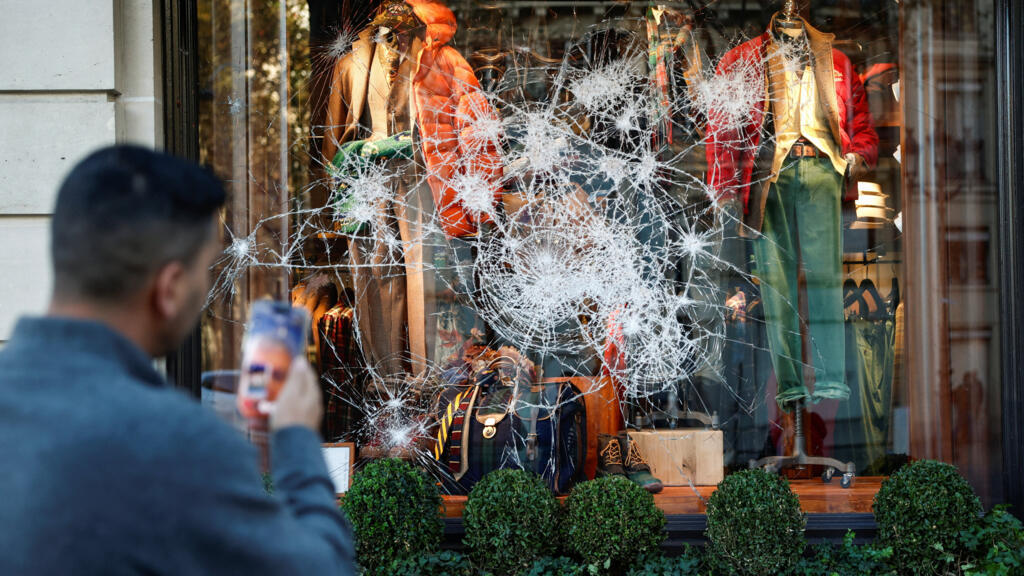
“严重倒退”:法国政府计划让抗议者为骚乱和抢劫买单10月17日,法国全国和平示威活动的边缘地带爆发了骚乱和抢劫。在法国继续收拾残局之际,政府正推进一项法案,要求抗议者为公共骚乱期间造成的损失支付最高1万欧元的赔偿——即使他们并非破坏行为的直接责任人。
'Deeply regressive': How the French government plans to make protesters pay for riots and looting As France continues to pick up the pieces after riots and looting broke out on the fringes of nationwide peaceful demonstrations on October 17, the government is pushing forward a bill that would make protesters have to pay up to €10,000 in reparations for damage caused during public unrest – even if they were not directly responsible for the vandalism. You’ve seen the images by now.
那些画面你大概已经看到了:汽车烧成灰色空壳,烟灰染黑沥青路面;精品店被洗劫一空,货物散落街头,任人争抢;火焰舔舐着燃烧路障的骨架,在巴黎上空越窜越高;利摩日市政厅烧焦的钟楼坠入熊熊燃烧的建筑内部。
The grey husks of cars staining the asphalt with soot. The gutted boutiques spilling their wares onto the street to be snatched up by eager hands. The fires licking the ribs of burning barricades, reaching higher and higher into the skies over Paris.
尽管10月17日席卷法国的反对生活成本上涨的公众示威绝大多数以和平方式进行,但许多街头游行边缘爆发的骚乱和抢劫令举国震惊。
The charred belfry of the Limoges town hall falling into the building’s blazing bowels. Although the overwhelming majority of the public demonstrations against the rising cost of living that swept France on October 17 unfolded peacefully, the riots and looting that broke out on the margins of many of the street marches left the country reeling.
虽然损失仍在统计之中,法国工商会表示,上周末有近2500家企业遭到破坏,其中超过1000家被洗劫、遭抢劫或被纵火。自由市场派智库IFRAP基金会估计,全国损失接近10亿欧元。
While the costs are still being tallied, France’s Chamber of Commerce and Industry has said that almost 2,500 businesses were damaged over the weekend, with more than a thousand of those ransacked, looted or set on fire. The free-market IFRAP Foundation has estimated the nationwide costs at not far short of a billion euros.
法国政府因被各方指责在应对大规模示威时严重失职、未能维护公共秩序,遂提交了一项法案草案,规定抗议者须为公共示威期间造成的损失承担最高1万欧元的赔偿责任——即使他们并非造成这些损失的人。
Hammered on all sides by accusations that it had badly bungled its role in ensuring public order in the face of mass demonstrations, the French government has brought forward a draft bill that would make protesters liable to pay up to €10,000 for damage caused during public demonstrations – even if they were not the people responsible for it.
这项“让暴徒买单”法案周三在右翼主导的参议院获得通过,现在将提交分歧较大的国民议会进行辩论。尽管最终版本尚未确定,但该草案已引发人权组织、工会以及法国左翼政党的强烈抗议,他们表示,按目前的形式,该法案将对举行和平示威这一基本权利构成全面攻击。其他法律专家也对这项法律的必要性提出了质疑。
The “make rioters pay” law passed through the right-wing-dominated Senate on Wednesday, and will now be debated in the more divided National Assembly. Although its final form has yet to be determined, the draft law has already raised an outcry from human rights organisations, workers unions and France’s left-wing political parties, who say the bill as it stands today would be an all-out assault on the fundamental right to hold peaceful demonstrations. Other legal experts have also questioned the need for such a law.
刑事辩护律师、国家律师协会自由与人权委员会成员洛朗·卡鲁索表示,法国刑事司法体系已有途径让人为骚乱造成的损害买单。
Laurent Caruso, a criminal defence lawyer and a member of the National Bar Council’s Liberties and Human Rights Commission, said that the French criminal justice system already had ways of making people pay for the damage they’d caused during riots.
他说:“如果你犯了罪,可能面临刑事处罚,或者必须缴纳罚款,而犯罪这一事实可能意味着你必须为造成的损害、破坏以及所有后果买单。所以这种机制早已存在——你对某事负责,就由你买单。”但在暴徒被驱散后,要找出造成最严重财产损失的具体个人并非易事。为此,草案不仅针对被判定犯有盗窃或破坏财产罪的个人,还针对“明知故犯地参与”专门为实施破坏活动而组成的团体的人员。
“If you’ve committed an offence, you may face criminal penalties, or you may have to pay a fine, and the fact that you’ve committed an offence may mean that you may be required to pay for the damage you’ve caused, the destruction and all the resulting consequences,” he said. “So this mechanism already exists – when you’re responsible for something, you pay.”But putting a name and face to the individuals responsible for the worst property damage after rioters have been driven from the streets is no easy task. To this end, the draft law targets not just individuals found guilty of theft or destruction of property, but people who have “knowingly taken part in” a group formed expressly to carry out acts of vandalism.
该法律还将适用于那些在警察两次命令解散后仍留在公共集会中的人员。
The law would also apply to people who have remained in public gatherings even after they have been ordered twice by police to disperse.
“根据这项拟议法律,其思路是扩大可能被追究责任的人群范围——这些人虽然未必参与了某事,但仍需为此承担责任,”卡鲁索说。“其目的似乎是:既然有时难以确定责任人,我们就扩大可能被追究责任的人群圈子,让某人为此买单。不管你实际上是否负有责任——你仍要为别人的所作所为买单,因为你本就不该在那里。”
“Under this proposed law, the idea is to broaden out the group of people who could be held liable – people who, although they may not necessarily have taken part in something, are nonetheless liable for it,” Caruso said. “And the aim seems to be that as it is sometimes difficult to identify the people responsible, we’re going to broaden the circle of people who could be held responsible, and we’re going to make someone or other pay. Never mind if you’re not actually responsible – you’ll still pay for what the others did, because you shouldn’t have been there in the first place.”
阅读更多“‘我不知道那是盗窃’:10月17日暴力事件后巴黎开庭审理” 该草案法案在目前的形式下引发了令人不安的问题。如果在和平游行中,你旁边的人开始在最近的公交站涂鸦标语,你现在是否被视为一伙破坏者?你得离他们走多远,才不再为他们的行为承担经济责任?你是否必须完全离开抗议活动?
Read more'I didn’t know it was theft': Trials begin in Paris following October 17 violence The draft bill as it stands raises uneasy questions. If the person next to you in a peaceful march starts scrawling slogans on the nearest bus stop, are you now considered part of a group of vandals? How far would you have to walk away from them before you’re no longer financially liable for their actions? Would you have to leave the protest altogether?
话虽如此,一旦警察下达解散令,你有多少时间离开示威现场,才不至于在法律上为之后发生的一切承担责任?任何曾在全副武装的防暴警察从四面八方包围下、挤在人群中艰难挪动的人都能告诉你,这并不像草案法案暗示的那样容易。
For that matter, how much time do you have to leave a demonstration once police have given the order to disperse before you’re legally on the hook for everything that follows after? As anyone who has struggled to push their way through a crowd of people kettled in on all sides by armed riot police can tell you, it’s not always as easy as the draft law would suggest.
正是出于这些原因,该草案法案遭到了权利团体的强烈批评。国际特赦组织警告称,该法律将是法国“一个严重倒退的步骤”。法国两大工会——总工会和法国民主劳工联合会——周四谴责该草案法案对和平抗议这一基本权利构成深远威胁。
It’s for these reasons that the draft law has come under heavy criticism from rights groups. Amnesty International warned that the law would be “a deeply regressive step” for France. Two of France’s major workers unions, the General Confederation of Labour and the French Democratic Confederation of Labour, on Thursday condemned the draft bill as a profound threat to the fundamental right to non-violent protest.
卡鲁索表示,该法案带来的不确定性,似乎专门旨在让潜在示威者在参加和平街头游行前三思而后行。
Caruso said that the uncertainty engendered by the bill seemed specifically designed to make potential demonstrators think twice before joining a peaceful street march.
“直接后果是,这是一部破坏自由、侵犯公民自由的法律,因为它直接攻击示威自由,”他说。“其目的正是要让人们望而却步,以免不得不应对这类局面——毕竟国家目前有点应接不暇。”他警告说,该法律措辞宽泛,留有任意执法甚至由负责执行的警察滥用职权的空间。
“The direct consequence is that this is a freedom-destroying law that infringes upon civil liberties, because it is a direct assault on the freedom to demonstrate,” he said. “And the aim is precisely to discourage people so as to avoid having to deal with this sort of situation – given that the state is, after all, a little overwhelmed at the moment.”He warned that the law’s broad wording left it open to arbitrary enforcement or even abuse by the police tasked with applying it.
“也存在歧视风险——如果你是穿西装打领带的白人男性参加游行,可能风险不大,但如果你是来自廉租房区的年轻人,可能更容易在人群中被挑出来,”他说。“所以存在任意执法的风险,这正是该法律模糊不清之处——这很危险。”担心该草案无异于集体惩罚的人还指出,法案中有条款规定,没收民众的社会福利以弥补街头暴力冲突造成的损失费用。低收入家庭的经济援助、住房援助以及法国最贫困民众有权领取的最低收入,都可能被部分扣除以支付财产受损的费用。
“There’s a risk of discrimination too – if you’re a white man in a suit and tie participating in a march, you might not risk much, but if you’re a young person from the housing estates, you might be more easily picked out of the crowd,” he said. “So there’s a risk that this will be arbitrary, and this is what’s murky about the law – and that’s dangerous.”Those who fear the draft law amounts to little less than collective punishment also point to provisions that would see people’s social benefits seized to cover the cost of damages caused during outbursts of street violence. Financial assistance for low-income households, housing assistance and the minimum income that France’s poorest people are entitled too could all partially be taken away to cover the costs of damaged property.
卡鲁索表示,根据法国法律,社会福利长期以来一直是不可触碰的。
Caruso said that social benefits had long been off-limits under French law.
“明天,如果我们取消一个家庭的福利,你们全家可能最终要为你们甚至可能根本没做过的事买单,”他说。“我认为,我们在处理这个问题的方式上走得太远了。从法律上讲,这是不可能的——首先它不公平,在道德上也不正确,此外,它完全与法律相悖。”
“Tomorrow, if we take away a family’s benefits, your whole family could end up paying for something you may not even have done,” he said. “And here, I think we’re taking things too far in the way we approach this issue. Legally, it’s not possible – it’s not fair to begin with, it’s not morally right, but on top of that, it’s completely out of keeping with the law.”
随着参议院辩论愈发激烈,法国共产党参议员法比安·加伊指出,按提案每月从领取最低收入的家庭中扣除 57 欧元,需要 14 年才能达到草案法律设定的 1 万欧元门槛。如果极右翼国民联盟(RN)提出的 3 万欧元门槛写入法律,家庭则需要 44 年才能偿还赔偿金。国民联盟参议员埃德维热·迪亚兹对此毫不在意。
As the Senate heating grew more heated, French Communist Party senator Fabien Gay pointed out that deducting €57 every month from a family receiving the minimum income as proposed would take 14 years to reach the €10,000 threshold set by the draft law. If the far-right National Rally’s (RN) threshold of €30,000 passed into law, it would take families 44 years to pay the damages. RN senator Edwige Diaz was unperturbed.
“对那些说我们在从弱势群体手中拿钱的人,我想说:别担心,”他说。“我们会给他们机会,用余生来偿还。”
“To those who tell us that we are taking money from disadvantaged people, I say: don’t worry,” he said. “We’ll give them the chance to pay it back over the rest of their lives.”
这一前所未闻的建议——剥夺那些成员因他人砸碎橱窗而被判定有责任的家庭的社会福利——也建立在一个令人不安的事实之上:在社会动荡中被判定犯有破坏财产罪的许多人,根本没有能力支付他们造成的损失。
The once unheard-of suggestion of stripping social benefits from families whose members have been judged responsible for the shop windows that other people have broken also rests on an uncomfortable truth: that many of those found guilty of property destruction during social unrest simply don’t have the means to pay for the damages they’ve caused.
“从一个没有钱的人那里拿钱很难——在这种情况下,选择也不多,”卡鲁索说。“从刑法角度来看,有诸如无偿从事社区服务之类的惩罚;这有益于社区,也是一种为罪行做出某种社会补偿的方式,当然前提是罪行不太严重。但除此之外,对于一个没钱的人,要让他们付款依然很难,除非通过法律途径一直追究他们,直到他们有了钱、有了工作,我们才能收取钱款来弥补所发生的损失。”
“It’s difficult to take money from someone who doesn’t have any – and in that situation, there aren’t many options,” Caruso said. “From a criminal law perspective, there are penalties such as carrying out community service without pay; this benefits the community and is a way of making some sort of social amends for offences, provided they aren’t too serious, of course. But otherwise, with someone who has no money, it’s still difficult to make them pay, apart from pursuing them through the legal system until they have money, they’re in work, and we can take money to compensate for what has happened.”
但他强调,反对该草案并非源于想保护抢劫者免受法律制裁,而是恰恰相反:旨在确保那些后果不会反而落在与10月17日爆发的那种骚乱毫无关系的人肩上。
But he stressed that opposition to the draft law was spurred not by a desire to shield looters from legal consequences, but the very opposite: to ensure that those consequences didn’t instead fall on the shoulders of people who had played no part in the kind of riots that erupted on October 17.
“作为律师,我们不赞成宽大处理或免除惩罚,”他说。“违法者理应受到惩罚,但必须遵循最基本的法律原则,不得损害我国现行的公民自由——从我们的角度来看,这是一条绝不能逾越的红线。”
“As lawyers, we are not in favour of leniency or impunity,” he said. “It’s only right that people are punished for breaking the law, but it has to be done in accordance with the most basic legal principles, without undermining the civil liberties as they stand in our country – and that, from our point of view, is a red line that must not be crossed.”