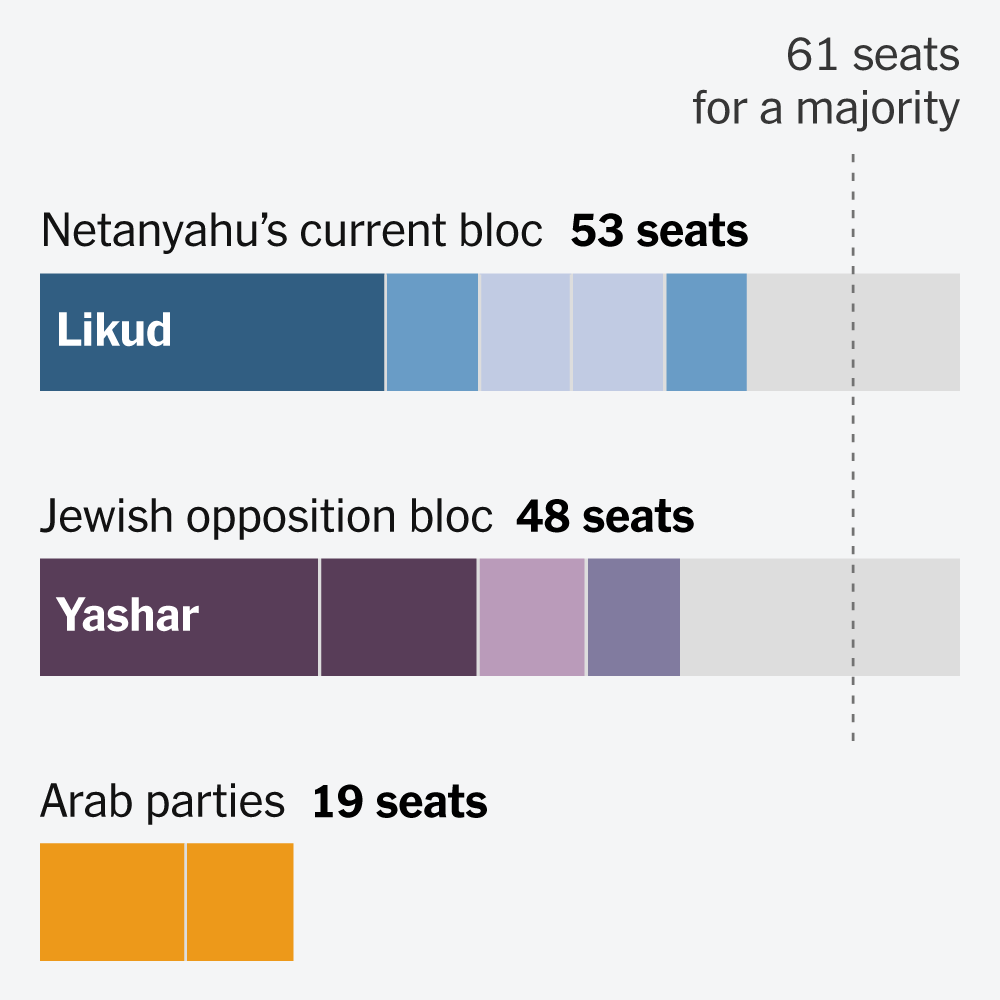
僵局是可能的,因为本内特总理的联盟和其主要挑战者均未获得多数席位。但仍有通往新政府的道路。
Deadlock is possible, as neither the bloc of Prime Minister Benjamin Netanyahu nor his main challenger have won a majority. But there are still paths to a new government.
以色列周二举行的高风险议会选举周四晚间最终结果公布后,没有产生明确的赢家。这本身并不出人意料——但其中仍有令人意外的结果。
Israel’s high-stakes parliamentary election on Tuesday produced no clear winner after final results were announced on Thursday night. That in itself was not unexpected— but there were nevertheless some surprises.
本内特右翼民粹主义政党利库德集团的表现优于许多提前公布的民调,成为议会中最大的政党。不过,它获得的席位比2022年上次全国选举时更少。
Mr. Netanyahu’s right-wing, populist party, Likud, outperformed many pre-election polls to become the largest party in Parliament. It won fewer seats than in 2022, though, when the last national election was held.
更值得注意的是以色列阿拉伯政党支持者投票率的提升,这为选举日画上了一个历史性的句号。
More noteworthy was the turnout by supporters of Israel’s Arab parties which ended Election Day with a historic boost.
以色列的议会制度通常要求各政党找到足够的共同点,在120席的议会中获得61席的多数联盟。多年来,这产生了一些意想不到的联盟——但也产生了 shaky、短命的政府。
Israel’s parliamentary system as a rule requires parties to find enough common ground to assemble a 61-seat majority bloc in Israel’s 120-seat Parliament. Over the years, that has produced some unlikely alliances — but also shaky, short-lived governments.
在不到四年间,从2019年到2022年,以色列人已经五次被送交投票站,因为各政党未能联合获得多数,或者根本无法组建联盟。
In less than four years, from 2019 to 2022, Israelis were sent to the polls five times as parties failed to hold a majority together, or to form one in the first place.
在未来的日子里,各党领袖将再次尝试组建政府。由于最终结果显示没有任何联盟有直接通往联合政府的道路,这可能意味着痛苦的谈判——或者僵局,再次举行选举的可能性很大。
In the coming days, party leaders will be back at it again. With the final election results showing no bloc with a straightforward path to a coalition, it could mean bitter negotiations — or deadlock, with the very real possibility of another election.
以下是各政党如何为以色列人组建政府、避免再次投票的几种可能方案。
Here’s how parties may align for Israelis to get a government and avoid another trip to the polls.
方案一:犹太-阿拉伯历史性联盟对本内特阵营的反对者来说,获得多数越来越取决于至少部分阿拉伯议员的支持。
Scenario A historic Jewish-Arab alliance For Mr. Netanyahu’s opponents, securing a majority increasingly appears to depend on support from at least some Arab lawmakers.
如果反对党领袖加迪·艾森科特领导的联盟同时包括阿拉伯政党——联合名单(一个意识形态多元的联盟)和拉姆(一个务实的伊斯兰主义政党)——他将在议会中获得显著的多数。这样的联盟将带来政治风险。
If the opposition leader Gadi Eisenkot’s coalition were to include both Arab parties — the Joint List, an ideologically diverse alliance, and Raam, a pragmatic Islamist party — he would have a significant majority in Parliament. Such a coalition would carry political risks.
艾森科特拒绝与不支持以色列犹太国家性质、或不支持在加沙地带击败激进组织哈马斯的政党结盟。他的许多选民可能会把与阿拉伯政党结盟视为竞选承诺的破裂,这在另一次大选可能迫在眉睫的政治格局中,将成为艾森科特的累赘。
Mr. Eisenkot has rejected alliances with parties that do not support Israel’s Jewish character or the defeat of militant group Hamas in the Gaza Strip. Many of his voters could see an alliance with Arab parties as a broken campaign promise, a liability for Mr. Eisenkot in a political landscape in which another election could be imminent.
艾森科特阵营的另一种可能性是,将阿拉伯议员排除在联合政府之外,但争取他们同意支持少数派政府。只要投赞成票的议员多于投反对票的议员,这种政府就能上台,即使组成它的政党所持席位不足61席。
Another possibility for the Eisenkot bloc is to leave Arab lawmakers out of the coalition but secure their agreement to support a minority government. Such a government can take office as long as more lawmakers vote for it than against it, even if the parties that make it up hold fewer than 61 seats.
根据临时结果,对于犹太反内塔尼亚胡阵营而言,这意味着在最初的信任投票中,需要阿拉伯政党至少六名议员的支持。但尚不清楚这些政党是否会同意支持一个将它们排除在外的政府,也不清楚这种安排能维持多久。
For the Jewish anti-Netanyahu bloc, based on provisional results, that would mean support from at least six lawmakers from the Arab parties in the initial confidence vote. But it is unclear whether those parties would agree to support a government from which they would be excluded, or how sustainable such an arrangement would be.
团结政府 由内塔尼亚胡和艾森科特共同领导的团结政府,可能为获得明确多数提供另一条路径。但这种联盟对两位领导人来说都可能令人不安。
A unity government A unity government led by Mr. Netanyahu and Mr. Eisenkot could offer a different path to a clear majority. But such an alliance could prove uneasy for both leaders.
艾森科特的整个竞选活动都聚焦于让内塔尼亚胡下台的紧迫性,他称内塔尼亚胡不适合担任总理。内塔尼亚胡可能不愿与劲敌分享权力,或授予其重要职权,哪怕是以牺牲长期盟友为代价。
Mr. Eisenkot’s entire campaign focused on the urgent need to unseat Mr. Netanyahu, whom he called unfit to serve as prime minister. Mr. Netanyahu may not be keen to share power, or delegate significant authority, to his fierce rivals, potentially at the expense of longtime allies.
一种可能的团结政府可以将内塔尼亚胡的利库德集团、艾森科特的“雅沙尔”党、“共同”联盟——即右翼人士纳夫塔利·贝内特与中间派人士亚伊尔·拉皮德的联盟——以及“以色列我们的家园”党聚集在一起,后者是一个右翼政党,其领导人阿维格多·利伯曼已与内塔尼亚胡决裂,长期以来一直是他在右翼的对手。
One possible unity government could bring together Mr. Netanyahu’s Likud party; Mr. Eisenkot’s Yashar party; Together, an alliance between the right-wing Naftali Bennett and the centrist Yair Lapid; and Yisrael Beiteinu, a right-wing party whose leader, Avigdor Liberman, broke with Mr. Netanyahu and has long been his rival on the right.
最终结果显示,这样的集团将拥有66个席位,拥有明确的执政多数,尽管这可能是一个摇摇欲坠的多数。
Final results give such a bloc 66 seats, a clear governing majority, if a shaky one.
未来几周的政治角力可能会为组建政府开辟其他途径。倒戈——在以色列政坛并不罕见——可能让一方阵营以牺牲另一方为代价而占上风,这种风险存在于两大政治阵营之中。
Defections The coming weeks of political wrangling could open other paths to a government. Defections — not uncommon in Israeli politics — could allow one bloc to prevail at the expense of the other, a risk that exists in both political camps.
竞选期间与艾森科特结盟的政党,甚至个别议员,都可能被劝说转而支持由内塔尼亚胡领导的政府。
Parties that allied with Mr. Eisenkot during the campaign, or even individual lawmakers, could be coaxed into supporting a government led by Mr. Netanyahu.
就艾森科特而言,他可以寻求两个极端正统派政党的支持,这两个党派长期以来是内塔尼亚胡的盟友,但也并非对他毫无怨言。考虑到反对派长期反对给予极端正统派男性免除兵役的特权,这可能颇为困难。
For his part, Mr. Eisenkot could seek the support of the two ultra-Orthodox parties, which are longtime allies of Mr. Netanyahu but not without grievances against him. That might prove difficult, given that the opposition has long opposed military draft exemptions for ultra-Orthodox men.
只有一点似乎很清楚:无论以色列人多么视这次选举为国家的转折点,内塔尼亚胡及其主要对手都未能获得他们所寻求的授权。
Only one thing appears clear: However much Israelis may have regarded this election as a turning point for their country, neither Mr. Netanyahu nor his chief rival got the mandate they sought.
如今,通往权力的任何道路都将需要意识形态上的妥协、令人不安的联盟,或两者兼而有之。否则,只能回到投票站重新投票。约什·霍尔德参与撰稿
Now, any path to power will require ideological compromises, uncomfortable alliances or both. Otherwise, it’s back to the voting booth. Additional work by Josh Holder