卡马拉·哈里斯的总统竞选之死最早在弗吉尼亚州劳顿县敲响。该县拥有富裕的选民,其中四分之一是亚裔后代,曾在2020年坚决投票支持乔·拜登。2024年选举之夜早些时候有报道称,哈里斯仅以16个百分点胜出,而拜登当年的优势为25个百分点,这让专家们怀疑是否出现了技术故障。
THE DEATH knell for Kamala Harris’s presidential campaign first sounded in Loudoun County, Virginia. Home to affluent voters, one-quarter of whom are of Asian descent, the county had plumped decisively for Joe Biden in 2020. When it was reported, early on election night in 2024, that Ms Harris had won by 16 points compared with Mr Biden’s 25, pundits wondered if there had been a glitch.
该县现在可能再次向左转。在一个提前投票中心,志愿者最近分发了印地语的样票。50多岁的阿尔琼描述了在两年前支持唐纳德·特朗普后产生的一种“买家悔悟”心理。“他说的每一句话都是谎言,”他解释道。在热闹的超级市场帕特尔兄弟门外,一位女性表示她将投票给民主党,因为特朗普的削减措施摧毁了对她残疾儿童的照料。其他前特朗普支持者表示,他们对伊朗战争、高昂物价、签证削减、残酷驱逐以及联邦劳动力缩减感到反感。“我的很多朋友都失去了工作,”建筑师穆罕默德说。
The county may now move left once more. At an early-voting centre, volunteers recently handed out sample ballots in Hindi. Arjun, a man in his 50s, described a case of “buyer’s remorse” after backing Donald Trump two years ago. “Everything he said was a lie,” he explained. Outside Patel Brothers, a bustling supermarket, one woman said she will vote for Democrats because Mr Trump’s cuts have gutted care for her disabled child. Other former Trump supporters said they were repelled by the Iran war, high prices, cuts to visas, cruel deportations and reductions in the federal workforce. “A lot of my friends lost their jobs,” said Mohammed, an architect.
特朗普在劳顿县支持率的下降在某种程度上反映了全国各地的趋势:在全国范围内,他的净支持率为负27。但这些摇摆——两年前倒向特朗普以及此后背离特朗普——在全美并未均匀分布。相反,它们集中在地理上截然不同但有一个显著人口统计相似性的州和选区:这些地方拥有大量亚裔或拉丁裔选民。
Mr Trump’s declining popularity in Loudoun in some ways mirrors trends across the country: nationally, his net approval rating is -27. But these swings, towards Mr Trump two years ago and away from him since then, are not distributed evenly across America. Instead, they have been concentrated in states and districts that are geographically disparate but share a striking demographic similarity: they have large shares of Asian or Latino voters.
民主党人和共和党人都曾过于频繁地将人口统计特征与命运划等号。对左派而言,非白人选民队伍的不断壮大似乎减轻了争取文化保守派白人的必要性;而共和党则担心移民会巩固民主党的长期执政地位。确实,在过去20年里,合格选民中拉美裔的比例从9%上升至16%,亚裔美国人的比例从3%上升至5%。但双方都判断失误。美国增长最快的族群也是政治观念最开放的族群。这使得美国最新的移民群体在决定国家走向方面拥有不成比例的影响力。
Democrats and Republicans alike have too often conflated demography with destiny. For the left, the growing ranks of non-white voters seemed to ease the need to win over culturally conservative whites, while Republicans have feared that immigrants would secure lasting Democratic power. Indeed, the share of eligible voters who are Latino has risen from 9% to 16% in the past 20 years, while the share of Asian-Americans has risen from 3% to 5%. But both sides were wrong. America’s fastest-growing ethnicities are also its most politically open-minded. That gives the country’s newest Americans disproportionate sway in determining its direction.
在这个移民国家,新近抵达者自历史伊始就塑造着党派政治。最新一波移民潮始于1965年,当时移民配额被取消,人们再次大量涌入,主要来自拉丁美洲和亚洲。他们并未成为僵化的党派拥趸。出口民调显示,罗纳德·里根在1980年赢得了37%的西班牙裔选票(他将他们描述为“尚未意识到自己是共和党人的共和党人”),乔治·W·布什在2004年赢得了强劲的44%。在1990年代,共和党在亚裔选民中的表现甚至更好,在1992年和1996年直接赢得了这一群体的支持。
In this country of immigrants, recent arrivals have shaped party politics throughout its history. The latest wave began after 1965, when immigration quotas were lifted and people began arriving once more, mainly from Latin America and Asia. They did not become rigid partisans. Exit polls showed that Ronald Reagan won 37% of Hispanics in 1980 (he described them as Republicans who “don’t know it yet”), and George W. Bush won a robust 44% in 2004. In the 1990s the Republican Party fared even better with Asians, winning them outright in 1992 and 1996.
直到2012年,出口民调发现贝拉克·奥巴马赢得了73%的亚裔美国人选票和71%的拉美裔选票,战略家们才开始将这些群体视为可靠的民主党基本盘。《大西洋月刊》2013年的一则标题写道:“有了新基本盘,奥巴马不再需要右倾白人了。”特朗普在2016年的胜利似乎印证了这样一种观点:共和党应当在白人选民中拼高票数,而非伸出援手争取少数族裔。
It was not until 2012, when exit polls found Barack Obama winning 73% of Asian-Americans and 71% of Latinos, that strategists started seeing these groups as reliable Democrats. “With New Support Base, Obama Doesn’t Need Right-Leaning Whites Anymore”, read one headline in the Atlantic in 2013. Mr Trump’s victory in 2016 seemed to vindicate the idea that Republicans should run up their numbers with white voters, rather than reach out to ethnic minorities.
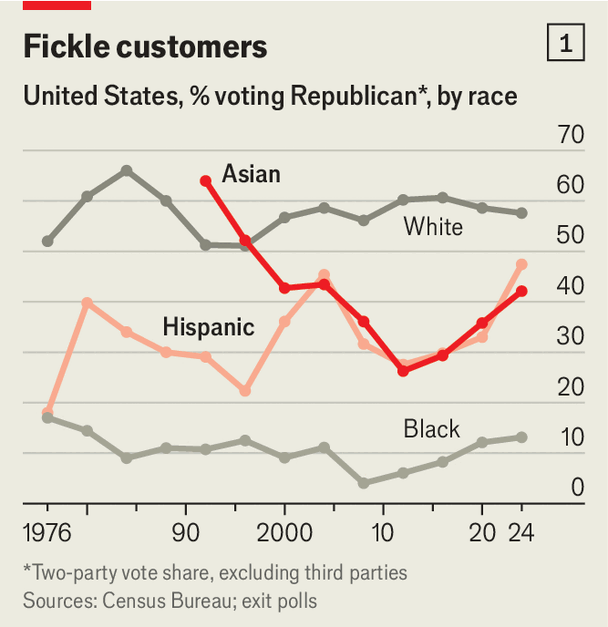
尽管特朗普先生的言论常带有种族主义色彩,他在西班牙裔和亚裔选民中的得票份额在2020年仍有所上升,这一趋势在2024年加速:他赢得了40%的亚裔选民和46%的西班牙裔选民支持(见图表1)。根据哈佛大学合作选举研究(CES)的数据,在该次选举中,亚裔和拉美裔占选民总数的14%,但却构成了2020年投票给某一党派总统候选人、四年后却投票给另一党派候选人的“转换选民”群体的24%。
Yet despite Mr Trump’s often racist rhetoric, his share of the Hispanic and Asian vote inched up in 2020, a trend that accelerated in 2024, when he won 40% of Asian voters and 46% of Hispanic ones (see chart 1). In that election, according to the Co-operative Election Study (CES) at Harvard University, Asians and Latinos made up 14% of voters, but comprised 24% of those who voted for a presidential candidate from one party in 2020 and a different party four years later.
这并不意味着他们在绝对数量上是最大的摇摆选民群体:非西班牙裔白人选民在2024年仍多于他们,占转换选民的59%。但正是他们对严格党派忠诚的摒弃、人数的增长以及转换党派的理由,赋予了他们特殊的影响力。
That does not make them the biggest bloc of swing voters in absolute terms: non-Hispanic white voters still outnumbered them in 2024, comprising 59% of switchers. But their rejection of strict partisanship, growing numbers and reasons for changing parties are what gives them particular clout.
即便在2012年,当时奥巴马先生赢得了超过70%的亚裔和拉美裔选票,根据《经济学人》委托YouGov进行的民调,只有13%的亚裔和27%的拉美裔自认为是“坚定”民主党人。西班牙裔选民和亚裔选民一样,因其非正统的政治立场而引人注目:他们在某些议题上同意民主党观点,在另一些议题上则同意共和党观点。《经济学人》分析CES中的一系列政策问题后发现,约34%的拉美裔和30%的亚裔持有温和或兼具左右倾向的混合立场,而白人选民这一比例仅为20%。
Even in 2012, when Mr Obama won more than 70% of Asians and Latinos, only 13% and 27% of them identified as “strong” Democrats, according to polling for The Economist by YouGov. Hispanic voters, as well as Asians, stand out for their heterodox positions, agreeing with Democrats on some topics and Republicans on others. Analysing a series of policy questions in the CES, The Economist found that around 34% of Latinos and 30% of Asians hold views which are either moderate or combine left- and right-leaning positions, compared with only 20% of white voters.
拉美裔和亚裔受访者在任何单一议题上的看法,都不太能预测他们在另一议题上的反应。例如,亚裔异常同时支持污染监管和政府福利领取的工作要求。西班牙裔比其他美国人更可能同时支持禁止堕胎和取消学生债务。
Latino and Asian respondents’ views on any single issue are less likely to predict how they will respond on another subject. For example, Asians are unusually supportive of both regulating pollution and work requirements for government benefits. Hispanics are more likely than other Americans to back a ban on abortion as well as cancelling student debt.
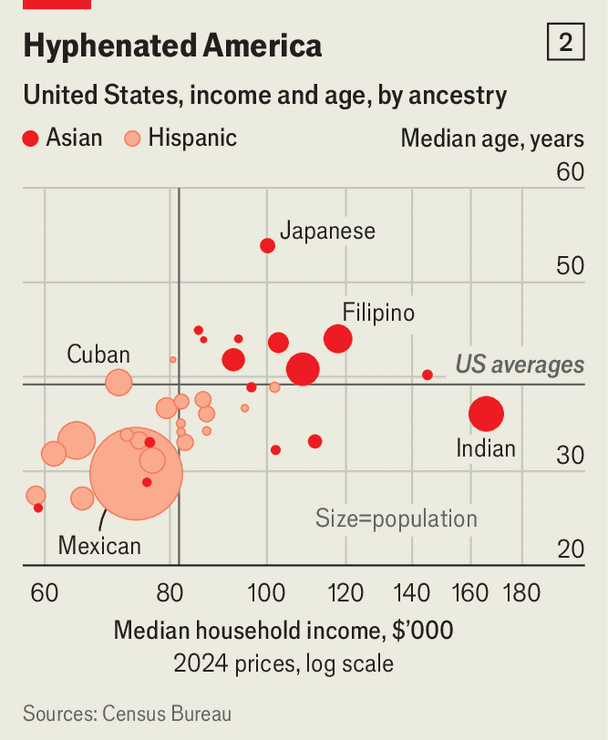
部分而言,这些观点的交织是这些群体之间以及群体内部不同文化传统产物,也是一系列收入水平(见图表2)的体现。它们也提醒人们,新移民并不能被整齐划一地归入既有类别之中。入籍公民绝大多数是拉美裔或亚裔。只有9%的亚裔和三分之一的拉美裔拥有两位在美国出生的父母(相比之下,白人的这一比例为90%,黑人为77%),这使得他们更不容易继承某种党派身份。
In part, these combinations of views are a product of diverse cultural traditions between these groups and within them, as well as a range of income levels (see chart 2). They are also a reminder that newcomers do not fit neatly in pre-existing categories. Naturalised citizens are overwhelmingly Hispanic or Asian. Just 9% of Asians and one-third of Hispanics have two native-born parents (compared with 90% of whites and 77% of blacks), making them less likely to inherit a partisan identity.
对这些选民而言,将大量且不断增加的白手起家的白人选民绑定到特定政党的文化战争并没有那么重要。经济议题才是最重要的。在YouGov于9月和10月为《经济学人》进行的民意调查中,将消费物价或“就业与经济”列为最重要议题的受访者比例,亚裔美国人和拉丁裔均达到了57%,相比之下,黑人受访者为50%,白人受访者为45%。
For these voters the culture wars, which bind a large and growing share of white voters to a particular party, are less important. Economic issues are paramount. In polling for The Economist by YouGov in September and October, the share of respondents listing consumer prices or “jobs and the economy” as their most important issue was 57% for both Asian-Americans and Latinos, compared with 50% for black respondents and 45% for white ones.
这反映出拉丁裔和亚裔美国人选民更广泛的优先事项。他们花在工作上的时间比普通美国人更多。拉丁裔创业的可能性是白人的两倍多;亚裔美国人花在学业上的时间更多。“即使你自己不是移民,但你是他们的后代,你来到这个国家是为了努力工作并取得成功,这意味着经济考量凌驾于其他许多事情之上,”专注于拉丁裔民调的研究员卡洛斯·奥迪奥(Carlos Odio)表示。
That reflects the broader priorities of Latino and Asian-American voters. They spend more time working than the average American. Latinos are more than twice as likely as whites to start a business; Asian-Americans spend more time in school. “Even if you’re not yourself an immigrant, but you’re descended from them, you’re in this country to work hard and get ahead, and that means that economic considerations come ahead of so much else,” says Carlos Odio, a researcher who specialises in surveying Latinos.
正如民主党参议员鲁本·加莱戈(Ruben Gallego)去年所说的那样,“每个拉丁裔男人都想要一辆超大的卡车”,这通常被亲切地称为la troquita。
As Ruben Gallego, a Democratic senator, put it last year, “every Latino man wants a big-ass truck”, often described affectionately as la troquita.
这一切使得拉美裔和亚裔美国选民成为2024年完美的摇摆群体,当时物价是主导议题。由于在汽车、卡车和燃油上的支出高于平均水平,拉美裔在2022年汽油价格飙升时受到的冲击尤为严重。随后,在2023年和2024年,通胀的影响转移到了住房成本;这对亚裔美国人造成了不成比例的影响,因为他们在住房上的支出高于其他群体。今年轮到特朗普先生承受他们的愤怒。
All this set up Latino and Asian-American voters as the perfect swing group in 2024, when prices were the dominant issue. Latinos were particularly exposed to the spike in petrol prices in 2022 owing to their higher-than-average spending on cars, trucks and fuel. Later, in 2023 and 2024, the effect of inflation shifted to housing costs; that disproportionately affected Asian-Americans, who spend more on housing than other groups. This year it is Mr Trump’s turn to feel their wrath.
根据为数字新闻公司“Argument”进行的一系列大样本可能选民民调,与2024年相比,民主党在西班牙裔选民中的领先优势上升了17个百分点,在亚裔选民中上升了14个百分点,而白人选民为10个百分点,黑人选民为5个百分点。尽管民调交叉表可能容易出错,但自特朗普先生就职以来的州级选举显示出相同趋势。在去年新泽西州和弗吉尼亚州的州长选举以及今年6月加利福尼亚州的全党派众议院初选中,与2024年总统大选相比,民主党最大的得票增长出现在其所在州亚裔和拉美裔浓度最高的选区或辖区。
According to a series of large-sample polls of likely voters conducted for the Argument, a digital news company, Democrats’ margin over Republicans has risen by 17 percentage points among Hispanics and 14 among Asians since 2024, compared with ten for white voters and five for black ones. And although poll cross-tabs can be prone to errors, statewide elections since Mr Trump’s inauguration show the same trend. In gubernatorial elections in New Jersey and Virginia last year and California’s all-party House primaries in June, Democrats’ biggest gains relative to the presidential vote of 2024 were in precincts or districts with their states’ highest concentrations of Asians and Latinos.
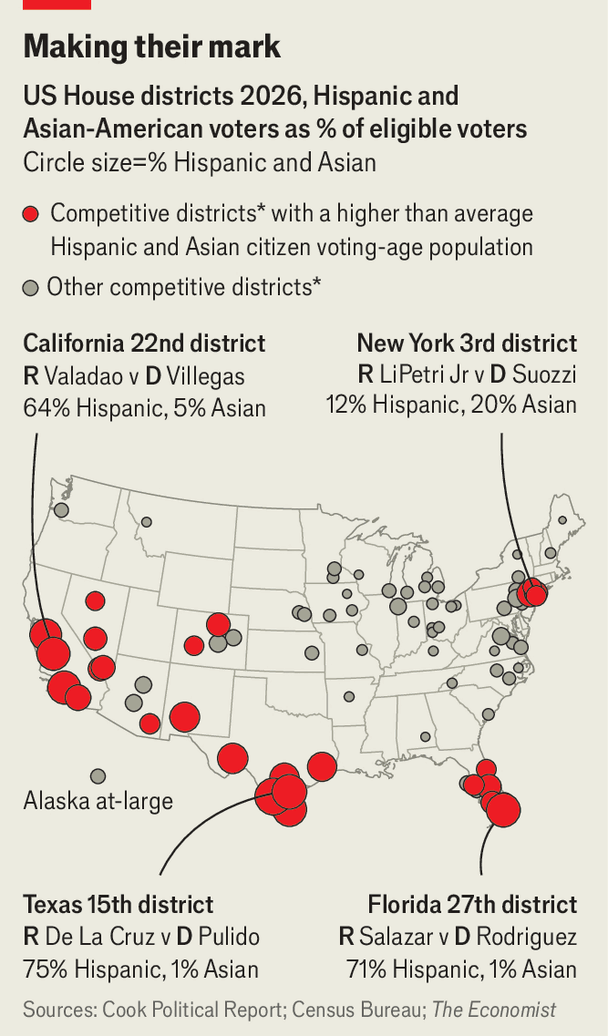
他们的不满将在中期选举中发挥关键作用。德克萨斯州的共和党人强行通过了一项选区划分,如果特朗普先生能守住其在以西班牙裔为主的南德克萨斯地区的得票增长,该党最多可净增五个众议院席位。相反,我们的预测模型显示民主党在其中三个选区占优,而在另外两个选区共和党仅以微弱优势领先。总的来说,在28个关键众议院竞选选区中(见地图),拉美裔和亚裔美国人占选民的比例高于平均水平。
Their discontent will play a crucial role in the midterms. Republicans in Texas pushed through a gerrymander that could net the party up to five seats in the House—if only Mr Trump could hold on to his gains in largely Hispanic south Texas. Instead, our forecasting model favours Democrats in three of these districts, and makes Republicans only narrow favourites in two more. In total, Latinos and Asian-Americans represent a larger than average share of voters in 28 battleground House races (see map).
拉美裔和亚裔也将在备受瞩目的全州选举中展现他们的政治分量。在得克萨斯州和佛罗里达州这两个支持特朗普的最大的州,这两个群体加起来分别占选民总数的36%和24%。由于在佛罗里达州拉美裔支持率领先12个百分点、在得克萨斯州领先27个百分点,民主党在这两个州的州长竞选中仅落后几个百分点。在参议院选举方面,佛罗里达州出现爆冷门的可能性不大。
Latinos and Asian-Americans will bring their political heft to high-profile statewide races, too. Combined, they make up 36% of the electorate in Texas and 24% in Florida, the two largest Trump-voting states. Democrats trail by just a few points in both states’ gubernatorial contests, thanks largely to leads among Hispanics of 12 points in Florida and 27 points in Texas. For the Senate, an upset in Florida is unlikely.
但在得克萨斯州,詹姆斯·塔拉里科(James Talarico)在整体民调中领先两个百分点,在拉美裔中领先33个百分点,他正力争成为自1988年以来首位赢得得州参议院选举的民主党人。
But James Talarico is up by two points overall and 33 points among Latinos in his bid to become the first Democrat to win a Senate race in Texas since 1988.
民主党政治顾问查克·罗查(Chuck Rocha)表示:“我的大半职业生涯都在告诉那些善意的白人政治顾问和候选人,拉美裔并非一个铁板一块的整体。”他现在却持相反的看法:“他们现在铁板一块地愤怒。”民主党人正猛烈抨击总统通过加征关税和挑起战争,令消费价格大幅飙升。
“I’ve spent most of my career telling white, well-intentioned political consultants and candidates that Latinos aren’t a monolith,” says Chuck Rocha, a Democratic political consultant. He now says the opposite: “they’re all monolithically pissed.”Democrats are hammering the president for turbocharging consumer prices by imposing tariffs and beginning a war.
在加利福尼亚州尘土飞扬的农业重镇中央山谷,民主党人兰迪·维勒加斯(Randy Villegas)正参加竞选,试图击败温和派共和党人戴维·瓦拉达奥(David Valadao)。该选区的选民中有三分之二是西班牙裔。维勒加斯先生在贝克斯菲尔德的一场集会上说:“如果你们或你们所爱的人曾开车过境到蒂华纳去买更便宜的处方药、更便宜的牙科护理或更便宜的医疗保健,我希望你们举手。”房间里四周齐刷刷地举起了手。
In California’s dusty, agricultural Central Valley, Randy Villegas, a Democrat, is running to unseat David Valadao, a moderate Republican in a district whose voters are two-thirds Hispanic. “I want you to raise your hand”, Mr Villegas said at a rally in Bakersfield, “if you or someone you love drives across the border to Tijuana to get cheaper prescription drugs, cheaper dental care, cheaper health care.”Hands shot up all around the room.
除了经济,移民问题今年也占据了显要位置。这两类选民的定义是已经入籍公民,他们普遍支持边境执法,对移民持温和立场。但他们视总统的手段为行事过度。在佛罗里达州,面临民主党强劲挑战者的迈阿密地区共和党现任众议员玛丽亚·埃尔维拉·萨拉扎尔,于9月播出一则针对特朗普的广告,其中表示:“2024年帮助你入主白宫的那些西班牙裔,今天感到被背叛了。”
In addition to the economy, this year immigration looms large. Voters in both groups, who by definition have already become citizens, generally support border enforcement and take a moderate view on immigration. But they see the president’s tactics as going too far. In Florida María Elvira Salazar, a Miami-area Republican incumbent facing a tough Democratic challenger, ran an ad in September addressed to Mr Trump in which she said that “the same Hispanics who helped you get to the White House in 2024 feel betrayed today.”
2025年初,美国移民与海关执法局(ICE)特工将目标对准加利福尼亚州的农业核心地带。在中期选举前夕,他们再次在该地区游弋。在德拉诺这个农业小镇,2024年特朗普的得票率领先优势达15个百分点,店铺招牌多为西班牙语,居民见面常以友好的“早安”问候。如今街道冷清,许多商店仍紧闭大门。“我就是不喜欢移民方面发生的事,”支持过特朗普两年前竞选、却参加了维列加斯集会的34岁母亲格丽塞尔达·阿吉拉尔说,“处理方式不人道。”
In early 2025 Immigration and Customs Enforcement agents targeted California’s agricultural heartland. They are once again roaming the area ahead of the midterms. In Delano, a farm town that swung towards Mr Trump by 15 points in 2024, shop signs are mostly in Spanish and residents often greet each other with a friendly “buenos días”. Now the streets are quiet and many stores remain shuttered. “I just don’t love what’s happening with immigration,” says Griselda Aguilar, a 34-year-old mother who backed Mr Trump two years ago but attended Mr Villegas’s rally. “The way it’s been handled is inhumane.”
在竞选进入尾声之际,白宫非但没有软化对移民的言辞,反而大肆渲染。副总统万斯大力吹捧特朗普的驱逐行动,并主张对技术工人签证进行彻底改革。10月26日在蒙大拿州,他对“开垦这片土地”、并将亲人安葬于该州“美丽土地”中美国人表达崇敬。特朗普反复警告——且无证据表明——非公民非法投票将威胁选举公正性。
In the waning days of the campaign, the White House—far from easing its rhetoric on immigrants—is playing it up. J.D. Vance, the vice-president, has touted Mr Trump’s deportation campaign and wants a radical overhaul of visas for skilled workers. In Montana on October 26th, he offered adulation for Americans who “homesteaded this land” and “buried their own kin” in the state’s “beautiful soil”. Mr Trump has repeatedly warned, without evidence, that illegal voting by non-citizens will threaten the elections’ integrity.
这种执念对亚裔或拉美裔选民毫无吸引力,也无法回应他们最关心的问题:经济。如果他们助民主党赢得胜利,该党可能会以为支持者“回归”了。然而,近年的教训是,两党都不应把这些选民视为理所当然。即使更多亚裔和拉美裔选民向左倾斜,自称民主党人的比例却比2024年更低。
This obsession is hardly welcoming to Asian or Latino voters, nor does it address their main concern: the economy. If they help secure victory for Democrats, the party may assume that supporters are “coming home”. The lesson of recent years, however, is that neither party should take these voters for granted. Even as more Asians and Latinos swing left, fewer identify themselves as Democrats than in 2024.
“我们竟然认为拉美裔选民转移20个百分点很奇怪,这本身就说明了问题所在,”《拉美裔世纪》作者迈克·马德里说。在其他群体中,“无论经历大流行、战争、衰退还是萧条,没人会改变立场,”他说。“如果干得不好,你就把他们炒了。拉美裔是唯一这么做的群体。”
“The fact that we view it as so peculiar that Latinos are moving by 20 points is the sign of what’s wrong,” says Mike Madrid, author of “The Latino Century”. Among other constituencies, “nobody moves despite pandemic and war and recession and depression,” he says. “If people do a bad job, you fire them. Latinos are the only group doing that.”