美联储官员正在探讨缩减持仓并通过借贷操作保持市场现金充裕的方法,他们面临一个酝酿多年的挑战:克服向中央银行借贷的污名化问题。
Federal Reserve officials ponder ways to shrink their holdings and keep markets flush with cash from lending operations, they face a challenge years in the making: Overcoming the stigma of borrowing from the central bank.
十多年来,美联储主要通过持有庞大的证券投资组合来供给准备金。转向借贷工具和所谓的回购协议体系,将重塑美联储、银行和货币市场之间的关系。
For more than a decade, the Fed has supplied reserves primarily by holding a massive securities portfolio. Shifting to lending facilities and a so-called repo-based system will reshape the relationship between the Fed, banks and money markets.
继纽约联储主席约翰·威廉姆斯和公开市场账户经理罗伯托·佩利发表讲话后,关于使用回购操作的讨论升温。主席凯文·沃什本周也表示,审查资产负债表管理的工作组很可能在明年初提交调查结果。
Discussions on the use of repo operations have ramped up following speeches by New York Fed President John Williams and Roberto Perli, manager of the System Open Market Account. Chairman Kevin Warsh also said this week a task force reviewing balance-sheet management will likely present findings early next year.
支持回购协议体系的一个主要论据是,这将使美联储能够以更精简的资产负债表和更少的准备金存量运行——这一直是沃什在领导美联储之前的目标。但这也要求市场参与者(包括监管机构)习惯向中央银行借贷。
A main argument in favor of a repo-based system is that it would allow the Fed to operate with a leaner balance sheet and a smaller stock of reserves — objectives of Warsh since before he led the Fed. But it would also require market participants, including regulators, to be comfortable borrowing from the central bank.
“显然,在工作组的背景下,正在推动探索这一选项,”美国银行全球利率策略联席主管马克·卡巴纳表示。“美联储官员谈论这些选项时,听起来好像它们是可行的。除非解决根本问题,否则它们不可行。”在2008年全球金融危机之前,美联储通常只供给有限数量的准备金,并依靠银行通过货币市场在彼此之间重新分配流动性。需要额外现金的机构也可以依赖贴现窗口,尽管许多公司不愿这样做。
“Clearly there’s a push to explore this in the context of the task force,” said Mark Cabana, co-head of global interest rate strategy at Bank of America Corp. “Fed officials are talking about these options like they’re viable. They’re not unless they address underlying issues.”Before the 2008 global financial crisis, the Fed generally supplied a limited amount of reserves and relied on banks to redistribute liquidity among themselves through money markets. Institutions that needed additional cash could also rely on the discount window, though many firms were reluctant to do so.
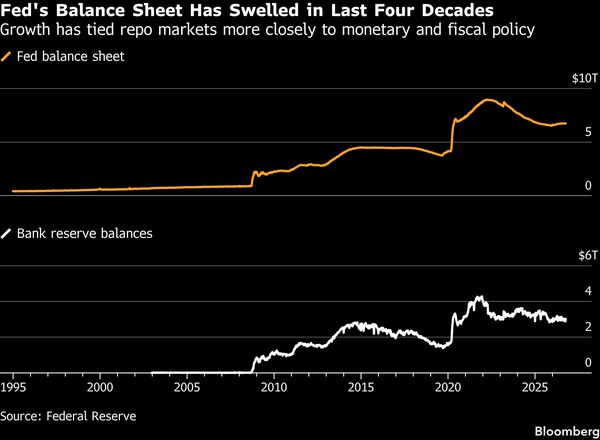
自那时起,美联储的资产负债表便急剧膨胀,因为资产购买向金融体系注入了大量银行准备金,从而提升了流动性并维持了低利率水平。虽然政策制定者最初计划缩减这些余额,但他们最终还是坚持了由庞大资产负债表支撑的充足准备金框架,该资产负债表目前规模约为6.8万亿美元。
The Fed’s balance sheet has ballooned since then as asset purchases flooded the financial system with bank reserves, boosting liquidity and keeping rates low. While policymakers initially planned to drain those balances, they’ve ultimately stuck with an ample-reserves framework supported by a large balance sheet, which now stands at about $6.8 trillion.
与这种以证券为基础、拥有庞大美国国债组合的方法不同,以回购为基础的框架通过借贷便利和回购操作提供了更大比例的准备金。
Unlike this securities-based approach, with its large portfolio of Treasuries, a repo-based framework supplies a larger share of reserves through lending facilities and repo operations.
英格兰银行、加拿大银行和澳大利亚储备银行都采用了这种方法。美国银行的策略师表示,这些框架之所以可行,部分原因在于从央行借贷便利进行借款已经成为流动性管理常规的一部分,而不再是陷入困境的信号。
The Bank of England, Bank of Canada and Reserve Bank of Australia use this approach. Strategists at Bank of America say those frameworks are possible in part because borrowing from central-bank facilities has become a routine part of liquidity management rather than a signal of distress.
德意志银行美国利率策略主管马修·拉斯金表示:“我一直认为,像英格兰银行或欧洲央行这样的系统很有吸引力,因为……如果你确信能够不受污名化影响、且能便捷地从央行获得回购流动性,它就能帮助减少对准备金的需求。”
“I have thought that a system like the Bank of England’s or the ECBs is attractive in that ... it can help reduce reserve demand if you’re confident that you’ll be able to obtain repo liquidity free of stigma and readily from the central bank,” said Matthew Raskin, head of US interest rate strategy at Deutsche Bank.
问题在于,这些系统依赖于各机构将央行的流动性便利视为常规融资工具,而非紧急后盾。要改变“任何借款都暗示机构濒临倒闭”这一长期存在的观念,实属不易。
The catch is that those systems depend on institutions viewing central-bank liquidity facilities as ordinary funding tools rather than emergency backstops. Transforming the long-held belief that any borrowing suggests an institution is on the precipice of failure has been difficult.
政策制定者一再呼吁利用窗口信贷(discount window),这是美联储的一项关键借贷便利,其所背负的污名与美国央行本身的历史一样悠久。包括美联储理事菲利普·杰斐逊在上个月在内的官员们一直在努力推动该窗口的现代化,使银行能够更高效地抵押贷款作为担保,让金融机构能够更快地获得资金,并与联邦住房贷款银行合作以提高重新分配抵押品的效率。
Policymakers have made repeated calls to utilize the discount window, a key Fed lending facility that carries a stigma as old as the US central bank itself. Officials, including Governor Philip Jefferson last month, have made efforts to modernize the window, making access more efficient for banks to pledge loans as collateral, give institutions faster access, and working with the Federal Home Loan Banks to increase the speed collateral can be reallocated.
但在去年与纽约联储主席威廉姆斯的一次私下讨论中,代表华尔街银行的主要交易商告诉官员,直接向央行借款——包括当时名为常设回购协议机制、允许机构隔夜借入现金的工具——带有污名。
But during a private discussion with the New York Fed’s Williams last year, primary dealers representing Wall Street banks told officials that borrowing directly from the central bank — including the then-named Standing Repo Facility that lets institutions borrow cash overnight — carries a stigma.
“机制确实存在污名,消除污名的唯一办法是让它们变得必要,”布鲁克林学会研究员、经济学家、2004年联合创立Facebook的克里斯·休斯表示。
“Facilities do have stigma and the only way to combat that is to make them necessary,” said Chris Hughes, a fellow at the Brookings Institution and economist who co-founded Facebook in 2004.
尽管关于美联储现有框架替代方案的言论增多,但鲜有观察人士预期美联储官员会匆忙转向新框架。
Despite the increased rhetoric about alternatives to the Fed’s existing framework, few observers expect Fed officials to rush toward a new framework.
目前的充裕准备金制度继续确保货币市场利率保持稳定,而向更多依赖回购的体系过渡将需要改变银行行为和市场结构,且因更多使用隔夜融资市场而存在潜在波动性。此外,基于证券的方法无意中保证了有一种机制来吸收美国财政部不断增长的短期国债供给。
The current ample-reserves regime continues to ensure money market rates remain stable, while any transition toward a more repo-based system would require changes to bank behavior and markets, with potential for volatility from increased use of overnight funding markets. In addition, a securities-based approach inadvertently guarantees there’s a mechanism to absorb Treasury’s growing pile of bill supply.
“高效且有效地实施货币政策有整整一套方法,”摩根士丹利全球首席经济学家、前美联储员工塞思·卡彭特表示。风险在于“你可能会做错”,他说。
“There’s a whole manifold of ways to conduct monetary policy efficiently and effectively,” said Seth Carpenter, global chief economist at Morgan Stanley and former Fed staffer. The risk is that “you can do it wrong,” he said.