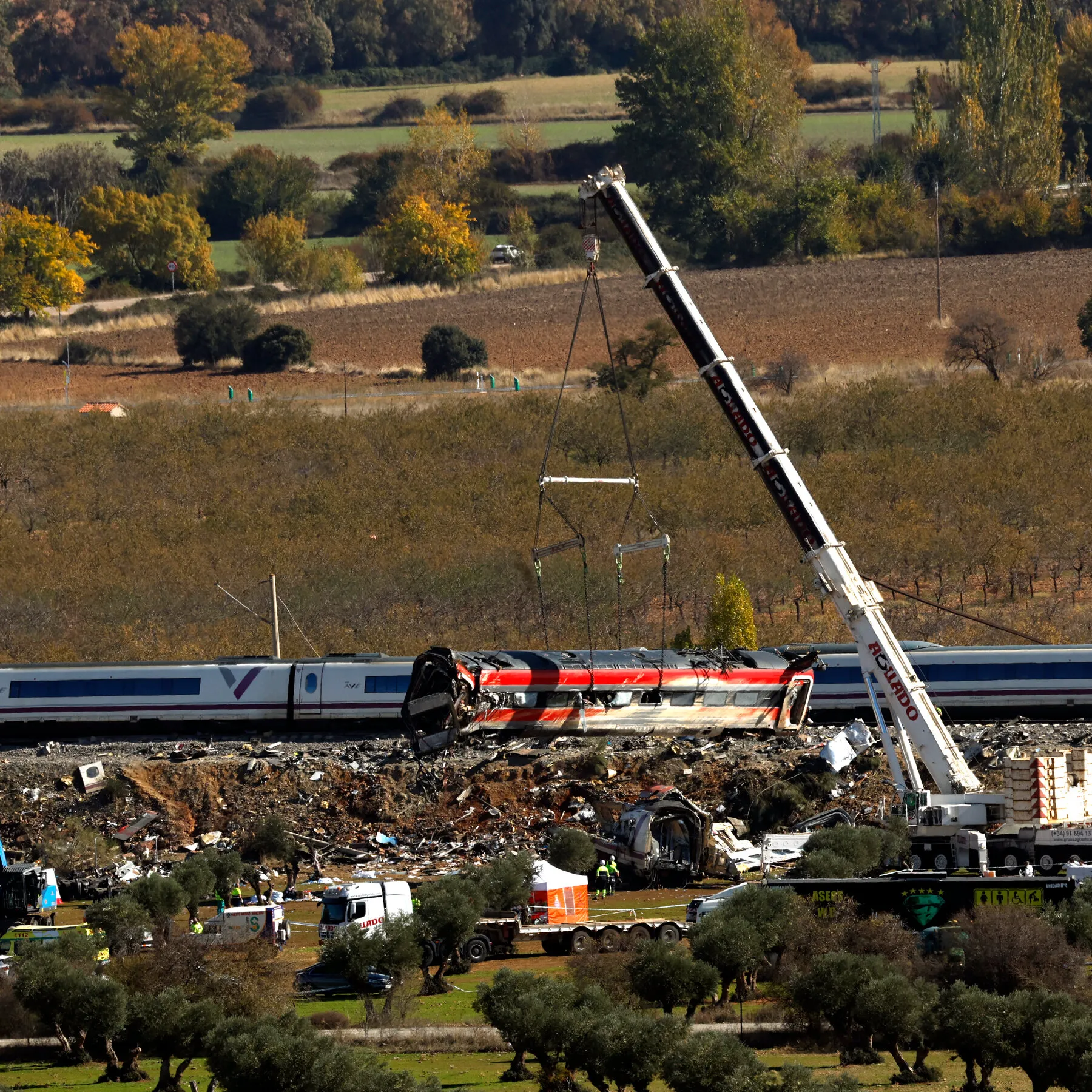
交通部长称调度失误导致西班牙致命列车相撞事故 法官将调查控制员行为,包括授权列车高速行驶尽管前方有列车停滞西班牙交通部长周五表示,铁路调度员本周批准一列以约每小时100英里(约160公里)的速度驶向一列停止的列车,导致了造成至少69人死亡、动摇西班牙民众对铁路系统信心的相撞事故。
Traffic Control Errors Caused Spain’s Deadly Train Crash, Official Says The transport minister said a judge would investigate controllers’ actions, including authorizing a train to proceed at high speed though another was stalled in front of it.
交通部长奥斯卡·普恩特在新闻发布会上表示,一名法官将调查控制员的多项“不可思议”的失误,包括指示行驶中的列车在存在技术问题的情况下仍高速行驶。这是官方迄今为止对周三事故原因的最详细通报。尽管在不到一年内发生第二起致命列车事故后辞职压力与日俱增,他表示无意辞职。
Rail traffic controllers gave the green light to a train racing at about 100 miles per hour toward a stopped train this week, precipitating the crash that killed at least 69 people and shook Spain’s confidence in its rail system, the transport minister said on Friday. A judge will investigate several “inexplicable” errors on the part of the controllers, including instructing the moving train to proceed at high speed despite a technical problem, the minister, Óscar Puente, said at a news conference, giving the most detailed account yet of what caused the crash on Wednesday. He said he had no intention of resigning, despite mounting pressure after the second deadly train crash in under a year.
普恩特说,在17分钟里,马德里运营中心的控制员能在“屏幕和系统”上看到一列列车在行驶而另一列停止不动。“控制中心的人员全程掌握事态发展,”他说,“但未采取任何行动制止。”
For 17 minutes, controllers at an operations center in Madrid were able to see on “screens and systems” that one train was moving while the other stood still, Mr. Puente said. “Those in the control center had full visibility of what was happening,” he said, but did nothing to stop it.
“这就是为什么必须展开调查,”他补充道。他说,将由独立调查人员和“一名法官获取适当解释,以便我们了解事情为何会发生。”这是西班牙十多年来最致命的铁路事故。官方称,除死者外,数十名乘客仍在住院治疗,其中17人在重症监护室。
“That’s why it has to be investigated,” he added. He said it would fall to independent investigators and “a judge to receive the appropriate explanations so we can understand how this could happen.”The crash was the deadliest in Spain in more than a decade. In addition to those killed, dozens of passengers remain hospitalized, 17 of them in intensive care, officials have said.
政府此前表示,周三由于一个老旧的自动安全系统(该系统通常控制信号)在西班牙中部部分地区关闭,马德里铁路调度中心不得不接管列车调动指挥。
The rail traffic center in Madrid had to take control of train movements on Wednesday after an aging, automatic safety system, which normally controls signals, shut down for part of central Spain, the government has said.
关于该系统(称为LZB)的年限和可操作性已出现疑问,但普恩特为其进行了辩护,称“它完全和明年将取代它的新系统一样可靠且稳固”。他表示,新系统的引入是为了让西班牙更符合其他欧洲国家的标准,并满足新的工业制造要求。
While questions have arisen about the age and operability of that system, known as LZB, Mr. Puente defended it, saying “it was every bit as solid and reliable” as a new system set to replace it next year. The new system, he said, is needed to bring Spain more in line with other European countries and to satisfy new industrial manufacturing requirements.
他说,该系统今年已发生约170次故障,这一数字与往年持平,且“完全在欧洲标准范围内”。他指出,许多故障与破坏行为、电缆盗窃以及轨道施工有关。
He said the system had gone down roughly 170 times this year, a figure he described as consistent with previous years and “well within standard European figures.”Many of those outages, he said, were related to vandalism, cable theft and construction on the tracks.
普恩特称,运营中心的人员配备和资金投入均符合要求,尽管铁路工人工会声称并非如此。即便如此,他补充道,面临11月29日大选的政府正在准备“一揽子即时措施”,通过为操作员提供“最先进的技术”以将风险降至最低,从而避免更多故障发生。
Mr. Puente said the operations center was properly staffed and funded, despite train worker unions’ claims to the contrary. Even so, he added, the government, which faces elections on Nov. 29, is preparing “a package of immediate measures” to avoid more failures by giving operators “the most advanced technology” to minimize risk.
当系统于周三上午8时31分瘫痪时,附近所有列车自动停运。这使得备用自动系统和调度员接管了信号控制,并与列车司机保持通联。
When the system went down at 8:31 a.m. on Wednesday, all trains in the vicinity automatically stopped. That left it up to a backup automated system and controllers to take charge of the signals, in communication with train operators.
普恩特解释说,在这种情况下,不允许一列列车进入已被另一列列车占用的轨道区段。问题在于,当主自动系统瘫痪时,两列火车停在了西班牙中部托莱多以南同一区块的轨道上。
Under those conditions, Mr. Puente explained, one train is not permitted to enter a sector of track already occupied by another train. The problem, he said, was that when the main automated system went down, two trains stopped in the same block of track south of Toledo, in central Spain.
普恩特表示,铁路法规规定“后车不得启动,直至前车驶离”。但他称,在上午8时36分,调度员指示由国有公司Renfe运营的后车恢复行程。
Rail regulations say that “the trailing train must not move until the forward train has departed,” Mr. Puente said. But at 8:36 a.m., he said, controllers told the trailing train, operated by the state-owned company Renfe, to resume its journey.
法规还规定,在此类情况下,列车时速不应超过约 25 英里(约 40 公里),以便司机若发现前方轨道上有物体能及时停车。普恩特说,然而控制中心却指示司机恢复正常速度,该路段的正常限速高达每小时 124 英里(约 200 公里)。
Regulations also stipulate that in such situations, trains should not travel faster than about 25 miles an hour, so that conductors can stop if they see something ahead on the track. Instead, he said, controllers instructed the driver to return to normal speed, which is up to 124 miles an hour on that stretch.
普恩特说,运营方仅授权由 Iryo 公司运营的前方列车于上午 8 点 41 分启动,将其前方的信号灯转为绿灯。
Mr. Puente said the operators only authorized the forward train, operated by the company Iryo, to proceed at 8:41 a.m., turning the signal ahead of it green.
但该列车无法重新启动。他说,上午 8 点 48 分,其司机联系控制中心报告称列车无法移动。
But the train couldn’t restart. At 8:48, he said, its driver contacted the control center to report that the train was unable to move.
“控制中心收到了该信息,”普恩特说,“但未采取任何行动。”普恩特说,由于 Iryo 列车前方的信号灯已转为绿灯,其后方的交通信号灯也随之转为绿灯,显示轨道畅通,尽管 Iryo 列车并未移动。Renfe 列车冲过该绿灯,随后发生碰撞。
“The center received the message,” Mr. Puente said, “but took no action.”Mr. Puente said that because the signal ahead of the Iryo train had turned green, the traffic signal behind it also did so, indicating that the tracks were clear, though the Iryo train had not moved. The Renfe train barreled past that green light before the collision.
“如果当时可以采取行动且有时间这样做,为什么却什么都没做?我完全不知道,”普恩特周五表示。“这是调查必须查清的事情之一。”
“Why, if it was possible to act and there was time to do so, was nothing done? I have absolutely no idea,” Mr. Puente said on Friday. “That is one of the things the investigation will have to clarify.”