《数字中的力量》是一份由读者资助的时事通讯,关注公众舆论、选举和美国民主。这项工作之所以能够持续,是因为有付费订阅者的支持。如果你想帮助这个项目保持独立,可以考虑今天就成为付费会员。
Strength In Numbers is a reader-funded newsletter on public opinion, elections, and American democracy. This work is possible because it is supported by paying newsletter subscribers. If you want to help keep this project independent, consider becoming a paying member today.
从现在起到11月4日午夜,你可以使用下方按钮,以八折优惠订阅《数字中的力量》年度会员!民主党人正从通常不投票的人群那里获得大量支持。
From now until midnight on Nov. 4, you can get 20% off an annual subscription to Strength In Numbers using the button below! Democrats are getting a lot of support from people who don’t usually vote.
截至10月中旬,在2022年没有投票记录的北卡罗来纳州选民所投出的两党提前选票中,登记民主党人投出了74.6%。在2022年的同一时间点,这一群体中民主党人占58.0%。在得克萨斯州,截至10月30日,休斯敦跳过2022年投票的民主党选民,其投票率比休斯敦的共和党人高出10个百分点。
As of mid-October, registered Democrats had cast 74.6% of the two-party early ballots from North Carolinians with no 2022 vote on record. At the same point in 2022, that group was 58.0% Democratic. In Texas, as of Oct. 30, Democratic voters in Houston who skipped 2022 are turning out at a 10-point higher rate than Republican Houstonians.
这对民主党人来说可谓是一次相当大的逆转。低参与度选民——包括2024年投票给特朗普的人——的支持,可能在下周的关键参议院席位争夺中起到决定性作用。
This is quite the turnaround for the Democrats. Support for low-engagement voters — including 2024 Trump voters — could be pivotal in key Senate seats next week.
两年前,正是那些不太关注政治的人,成为唐纳德·特朗普赢得总统职位的原因。在《数字中的力量》与Verasight的联合民调中,哈里斯实际上以约3个百分点的优势赢得了参与度较高的那四分之三的2024年选民。但特朗普以13个百分点的优势赢得了参与度最低的那四分之一选民——而这已经足够了。
Two years ago, people who don’t pay much attention to politics were the reason Donald Trump won the presidency. In our Strength In Numbers/Verasight polling, Harris actually won the more engaged three-quarters of 2024 voters, by about 3 points. But Trump won the least engaged quarter by 13 — and that was enough.
正如我之前所论述的,我对2024年大选的解读是,这些低参与度选民并不买MAGA所推销的东西。相反,他们是在物价高企之际投票反对执政党。
My read of the 2024 election, as I’ve argued before, is that these low-engagement voters weren’t buying what MAGA was selling. Rather, they were voting against the party in power while prices were high.
如今,特朗普和共和党人成了执政党。那么,这些低参与度选民现在立场如何?他们又会出来投票吗?
Now, Trump and Republicans are the party in power. So where do those low-engagement voters stand now? And will they show up?
我利用两项新民调深入探究了低参与度选民的态度,我通过一系列关于政治信息获取、新闻关注度和投票可能性的问题来界定这一群体。其中一项是由我运营的民调公司 Wave Polling and Research 进行的全国性调查,样本为 5,240 名成年人,调查期为 10 月 5 日至 29 日。另一项是我们 10 月的 Strength In Numbers/Verasight 民调,样本为 2,028 名成年人(调查期为 10 月 13 日至 19 日)。
I’ve used two new polls to dive into the attitudes of low-engagement voters, who I define using a series of questions about political information, engagement with the news, and likelihood to vote. One is a national survey of 5,240 adults from Wave Polling and Research, the polling firm I run, conducted Oct. 5–29. The other is our October Strength In Numbers/Verasight poll of 2,028 adults (conducted Oct. 13–19).
随后,我根据四项指标的总和对每位受访者的整体参与度进行评级:(1) 他们是否表示肯定会在今年 11 月的中期选举中投票;(2) 基于过往中期选举建立的投票率模型是否显示他们投票的几率超过五五开;(3) 他们是否表示每天至少关注一次政治新闻;(4) 他们能否正确回答两个关于政治的基本事实性问题。在其中两项或以上指标上不达标者,即被归类为低参与度选民。
I then grade each respondent’s overall engagement level as a sum of four qualities: (1) whether they say they’ll definitely vote for this November’s midterm elections, (2) whether a turnout model built on past midterms gives them better than a coin flip’s chance of voting, (3) whether they say they follow political news at least daily, and (4) whether they can correctly answer two basic factual questions about politics. Anyone who comes up short on two or more of these criteria counts as a low-engagement voter. (People who skipped 2024 entirely are, of course, the least engaged of all.)
(完全未参与 2024 年选举的人,当然是参与度最低的群体。)在本周的“每周图表”——2026 年大选前的最后一期!——我发现,参与度最低的选民在本轮选举周期中对特朗普的反感程度最大。
In this week’s Chart of the Week — the last before the 2026 general election! — I find that the least engaged voters have swung hardest against Trump this cycle.
本轮选举周期的一个重要教训是,并非所有民调都同等可靠。获取的新闻也是如此。这就是为什么 Strength In Numbers 很高兴与 Ground News 合作,后者是一个我常用的网站和应用程序,能帮我识别新闻报道何时被意识形态光谱的一方推波助澜。Ground News 汇集了全球 50,000 多家新闻来源的文章,并展示每家媒体的事实性、所有权和政治偏见评分。你还可以按媒体所有权类型筛选新闻,例如是否由私募股权或企业集团拥有,又或是像这份 Substack 通讯一样的独立媒体!
One of the big lessons from this election cycle is that not all polls are created equal. The same is true for the news you get. That’s why Strength In Numbers is happy to partner with Ground News, a website and app I use that helps me identify when stories are being pushed by one side of the ideological spectrum. Ground News gathers news articles from over 50,000 sources worldwide and shows you a measure of each outlet’s factuality, ownership, and political bias. You can also filter news by whether an outlet is owned by private equity or a corporate conglomerate — or is an independent outlet, like this Substack!

Ground News 是一款智能新闻聚合工具,旨在帮助您应对现代信息生态系统带来的挑战。持续的新闻监测和功能筛选帮助我让自己的“新闻食谱”紧贴事实,而非炒作。我认为这些工具对我的受众——试图在新闻中寻找事实的知情读者——将大有裨益。今天,他们为《Strength In Numbers》的读者提供“Vantage 计划”4 折优惠(即 40% off),该计划为您提供个性化信息流,以及每家新闻媒体的事实性、党派偏见和资金来源数据。
Ground News is a smart news aggregator to help you deal with the challenges of our modern information ecosystem. The constant news monitoring and feature filtering help me keep my own news diet attuned to facts, not spin. I think these tools would be incredibly useful to my audience — informed readers trying to find the facts in the news. Today, they’re offering readers of Strength In Numbers 40% off their “Vantage plan,” which gives you a personalized feed as well as data on factuality, partisan bias, and funding information for every news outlet.
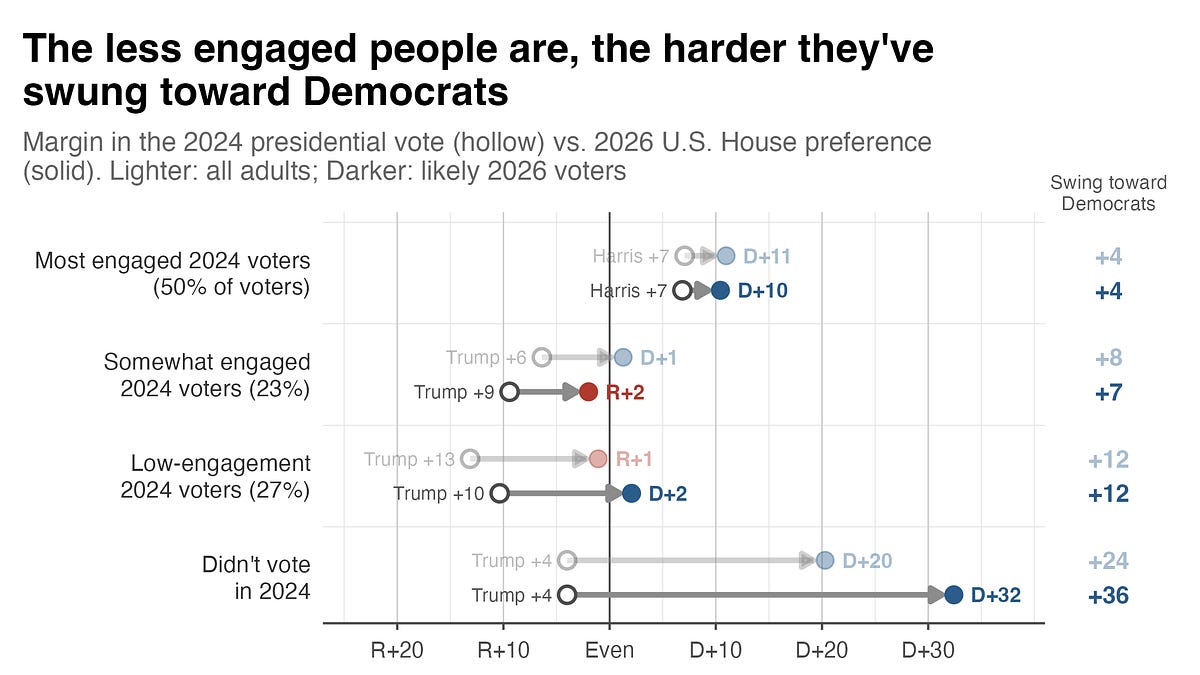
政治参与度越低的人,对特朗普的反感幅度越大。虽然低参与度选民在 2024 年以 13 个百分点的优势支持特朗普而非卡马拉·哈里斯,但低参与度的潜在选民现在以 2 个百分点的优势支持民主党参选国会议员。这是一个朝向民主党 15 个百分点的摇摆,这一群体约占 2024 年选民的四分之一。相比之下,参与度最高的半数选民仅移动了 4 个百分点。
The less politically engaged someone is, the more they have swung against Trump While low-engagement voters favored Trump over Kamala Harris by 13 points in 2024, low-engagement likely voters now favor Democrats in congressional races by 2 points. That’s a 15-point swing toward Democrats in a group that made up about a quarter of 2024 voters. The most engaged half of voters, by comparison, have moved just 4 points.
正如我在此文中所写,根本没在 2024 年投票的美国人摇摆幅度最大。两年前,根据皮尤研究中心经验证选民的研究,他们倾向特朗普,为 44% 对 40%。如今,他们在两项民调中均以 20 个百分点的优势支持民主党竞选众议员(Wave 民调为 21 个百分点,SIN 民调为 18 个百分点)。如果按他们实际投票的可能性加权,民主党的领先优势扩大到 32 个百分点。这些是在一个不容忽视的选民群体中发生的巨大变化,他们可能成为民主党下周翻盘众议院和参议院的关键。
As I’ve written here, Americans who didn’t vote at all in 2024 have moved the most. Two years ago, they leaned toward Trump, 44% to 40%, according to Pew Research Center’s validated-voter study. Today, they favor Democrats for the House by 20 points across both polls (21 in the Wave poll and 18 in SIN). And if you weight them by how likely each one is to actually vote, the Democratic lead grows to 32. Points. These are massive shifts in a not insignificant block of voters, who may be key to Democrats flipping the House and Senate next week.
下图显示了从 2024 年到 2026 年投票意向的摇摆情况,针对所有成年人(浅色点和线)和潜在选民(深色点和线)免费提供给《Strength In Numbers》以继续阅读
The chart below shows swings from 2024 to 2026 vote for all adults (light points and lines) and likely voters (dark points and lines) for free to Strength In Numbers to keep reading