过去一个月,石油期货价格上涨,但打破了今年高达80%的相关性,同期美国国债收益率却出现下跌。
Oil futures have risen over the past month, but breaking with what had been an 80% correlation this year, treasury yields declined during the same time period.
发生了什么变化?据全球最大资产管理公司贝莱德系统化另类投资ETF高级投资组合经理杰弗里·罗森伯格在最近一期CNBC《ETF Edge》节目中表示,是领涨人工智能股票“美股七巨头”出现回落。
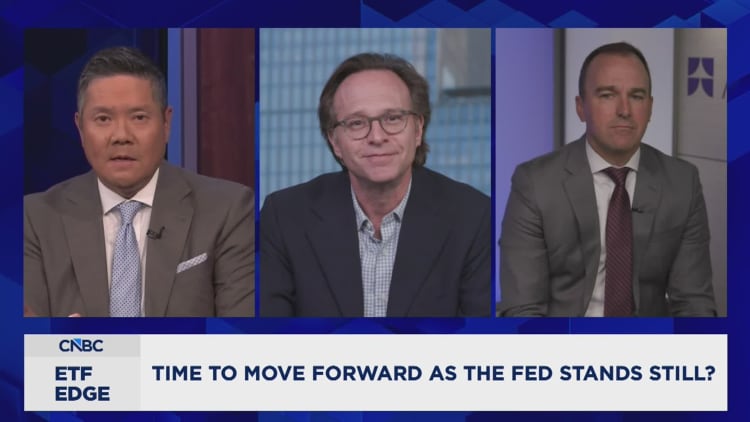
What changed? The decline in the leading artificial intelligence stocks, the Mag 7, according to Jeffrey Rosenberg, senior portfolio manager of the Systematic Alternatives ETF at the world's largest asset manager, BlackRock, speaking on the most recent CNBC "ETF Edge."
“石油与国债收益率曾有着惊人的相关性,但在10月突然中断了,”他说。“这告诉我们一个重要信息:在市场眼中,地缘政治风险次于AI风险。”
"Oil and treasury yields had this amazing correlation and in October it just stopped," he said. "It told us something important. In the market's mind, the geopolitical risk is secondary to AI risk."
如果在2024年有一笔稳赚不赔的交易,那就是押注国债收益率会随石油期货合约上涨而上升。过去一个月,这一规律失效了,据贝莱德系统化另类投资ETF(IALT)高级投资组合经理杰弗里·罗森伯格表示,这一交易关系的破裂对市场有重大影响。
If there was one safe bet over the course of 2026, it was that treasury yields would rise alongside a move up in oil futures contracts. Over the past month, that ended, and according to Jeffrey Rosenberg, senior portfolio manager of the Systematic Alternatives ETF ( IALT ) at BlackRock, the world's largest asset manager, the breakdown in that trade has big implications for the market.

“石油与国债收益率曾有着惊人的相关性,但在10月突然中断了,”罗森伯格在最近一期CNBC《ETF Edge》节目中表示。
"Oil and treasury yields had this amazing correlation and in October it just stopped," Rosenberg said on the most recent CNBC "ETF Edge."
美联储主席凯文·沃什在周三的FOMC新闻发布会上提到了石油与债券收益率的关系,沃什指出石油期货持续上涨,这是央行抗击通胀必须考量的因素。但罗森伯格表示,沃什没谈到的才是“最重要的启示”。
The relationship between oil and bond yields was featured in Federal Reserve Chair Kevin Warsh's FOMC press conference on Wednesday, with Warsh noting how oil futures have continued to rise, a factor the central bank must consider in its fight against inflation. But Rosenberg said what Warsh didn't talk about was "the most important takeaway."
“今年国债与石油有80%的相关性,”罗森伯格说,这相对于正常相关性而言“过高”。“我们基本上一直在围绕石油进行交易,且有充分理由。”
"Treasuries and oil had an 80% correlation this year," Rosenberg said, which is "outsize" relative to normal correlations. "We've basically been trading off oil for good reason."
发生了什么?罗森伯格表示,可以用AI交易降温来概括。随着市场在10月摆脱石油-国债交易相关性,“这告诉我们一个重要信息,”他说。“在市场眼中,地缘政治风险次于AI风险,”他说。
" What happened? Rosenberg says you can sum it up by looking to the deflated AI trade. As the market moved away from that oil-treasuries trading correlation in October, "It told us something important," he said. "In the market's mind, the geopolitical risk is secondary to AI risk," he said.
在过去一个月里——这在周五纳斯达克市场的暴跌以及本周早些时候谷歌股价遭遇史上最大单日跌幅、市值蒸发半万亿美元中表现得最为惨痛——AI交易经历了一次回调。罗森伯格表示,债券收益率下行,是因为市场将AI交易的疲软等同于美国经济更广泛的疲软。他还说,上周的GDP报告支持了这种看法。“AI无处不在,时刻主导一切,”他说。无论是投资端对经济增长的拉动,还是财富效应对消费端的提振,全部都是AI在驱动。
Over the past month — which became most painfully clear in Friday's Nasdaq market wipeout and, earlier the week, Google's biggest single-day decline in its history, wiping out half a trillion dollars in value — the AI trade experienced a retracement. Bond yields went lower, Rosenberg says, because the market is equating weakness in the AI trade as a broader weakness in the U.S. economy. And he said, last week's GDP report backed up that thinking. "AI is everything, everywhere, all the time," he said. Both the growth for the economy on the investment side and the wealth effect on the consumption side are all AI, he said.
“第三季度GDP是一个爆表的数字,且完全与AI相关,”罗森伯格在“ETF Edge”播客的延长对话中表示。他指出,设备投资增加、消费远超预期,两者均由AI财富效应推动,后者更为引人注目,因为美国实际收入一直在下降。
"Q3 GDP was a blowout [number] and all AI-related," Rosenberg said on the "ETF Edge" podcast extended conversation He pointed to equipment investment increases and consumption well above expectations and both fueled by the AI wealth effect, which with the latter is even more notable given that real incomes have been coming down in the U.S.
第三季度企业投资增长12.7%,为疫情以来除疫情期外最大增幅,自2011年以来首见,主要由信息处理设备投资激增37%带动。工业设备投资增长近25%,虽非纯粹的AI交易,但部分反映了数据中心支出。
Business investment of 12.7% in Q3 was the biggest increase outside the pandemic since 2011, led by a 37% rise in information processing equipment. Industrial equipment investment rose nearly 25%, which while not a straight AI trade, does partially reflect spending on data centers.
沃什在FOMC新闻发布会上对经济的评估并不认同这种观点。“把经济强劲完全归因于这波新技术浪潮,这种说法很方便。事实上,如果看数据——真正包括从上次会议到这次会议的数据——资本支出的故事不仅强劲、不仅稳健,而且正在拓宽。因此,如果你想讲这个故事,说我们看到的强劲仅集中在狭窄领域,现在要讲通这个故事比几个季度前难得多,”他说。
Warsh did not agree in his assessment of the economy at the FOMC press conference. "It is convenient to say that the strength of the economy is all about this new technology wave. In fact, if we look at the data, really including data from the last meeting until this, the capex story is not just robust, not just strong, but it is broadening. And so if you wanted to tell the story somehow that this is strength we're seeing only in narrow pockets, that's a much harder story to tell now than it would have been several quarters ago," he said.
但罗森伯格表示,10月份的市场并未得出这一结论,所有因素加在一起形成了一种局面:在他看来,人工智能交易的任何“动荡”都将被视为美国增长前景的动荡,并被视为通胀放缓的信号。他在通胀放缓的环境下,“只有一样东西能起到对冲作用”,他说,“那就是大家都想讨厌的东西……国债收益率曲线的长端。”“这是上个月市场表现给我们的真正重要的一课,”他说。
But Rosenberg says that's not a conclusion that the October market came to and it all adds up to a situation in which he says any "wobble" in the AI trade is going to be seen as a wobble in the growth outlook for the U.S., and as disinflationary. And in a disinflationary environment, there is "only one thing that hedges," he said, and that is "the thing everyone wants to hate. ... the long end of the treasury curve." "That's the really important lesson from last month of market performance," he said.
尽管持有这一观点,罗森伯格对这种动态是否意味着债券成为稳妥押注仍持谨慎态度。“简单的回答是,这不是回归常态,常态曾是债券对冲股票,”他说。
Despite this view, Rosenberg is cautious about suggesting that this dynamic makes bonds a safe bet. "The simple answer is it's not a return to normal, where normal was bonds hedging stocks," he said.
这是因为债券面临相互冲突的力量。油价上涨和持续高于目标的通胀水平,作为固定收益资产的挑战以及固定收益作为对冲工具的“功效”,都不会消失,罗森伯格说。
That is because of the conflicting forces on bonds. Oil price increases and the persistent level of inflation above target are not going away as challenges to fixed-income assets and the "efficacy," Rosenberg said, of fixed income as a hedge.
“通胀过多,这限制了美联储提供宽松政策的能力,我们还没有摆脱这一点,”他说。“但我们在过去一个月学到的是,如果力度足够大,如果人工智能趋势转而对宏观经济和通胀趋势产生不利影响,它可能会带来方向上的彻底改变,这种改变是通胀放缓的,债券可能会像10月份那样做出反应,”他说。
"There's too much inflation and that limits the ability of the Fed to provide accommodation, and we haven't gotten away from that," he said. "But what we've learned in the last month is if it's big enough, if the AI trend turns against the macroeconomy and inflationary trends, it can bring about a wholesale change in that direction that's disinflationary and bonds may react like they did in October," he said.
尽管如此,他表示投资者不应押注这一交易将是单边的,或不会伴随潜在成本。投资者需要权衡基于10月份行情债券可能带来的分散化收益,与人工智能不拖垮经济这一情景之间的对比。而且,人工智能繁荣持续的时间越长,加上美国更广泛的财政挑战,“债券将面临挑战”,他说。
Still, he says investors should not bet the trade will be one-directional or come without a potential cost. Investors need to weigh the potential diversification benefit from bonds based on the October action versus a scenario in which AI does not unravel the economy. And the longer the AI boom persists, coupled with the broader fiscal challenges in the U.S., "bonds will be challenged," he said.
如何交易人工智能超大规模云服务商债券繁荣 人工智能交易本身是债券市场的重要组成部分,过去一周,随着谷歌财报下滑和微软重返公共债券市场,这一现象尤为明显。“这让市场感到意外。它已经将近十年没有回到公共债券市场了,”罗森伯格说。
How to trade the AI hyperscaler debt boom The AI trade itself is a very big piece of the bond market, and that showed up over the past week in a major way between both the Google earnings decline and Microsoft coming back into the public bond market. "It was a surprise to the markets. It hadn't been back in close to a decade," Rosenberg said.
随着科技巨头的资本开支需求越来越频繁地超过其自由现金流,公共债券市场正在适应预期中的大规模债券发行潮。“当债券市场,公共债券市场,审视这一切资金来源时……它是一个巨大的边际发行主体,而且资金越来越一再地来自同一来源,”他说。
As the capex needs of the tech giants begin to overwhelm their free cash flow more regularly, the public bond markets are coming to terms with an expected flood of issuance "When the bonds markets, the public bond markets, look at where it is all coming from ... it's a huge marginal issuer, and its increasingly all coming again and again," he said.
超大规模云服务商正在触及银行贷款和私人信贷市场所能提供的融资上限,而罗森伯格强调,40万亿至60万亿美元的全球债券市场可以吸收未来四年预期的4万亿美元人工智能债务,“但市场的容量并非无限。”这种需求将导致价格下降和利差扩大,尽管微软的债券交易吸引了巨大的投资者兴趣并被超额认购。
The hyperscalers are reaching the limits of the financing that bank loan and private credit markets can offer and while Rosenberg stressed that a $40 trillion to $60 trillion global bond market can absorb an expected $4 trillion in AI debt over the next four years, "the market is not unlimited in capacity." That demand will lead to lower prices and higher spreads, though Microsoft's deal attracted huge investor interest and was oversubscribed.
罗森伯格表示,更多超大规模债务被推向公共债券市场是件好事,因为这意味着债券价格和信用违约互换(CDS)利差将更加透明。虽然微软信用违约互换的利差目前接近五年高点,大约为55个基点,但与甲骨文的信用违约互换利差相比,后者接近300个基点,两者仍有巨大差距。这为那些可能不想在当前美国通胀环境和财政挑战下直接购买债券,但仍在寻找对冲人工智能繁荣赌注方式的投资者提供了另一种交易机会。
Rosenberg said it's a good thing that more of the hyperscale debt is being pushed into the public bond market because it means there will be more transparency in the form of bond prices and CDS spreads. While spreads on Microsoft credit default swaps are currently trading near a five-year high, roughly 55, they are still a world away from Oracle CDS spreads, by comparison, which are closer to 300. That presents another trading opportunity for investors who may not want to buy bonds outright given the inflationary environment and fiscal challenges in the U.S., but may still be looking for ways to hedge bets on the AI boom.
“那个来自全球金融危机的老工具,”他说。“做空它。你可以在[公共]信贷市场双向交易,但在银行贷款和私人信贷中做不到。但一旦它们开始在公共市场交易,你就可以这样做。”罗森伯格表示,谷歌单日下跌12%在历史上“甚至不在图表上”。“所以它正在进入一个不同的‘邮编区’,可以说,市场定价、市场波动和市场消化能力都不同。这不是世界末日,只是AI建设的一个不同世界,”他说,公共债券市场的更高透明度让投资者更有能力交易“恐惧与贪婪之间的情绪波动”,他说。
"That old tool from the Great Financial Crisis," he said. "Short it. You can trade two ways in [public] credit markets and you can't do that in bank loans and private credit. But once they start going in public markets, you can do that." Rosenberg said a 12% down day in Google is "not even on the chart" historically. "So it's moving into a different zip code, if you will, of market pricing and market volatility and market indigestion. It's not the end of the world, it's just a different world of the AI buildout," he said, with the greater transparency in the public bond market giving investors more ability to trade "the emotional swings between fear and greed," he said.
根据罗森伯格的说法,CDS市场对大型超大规模云服务商名称所传递的信息,并非违约前景很高,而是随着所有公司都试图获取更多债务融资,银行和金融中介机构为风险寻找交易对手的能力正变得越来越有限。
What the CDS market is telling investors with the large-cap hyperscaler names, according to Rosenberg, is not that the prospect of default is high, but that as all the companies try to access more debt financing, the capacity of the banks and financial intermediaries to find counter-parties for the risk is becoming more limited.
“想想金融市场和这些大规模投资繁荣。它们不会单向移动。它们是阶梯式上升,然后重置。”但随着AI热潮,到目前为止只有“积极的一面”,罗森伯格说。“这仍然是一个极其积极的故事,但你会通过AI悲观论得到一点平衡。”该内容超越直播,对塑造ETF市场的趋势和数据进行更深入的观察。免责声明
"Think about financial markets and these big investment booms. They don't move in one direction. They ratchet up, reset." But with the AI boom, it's only been "the positive part," Rosenberg said. "It's still an incredibly positive story, but you get a little of the balance with the AI pessimism." that goes beyond the livestream, offering a closer look at the trends and figures shaping the ETF market. Disclaimer