尽管华尔街对过多资金涌入人工智能领域感到焦虑,但这场热潮的最大受益者之一正全速前进。
For all the anxiety on Wall Street that too much money is being pumped into artificial intelligence, one of the biggest beneficiaries of the boom is powering ahead.
纽约距离首尔乘飞机需15小时,但在经济层面,两地仿佛处于不同的星球。韩国的数据几乎没有迹象表明其由人工智能驱动的增长势头即将衰退。这并不意味着家庭平等分享了繁荣成果,也不意味着决策者可以忽视未来的挑战。尽管表现出非凡的韧性,但这种扩张极不均衡。
New York may be 15 hours by air from Seoul, but economically they might as well be on different planets. There is little in South Korea’s data to suggest its AI-driven growth surge is about to run out of steam. That doesn’t mean households are sharing equally in the good times, or that policymakers can ignore what comes next. Despite its remarkable strength, the expansion is strikingly uneven.
不过,目前这种增长势头难以忽视。出口的一个关键指标显示,10月出口额较去年同期几乎翻倍;半导体出货量激增260%,计算机出货量增长六倍。据韩国央行预测,海外客户今年购买韩国商品的金额可能超过1万亿美元,这将使韩国成为继美国、中国和德国之后,第四个跨越这一门槛的国家。甚至长期令人担忧的韩元,今年也是亚洲兑美元表现最好的货币。
For now, though, it’s hard to miss. A key gauge of exports almost doubled in October from a year earlier; semiconductor shipments surged 260%, while computers posted a sixfold increase. Overseas customers are likely to buy more than $1 trillion of South Korean goods this year, according to the central bank, making it only the fourth country, after the US, China and Germany, to cross that threshold. Even the won, long a source of worry, is Asia’s best-performing currency against the dollar this year.
国内生产总值预测频繁上调,首尔在国际货币基金组织最新的全球经济评估中脱颖而出。然而,韩国的经济实力常难以在其音乐、电影和美食获得的赞誉面前引人注目。如果人工智能无其他作为,至少提供了一个竞争性叙事——一个建立在该国工业和技术优势之上的叙事。
Forecasts for gross domestic product are being upgraded frequently, and Seoul was a standout in the International Monetary Fund’s latest assessment of the global economy. Yet South Korea’s economic prowess has often struggled for attention beside the acclaim showered on its music, movies and food. If AI does nothing else, it has at least offered a competing narrative — one built around the country’s industrial and technological strengths.
韩国并非唯一受益于人工智能的经济体。芯片需求推动了中国台湾、新加坡和马来西亚的增长,而中国在技术雄心方面也不乏野心。投资者正日益将东亚划分为人工智能赢家和输家,仅仅是出口强国已不再足够。印度尼西亚和菲律宾面临被甩在后面的风险,而凭借电子产品细分领域优势的泰国,大概率将像往常一样:勉强应付、混日子。
Korea isn’t the only economy being lifted by AI. Chip demand has propelled growth in Taiwan, Singapore and Malaysia, while China has no shortage of technological ambition. Investors are increasingly sorting East Asia into AI winners and losers, and being an export powerhouse is no longer enough. Indonesia and the Philippines risk being left behind, while Thailand, with its niche in electronics, is likely to do what it often does: muddle through.
韩国之所以与众不同,在于其拥有SK海力士和三星电子等全球龙头企业,这些企业的成功也在推动国内资本支出激增。这使韩国拥有了许多邻国所缺乏的优势:既能分享人工智能繁荣的红利,又拥有能将其转化为国内投资的企业。
What sets Korea apart is that it’s home to global leaders such as SK Hynix Inc. and Samsung Electronics Co., whose success is also fueling a domestic capital-spending surge. That gives the country something many of its neighbors lack: both exposure to the AI boom and companies capable of turning it into investment at home.
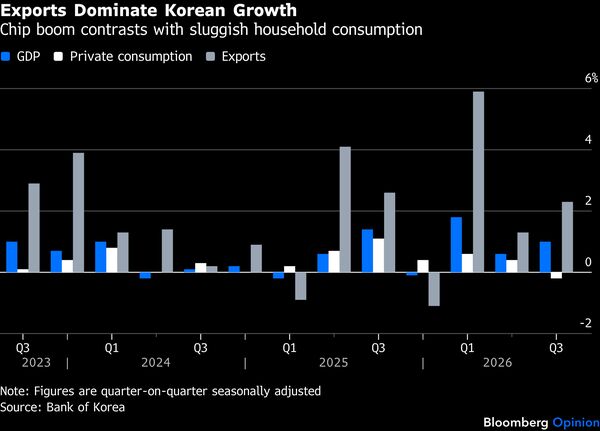
然而,并非一切都在顺风顺水。上一季度家庭消费萎缩,尽管GDP增速超预期,制造业信心却远超其他行业。沉重的债务负担、股市热情降温以及劳动力市场复苏不均衡,正在拖累消费者。青年失业率正在上升。基准KOSPI指数今年累计上涨30%,涨幅尚可,但一度涨幅高达100%,随后的单日剧烈波动令人担忧。
Not everything is humming, however. Household consumption shrank last quarter even as GDP expanded faster than expected, and confidence among manufacturers is running well ahead of sentiment in other industries. Consumers are being held back by heavy debt burdens, a cooling of stock-market enthusiasm and an uneven labor-market recovery. Youth unemployment is rising. The benchmark Kospi index is still up a respectable 30% this year, but at one point its gains had reached 100%, and some of the subsequent daily swings have been jarring.
所有繁荣都伴随着不满。即便是如今普遍回顾向好的1990年代美国经济,也有其粗糙边缘。就业市场从本世纪初衰退中复苏缓慢,即使经济增长已反弹,这也助推老布什总统竞选连任失败。全球金融危机后的扩张成为美国历史上最长的一次,却常因未能创造足够优质就业岗位而受批评。尽管近期整体增长强劲,许多美国人对经济感到失望——本周选民更让特朗普总统的共和党失去了国会控制权。
All booms have their discontents. Even the US economy of the 1990s, now generally remembered fondly, had its rough edges. The job market was slow to recover from the recession earlier that decade even as growth rebounded, helping cost President George H.W. Bush a second term. The expansion after the Global Financial Crisis became the longest in American history, yet was frequently criticized for failing to generate enough good jobs. And despite strong overall growth more recently, many Americans have soured on the economy — and this week voters evicted President Donald Trump’s Republicans from congressional control.
韩国的高光时刻也值得类似审视。人工智能热潮可能掩盖了哪些长期挑战?人口约束首当其冲,并未消失。韩国生育率仍处于工业化国家最低水平,甚至低于日本。后果已在邻国显现。日本央行本周警告,人口萎缩将使维持强劲消费支出增长变得日益困难。韩国最终可能面临相同障碍。
South Korea’s star turn deserves similar scrutiny. What long-term challenges might the AI rally be obscuring? Demographic constraints, for one, haven’t gone away. Korea’s fertility rate remains among the lowest in the industrialized world, below even Japan’s. The consequences are already visible next door. The Bank of Japan warned this week that a contracting population will make it increasingly difficult to sustain robust growth in consumer spending. Korea may eventually confront the same obstacle.
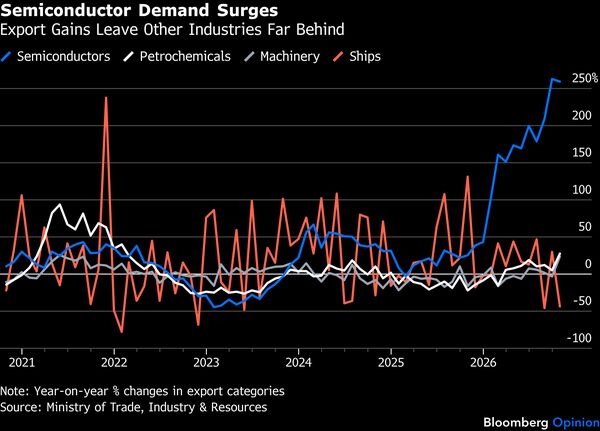
另一个挑战可能来自其庞大的邻国。据凯投宏观称,中国在电池、造船和石化产品生产方面的进步正在侵蚀韩国的传统优势。当人工智能热潮最终消退时,无论是在几个月还是几年后,首尔将不得不依赖那些其竞争优势已在收窄的产业。失业必将随之而来。韩国的高光时刻既是实至名归,也是机缘巧合。这波繁荣更多取决于全球需求,而非国内发展。这绝非批评:韩国花了几十年将自己打造成出口强国,正是为了能抓住这样的时刻。
Another challenge may be coming from its giant neighbor. Advances in Chinese production of batteries, ships and petrochemicals are eroding Korea’s traditional advantages, according to Capital Economics. When the AI boom does fizzle, whether months or years from now, Seoul will fall back on industries where its competitive edge is already narrowing. Job losses will surely follow. The country’s time in the sun is both deserved and fortuitous. The boom depends more on global demand than on developments at home. That’s hardly a criticism: Korea spent decades building itself into an export powerhouse precisely so it could capitalize on moments like this.
但要关注那些被抛在身后的人。奉俊昊执导、2019年获得奥斯卡奖的电影《寄生虫》描绘了一个靠诈骗为生的家庭,他们挣扎求存并设法讨好一位科技高管的富裕家庭。片中无人形象特别光鲜。在这部黑色喜剧的表象下,是一个关于在现代韩国繁荣获益者与为生存而奋斗者之间鸿沟的故事。
But watch those being left behind. Bong Joon Ho’s Oscar-winning 2019 movie depicted a family of grifters struggling to make it and ingratiating themselves with the rich house of tech executive. Nobody emerges particularly well. Beneath the dark comedy was a story about the gulf between those prospering in modern Korea and those fighting to get by.
如今的人工智能热潮令人印象深刻。但它变得越是失衡,当派对结束时会发生什么这个问题就越重要。还要多久,“韩国冲击”才会成为家喻户晓的词汇?
Today’s AI boom is impressive. But the more lopsided it becomes, the more important it is to ask what happens when the party ends. How long before “Korea Shock” becomes a household word?