韩国出口在10月保持强劲增长,人工智能驱动的繁荣持续为这个依赖贸易的经济体提供动力。
Korea’s exports maintained strong growth in October, with an artificial intelligence-driven boom continuing to power the trade-reliant economy.
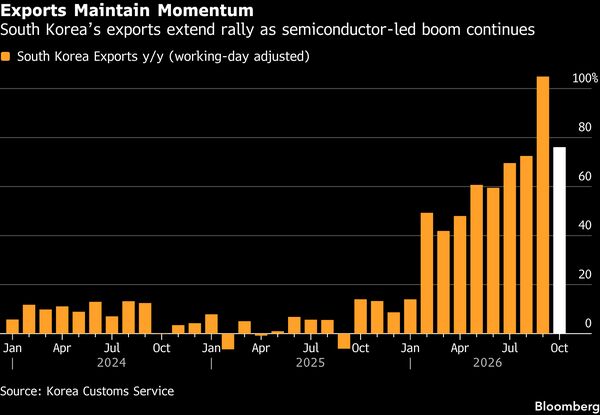
据产业通商资源部周日发布的数据,按工作日差异调整后,出口同比增长76.1%。出口额达到1153亿美元,继上月创下的1211亿美元纪录之后。
Exports adjusted for working-day differences climbed 76.1% from a year earlier, according to the Ministry of Trade, Industry and Resources data released Sunday. The value of shipments reached $115.3 billion, following the previous month’s record $121.1 billion.
未经调整的基础上,出口增长93.7%,而进口增加36%,贸易顺差达425亿美元。相比之下,9月经修正的出口增幅为83.7%。
On an unadjusted basis, exports rose 93.7%, while imports increased 36%, resulting in a trade surplus of $42.5 billion. That compared with a revised 83.7% export increase in September.
持续的强劲表现增加了韩国央行本月加息的理由,此前决策者在10月维持利率不变,以评估7月和8月连续加息的影响。周二将公布的通胀数据将为韩国央行11月26日的决策提供另一关键参考。
The continued strength adds to the case for the Bank of Korea to raise interest rates this month after policymakers stood pat in October to assess the impact of consecutive increases in July and August. Inflation data due Tuesday will provide another key input before the BOK’s Nov. 26 decision.
半导体继续成为增长的主要驱动力,芯片出口同比激增259%至564亿美元。计算机出货量增长497%,石油产品和汽车分别增长80%和18%。
Semiconductors continued to be the main driver of the gains, with chip exports surging 259% from a year earlier to $56.4 billion. Shipments of computers rose 497%, while petroleum products and automobiles gained 80%, and 18%, respectively.
日历效应可能使比较变得复杂。今年中秋假期在9月,去年在10月,这使得工作日调整后的数据成为衡量贸易基本面势头的有用指标。
Calendar effects may have complicated the comparisons. The Chuseok holidays fell in September this year and October last year, making working day-adjusted figures a useful gauge of underlying trade momentum.
韩国央行行长申贤松表示,出口繁荣也使韩国有望今年首次实现年度出口额突破1万亿美元。据产业通商资源部称,这将使韩国成为继美国、中国和德国之后第四个达到这一里程碑的经济体。
The export boom is also putting South Korea on course to exceed $1 trillion in annual shipments for the first time this year, BOK Governor Shin Hyun Song said. That would make it the fourth economy to reach the milestone after the US, China and Germany, according to the trade ministry.
这些数据表明,韩国出口引擎在第四季度初依然强劲,尽管芯片繁荣的益处尚未均匀扩散到整个经济。这种分化使韩国央行的任务复杂化,因为它在权衡强劲增长和高于目标的通胀与疲软的家庭需求。
The figures suggest South Korea’s export engine remained strong at the start of the fourth quarter, even as the benefits of the chip boom have yet to spread evenly across the economy. That divergence complicates the BOK’s task as it weighs strong growth and above-target inflation against weak household demand.
经济第三季度环比扩张1%,超出经济学家预测的0.8%增幅。设备投资跃升4.1%,但私人消费下降0.2%,凸显半导体繁荣带来的收益分布不均。
The economy expanded 1% in the third quarter from the previous three months, beating economists’ forecasts for a 0.8% gain. Facility investment jumped 4.1%, but private consumption fell 0.2%, underscoring the uneven benefits of the semiconductor boom.
韩国央行预计,今明两年经济增长将大幅超过其8月预测的3.3%和2.9%。央行指出,半导体出口和投资持续强劲,而收入改善将逐步支撑更广泛的消费复苏。
The BOK expects growth this year and next to substantially exceed its August projections of 3.3% and 2.9%, respectively. It has pointed to continued strength in semiconductor exports and investment, while expecting improving incomes to gradually support a broader consumption recovery.
行长申和星表示,在官员确信通胀将收敛至央行2%目标之前,货币政策将保持限制性。韩国央行还将在11月利率决议中发布更新后的增长和通胀预测。
Governor Shin said monetary policy will remain restrictive until officials are confident inflation will converge to the bank’s 2% target. The BOK will also release updated growth and inflation forecasts with its November rate decision.
尽管家庭需求举步维艰,通胀仍是政策制定者的制约因素。9月消费者物价指数同比上涨2.9%,剔除食品和能源的核心通胀率为2.8%。两者均较8月有所回落,但仍远高于韩国央行的目标。
Inflation remains a constraint on policymakers even as household demand struggles. Consumer prices rose 2.9% in September from a year earlier, while core inflation excluding food and energy registered 2.8%. Both eased from August but remained well above the BOK’s target.
韩元升值有助于抑制进口型通胀。持续的出口强劲和巨额贸易顺差可能支撑货币进一步升值,尽管升值步伐也将取决于资本流动和全球市场状况。
The won’s appreciation has helped curb imported inflation. Continued export strength and large trade surpluses could support further currency gains, although the pace of any appreciation will also depend on capital flows and global market conditions.