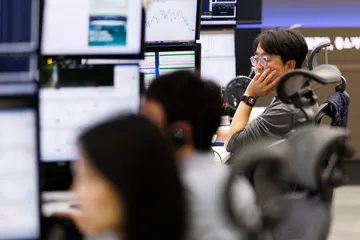
韩国政府将全球最火热的股市变成了政治战利品。如今,一场抹去逾1万亿美元市值的逆转正在激起散户投资者的反弹,并考验着公众对领导层的信任。
Korea’s government turned the world’s hottest stock market into a political trophy. Now, a reversal that’s wiped out more than a trillion dollars in value is stirring a retail investor backlash and testing public faith in its leaders.
那些表示听从政府号召、青睐股市而非房地产的个人投资者愤懑不已,因为官方曾大力吹捧综合股价指数(Kospi)在人工智能热潮推动下于6月创下历史新高。眼下,该基准指数自那时起已暴跌逾40%,全球科技股反弹戛然而止;与此同时,首尔房价已连涨创纪录的91周。
Frustration is acute among individuals who say they heeded the government’s call to favor the equity market over real estate, as officials championed the Kospi’s artificial intelligence-fueled surge to a record high in June. As things stand, the benchmark has plummeted over 40% since then amid an unraveling global tech rally, while property prices in Seoul have climbed for a record 91 straight weeks.
周五,随着综合股价指数跌破5000点大关——这是总统李在明在竞选期间大力宣传的水平——散户投资者在网络股票论坛上发泄不满,嘲讽李在明的承诺。
On Friday, as the Kospi slumped below the 5,000 level that President Lee Jae Myung touted during his election campaign, retail investors vented frustration and mocked Lee’s pledge on online stock forums.
股市表现与房价的强烈反差,对首尔上班族金敏(Kim Min,音)造成了特别沉重的打击。金敏称,他原本打算2026年初买房,但最终决定将4000万韩元(约合2.95万美元)投入一只挂钩中小型股Kosdaq指数的交易型开放式指数基金(ETF)。约七个月过去了,他声称这笔投资已亏损逾65%。
The contrast between share-market performance and property prices has proved particularly painful for Kim Min, a salaried worker in Seoul. Kim says he deferred a decision to buy a house in early 2026, and instead put 40 million won ($29,500) in an exchange-traded fund tied to small-cap Kosdaq gauge. About seven months on, more than 65% of that investment has been wiped out, he claims.
“回头看,我认为政府煽动这波行情简直是纯粹的疯狂,”这位40岁男子说。“只要能把本金捞回来,我这辈子都不会再碰韩国股票了。绝不。”
“Looking back, I think it was just pure madness that the government has fueled this rally,” the 40-year-old said. “If I can just get my money back, I would never ever trade Korean stocks again. Never.”
2025年6月上台的李在明,将引导家庭财富从房地产流向股市作为其经济议程的核心。其政府收紧抵押贷款、遏制房市投机以抑制房地产投资,同时采取措施提升股东回报。
Lee, who took power in June 2025, made shifting household wealth away from real estate and into equities a centerpiece of his economic agenda. His administration tightened mortgage lending and sought to curb speculation in the housing market to restrain property investment, while also taking steps to boost shareholder returns.
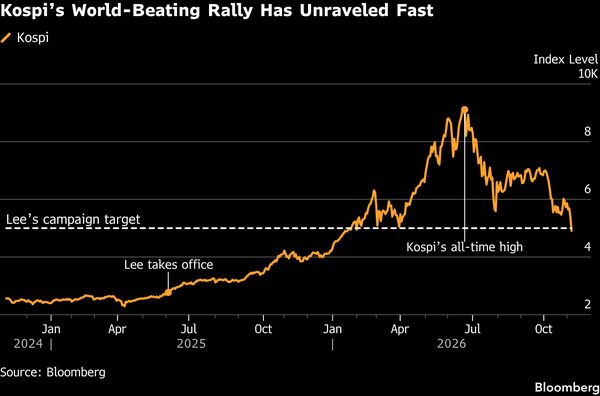
竞选期间,李在明承诺将韩国综合股价指数(Kospi)推升至5000点,约为当时水平的两倍,将其政府的公信力与股市表现紧密挂钩。2026年4月,时任执政党共同民主党党首郑清来表示,Kospi指数有望达到8000点。
During his campaign, Lee pledged to lift the Kospi to 5,000, or about double its level at the time, tying his administration’s credibility closely to the market’s performance. In April 2026, Jung Chung-rae, then chief of the ruling Democratic Party, said the Kospi could reach 8,000.
虽然人工智能热潮推动指数突破这些水平,创下9114.55点的历史新高,但7月的一轮惨烈抛售——这是近二十年来最差单月表现——以及10月的另一轮大幅下跌,动摇了散户投资者的信心。周五Kospi指数盘中一度暴跌8.8%至4911.28点,随后收复约一半跌幅。此前周四指数已暴跌5.3%。
While the AI boom saw the index shatter those levels to hit a record 9,114.55, a punishing selloff in July — which marked its worst month in nearly two decades — and another bruising slide in October have shaken retail investors. The Kospi plunged as much as 8.8% on Friday to 4,911.28, before paring about half the loss. That followed a 5.3% slump on Thursday.
“总统出来向公众极力主张:别把钱投进房地产,要投资股票,”首尔成均馆大学社会学教授具正宇(音)说。“但很多听从该建议的人现在亏了钱。”总统办公室拒绝就此事置评。
“The president went out there and made a very confident case to the public: don’t put your money into real estate, invest in stocks instead,” said Koo Jeong-woo, a sociology professor at Sungkyunkwan University in Seoul. “But a lot of people who followed that advice have now lost money.”The presidential office declined to comment for this story.
Kospi指数近期下跌,正值全球科技股抛售之际,市场担忧民主党在美国中期选举中表现强势后,将寻求对人工智能行业实施更严格监管。这可能减缓美国数据中心扩张步伐,并拖累韩国芯片制造商的需求前景。
The latest declines in the Kospi have come amid a selloff in tech stocks globally due to growing concern that Democrats will seek tighter regulation of the AI industry after their strong showing in the US midterms. That could potentially slow the expansion of US data centers and weigh on the demand outlook for Korean chipmakers.
彭博汇编的数据显示,自6月22日市值峰值5.1万亿美元以来,韩国股市市值已蒸发约1.7万亿美元。这尚未计入周五的损失。
Overall, about $1.7 trillion has been eroded from the market value of Korean stocks since a peak of $5.1 trillion on June 22, data compiled by Bloomberg show. That’s before taking into account Friday’s losses.
对于韩国日内交易者而言,不满在于政府将Kospi指数上涨作为其经济议程的展示窗口,而这轮涨势很大程度上是由更广泛的人工智能热潮推动的。
For Korean daytraders, the grievance is that the government made the Kospi’s rise a showcase for its economic agenda even as much of the rally was being powered by the broader AI boom.
“每个里程碑都有庆祝仪式和拍照留念,看到这些的人都以为市场会涨得很高,”首尔的上班族金某(音)说。
“There were celebrations at every milestone with photo ceremonies, and people who saw them thought the market would go up really high,” said Kim, the salaried worker from Seoul.
许多散户投资者借贷入市,券商iM Securities Co.估计,在Kospi指数运行于7000点上方期间,购入的股票价值超过600亿美元,主要由个人投资者买入。部分投资者涌入与芯片股挂钩的杠杆ETF,此类基金可放大收益,但也会放大亏损。这些基金目前较高点下跌逾70%。
Many retail investors took on debt to enter the market, with brokerage iM Securities Co. estimating that more than $60 billion of stocks were bought while the Kospi traded above 7,000, mostly by mom-and-pop investors. Some piled into leveraged ETFs tied to chip stocks, which can magnify gains but also amplify losses. Those funds are down more than 70% from their peaks.
10月中旬的一项民调显示,李在明的不支持率从51%升至52%。在不支持者中,19%提到政府的住房政策,12%提到经济状况及对股市的应对。
A mid-October poll showed that the disapproval rating for Lee rose to 52% from 51%. Among those who disapproved, 19% cited the government’s housing policy while 12% cited the state of the economy and response to the stock market as reasons.
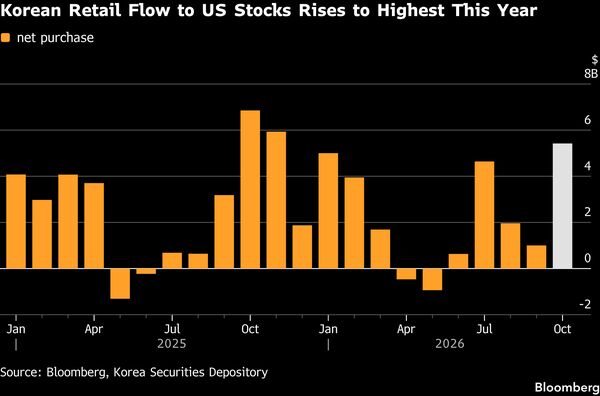
此次暴跌的另一后果可能是散户投资者转而抛弃本地股票,使政府遏制资金外流以支撑韩元的努力更加复杂。据存托机构数据,在截至10月的四个月里,韩国投资者买入约130亿美元美股,同期净卖出17亿美元Kospi股票。
Another fallout of the rout may be that retail investors are turning their backs on local stocks, complicating the government’s efforts to discourage outflows as a way to support the Korean won. Koreans bought about $13 billion worth of US stocks in the four months through October, while selling a net $1.7 billion of Kospi shares in the period, according to depository data.
公平地说,在李在明执政下,韩国实施了一系列公司治理改革以缩减所谓的“韩国折价”,这支撑了Kospi指数跑赢全球大涨。其政府还致力于拆除资本市场的过度监管和低效环节。Kospi指数今年以来仍上涨逾20%。
To be sure, under Lee, Korea has implemented a series of corporate governance reforms to reduce the so-called Korea Discount, and that supported the Kospi’s world-beating ascent. His administration has also sought to dismantle excessive regulation and inefficiencies in capital markets. The Kospi is still up more than 20% this year.
随着AI热潮在今年早些时候升温,包括高盛集团和摩根大通在内的华尔街银行纷纷将Kospi目标位上调至至少12000点。
As the AI frenzy intensified earlier in the year, Wall Street banks including Goldman Sachs Group Inc. and JPMorgan Chase & Co. were among those that boosted their Kospi targets to at least 12,000.
如今,曾推动指数上涨的全球力量正在反向发挥作用,市场担忧估值过高,以及投入科技领域的数十亿美元资金能否带来足够回报。高盛上月将目标位下调至9000点。
Now, the same global forces that propelled the index are working in reverse, as concerns mount over lofty valuations and whether the billions of dollars being poured into the technology will bring sufficient returns. Goldman last month cut its target to 9,000.
“振兴股市可以是政府的目标,但提出5000点或8000点这样的具体数字作为目标,可能会留下错误的印象,”淑明女子大学经济学教授姜仁洙(Kang In Soo,音)表示。他说,现在,韩国综合股价指数(Kospi)从9000点以上大幅下跌的情形,恐怕将主导公众记忆,而不是李在明竞选期间5000点的目标。
“Reinvigorating the stock market can be a government’s goal but proposing a number such as 5,000 or 8,000 as the goal could leave a wrong impression,” said Kang In Soo, an economics professor at Sookmyung Women’s University. Now, the Kospi’s sharp fall from over 9,000 will likely dominate public memory, rather than Lee’s election campaign target of 5,000, he said.