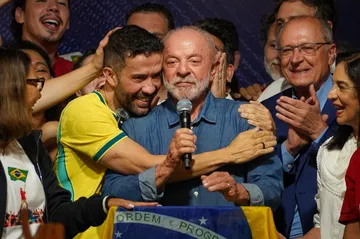
1989年路易斯·伊纳西奥·卢拉·达席尔瓦首次竞选巴西总统时,柏林墙还矗立着。他当时已是全国最著名的工会领袖,最终得票位列第二。此后他又参选六次,赢下其中四次,当过12年总统,还因腐败入狱两年。但这位民主世界最顽强的政治幸存者把最精彩的表现留给了最后一次竞选——在上个月的选举中逆转获胜,令所有人震惊。
The Berlin Wall was still standing when Luiz Inacio Lula da Silva ran his first campaign for Brazil’s presidency in 1989. Already the nation’s most famous union leader, he came in second. Since then, he’s run six more times — winning four of them — and spent 12 years as president as well as two in jail for corruption. But the greatest political survivor in the democratic world saved the best for his last campaign, astonishing everyone with a come-from-behind victory in last month’s election. Investors greeted that news with Brazil’s own Black Monday — a sweeping selloff of stocks, bonds and the currency. This made an odd book-end with Lula’s first victory, in 2002, when markets panicked at the prospect of a leftist in power, and then went on a sustained decade-long rally as he proved himself a pragmatist who understood the need to keep capital markets happy. Panic turned into one of history’s greatest buying opportunities, with the benchmark Bovespa index gaining an astonishing 1,500% in dollar terms over the next five years. He had luck on his side — notably the growth of China and its insatiable appetite for Brazilian raw materials. To date, Lula, now 81, has managed to avoid a major market crisis. Investors could not possibly know him better, and yet, a quarter-century after first taking office, they greeted his re-election with horror. What Happened? Lula’s run-off victory sprung a big surprise because he had been beaten into second place on the first ballot. All previous first-round leaders had gone on to prevail in the second. Prediction markets gave Flavio Bolsonaro, his opponent and the son of Jair Bolsonaro, the former president defeated by Lula in 2022, an 80% chance of victory. Yet Lula overcame him and won decisively by three percentage points. Bolsonaro, under criminal investigation that he says is politically motivated, swiftly fled the country for Miami.
投资者用巴西自己的“黑色星期一”回应这一消息——股票、债券和本币遭全面抛售。这与卢拉2002年首次胜选形成了一个奇特的呼应:当时市场因担心左翼上台而恐慌,随后却开启了长达十年的持续上涨,因为他证明自己是个务实的人,懂得需要让资本市场满意。恐慌变成了历史上最好的买盘机会之一,基准博维斯帕指数在随后五年里以美元计价上涨了惊人的1500%。
Alberto Carlos Almeida, a veteran political scientist, describes the election as an “outlier” because it swung on the campaign between the two rounds. The first had been a referendum on Lula: People were unhappy, he’d been around for a long time, and many wanted a change. That turned the second round into a referendum on Bolsonaro, a deeply flawed candidate whose problems Lula’s team brilliantly exploited in a social media campaign. Even investors, who bid up Brazilian stocks on the assumption of a Bolsonaro victory, disliked the choice. One fund manager said:

他也有运气的眷顾——尤其是中国的增长及其对巴西原材料的巨大需求。迄今为止,现年81岁的卢拉成功避免了重大市场危机。投资者对他再熟悉不过,然而在他首次执政四分之一个世纪之后,他们却以惊恐的态度迎接他的再次当选。发生了什么?
Had Brazil placed both these men where they were supposed to be — which is in jail — we would have had a much better choice and this would have been a better country.
卢拉在第二轮投票中获胜出人意料,因为他在首轮投票中被挤到了第二位。此前所有首轮领先者都在第二轮中最终胜出。预测市场认为,他的对手、2022年被卢拉击败的前总统雅伊尔·博索纳罗之子弗拉维奥·博索纳罗有80%的胜算。然而卢拉战胜了他,以三个百分点的优势决定性获胜。博索纳罗正受到刑事调查——他称调查出于政治动机——他迅速离国前往迈阿密。
Mistakes by Bolsonaro made the Lula campaign’s job easier. Most disastrously, in a televised debate he called Lula — who lost a finger in an industrial accident at the age of 17 — “nine-fingers.”Lula responded that he could not permit a “grifter” who “never did a day’s work in his life” to make light of his injury. He won the exchange. Voting is compulsory between the ages of 18 and 70 in Brazil, while 16- and 17-year-olds and over-70s can abstain without paying a fine. Very unusually, turnout rose between the two rounds. Grandchildren dragged aged relatives to the polls, with the clear perception that the job was Bolsonaro’s for the taking and that they needed to stop him. “If Bolsonaro had come in second in the first round, he might have won,” says Almeida. “Most elections are won by the candidate who’s seen by the electorate to be the one to solve the main problem for the moment. For Brazil, that problem is violence, and that would mean a vote for Flavio.”Lula should not have been counted out. Polls showed a statistical dead heat, with the veteran campaigner gaining. But his victory was still a genuine surprise that created the conditions for a big market reaction.
资深政治学者阿尔贝托·卡洛斯·阿尔梅达(Alberto Carlos Almeida)将此次选举描述为“特例”,因为它在两轮投票之间发生了转变。第一轮是对卢拉的公投:人们不满意,他已经存在了很长时间,许多人希望改变。这使得第二轮成为对博索纳罗的公投,他是一位有严重缺陷的候选人,卢拉的团队在社交媒体竞选活动中巧妙地利用了他的问题。
What’s Different This Time? The selloff was so brutal because the investment community in São Paulo has fallen totally out of love with the man. Even if his political luck hasn’t run out, they believe that inexorable economic trends have created conditions where Lula’s approach can no longer work and could lead to disaster. Some of this is bad luck, and some is due to his own failure to deal with deep structural problems when he had the chance. Brazil had a primary surplus in 2002, meaning that ongoing receipts exceeded expenses; it now has a deficit. Debt was 60% of gross domestic product. It’s now on course for 100% by the end of this decade, according to the International Monetary Fund. Extreme hyperinflation has been beaten, but prices remain prone to rise faster than in any similar country, with inflation currently running at 4.6%. Dependence on dollar-denominated debt has fallen as local pension funds have grown. Default is no longer an issue.
甚至连那些假设博索纳罗获胜而推高巴西股市的投资者也都不喜欢这个选择。一位基金经理说:如果巴西把这两个人都关进他们本该待的地方——也就是监狱——我们就会有更好的选择,这个国家也会更好。
But debt has accumulated to a point where there seems no way of dealing with it, other than printing money and letting loose inflation to attack its value. This is not all or indeed mostly Lula’s fault. Brazil’s issues date back to the immense 425-page constitution adopted in 1988. It enshrines rights that the country can no longer afford — but which Brazilians can scarcely be expected to surrender without a fight. Constitutionally mandated spending now accounts for about 90% of the government budget. High interest rates are particularly painful because of progress toward a consumption-driven economy with a growing middle class. That has come with a price in terms of indebtedness; some 30% of disposable income goes on interest payments.
博索纳罗的失误让卢拉竞选团队的工作变得更容易。最糟糕的是,在一次电视辩论中,他称卢拉——卢拉在17岁时因工伤失去了一根手指——为“九指”。卢拉回应说,他不能允许一个“骗子”和“一生从未工作过一天”的人拿他的伤势开玩笑。他赢得了这场辩论。在巴西,18至70岁之间投票是强制性的,而16至17岁以及70岁以上的人可以弃权而不受罚款。
Lula cannot be blamed, either, for a looming demographic shift. Brazil is a younger nation than Japan or the western European nations where the growing share of retirees is already generating acute problems — but that will soon change, and its own demographic reversal will happen far faster. But it’s also fair to say as these problems come to a head that Lula has not previously shown any willingness to deal with them.
非常不寻常的是,两轮投票之间的投票率有所上升。孙辈们把年长的亲戚拖到投票站,人们普遍认为博索纳罗唾手可得,他们需要阻止他。阿尔梅达说:“如果博索纳罗在第一轮中排名第二,他可能会赢。”“大多数选举都是由选民认为能够解决当前主要问题的候选人赢得的。对巴西来说,那个问题是暴力,这意味着会投票给弗拉维奥。”不应低估卢拉。
民意调查显示双方势均力敌,这位经验丰富的竞选者正在获得支持。但他的胜利仍然是一个真正的惊喜,为市场的大幅反应创造了条件。
The business community once thought he might be the ideal politician to persuade the working classes to accept a little less. They now fear that as an old man who will never run for office again — and who may well feel invincible — he could instead move emphatically in the wrong direction.

这一次有何不同?抛售之所以如此惨烈,是因为圣保罗的投资界已彻底对这位领导人失去了信心。即便他的政治运气尚未耗尽,他们也认为不可逆转的经济趋势已造成这样一种局面:卢拉的做法不再奏效,甚至可能导致灾难。这其中一部分是运气不好,另一部分则是他自己在有机会时未能解决深层结构性问题。巴西在2002年曾实现初级盈余,即经常性收入超过支出;如今却陷入赤字。
债务曾占国内生产总值的60%,根据国际货币基金组织预测,本世纪末将升至100%。极端恶性通胀已被遏制,但物价仍易于比任何同类国家上涨得更快,目前通胀率为4.6%。随着本地养老基金壮大,对美元计价债务的依赖已下降,违约不再是问题。但债务已累积到一个地步,似乎除了印钞、任由通胀侵蚀其价值外,别无他法。
这并非全是、甚至主要不是卢拉的过错。巴西的问题可追溯至1988年通过的长达425页的宪法。该宪法确立了该国已无力负担的权利——但巴西人几乎不可能在不抗争的情况下放弃这些权利。宪法强制性支出现约占政府预算的90%。高利率之所以格外痛苦,是因为巴西已向消费驱动型经济迈进,中产阶级不断壮大。这伴随着债务负担的代价;可支配收入中约有30%用于支付利息。
What Next?
卢拉也不能为即将到来的人口结构变化负责。巴西比日本或西欧国家更年轻,在这些国家,退休人员比例不断上升已引发严重问题——但这种情况很快就会改变,巴西自身的人口逆转将发生得快得多。但也公平地说,随着这些问题达到顶点,卢拉此前并未表现出任何解决它们的意愿。商界曾认为,他可能是那位能说服工人阶级接受稍少一点利益的理想政客。他们现在担心,作为一个永远不会再竞选公职的老人——且很可能自觉无敌——他反而可能坚决地朝错误方向迈进。接下来会怎样?
The fear, widely voiced in São Paulo, is that Lula has never liked dealing with capital markets, and now might truly believe he can do without them. Markets staged a second selloff this week after reports that he would meet with an economist who has argued for lowering interest rates to control inflation. That went down like a lead balloon. One investor commented:
圣保罗普遍担心,卢拉从未喜欢与资本市场打交道,现在可能真心认为他可以不依赖它们。本周市场出现第二轮抛售,此前有报道称他将与一位主张降息控制通胀的经济学家会面。这消息反响极差。一位投资者评论道:“这是土耳其和阿根廷的奇怪混合体,非正统政策听起来很性感。对于不了解的人来说,降息当然听起来很棒。”
This is a weird mix between Turkey and Argentina where unorthodox policy sounds very sexy. For people who don’t understand, of course it sounds great to cut interest rates.
如果卢拉真的尝试这种非正统做法,将迅速导致全面危机——一些投资者认为,需要一场大规模的债券义警对决,将利率推至不可持续的水平,才能迫使卢拉改变路径。但他从政多年,从未尝试过任何背离常规的举措;很难看出他为何会这样做并危及自己的政治遗产。
If Lula really did try something that heterodox, it would swiftly lead to all-out crisis — and some investors think that a major bond vigilante showdown, taking interest rates to unsupportable levels, will be needed to force Lula to change path. But he’s been around a long time and hasn’t tried anything divergent before; it’s hard to see why he would do so and endanger his legacy.
另一种,或许更可能的情况是,他继续勉强维持。他过去曾这样做,而且也许还能继续下去,尽管怀疑论者正确地指出,随着债务和利息支付的增加,每一次拖延都将更加困难。经济已经连续增长了20个季度——这是一项了不起的成就。但预计明年经济将收缩,这将使债务偿还的压力进一步增大。
A second, perhaps more likely scenario is that he continues to muddle through. He has before and maybe can keep doing so, even though skeptics rightly point out that each kick of the can down the road is harder as debt and interest payments mount. The economy has grown for the last 20 consecutive quarters — quite a feat. But it’s projected to contract next year, and that will compound debt payments even higher.
最后一种可能性,虽然有些牵强,是他与投资者对抗并获胜——也许通过堵塞漏洞来增加收入,从而实现预期的财政紧缩。愤世嫉俗者可能会认为,这样的政策会加剧那些刚刚损失巨额资金的投资界的愤怒。而且与市场对抗可能是危险的。
A final possibility, more of a stretch, is that he takes on the investors and wins — perhaps by achieving the desired fiscal retrenchment by closing loopholes to raise revenues. Cynics might suggest that such a policy contributes to the anger in a investment community that has just lost huge sums. And it can be dangerous to take on markets.
这就留下了一个由令人震惊的选举结果造成的难题,这个问题将在未来四年内得到解决。这提醒我们,卢拉是一位伟大的竞争者,永远不应被忽视——但这次意外的规模可能会让他过于自信,从而失去他过去四十年来作为巴西关键人物所具备的判断力。
That leaves the conundrum created by the astonishing election result, which will play out over the next four years. It reminds us that Lula is a great competitor who should never be counted out — but the scale of the upset might indeed leave him so overconfident that he loses the judgment that has kept him as Brazil’s pivotal figure for four decades.