华尔街对美国中期选举的反应大约用了 24 小时才转为负面。一旦转向,便引发了一连串抛售,速度快得多。
It took around 24 hours for Wall Street’s response to the US midterm elections to turn negative. Once it did, it set in motion a chain reaction of selling that moved considerably faster.
蓝色浪潮席卷国会,最初换来美股稳健上涨,因为与投票相关的事件风险已出清、油价回落,且市场预期特朗普政府将受到制约。但到周四上午,投资者开始重新评估更广泛的影响,以及民主党对人工智能革命赖以依存的数据中心扩张持有的深度怀疑。
The blue wave that swept Congress was initially met with a solid gain in American stocks, with the event risk tied to the vote out of the way and oil prices in retreat, and on expectations the Trump administration would now be reined in. But by Thursday morning, investors were reassessing the wider implications, and the Democrats’ deep skepticism of the data-center expansion on which the artificial intelligence revolution depends.
始于散户投资者抛售的行情,随后被对冲基金和长线基金经理加速,接着做市场波动的量化公司进一步放大了跌幅。最终结果是以科技股为主的纳斯达克 100 指数录得 2020 年 3 月以来最大单日跌幅 —— 美国市值一天内蒸发 3.7 万亿美元。
What began with selling by retail investors was accelerated by hedge funds and long-only managers, before quantitative firms that ride market volatility compounded the losses. The final result was the tech-heavy Nasdaq 100 Index’s worst drop since March 2020 — and $3.7 trillion of US market value wiped out in a day.
随着市场似乎将以更稳健的姿态结束本周,纳斯达克 100 指数收复部分失地,以下是最初抛售的演变过程。周四交易的前半小时属于散户。
As the market looks set to end the week in more stable fashion with the Nasdaq 100 regaining some of the ground it lost, this is how the initial selloff unfolded. The first half hour of Thursday trading belonged to retail.
在中期选举后的反弹行情以及政策不确定性逼近之际,这些投资者决定落袋为安,制造了伦敦杰富瑞集团策略师 Mohit Kumar 所说的自新冠暴跌以来最大规模的散户抛售潮。
After the mid-week rally and with policy uncertainty looming, those investors decided to cash-in gains, creating what Mohit Kumar, strategist at Jefferies LLC in London, said was the largest wave of retail selling since the Covid crash.
数据印证了这一点:分析机构 Vanda Research 显示,周四散户对个股的净卖出规模,仅次于 2020 年 3 月新冠疫情冲击时期的两个交易日。摩根大通市场情报部门称,该群体的抛售幅度超过常态三个标准差。
The data bears that out: The net selling of single stocks by retail investors on Thursday ranks behind only two days, both in March 2020 as the Covid pandemic was hitting, according to the analytics firm Vanda Research. JPMorgan Market Intelligence said the group’s selling was more than three standard deviations from the norm.
正如华尔街常有的情况,抛售引发更多抛售,早期的下行走势加速,因为对冲基金率先增加了压力,随后纯多头资产管理公司也跟进。库马尔表示,该群体的交易量异常巨大,因为管理人员开始锁定收益,而总体而言,股市今年表现强劲。问题在于另一方没有出现主要买家。
As so often happens on Wall Street, selling begets selling, and the early downward move accelerated as hedge funds added to the pressure before long-only asset managers did the same. Volumes from that cohort were unusually large as managers began to lock in gains from what has overall been a strong year in equities, Kumar said. The problem was no major buyers emerged on the other side.
万达全球宏观策略师维拉杰·帕特尔在一份报告中写道:“机构投资者退场,而散户和系统化策略正在激进抛售。这种资金流向动态,通常只在真正的市场压力时期才会出现。”在摩根大通,全球股票高触交易联席主管罗恩·阿德勒从现货交易台目睹了这一切,那里的交易量上涨了50%。
“Institutional investors have stepped back just as retail and systematic are selling aggressively,” Viraj Patel, Vanda’s global macro strategist, wrote in a note. “These are the kind of flow dynamics we rarely see outside periods of genuine market stress.”At JPMorgan Chase & Co., Ron Adler, global co-head of equity high touch trading, watched it all unfold from the cash desk, where trading volumes were up 50%.
他在给客户的报告中写道:“我们看到的部分原因是投资组合亏损和无差别抛售。今天的资金流向坦率地说在方向上是合理的。令人担忧的是其规模。”一旦股票走势方向确立,且幅度足够大,一系列机械性交易就会启动,从而放大亏损。
“Part of what we’re seeing is portfolio pain and indiscriminate selling,” he wrote in a note to clients. “The candor of the flows today seems directionally rational. It’s the magnitude that’s raising eyebrows.”Once the direction of a stock move is set, and if it is large enough, a host of mechanical transactions come into play that can amplify losses.
例如,期权交易商必须根据市场走势不断调整敞口。有时他们发现自己在股市下跌时卖出股票、上涨时买入股票,这种情况被称为负伽马。根据野村证券国际公司跨资产策略董事总经理查理·麦克利戈特的估算,周四盘中,交易商的负伽马约为每1%波动70亿美元。
For instance, options dealers have to continually adjust their exposure based on how the market moves. Sometimes they find themselves selling stocks when they’re falling and buying when they’re rising, a situation dubbed negative gamma. Midway through Thursday’s session, dealer negative gamma was at about $7 billion for every 1% move, according to estimates from Charlie McElligott, managing director of cross-asset strategy at Nomura Securities International Inc.
换句话说,股市每下跌1%,他们就会增加70亿美元的抛售压力。
In other words, for each 1% decline in equities, they would add an additional $7 billion in selling pressure.
麦克利戈特还估计,根据当时的市场波动,波动率控制基金(根据市场波动幅度买卖)需要抛售约610亿美元股票,其中周三产生的250亿美元抛单仍在执行中。他估计,杠杆交易所交易基金(ETF)的盘尾调仓将意味着另外470亿美元股票待售。
McElligott also estimated that volatility-control funds, which buy and sell depending on how much the market swings, needed to offload about $61 billion of stocks based on moves at the time, with $25 billion of selling from Wednesday still being executed. End-of-day adjustments by leveraged exchange-traded funds would mean another $47 billion of stocks on sale, he estimated.
麦克利戈特在致客户的信中写道:“与客户的交流表明,他们目前感到更有动力降低风险敞口。”他说,反馈的主题是“保住今年以来仅存的微薄业绩,并熬到明年获得新资金和风险额度”。随着主要指数跌破关键水平,进一步引发了系统性抛售。据万得估算,趋势跟踪量化基金(即商品交易顾问,CTAs)在标普500指数和纳斯达克指数期货上抛售了约130亿美元,使其敞口降至其数据中的近期最低水平。
“Conversations with clients are telling-me that they’re feeling further incentivized to take risk down at this point,” McElligott wrote to clients. He said the theme of feedback was “preservation of residual shreds of remaining YTD performance and staying-alive into next yr’s fresh capital and risk.”As major indexes dropped below key levels, there was further systematic selling. Trend-following quants called commodity trading advisers, or CTAs, sold about $13 billion across S&P 500 and Nasdaq futures, according to Vanda estimates, taking their exposure near the lowest in its data.
总而言之,午后反弹的机会微乎其微。标普500指数收于当日低点附近,录得自去年4月以来最大单日跌幅。
All told, there was little chance of an afternoon rebound. The S&P 500 closed near its lows of the day, posting its biggest loss since April last year.
一些对冲基金似乎预见到了大行情将至。10月下旬,做空头寸(即机构押注下跌而非上涨)接近五年高位。净杠杆率(衡量基金借贷放大押注程度的指标)处于三年低位。
Some hedge funds appear to have seen a big move coming. Short positioning — where the firms wager on declines, rather than gains — were near a five-year high in late October. Net leverage, a measure of how much funds have borrowed to amplify their bets, was at a three-year low.
即便如此,高盛集团主经纪商部门估计,基本面多空基金周四亏损1.3%,属于两个标准差事件;科技聚焦型基金跌幅超过4%,今年以来业绩大致持平。动量策略(一种追逐赢家、抛售输家的投资风格)遭受了3.7个标准差的损失。
Even so, Goldman Sachs’s Prime desk estimates fundamental long/short funds lost 1.3% on Thursday, a two-standard-deviation event, with technology-focused funds down more than 4% and now roughly flat for the year. Momentum — an investing style that chases winners and dumps losers — suffered a 3.7 standard deviation loss.
周四股市的杀跌呈现“窄而深”特征。存储芯片、光网络、数据中心和AI半导体板块下跌12%至15%,属于五到六个标准差的波动。剔除AI个股后,标普500指数下跌2.3%。
Thursday’s damage across equities was narrow and deep. Memory, optical networking, data-center and AI-semiconductor baskets fell 12% to 15%, five to six standard deviation moves. The S&P 500 without its AI names lost 2.3%.
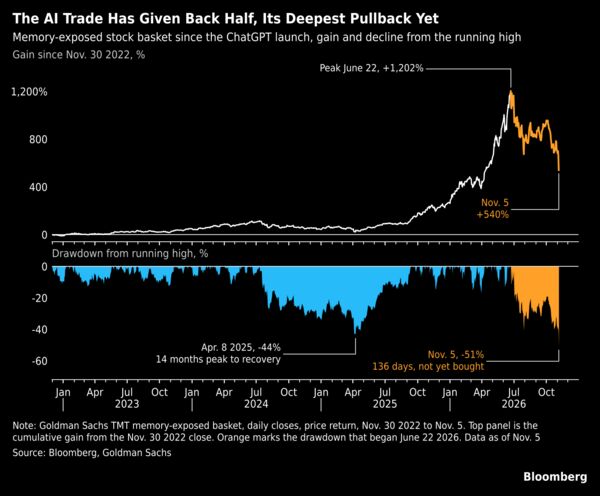
对于大约十几类AI股票而言,这是自2022年11月OpenAI推出ChatGPT以来最糟糕的一天。受冲击最严重的两类——存储和光网络——已较6月峰值下跌约一半,跌幅超过它们四年来完成的任何一次回调。存储类股票组合的下跌是2022年以来九次下跌中第一次未被逢低买入,此时已是第136天。
For about a dozen baskets of AI stocks it was the worst day since the launch of OpenAI’s ChatGPT in November 2022. The hardest-hit baskets, memory and optical networking, have roughly halved from their June peaks, deeper than any pullback they completed in four years. The memory basket’s decline is the first of nine since 2022 not to be bought, 136 days in.
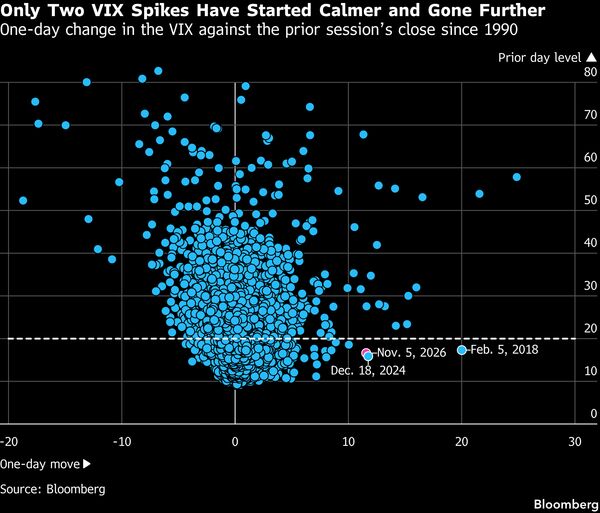
这一切之所以显得更具戏剧性,是因为它是在毫无预兆的情况下突然出现的。芝加哥期权交易所波动率指数(Cboe VIX Index)是衡量预期股票波动性的指标,常被称为华尔街的恐慌指数,周四开盘时为16.6点,低于其一年均值。到收盘时已接近28点。
All this seemed more dramatic because it emerged from a standing start. The Cboe VIX Index, a measure of expected equity volatility often dubbed Wall Street’s fear gauge, was at 16.6 points at the start of trading Thursday, below its one-year average. By the close it was near to 28 points.
自1980年以来,标普500指数在上涨1.5%之后的第二天跌幅达到或超过2%的情况仅出现过48次,几乎全部发生在熊市或危机期间。只有四次距离历史高点如此之近;其中两次在50个交易日内收复失地,另外两次发生在1987年。
Since 1980, the S&P 500 has fallen 2% or more the day after gaining 1.5% only 48 times, almost all inside bear markets or crises. Only four came this close to a record; two recovered within 50 sessions, and two came in 1987.
周五复苏已开始显现,芯片股领涨标普500指数,纳斯达克100指数一度上涨2.6%。然而,这些涨幅能否持续仍是未知数。
The recovery was starting to show up already on Friday, with chip stocks leading the S&P 500 higher and the Nasdaq 100 climbing as much as 2.6%. Whether those gains will stick, however, remains an open question.
DataTrek Research联合创始人尼克·科拉斯在给客户的报告中写道,投资者此前过于乐观,周四“是重置观点、将其建立在更可持续基础上的一个令人不快但必要的步骤”。“我们仍看好美国大盘股,并预计市场将在下周企稳。”
Investors were overly optimistic and Thursday “was an unpleasant but necessary step in resetting their views onto a more sustainable footing,” Nick Colas, co-founder of DataTrek Research wrote in a note to clients. “We remain bullish on US large caps and expect markets to stabilize in the coming week.”