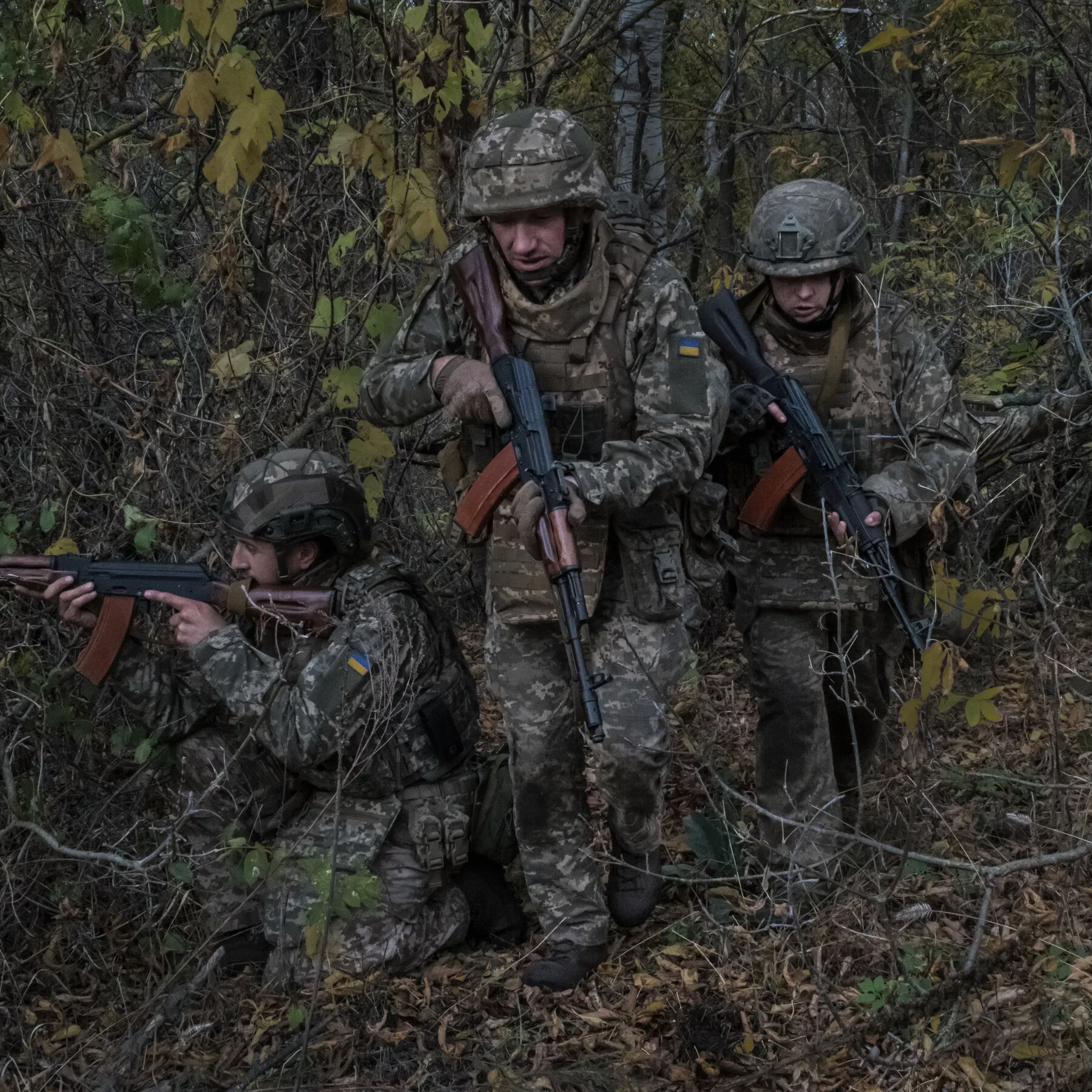
在这次帮助乌克兰扭转局势的行动内部在数月的保密之后,乌克兰指挥官允许《纽约时报》记者进入他们用来收复部分俄军领土得失的地堡和训练场。乌克兰士兵上个月在乌克兰哈尔科夫地区训练。图片来源……持续不断的活动声充斥着乌克兰东部的地下掩体。上个月的一个清晨,士兵们互相呼喊着,盯着一排排屏幕,上面显示着来自战场的实时视频画面。
Inside the Operation That Helped Ukraine Turn the Tables After months of secrecy, Ukrainian commanders let New York Times journalists join them in bunkers and training grounds used to reverse some Russian territorial gains. Ukrainian soldiers training in the Kharkiv region of Ukraine last month. Credit... Supported by A steady hum of activity filled the underground bunker in eastern Ukraine. Soldiers called across one another as they monitored banks of screens showing livestream video feeds from the battlefield one morning last month.
“各位,咱们先打仗,自己的事儿等会儿再说,”指挥官尤里·霍罗贝茨大喊一声,让屋里安静下来。“咱们的FPV(第一人称视角无人机)正在飞来,”他指着侦察画面屏幕上一个微小、苍白的物体——一架第一人称视角无人机——说道。这架无人机,一架远程遥控四旋翼飞行器,正在锁定目标准备发动攻击。
“Guys, let’s fight the war first and deal with our stuff later,” the commander, Yuriy Horobets, shouted, quieting the room. “Our FPV is coming in now,” he said, pointing out a tiny, pale object, a first-person-view drone, moving across the screen of a reconnaissance feed. The drone, a remotely piloted quadcopter, was homing in to attack.
那天,他的旅——第66机械化旅——有多架无人机在空中,用于打击俄军阵地,与此同时该旅部队正准备冲锋夺取一片树林地带。这次突击是一项持续数月、收复了大片东部领土的行动的尾声。
His brigade, the 66th Mechanized Brigade, had multiple drones in the sky that day to strike Russian positions as its troops prepared to storm a tree line. The assault was at the tail end of a monthslong operation that recaptured a sizable portion of eastern territory.
这次代号为“维瓦尔第”的行动,挫败了俄军今年包围顿涅茨克省最后几座城市的企图,而这些城市正是莫斯科坚称要夺取以结束战争的奖品。
That operation, called Vivaldi, thwarted Russian efforts this year to encircle the last cities of Donetsk Province, the prize that Moscow insists it wants to end the war.
在数月的作战沉默之后,参与行动的乌克兰旅开始披露它们如何设法将一场对阵俄军的失利防御战,转变为沿部分前线的成功进攻的细节。它们允许《纽约时报》记者团随军嵌入采访两周,亲眼目睹其工作。
After months of operational silence, the Ukrainian brigades involved have begun to reveal details of how they managed to turn a losing defensive fight against Russian forces into a successful offensive along parts of the front line. They allowed a team of New York Times reporters to embed with them for two weeks and see their work firsthand.
在大部分长达近两年的时间里,乌克兰军队在兵力远占优势的俄军面前节节败退。但无人机和遥控车辆的更广泛应用,以及部分部队指挥架构和文化的变革,使乌克兰得以换挡提速。
Ukrainian troops had been losing ground to the far more numerous Russian Army for the best part of two years. But the wider use of drones and remote-controlled vehicles, and changes in the command structure and culture within parts of the army, enabled Ukraine to shift gears.
准将安德烈·比列茨基是此次行动的总指挥,他宣称战术极其成功,部队在战斗中歼灭了俄军第144摩托化步兵师,并扭转了俄军一整年的战果。
Brig. Gen. Andriy Biletsky, the overall commander of the operation, claimed that the tactics were so successful that his troops had wiped out Russia’s 144th Motor Rifle Division in the fighting and reversed Russia’s gains of a whole year.
“我们现在看到的更像是试图建立防线的绝望举动——是垂死挣扎,而非有组织、有系统的军事行动,”他在10月的一次记者会上对记者们说。
“What we are seeing now looks more like desperate attempts to establish a defensive line — an agony, rather than organized, systematic military operations,” he told journalists in a briefing in October.
他与几位指挥官一起,在一个地下掩体内召集新闻媒体,宣布“维瓦尔迪行动”结束,并总结其成果。他表示,该行动的主要攻势始于5月。
Alongside several of his commanders, he had gathered members of the news media in an underground bunker to announce the end of Operation Vivaldi, the main thrust of which he said began in May, and to sum up its results.
据战争研究所统计,10月份是连续第二个月乌克兰夺取的领土多于俄罗斯,俄军遭受了战争以来最高的单月伤亡人数——超过5.4万人阵亡或重伤。
In October, for the second consecutive month, Ukraine gained more territory than Russia, and Russian forces suffered their highest monthly casualty toll — more than 54,000 killed or seriously wounded — of the war, according to the Institute for the Study of War.
军事分析人士和俄罗斯军事博主证实了乌军的进展,俄军失去了利曼市以北的一个关键突出部,以及乌克兰南部扎波罗热前线上等量的领土。
Military analysts and Russian military bloggers have confirmed Ukrainian gains, as Russian forces lost a key salient north of the city of Lyman and an equal amount of territory on the Zaporizhzhia front line in southern Ukraine.
第66旅对这一成功至关重要。它面临的挑战是许多乌克兰军事编制的典型缩影,如装备老旧、人员和资源短缺。其许多步兵士兵年龄在40多岁或50多岁,像45岁的霍罗贝茨营长一样。
The 66th brigade was essential to that success. Its challenges were typical of many Ukrainian military formations, like struggling with old equipment and shortages of personnel and resources. Many of its infantry soldiers are in their 40s or 50s, like Mr. Horobets, 45, a battalion commander.
霍罗贝茨说,去年该旅在俄军优势兵力面前节节败退。他们的补给线遭到火力覆盖,无法运入弹药、撤离伤员。
Last year, the brigade, vastly outnumbered by Russian forces opposing them, was steadily losing ground, Mr. Horobets said. Their supply routes were under fire, preventing them from bringing in ammunition and evacuating the wounded.
然而,正是在这种漩涡中,几名营长因厌倦在俄军火力下被消耗,决定亲自掌控局面。他们夺取了俄军占据的、位于一座村庄上方制高点上的关键阵地,俄军正是从那里指挥对他们的打击。
Yet it was from that maelstrom, fed up with being destroyed by Russian firepower, that a few battalion commanders said they took things into their own hands. They seized critical Russian positions on high ground above a village from which Russian troops were directing the strikes against them.
一旦他们控制了制高点并瘫痪了俄军通讯,便发现自己占据了优势。据几名参与行动的指挥官称,村里的俄军士兵不知发生了何事,也无法更换装备,因为乌军正在击落俄军补给无人机,并阻止车辆通过道路前进。
Once they controlled the heights and knocked out Russian communications, they found they had an advantage. The Russian soldiers in the village did not know what had happened and could not replace equipment because the Ukrainian forces were bringing down the Russian supply drones and preventing vehicles getting through on the roads, several commanders involved in the operation said.
“那时,我们在打击无人机和空中侦察方面都取得了对敌人的优势,”代理机械化营指挥官纳扎尔·基纳什(Nazar Kinash,25岁)说。俄军“实际上已被致盲”,他说。
“At that point, we had superiority over the enemy in terms of both strike drones and aerial reconnaissance,” said Nazar Kinash, 25, the acting commander of a mechanized battalion. The Russians “had effectively been blinded,” he said.
霍罗贝茨说,第66旅开始渗透士兵进入村庄并设下伏击。一个月内,他们攻下了该村,六周后,又夺取了另一个村庄。
The 66th brigade began infiltrating soldiers into the village and setting up ambushes, Mr. Horobets said. Within a month, they had taken the village, and six weeks later, they seized another.
“现在你们看到的是寂静,”霍罗贝茨指着地下指挥所里的一排视频屏幕说。“一个月前,这里是一场可怕的战争,因为敌人试图夺回阵地并发动反击,”他说。“但现在,他们已精疲力竭。”据几名营指挥官称,这次行动是比列茨基大将执掌第三军团指挥权以来新方向的首个迹象,他于2025年夏接任,给他们所在前线段的六个旅带来了统一指挥和协同作战。
“For now, you see silence,” Mr. Horobets said as he gestured at a bank of video screens in his underground command post. “A month ago, there was a terrible war here because the enemy was trying to regain its positions and counterattack,” he said. “But, for now, they are exhausted.”The operation is the first sign of a new direction under General Biletsky, who took command of the Third Army Corps in summer 2025, bringing a unity of command and coordination among six brigades along their part of the front line, several battalion commanders said.
他们说,决策权下放给了一线指挥官,而不再从指挥所层层传达;高级指挥官则专注于更宏观的作战层面,以瓦解俄军指挥体系。
Decision making was given to commanders on the ground rather than being relayed from a command post, while the senior commanders focused on the broader operational level to disrupt the Russian command, they said.
第66旅指挥官称,他们首次与周边单位协同作战,破解了俄军渗透难题,封堵了单位间的空隙——俄军士兵此前正是通过这些缝隙渗透至乌军防线后方建立据点。
Working in sync for the first time with the units around them, the commanders of the 66th brigade said they had cracked the problem of Russian infiltration, sealing the gaps between units where Russian soldiers had been slipping through to set up positions behind Ukrainian lines.
无人机战争已将乌克兰前线变成了一个数英里宽的杀戮区,车辆极易成为目标,以至于士兵大多只能分成小组徒步行进。俄罗斯军队已基本放弃正面装甲突击,转而采取派遣步兵隐蔽推进的方式。
Drone warfare has transformed the front line in Ukraine into a miles-wide kill zone, where vehicles are so easily targeted that soldiers mostly move on foot in small groups. The Russian Army has largely abandoned full-frontal armored assaults in favor of a stealthy advance by inserting foot soldiers.
霍罗贝茨说,数月来,第66旅搜寻并摧毁了其能发现的每一个俄罗斯阵地,包括躲藏在乌克兰防线后方掩体中的单个士兵、战壕里的步兵以及掩体内的无人机飞手。
For months, the 66th brigade hunted down and destroyed every Russian position it could find, including single soldiers holed up in dens behind Ukrainian lines, infantry in trenches and drone pilots in bunkers, Mr. Horobets said.
“归根结底,关键在于协调,”他说。他在视频屏幕上展示了两个用红框标出的灌木林区域。他说,俄罗斯士兵仍挖掘工事驻守在那里,是他下午的打击目标。
“Overall, it comes down to coordination,” he said. He showed two areas of scrubby woodland outlined in red on a video screen. Russian soldiers were still dug in there and were his target for the afternoon, he said.
“我们将先摧毁天线,再摧毁发电机,”他说。“结果飞手也会被一并消灭。”随着乌克兰军队开始推进,他们中程无人机打击的价值显现出来。别列茨基将军说,第3军团每天最多可打击50辆俄罗斯车辆,有时打击深度可达俄罗斯防线后方100英里(约160公里)。
“We will destroy the antennas first, then destroy the generators,” he said. “It will turn out that we destroy the pilots, too.”As the Ukrainians began advancing, the value of their middle-range drone strikes became clear. The Third Army Corps was striking up to 50 Russian vehicles a day, sometimes as deep as 100 miles behind Russian lines, General Biletsky said.
“敌人在距前线40至50公里处卸车、然后继续徒步行进已成常态,”他说。有时一名士兵要背着一枚炮弹走20英里(约32公里)。“他们的后勤实际上已瘫痪。”几名指挥官说,俄罗斯士兵面临燃料、弹药和食物短缺。一些人开始在阵地外举起纸板牌,写着他们又饿又渴。
“It became normal for the enemy to unload 40 to 50 kilometers from the front line and then continue on foot,” he said. Sometimes a soldier would carry a single artillery shell 20 miles, he said. “Their logistics have effectively been paralyzed.”Russian soldiers were running short of fuel, ammunition and food. Some began holding up cardboard signs outside their positions, saying they were hungry and thirsty, several commanders said.
关键在于,当俄罗斯增援部队被调来时,乌克兰无人机在他们下车的那一刻、距前线还有数英里时就对其发动打击,霍罗贝茨说。
Critically, when Russian reinforcements were called in, Ukrainian drones struck them as they dismounted from vehicles miles before they could reach the front line, Mr. Horobets said.
战场机器人的更广泛应用,旨在抵消俄罗斯在兵力上的数量优势,这一趋势稳步增长。一名27岁的乌克兰前突击队员表示,自去年秋天起,他被委以组建一支由遥控打击车辆组成的特种营的重任。出于安全考虑并依照惯例,他要求仅以其呼号“马卡尔”示人。
The wider use of battlefield robots to beat Russia’s superiority in numbers has steadily grown. A 27-year-old former Ukrainian assault trooper said he had been put in charge of building up a special battalion of remote-controlled strike vehicles since last fall. He asked to be identified by only his call sign, Makar, for security reasons and according to protocol.
他在接受采访时表示,乌克兰在人员数量上无法超过俄罗斯。“但我们可以在技术上超越他们,”他说,“在质量和规模上,只要我们始终保持领先他们数步。”如今,地面机器人至关重要。在我们团队探访的几个地下指挥所里,乌克兰士兵注视着车辆穿越杀伤区运送物资时,屏幕上实时传回的履带和灌木丛画面。有时这些车辆还会运回阵亡士兵的遗体。
The Ukrainians cannot outnumber the Russians in terms of personnel, he said in an interview. “But we can outperform them technologically,” he said, “in terms of quality and scale, if we consistently stay several steps ahead of them.”By now, ground robots are vital. In several underground command posts our team visited, Ukrainian soldiers watched livestream videos of tracks and undergrowth as the vehicles trundled through the kill zone carrying cargo. Sometimes they brought out the bodies of dead soldiers.
许多车辆会故障或遭到俄罗斯无人机袭击,它们的摄像头拍下了其他车辆的残骸。
Many of the vehicles break down or get attacked by Russian drones, and their cameras showed the wrecks of other vehicles.
但也有许多车辆成功突围。别列茨基将军表示,他的旅向前线士兵运送物资的量,是最近纳入其指挥的其他旅的三倍。
But many of them get through. General Biletsky said his brigades were delivering three times as much cargo to their soldiers on the front line as other brigades that recently came under his command.
他说:“这意味着,第三军团的士兵比其他地方的士兵拥有多得多的资源和能力:粮食补给、弹药、装备、电源、电池等等。”他还说,他们甚至收到了挖掘机,以帮助建设地下掩体。
“That means a soldier in the Third Army Corps has considerably more resources and capabilities available to them: food supplies, ammunition, equipment, power sources, batteries and so on, compared with a soldier elsewhere,” he said. They were even receiving diggers to help build underground bunkers, he said.
马卡尔表示,他专注于将遥控车辆用作进攻工具。隶属于第三突击旅的NC13部队士兵,在“维瓦尔第行动”中处于最前沿,驾驶此类打击车辆投入战场。
Makar said he had focused on using remote-controlled vehicles as tools of attack. Soldiers of his unit, NC13, part of the Third Assault Brigade, were at the forefront of Operation Vivaldi, piloting such strike vehicles on the battlefield.
《纽约时报》在一次实弹训练中见到了其中一组士兵,他们是服役九个月的20岁年轻人,正在操控装备火箭推进榴弹和勃朗宁机枪的遥控越野车。另一组士兵则驾驶一架侦察无人机,提供持续的视频画面。
The Times met a group of them, 20-year-olds with nine months’ experience in the army, during a live-fire training exercise, in which they directed remote-controlled buggies armed with rocket-propelled grenades and a Browning machine gun. Another team piloted a reconnaissance drone to supply a constant video feed.
第二天,呼号为“Bar”的教官亲自操控,引导一辆机器人车辆冲入树林,发动真实攻击。
The next day, their trainer, who uses the call sign Bar, was at the controls, guiding a robot vehicle into a tree line in a real attack.
通过监视无人机的视频流可以看到,这台机器在接近掩体入口时,笨拙地在灌木丛中来回移动、纠缠不清。随后画面突然被一团烟雾填满。
The machine, visible in a video stream from a surveillance drone, was moving clumsily back and forth, tangled in the undergrowth as it approached the entrance of a bunker. Then suddenly the screen filled with a cloud of smoke.
马卡尔看着视频回放说:“那是20公斤炸药。掩体里的人不大可能在爆炸中幸存。”当“维瓦尔迪”行动接近尾声时,霍罗贝茨仍专注于清理其负责区域内的残敌。在一段直播视频中,一名背着背包、携带武器的士兵从树林小心翼翼地移向空旷地带。当他到达一片高草丛时,停下蹲低身子,几乎隐形。
It was unlikely that anyone inside the bunker had survived the blast, Makar said as he watched the video replay, “That’s 20 kilos of explosive.”As Vivaldi was drawing to conclusion, Mr. Horobets was still focused on stragglers in his area. On a livestreamed video, a soldier carrying a backpack and a weapon moved cautiously from the trees into an open field. When he reached a patch of tall grass, he stopped and crouched low, barely visible.
“他是俄罗斯人,”霍罗贝茨说,“我们还有活要干。”卡尔洛塔·加尔是资深记者,负责报道乌克兰战争。
“He’s Russian,” Mr. Horobets said. “We have work to do.”Carlotta Gall is a senior correspondent, covering the war in Ukraine.