美国、英国、中国等国家正斥资数十亿,将人工智能融入军事软硬件,尽管这引发了法律和伦理方面的担忧。加拿大国防科技公司、军事专家和国防官员均表示,让人类始终保持在决策回路中将至关重要。
Countries like the U.S., U.K. and China are pouring billions into AI-integrated military software and hardware, despite legal and ethical concerns. Canadian defence technology companies, military experts and defence officials all say keeping humans in the loop will be key.
据报道,俄罗斯已在乌克兰以致命效果使用了自主无人机 詹妮弗·尹 加拿大广播公司新闻 发布时间:2026年11月7日 东部标准时间凌晨4:00 | 最后更新:7小时前 播放 预计7分钟 本文的音频版本由基于人工智能的技术生成。可能出现发音错误。我们正与合作伙伴持续审查并改进结果。
Russia has reportedly already used autonomous drones to deadly effect in Ukraine Jennifer Yoon CBC News Posted: Nov 07, 2026 4:00 AM EST | Last Updated: 7 hours ago Play Estimated 7 minutes The audio version of this article is generated by AI-based technology. Mispronunciations can occur. We are working with our partners to continually review and improve the results.
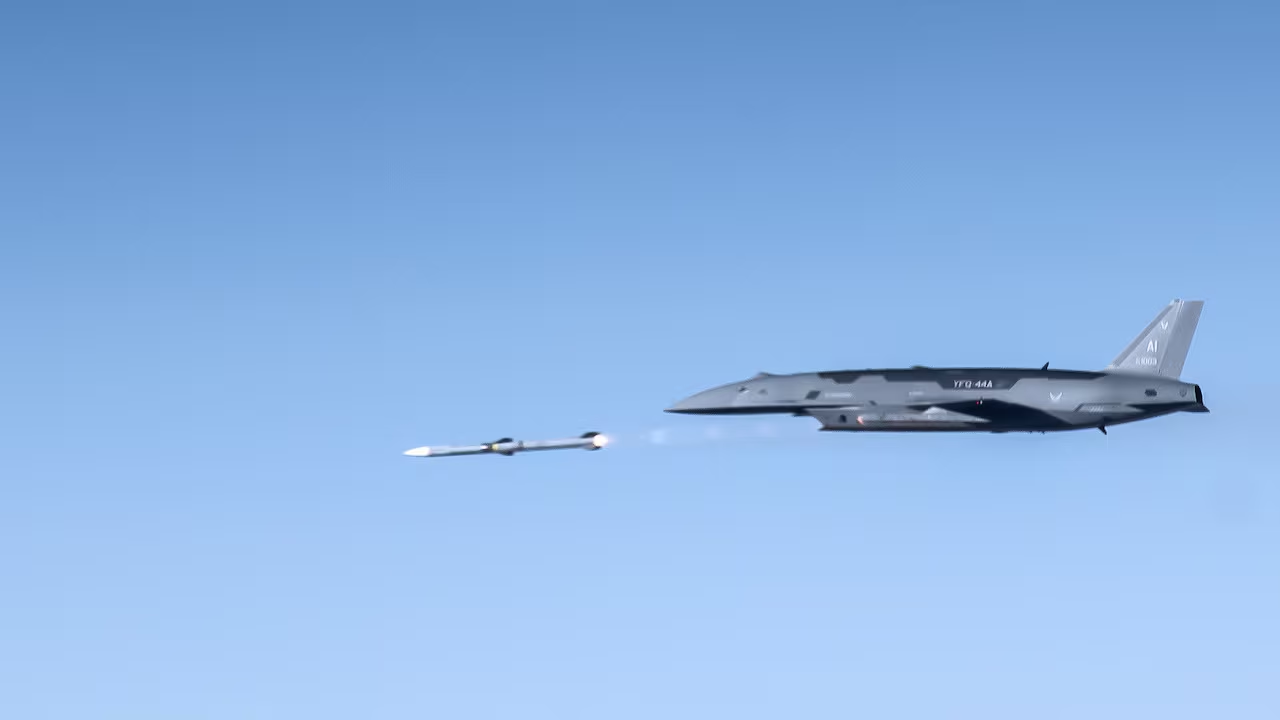
一架YFQ-44A协同作战飞机于7月在加利福尼亚州莫哈韦沙漠上空隐蔽空域的实弹测试中发射了一枚空对空导弹。
A YFQ-44A Collaborative Combat Aircraft fires an air-to-air missile in a live-fire test in secluded airspace over California's Mojave Desert in July.
这架无人机外形酷似一架小型战斗机。人工智能在驾驶它,并由它发射导弹。人类批准了射击,但执行的是人工智能。这并非科幻小说。它可能是现代战争的未来。
The drone looks like a small fighter jet. Artificial Intelligence is flying it, and it's firing a missile. A human approved the shot, but AI carried it out. That's not science fiction. It may be the future of modern warfare.
7月,美国国防公司Anduril的YFQ-44A无人机(代号“狂怒”)在加利福尼亚州莫哈韦沙漠向模拟目标发射了一枚空对空战术导弹。10月,一名驾驶F-22战斗机的飞行员成功让该无人机执行了模拟战斗任务。
In July, American defence company Anduril's YFQ-44A drone, known as Fury, fired an air-to-air tactical missile at a simulated target in California's Mojave Desert. In October, a pilot in an F-22 fighter jet was able to get the drone to carry out simulated combat tasks.
这是全球自主武器竞赛的最新一步,各国军队试图借此获取战术优势。
It's the latest step in the global race for autonomous weapons as armies try to gain a tactical edge.
随着各国政府日益将人工智能融入军事软硬件,加拿大面临一个问题:尽管存在法律和伦理担忧,它是否应加入自主武器竞赛,开始加大对人工智能增强型武器的投资?“植入致命平台的人工智能”YFQ-44A是一种协同作战飞机(CCA),设计用于伴随有人战斗机飞行。其旨在延伸战斗机的作战半径,同时降低飞行员风险。该无人机将利用人工智能执行许多战斗机任务,包括根据指令发射武器,并最终参与近距离空战。
With governments increasingly integrating AI into military software and hardware, Canada faces a question: should it join the autonomous arms race and start investing more in AI-enhanced weapons despite legal and ethical concerns? 'AI in a platform that is deadly' YFQ-44A is a collaborative combat aircraft (CCA), designed to fly alongside manned fighter jets. It's meant to extend the jet's reach, while reducing risk to the pilot. The drone would use AI to carry out many fighter jet tasks, including firing weapons on command and eventually engaging in close aerial combat.
“这是一个致命平台,你正在把人工智能装进去,”伊万·布隆丹(Yvan Blondin)说。他于2012年至2015年担任加拿大皇家空军司令。
"You're getting artificial intelligence in a platform that is deadly," said Yvan Blondin, who commanded the Royal Canadian Air Force from 2012 to 2015.
渥太华无人机制造商为国防预算增加做准备 随着加拿大国防开支增加,伦敦企业对机遇感到兴奋 布隆丹认为,到2030年代,这些无人机将成为现代军队不可或缺的一部分。
Ottawa drone makers tool up for increased defence budget As Canadian defence spending ramps up, London firms excited about opportunities Blondin believes these drones will become integral to modern militaries by the 2030s.
美国有两款原型机,包括“暴怒”(Fury)。澳大利亚拥有一款波音制造的协同作战飞机(CCA)——并且正在研发由安德鲁尔(Anduril)制造的水下版本。英国正投入50亿英镑,以提升其军队的无人机和自主系统能力。
The U.S. has two prototypes including Fury. Australia has a Boeing-built CCA— and they're working on an underwater version built by Anduril. The U.K. is spending five billion pounds to boost drones and autonomous systems in their military.
西方军队表示,人类将继续掌握控制权,并对使用致命武力的武器负责:这是北约负责任使用人工智能政策的一部分。
Western armies say humans will stay in control and responsible for weapons using lethal force: it's part of NATO's policy on responsible use of AI.
加拿大官员告诉加拿大广播公司(CBC),战争必须始终是一项根本上的人类事业,并表示没有任何机器、武器系统或算法代码能为遵守国际人道法负责。但布隆丹说,其他对手可能不会等待。
Canadian officials told CBC that warfare must stay a fundamentally human endeavour, and said that no machine, weapons systems or algorithmic code can be held responsible for complying with International Humanitarian Law. But Blondin says other adversaries may not wait.
如果一个国家在冲突中使用自主人工智能,布隆丹想知道其他国家会如何反应——它们会提高道德标准,还是完全放弃?“战时,中国会在乎‘人在回路’这一环节吗?”他问道。
If one country uses autonomous AI in a conflict, Blondin wonders how other countries would respond — would they raise their ethical standards, or drop them entirely? "In times of war, would China bother with the step of having a human in the loop?" he asked.
加拿大的角色 在发给加拿大广播公司新闻的一份声明中,国防部表示,加拿大皇家空军正在研究这些系统对加拿大可能的用处,但尚未就是否采购协同作战飞机做出决定。
Canada's role In a statement sent to CBC News, the Department of National Defence said the Royal Canadian Air Force is examining how these systems could be useful for Canada, but that no decision has been made about plans to procure CCAs.
加拿大武装部队支持自主功能的开发,声明称,前提是必须“在负责任的人类指挥和控制链条内运作,并承诺维护此类武器系统的可靠和合法使用。” 军事指挥官誓言在人工智能和机器人领域迅速行动,认为加拿大拥有“未被开发的潜力” 在加拿大的无人机“沙盒”竞赛中,公司角逐100万加元奖金 加拿大没有协同作战飞机,但Dominion Dynamics首席执行官Eliot Pence想要改变这一现状。
The Canadian Armed Forces supports the development of autonomous functionality, the statement said, on the condition that it would be "operated within a responsible chain of human command and control and commits to uphold the reliable and lawful use of such weapon systems." Military commander vows fast action on AI and robots, sees 'untapped potential' for Canada In Canada's drone-killing 'Sandbox,' companies compete for a $1M prize Canada has no collaborative combat aircraft, but Dominion Dynamics CEO Eliot Pence wants to change that.
他的防务技术公司正在研制“Scout”(侦察兵),这是一种协同作战飞机,将在有人驾驶战机前方飞行,每架战机搭配三到四架无人机,超越雷达探测边缘——并具备通过发射导弹等武器实施打击的能力。
His defence technology company is building Scout, a CCA that would fly ahead of a crewed fighter, three or four drones per jet, beyond the radar's edge — and be able to strike by firing a weapon, like a missile.
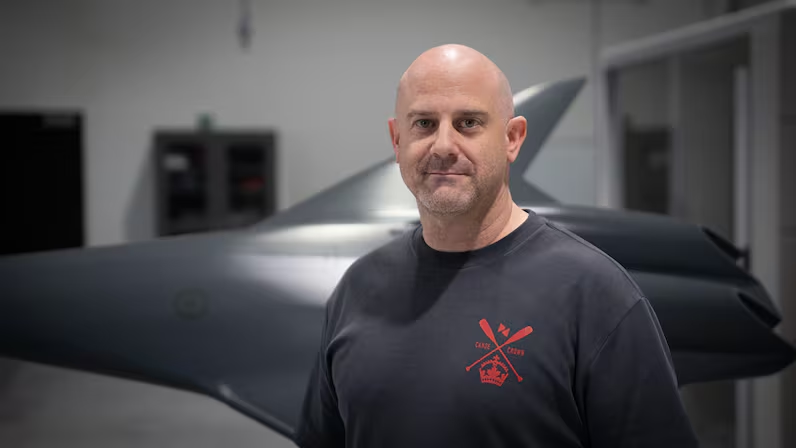
Dominion Dynamics首席执行官Eliot Pence站在Scout亚比例模型前,Scout是该加拿大防务技术公司正在研制的一种协同作战飞机。Scout将在有人驾驶战机前方、超越其雷达探测边缘飞行,并具备通过发射导弹等武器实施打击的能力。
Dominion Dynamics CEO Eliot Pence stands in front of a subscale model of Scout, a collaborative combat aircraft that the Canadian defence technology company is building. Scout would fly ahead of a crewed fighter beyond the edge of its radar and be able to strike by firing a weapon, like a missile.
Pence曾在Anduril工作,他表示,对协同作战飞机的需求关乎主权,特别是北极地区的主权,北极地区约占加拿大领土的40%。Pence认为,加拿大没有足够的战斗机覆盖所有这些领土,这在加拿大执行情报、监视和侦察的能力方面留下了空白——Dominion正试图填补这一空白。
Pence, who previously worked at Anduril, says the need for CCA is about sovereignty, especially over the Arctic, which makes up about 40 per cent of Canada. The country doesn't have the fighter jets to cover all that territory, Pence argues, noting that leaves a gap in Canada's ability to carry out intelligence, surveillance and reconnaissance — a gap Dominion is trying to fill.
“最高效、技术最先进的方法是将这些战机与自主系统配对。”如果渥太华采购,Dominion将受益。
"The best, most efficient and technologically advanced way of doing that is by pairing those jets with autonomous systems." Dominion stands to benefit if Ottawa buys in.
Pence表示,他已筹集到建造原型机所需5亿加元资金的约三分之一,虽然渥太华已采购了Dominion的仿真平台,但尚无政府原型机合同。“我们不在乎。我们反正要造出来。” 在边界内构建彭斯表示,Dominion 希望由人类仍然作为无人机的最终决策者,并将这一边界构建进其 AI 模型的决策逻辑中。
Pence says he's raised about a third of the $500 million needed to build the prototype, and though Ottawa has bought into Dominion's simulation platform, there's no government contract for a prototype. "We don't care. We're going to build it anyway." Building in boundaries Pence says Dominion wants a human to remain the last decision maker for the drone, and is building that boundary into the decision-making of its AI models.
但他们尚未弄清所有这些保障措施具体会是什么,Dominion 航空航天工程高级副总裁 Benoit Breault 说。
But they have yet to figure out what, specifically, all those safeguards would be, says Benoit Breault, senior vice-president for aerospace engineering at Dominion.
Breault 表示,有些边界很直观——例如,任何武力使用都将需要人工批准。
Some boundaries are straightforward, Breault says — for example, any use of force will require human approval.
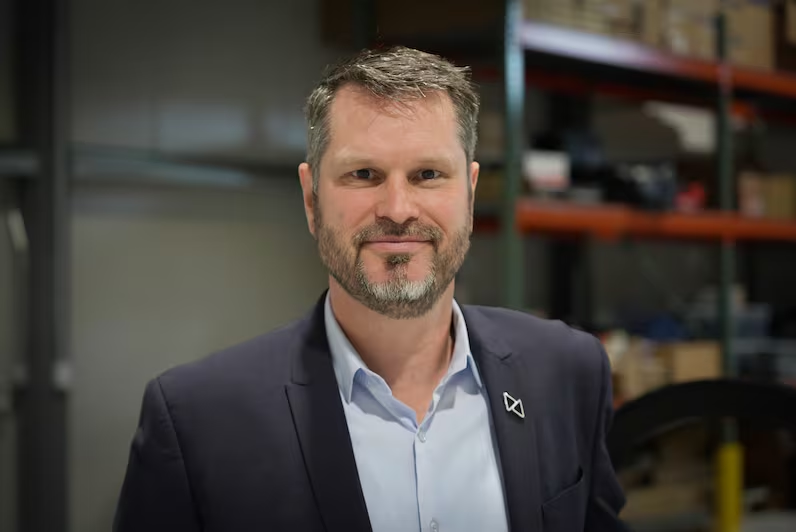
Dominion 航空航天工程高级副总裁 Benoit Breault 正在致力于保障措施,以确保他们想要建造的无人机由人类作为最终决策者。
Benoit Breault, senior vice-president for aerospace engineering at Dominion, is working on safeguards to make sure a human is the last decision maker for the drone they want to build.
其他边界乍看之下可能似乎不那么关键,但可能变得意外地危险。例如,如果工程师希望无人机返航,AI 能否决定走什么路线?
Other boundaries may seem less critical at first blush, but can become unexpectedly dangerous. For instance, if engineers want the drone to return home, can AI decide what route to take?
“你不希望直接穿越危险环境或争夺空域返航,”Breault 说。
"You don't want to return to base straight into dangerous environments or contested airspace," Breault said.
他还在思考如何避免让飞行员不堪重负。来自三四架无人机的过多信息可能会让飞行员难以保持对 CCA 的控制。无人机和 AI 正在改写海战规则——后果未卜但目前,Breault 承认人机界面的开发仍处于“胚胎期”。
He's also thinking about how to avoid overwhelming the pilot. Too much information from three or four drones could make it difficult for the pilot to maintain control of CCAs. Drones and AI are rewriting the rulebook on naval warfare — with uncertain consequences But right now, Breault acknowledges development of the human-machine interface is still "embryonic."
他说,他们仍在试图确定重要问题的答案,例如:“我们究竟将如何向战机飞行员提供信息?决策建议究竟将如何显示。”充分的人类控制这些细节是关于自主武器系统伦理担忧的核心,前加拿大海军军官、武装冲突法专家、在堪萨斯州托皮卡的 Washburn University 任教的 Craig Martin 说。
He says they're still trying to determine answers to important questions like, "How exactly are we going to provide information to the fighter jet pilots? How exactly are the decision recommendations going to be displayed." Adequate human control These details are central to ethical concerns about autonomous weapons systems, says Craig Martin, a former Canadian navy officer and an expert in armed conflict laws who teaches at Washburn University in Topeka, Kan.
“这是个百万美元的问题,”他说。“对该武器系统所行使的人类控制,其程度和性质究竟是什么?”马丁担心自动化偏见——即人类过度信任机器,尤其是在例如仅有几秒钟反应时间的情况下。马丁表示,如果人工智能系统用于其未经过训练的环境中,也可能失效。例如,为在阿富汗使用而训练的系统,若用在乌克兰可能会出错。
"This is the million dollar question," he said. "What is the extent and the nature of the human control that's being exercised over that weapon system?" Martin is worried about automation bias — where humans put too much trust in the machine, especially if, for instance, they have just seconds to respond. Martin says AI systems can also fail if they're used in environments where they weren't trained. For instance, a system trained for use in Afghanistan could make mistakes if it's used in Ukraine.
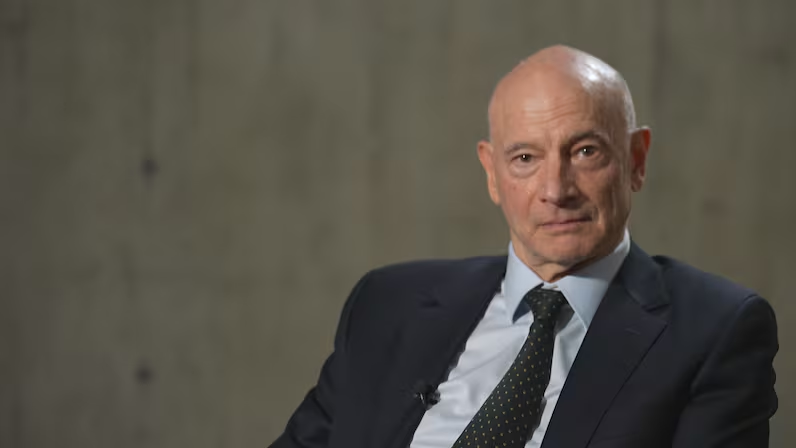
他说,此类错误“实际上可能在呈指数级的反馈循环中累积,导致偏见,进而可能造成平民伤亡”。本月,外交官将在日内瓦会晤,探讨各国是否愿意就管辖自主武器使用的规则展开谈判。前加拿大海军军官、武装冲突法专家克雷格·马丁希望加拿大引领这一对话。
Such errors, he says, "can actually compound in sort of exponential feedback loops that result in biases that can possibly lead to the killing of civilians." This month, diplomats will meet in Geneva to see if countries want to enter into negotiations about rules governing the use of autonomous weapons. Craig Martin, a former Canadian navy officer and an expert in armed conflict laws, wants Canada to lead that conversation.
联合国秘书长古特雷斯希望在2026年底前达成一项关于自主武器的具有法律约束力的条约。
UN Secretary-General António Guterres wants a legally binding treaty on autonomous weapons by the end of 2026.
古特雷斯在8月重申了这一呼吁,此前一个月,《纽约时报》报道称,一架无人操作的俄罗斯无人机在乌克兰击毙了三名平民。据报道,该无人机是一种廉价、可消耗的武器,能自主选择目标。它属于不同于CCA(协同作战飞机)的另一类别,但这类无人机和CCA都具备足够的自主性,能够自行做出部分决策。
Guterres renewed that call in August, a month after a Russian drone, acting with no human operator, killed three civilians in Ukraine the New York Times reported. The drone was reportedly a cheap, expendable weapon that picked its own target. It was in a different category from CCAs, but both that type of drone and CCAs are autonomous enough that they are able to make some of their own decisions.
马丁呼吁修改国际法,禁止完全自主武器,并限制半自主武器。本月,外交官将在日内瓦会晤,探讨各国是否愿意就管辖这些武器使用的规则展开谈判——马丁希望加拿大引领这一对话。
Martin is calling for changes to international law that would ban fully autonomous weapons and restrict semi-autonomous weapons. This month, diplomats will meet in Geneva to see if countries want to enter into negotiations about rules governing the use of these weapons — and Martin wants Canada to lead that conversation.
加拿大对2025年联合国决议投了赞成票,该决议呼吁各国为可能就管辖致命自主武器系统使用的条约进行谈判奠定基础。
Canada voted yes to a 2025 UN resolution calling on countries to lay the groundwork for possible negotiations on a treaty governing the use of lethal autonomous weapons systems.
加拿大国防部官员表示,加拿大将继续参与关于这些武器的国际谈判。加拿大还在增加国防开支,已承诺到2035年达到北约将国内生产总值(GDP)的5%用于国防的目标。
DND officials say Canada will continue to participate in international talks about these weapons. It's also ramping up defence spending, having committed to NATO's target of spending five per cent of GDP on defence by 2035.
无论加拿大是否采购自主武器,前加拿大皇家空军指挥官布隆丹表示,它们终将到来。“这是我们作为一个社会需要进行的讨论。”
Whether or not Canada buys in to autonomous weapons, Blondin, the former RCAF commander, says they're coming. "This is a discussion we need to have as a society."