数据中心会在大选后被取消吗?为什么我们不担心得克萨斯州?资本而非监管决定建设规模大选后,数据中心股票遭遇重挫。许多股票在三个交易日内跌去约三分之一,此前今年早些时候已从高点下跌 30% 至 40%。
Will data centers get canceled post the election? Why are we not worried about Texas? Capital, not regulation, determines the buildout Data center stocks were hit hard after the vote. Many lost about a third of their value in three trading days, on top of 30–40% declines from their peaks earlier this year.
周二,民主党赢得国会两院多数席位,以及得克萨斯州、佐治亚州和俄亥俄州的州长职位。投资者迅速将计划中数据中心有四分之一到一半永不建成的风险计入股价。我们认为现实要复杂得多。
Democrats won both chambers of Congress on Tuesday, along with the governorships of Texas, Georgia and Ohio. Investors quickly priced in the risk that a quarter to half of planned data centers never get built. We think the reality is much more nuanced.
首先,过去三年数据中心一直是美国经济增长和就业的最大驱动力之一。针对它们的抵制并非新事物。抵制主要来自希望确保减轻建设带来的任何负面影响(如电价上涨或环境破坏)的社区。一些社区完全反对数据中心,但这些地方的项目甚至不在可能建设的管线之中。
First, data centers have been one of the biggest drivers of U.S. economic growth and employment over the past three years. Pushback against them is nothing new. It mostly comes from communities that want to make sure to mitigate any negative impact associated with the buildout (e.g., higher electricity prices or damage to the environment). Some communities oppose data centers outright, but projects there aren’t even in the pipeline of likely builds.
其次,无论在美国还是全球,项目管线规模都远超我们预期的建设量。如果某州或社区增加监管障碍导致项目不具经济性,资金很可能会流向别处。大选最可能的结果是,尚未获批项目的经济性和时间表发生变化,而其他地方的产能将填补缺口。这在得克萨斯州最为关键,我们将在下一节详述。
Second, the project pipeline is enormous compared with what we expect to be built, in the U.S. and globally. If a state or community adds regulatory hurdles that make a project uneconomical, the capital will likely go elsewhere. The most likely outcome of the election is that economics and timelines change for some projects that aren’t yet approved, and capacity elsewhere fills the gap. This matters most in Texas, which we cover in the next section.
第三,也是最重要的,建设放缓应意味着 GPU 价格上涨和更强劲的硬件周期。我们认为这是大多数投资者忽视的。因为英伟达及产业链其他企业提前一年规划产能,提前一至两年锁定关键组件。
Third, and most important, a slower buildout should mean higher GPU prices and a stronger hardware cycle. We think this is what most investors are missing. That’s because NVIDIA and the rest of the value chain plan their capacity a year ahead and lock in critical components one to two years ahead.
看看 2027 年。我们追踪的管线约为 40 吉瓦,其中约 70% 已获许可且在建。即使只有 25 至 30 吉瓦投入运营,也比我们预期 2026 年的 12 至 14 吉瓦增长约 100%。
Look at 2027. We track a pipeline of roughly 40 GW, and about 70% of it is already permitted and under construction. Even if only 25-30 GW comes online, that’s roughly 100% growth from the 12-14 GW we expect in 2026.
相比之下,硬件的一个替代指标显示,市场共识预期其将增长约 70%,而公司表示是供应限制了增长。
Compare that with a proxy for hardware: consensus expects it to grow about 70%, and the company says supply is what’s holding it back.
到 2028 年,我们追踪的数据中心项目管线约为 60 GW。如果仅建成 35-40 GW,这在我们看来是一个保守假设,那么产能将增长约 35%,而市场共识预期英伟达的增长约为 30%。
In 2028, the pipeline we track is about 60 GW. If only 35-40 GW is built, which we see as a conservative assumption, capacity would grow about 35%, compared with consensus growth of about 30% for NVIDIA.
简而言之,硬件周期需要健康的数据中心项目管线,但最重要的是需求与可用供应的对比。这种平衡决定了 GPU 定价,进而决定了周期能持续多久。如果需求强劲,项目总能找到建设地点。
In short, the hardware cycle needs a healthy data center pipeline, but what matters most is demand vs. available supply. That balance sets GPU pricing and, with it, how long the cycle lasts. If demand is strong, the projects will find a place to be built.
我们的判断是:新法规会让数据中心更难建设?是的。这足以证明本周硬件股的抛售合理吗?我们不这么认为。在投票前租金就已上涨:H100 的租赁成本比 1 月高出约 35%,而其发布已有四年。建设放缓也会将硬件订单分散到更多年份,降低过度建设的风险。我们看到的是一个更长的周期,而非更短的周期。
Our read is new regulation making data centers harder to build? Yes. Is it enough to justify this week’s sell-off in hardware stocks? We don’t think so. Rents were climbing before the vote: an H100 costs about 35% more to rent than in January, four years after its launch. A slower build also stretches hardware orders across more years and lowers the risk of overbuilding. We see a longer cycle, not a shorter one.
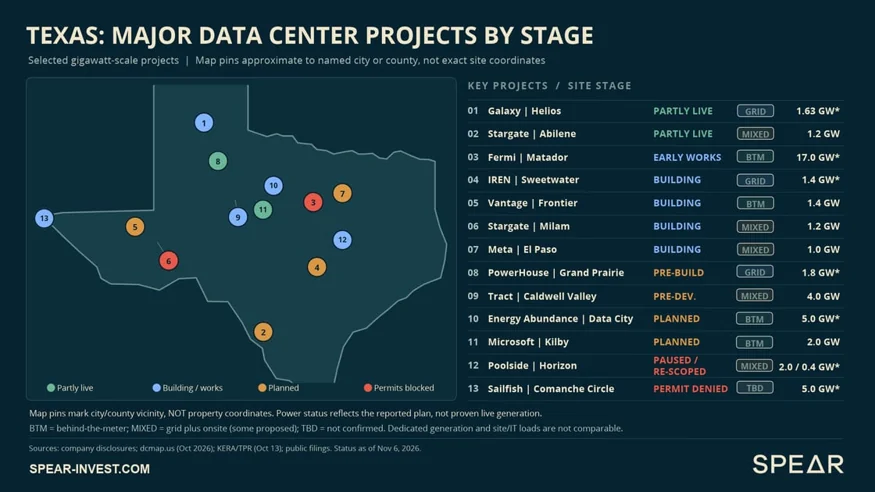
- 为什么我们不担心德克萨斯州?最大的负面反应针对德克萨斯州,该州拥有全美最大的数据中心项目管线:已宣布项目约 93 GW,几乎是弗吉尼亚州的三倍,接近 2028 年美国计划产能的 30%。
- Why Are We Not Worried About Texas? The biggest negative reaction was to Texas, which has the country’s largest data center pipeline: about 93 GW of announced projects, nearly three times Virginia’s, and close to 30% of the U.S. capacity scheduled for 2028.
但对数据中心的抵制并非新事物,无论中期选举结果如何,监管机构都会采取行动。
But pushback on data centers isn’t new, and regulators were going to act regardless of the midterm results.
今年早些时候,要求将新数据中心接入 ERCOT(服务于德克萨斯州大部分地区的电网运营商)的申请失控增长。到 2 月,排队的大负荷接入申请超过 230 GW。到 6 月,该数字已攀升至 438 GW 以上,其中近 90% 来自数据中心。
Requests to connect new data centers to ERCOT, the grid operator that serves most of Texas, got out of control earlier this year. By February, more than 230 GW of large-load requests were in the queue. By June, that number had climbed past 438 GW, nearly 90% of it from data centers.
作为背景,ERCOT 的历史峰值需求约为 85 GW,而目前德克萨斯州的数据中心仅使用约 10 GW。
For context, ERCOT’s all-time peak demand is around 85 GW, and data centers there use only about 10 GW today.
5 月我们与多家新云公司会面时,已经清楚 ERCOT 不会批准现有管线以外的新项目,因此这一切并非完全新鲜事。
When we met with several neocloud companies in May, it was already clear that ERCOT wasn’t approving new projects beyond the existing pipeline, so none of this is entirely new.
8月:州长格雷格·阿博特下令得州电力可靠性委员会(ERCOT)审查等待接入电网的大型数据中心,此举冻结了新的接入申请。
August: Gov. Greg Abbott ordered ERCOT to review large data centers waiting to connect, which froze new connections.
9月:他指示得州环境质量委员会(TCEQ)——该州的环境监管机构——在审查完成前停止发放数据中心许可证,预计审查将于12月中旬完成。
September: he told TCEQ, the state environmental regulator, to stop issuing data center permits until that review is done, expected in mid-December.
11月:民主党人吉娜·伊诺霍萨赢得州长选举。她将于1月19日就职,并承诺在立法者制定关于电力、用水和地方意见征询的规则前,暂停新建数据中心。
November: Democrat Gina Hinojosa won the governor’s race. She takes office on January 19 and has promised a moratorium on new data centers until lawmakers set rules on power, water and local input.
这三个步骤都回应同一组本地担忧:电网、电费、空气和水质。自行承担成本的项目最终仍应能获批,只是时间会推迟、成本会增加。
All three steps come back to the same local concerns: the grid, power bills, air and water. Projects that pay their own way should still get through, later and at a higher cost.
这将得州的项目管线一分为二。其中仅约五分之一、即19.5吉瓦处于在建状态,这些项目继续推进:Galaxy(盖勒克西)全资建设的Helios园区将于2027年第二季度开始向CoreWeave交付260兆瓦首期工程,Oracle(甲骨文)位于Shackelford的Stargate园区将于上半年开始交付。仍需为现场燃气电厂申请空气许可证的阶段——如Meta(美塔)的El Paso(埃尔帕索)园区——风险最大。
That splits the Texas pipeline in two. Only about a fifth of it, 19.5 GW, is under construction, and those projects keep moving: Galaxy’s fully financed Helios campus starts delivering a 260 MW phase to CoreWeave in the second quarter of 2027, and Oracle’s Stargate campus at Shackelford begins deliveries in the first half. Phases that still need an air permit for an on-site gas plant, such as Meta’s El Paso campus, are the most exposed.
在得州不再具备建设条件的项目,很可能会转向其他地方建设:其他州:弗吉尼亚州、宾夕法尼亚州和印第安纳州已有约20吉瓦在建。
Projects that stop making sense in Texas will likely be built elsewhere: Other states: Virginia, Pennsylvania and Indiana already have about 20 GW under construction.
其他国家:建设方正更认真地考虑北欧、加拿大和拉丁美洲,谷歌本周刚承诺向马来西亚投资150亿美元,用于2027至2028年的建设。
Other countries: builders are looking harder at the Nordics, Canada and Latin America, and Google committed $15 billion to Malaysia for 2027–28 this week.
风险在于时机,而非取消。我们的逐项目审查显示,仅有几吉瓦2027年的产能与得州许可证暂停直接相关;对于2028年,关键在于审批需要多长时间。政策制定者试图疏通一个超过400吉瓦的不切实际的排队队列,而非叫停建设热潮。
the risk is timing, not cancellation. Our project-by-project review ties only a few gigawatts of 2027 capacity to the Texas permit hold; for 2028, the question is how long approvals take. Policymakers are trying to clear an unrealistic queue of more than 400 GW, not to stop the buildout.
随着利率上升,赢家将是那些能筹集资金锁算力的公司。但资金可得性远不如上一轮科技周期那样紧张。
As interest rates rise, the winners will be the companies that can raise the capital to secure compute. But capital availability is nowhere near as stretched as it was in the last tech cycle.
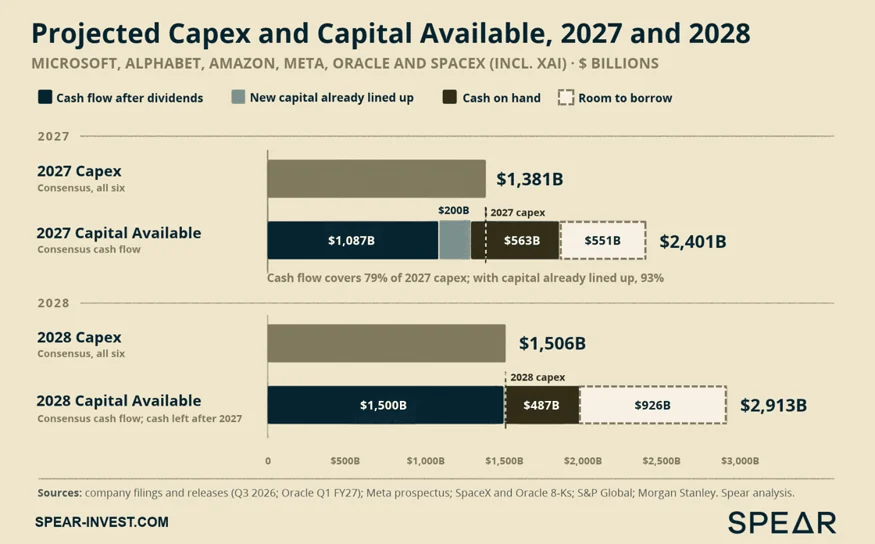
巨头企业产生大量现金流。虽然它们正在增加一些债务和股权融资以支撑本轮建设,但回报强劲,且已开始在业绩中体现。以下是未来两年的展望:2027年:我们预计将建成 25–30 吉瓦(GW),意味着投资约 1.0–1.2 万亿美元,按每吉瓦约 400 亿美元计算。资金将如何筹措?
The megacaps generate significant cash flow. And while they are adding some debt and equity to fund this leg of the buildout, the returns are strong and already showing up in their results. Here’s how the next two years look: 2027: the 25–30 GW we expect to be built implies roughly $1.0–1.2 trillion of investment, at about $40 billion per GW. How will it be funded?
微软、Alphabet、亚马逊、SpaceX 计划的资本支出合计 1.4 万亿美元,其中 79% 可由预期的股息后现金流覆盖,93% 可用已敲定的债务和股权融资覆盖。
$1.4 trillion of capex is planned across Microsoft Alphabet Amazon SpaceX 79% can be paid from expected cash flow after dividends, and 93% with the debt and equity already lined up.
Alphabet 和亚马逊:市场共识预期两家各自支出将超过 2000 亿美元,即便不计其他资本支出,也相当于每季度各新增逾 1 吉瓦产能。
Alphabet and Amazon: consensus has each spending more than $200 billion, which works out to over 1 GW of new capacity a quarter each, even before other capex.
据报道,Meta 计划 2027 年新增约 7 吉瓦,使其产能较 2026 年翻倍。
Meta reportedly plans to add about 7 GW in 2027, doubling its ‘26 capacity.
旨在 2027 年新增 10 吉瓦算力,并制定了最高可支持 20 吉瓦的雄心勃勃的供电与散热方案,但我们认为上限难以实现。
aims to add 10 GW of compute in 2027, with an ambitious power and cooling plan for up to 20GW, though we see the high end as a stretch.
2028年:我们预计将建成 35–40 吉瓦,意味着投资约 1.4–1.6 万亿美元,与当前预估一致:同六家公司的资本支出合计 1.5 万亿美元。
2028: the 35–40 GW we expect implies about $1.4–1.6 trillion, in line with current estimates: $1.5 trillion of capex across the same six companies.
约 100% 可由预期的股息后现金流覆盖,若算上现金储备和借贷额度,总可用资金约 2.9 万亿美元。
About 100% can be paid from expected cash flow after dividends, with about $2.9 trillion available in total once cash and borrowing capacity are included.
按计划建设 2028 年的全部 60 吉瓦需要约 2.4 万亿美元,远超任何公司的支出计划。管道项目并非都会落地,资金将决定哪些项目得以建设。
Building the full 60 GW scheduled for 2028 would take about $2.4 trillion, well beyond what anyone plans to spend. Not every project in the pipeline will be built, and capital will decide which ones are.
按我们的测算,资金足以支撑我们预期建成的规模。决定建设节奏的,是哪些项目值得投资。
On our math, the money is there for what we expect to be built. What sets the pace is which projects are worth funding.
资本决定建设节奏,最大建设方资金充裕。资金紧张的在于边缘环节,即依赖借贷的新型云服务商和开发商。我们预期价格将在反弹前企稳。我们看好受益于数据中心内部配置的业务,例如服务器内部光模块、面向 AI 智能体的 CPU 以及芯片制造设备,而非那些需要数据中心数量持续增加的业务。
capital sets the pace of this buildout, and the largest builders have plenty of it. Where money is tight is at the margin, among neoclouds and developers that depend on borrowing. We expect prices to stabilize before they rebound. We favor businesses that gain from what goes inside each data center, such as in-server optics, CPUs for AI agents and chipmaking equipment, over those that need the building count to keep rising.
政治与利率因素本周给投资者提供了两个更多抛售 AI 硬件的理由。这两个理由均未减少需求。
Bottom Line Politics and rates gave investors two more reasons to sell AI hardware this week. Neither reduces demand.
2027 年的大部分产能已在建设中,得克萨斯州的问题更多在于时机而非取消,而最大的建设方拥有的资本比其 2027 年计划所需多出约 1 万亿美元。投票可能放缓建设进度,但无法取消需求。
Most of 2027’s capacity is already under construction, Texas is a question of timing more than cancellation, and the biggest builders have about $1 trillion more capital than their 2027 plans need. The vote can slow the build. It can’t cancel the demand.
我们正在关注 得克萨斯州电网将于 12 月中旬进行的审查,以及许可暂停是否会在新州长于 1 月 19 日就职后持续超过审查期。
What We’re Watching Texas’s grid review in mid-December, and whether the permit hold outlasts it once the new governor takes office on January 19.
CoreWeave 将于 11 月 10 日发布业绩,可窥见租赁价格与借贷成本。英伟达将于 11 月 17 日发布业绩。
CoreWeave’s results on November 10, a read on rental prices and borrowing costs. And NVIDIA on November 17.