
向东南亚数据中心和人工智能芯片采购提供数十亿美元贷款的银行和私人信贷基金,正被迫面对一个长期担忧的场景:失去关键的中国客户。
Banks and private credit funds that lent billions to fund data centers and AI chip purchases in Southeast Asia are being forced to confront a long-feared scenario: the loss of critical Chinese customers.
周一,特朗普政府宣布了一项新规定,要求新加坡、马来西亚、印度尼西亚和泰国的数据中心运营商必须获得许可,方可采购美国制造的高端芯片。此举朝着堵住一个漏洞迈出了重要一步,该漏洞一直是促使中国对中国大陆以外算力需求的重要驱动因素。
On Monday, the Trump administration announced a new rule that would require data center operators in Singapore, Malaysia, Indonesia and Thailand to obtain licenses to purchase advanced chips made in the US. The change takes a significant step toward closing a loophole that has been an important driver of Chinese demand for computing power outside the mainland.
知情人士透露,近期的人工智能板块抛售潮已经让一些放贷机构对增加该行业的风险敞口感到不安,而新的限制措施则促使各方重新评估正在筹备中的交易。几位正在审查与中国包销商相关交易的银行家表示,他们已决定不参与或者正在将事情搁置。
The recent AI selloff had already made some lenders nervous about increasing their exposure to the sector and the new curbs have prompted a reevaluation of deals in the pipeline, according to people familiar with internal discussions. Several bankers who are reviewing deals tied to Chinese offtakers said they’ve decided not to participate or are putting things on hold.
加州大学伯克利分校哈斯商学院专注于人工智能研究的实践教授奥拉夫·格罗斯表示:“新闻头条讲的是芯片,但账单却落在了放贷机构头上。”他称,如果涉及中国客户,交易可能会变得更加难做,而且“可能会对总部设在美国以外、共享这些数据中心的客户产生连锁反应”。
“The headline is about chips, but the bill lands on the lenders,” said Olaf Groth, a practice professor at UC Berkeley Haas whose research focuses on AI. If Chinese customers are involved it could make it harder to do deals, he said, and there “may be a ripple effect to those customers sharing those data centers” headquartered outside the US.
中国公司可能被切断与东南亚数据中心联系的威胁长期以来一直悬在交易撮合者的头顶,但尽管存在风险,融资仍在继续。根据彭博社汇编的数据,亚太地区的数据中心公司自2023年以来已筹集了约490亿美元的贷款。客户合同经常被用来为这些交易提供担保,芯片本身有时也被用作抵押品。
The threat that Chinese companies could be cut off from Southeast Asian data centers has long loomed over dealmakers, but financing has continued despite the risk. Data center companies based in Asia Pacific have raised about $49 billion in loans since 2023, according to figures compiled by Bloomberg. Customer contracts were often used to secure those deals, with chips themselves sometimes used as collateral.
在许多情况下,这些客户包括中国科技公司。TikTok的母公司字节跳动有限公司向该地区两家最大的数据中心借款方——DayOne数据中心有限公司和桥数据中心租用算力。阿里巴巴集团控股有限公司在马来西亚向Megaspeed International Pte租用了算力,这家总部位于新加坡的新兴云服务商曾被美国指控向中国走私芯片。
In many cases, those customers include Chinese technology companies. ByteDance Co Ltd., the owner of TikTok, rents computing power from two of the region’s largest data center borrowers, DayOne Data Centers Ltd. and Bridge Data Centres. Alibaba Group Holding Ltd. rented compute in Malaysia from Megaspeed International Pte, the Singapore-based neocloud that’s been accused by the US of smuggling chips into China.
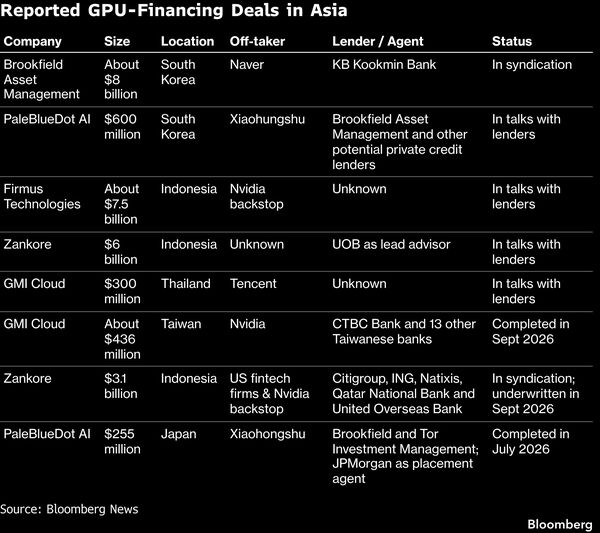
一家曾参与向美国新兴云服务商PaleBlueDot AI提供2.55亿美元贷款的放贷机构表示,其公司正在就规则变动寻求法律意见。这笔贷款用于购买将由中国社交媒体平台小红书使用的高端芯片。涉事数据中心位于日本,该国不受新规定约束,尽管限制措施的适用范围目前仍不清楚。知情人士称,其中一个调查方向是法律的此类变动是否会触发强制提前还款。
One lender that participated in a $255 million loan to PaleBlueDot AI, a US-based neocloud, for advanced chips that will be used by Chinese social media platform Xiaohongshu said their firm is seeking legal opinions on the rule change. The data center in question is in Japan, which isn’t subject to the new rule, though it’s still unclear how widely restrictions will be applied. One line of inquiry is whether such changes in law could trigger mandatory prepayment, the person said. PaleBlueDot AI did not immediately respond to an email sent outside their regular business hours.
在其正常营业时间之外发出的电子邮件未立即得到PaleBlueDot AI的回应。
“Data center financing may hit the brakes,” said Gary Ng, senior economist at Natixis.
法国外贸银行高级经济学家吴卓殷表示:“数据中心融资可能会踩刹车。人工智能投资的步伐可能会放缓,放贷机构将重新评估出口管制、数据主权、能源瓶颈和现金流的风险。”甚至在新的美国限制措施出台之前,一些融资交易就已经开始将进一步限制的风险考虑在内。据知情人士透露,在过去几个月中,用于购买将供中国客户使用的芯片的贷款一直在力求加入额外的保护措施,例如巨额终止费、更高的首付款和提前还款。
“The pace of AI investment may slow down, and lenders will reassess the risks of export controls, data sovereignty, energy bottlenecks and cash flows.”Even before the new US curbs, some financing deals had already begun to take into account the risk of further restrictions. Over the last couple of months, loans to purchase chips to be used by Chinese customers have sought to include extra protections such as hefty termination fees, higher upfront payments and early repayment, according to people familiar with the talks.
英伟达公司的合作伙伴GMI Cloud目前正寻求借款3亿美元,为其位于泰国的数据中心购买芯片,该数据中心将为中国科技巨头腾讯控股有限公司提供服务。彭博社看到的一份条款清单显示,该贷款的一项拟议契约规定,如果腾讯被列入美国受限方名单,GMI Cloud将被迫提前偿还全部金额。GMI Cloud未立即回应置评请求。
GMI Cloud, an Nvidia Corp. partner, is currently seeking to borrow $300 million to buy chips for its data center in Thailand that would service Chinese tech giant Tencent Holdings Ltd. One of the loan’s proposed covenants would force GMI Cloud to repay the entire sum early if Tencent is added to a US list of restricted parties, according to a term sheet seen by Bloomberg. GMI Cloud did not immediately respond to a request for comment. Still, the abrupt announcement on Monday caught many bankers by surprise.
尽管如此,周一的突发宣布还是让许多银行家感到措手不及。新体制将企业置于一个目前透明度极低的审批流程的摆布之下。
The new system puts companies at the mercy of an approval process that currently has little clarity. “A US license can now decide whether chips reach a site at all, and who they can serve,” said Anna Wu, an investment strategist and founder of Floodlines Research.
Floodlines Research创始人、投资策略师安娜·吴表示:“美国许可证现在可以决定芯片是否能够运抵某个站点,以及它们可以服务于谁。对于围绕中国租户建立的站点,借款人、租户和抵押品都面临着华盛顿方面的同一项决定。”
“For a site built around a Chinese tenant, the borrower, the tenant and the collateral are all exposed to the same decision in Washington.”