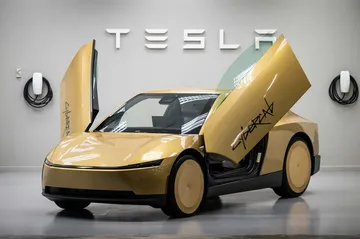
从某种意义上说,特斯拉的 Cybercab 是一款理想的产品。这是一款名义上的自动驾驶汽车,在一定程度上能在美国极小的一部分地区行驶;如果你做了被认定为“不当”的事情,特斯拉公司可以让它瘫痪;未经特斯拉许可,你不能将其作为 Robotaxi 用来赚钱。你不得转售你的 Cybercab,也不得对其进行改装,甚至连金色车漆都不行,而且特斯拉可以收集你在车内的一举一动的视频录像。此外,Cybercab 没有方向盘和踏板,所以正如人们所说,要么按特斯拉的方式来,要么别想上路。
Tesla’s cybercab is, in one sense, the ideal product. Here is a nominally autonomous vehicle that works, up to a point, in a bare sliver of the US; it can be rendered inoperable by Tesla Inc. if you do something deemed “improper”; and can’t be used to earn money as a robotaxi without Tesla’s permission. You aren’t allowed to resell your cybercab or modify it, even the gold paint job, and Tesla can collect video footage of whatever you’re doing in the car. Plus, the cybercab lacks a steering wheel and pedals, so it’s Tesla’s way or not the highway, as it were.
哪家车企不梦想说服人们先掏近 3 万美元,再每月付 299 美元,以换取准拥有这款车的“特权”?
Surely every automaker dreams of persuading people to hand over almost $30,000 upfront, and then $299 a month, in exchange for the privilege of quasi-owning that?
特斯拉从不缺乏大胆魄力。在承诺多年称特斯拉的普通车辆基本已准备好实现自动驾驶后,如今却要求人们为这种功能极其有限的自动驾驶版本支付数万美元外加订阅费,这还能怎么形容?Cybercab 的受邀专属销售活动看起来更像是冲着股市去的,而非车市。尽管如此,它有助于揭示一个更大的问题,这不仅关乎特斯拉,也关乎整个行业:Cybercab 到底是为谁而造?
Tesla never wants for audacity. How else to describe asking people to pay tens of thousands of dollars, plus subscription, for this extremely limited version of autonomy after promising for years that Tesla’s regular vehicles were essentially ready to drive themselves? The cybercab’s invite-only sales event looks geared more toward the stock market than the car market. Still, it helps surface a bigger question with implications not just for Tesla but the entire industry: Who exactly is the cybercab for?
车辆自动驾驶通常按两大商业模式来界定。一种是自动驾驶车队通过提供载人服务赚钱:Robotaxi。另一种是向个人出售自动驾驶汽车供自用。
Vehicle autonomy is generally framed in terms of two broad business models. One is where self-driving fleets make money by ferrying people around as a service: robotaxis. The other concerns selling self-driving vehicles to people for individual ownership.
作为车队无人驾驶出租车,Cybercab 的设计更合理,但有一个巨大的前提:只有当特斯拉最终能够部署一套能够大规模安全运行的自动驾驶系统时,这种设计才说得通。这种只有两个座位、没有任何控制装置的车身结构,更适合在城市中进行短途载客行程,而不适合那些需要车辆承担多种用途的人群。例如,特斯拉建议不要让青春期前的儿童乘坐这种车辆。缺少常规控制装置也意味着制造商成本更低,这对降低无人驾驶出租车的每英里成本至关重要。
The cybercab makes more sense as a fleet robotaxi, albeit with the giant caveat that it only makes sense if Tesla eventually manages to deploy a self-driving system capable of operating safely at scale. The form factor, with just two seats and no controls, is more suited to short urban trips for paying passengers rather than people who require a vehicle to serve multiple roles. Tesla recommends, for example, that you don’t put pre-teen children in one. The lack of regular controls also means lower costs for the manufacturer, critical to reducing robotaxis’ cost per mile.
如今,自动驾驶汽车几乎已成为无人驾驶出租车的代名词,尤其是在美国,主要车队运营商 Waymo LLC 据估计已在各城市部署了约 4000 辆车。然而,技术成本的下降 —— 这一整个产业建立的基础假设 —— 意味着无人驾驶出租车不可能是全部游戏。要想收回在自动驾驶领域投入的巨额资金,必须开拓尽可能广阔的可触达市场,而不能仅局限于城市和郊区的网约车用户。
Autonomous vehicles are synonymous with robotaxis today, particularly in the US, where dominant fleet operator Waymo LLC has an estimated 4,000 vehicles across cities. Yet falling costs for the technology — the foundational assumption on which this whole edifice rests — means robotaxis cannot be the whole ballgame. Making a return on the gargantuan sums being invested in autonomy necessitates tapping as wide an addressable market as possible, beyond just urban and suburban ride-hailers.
自动驾驶专家、风投公司 New Industry Management LLC 联合创始人 Alex Roy 长期主张开发“带有自动驾驶按钮”的私人拥有车辆,即保留手动控制装置,但在需要时具备自动驾驶能力。除了在自动驾驶系统陷入困境时,备用控制装置带来的安全收益外,Roy 认为私人拥有的车辆还提供了宝贵的选择性:你无法在无人驾驶出租车里存放孩子的安全座椅和运动装备,有时你也不想等车。此外,车辆不仅承载人和物品,还承载着更沉重的个人愿望和自我形象,尤其是在美国。
Alex Roy, an autonomy expert and co-founder of venture firm New Industry Management LLC, has long argued in favor of developing personally owned vehicles “with a self-driving button,” retaining manual controls but capable of autonomous operation when wanted. Besides the safety benefits of having backup controls when autonomous systems get stuck, Roy argues that personally owned vehicles come with valuable optionality: You can’t store your kids’ car seat and sports paraphernalia in a robotaxi, and sometimes you don’t want to wait for a ride. Plus, vehicles don’t just carry people and stuff but also heavier cargoes of personal aspiration and self-image, especially in the US.
虽然 Robotaxi(无人驾驶出租车)对任何能够提供安全且盈利服务的公司来说都是巨大的机遇,但更大的机遇可能在于为数百万辆私人拥有的车型提供自动驾驶“大脑”。“真正有趣的事情将发生在我们实现可靠的自动驾驶时,而不仅仅是这些可靠性的孤岛,”咨询公司 AlixPartners LLP 全球汽车市场负责人 Mark Wakefield 表示。对他来说,这将呈现“iPhone 时刻”,意指创造一个新颖的平台,从而催生新的市场细分领域,例如派遣私家车去取杂货,从而与亚马逊送货货车竞争。
While robotaxis represent a huge opportunity to anyone who can deliver a safe and profitable service, the bigger opportunity may lie in providing the self-driving brains for millions of personally owned models. “The really interesting thing will be when we get to reliable autonomy, not just these pockets of reliability,” says Mark Wakefield, global automotive market lead at AlixPartners LLP, a consultancy. For him, this would present “an iPhone moment” in the sense of creating a novel platform enabling new market segments, such as sending your privately owned vehicle to collect groceries, thereby competing with the Amazon delivery van.
我们距离那里还有很长的路要走,但车企、技术提供商和交通服务公司朝着这一目标汇聚的趋势是不可否认的。Waymo 与丰田汽车公司的合作便是一个重要例证,后者现在已准备将 Waymo 的硬件直接集成到其某款电动车型中。这部分是为了给 Robotaxi 运营商提供一款新的专用车辆。但这同时也为将更先进的驾驶辅助和自动驾驶系统装入一系列可面向公众销售的车型敞开了大门。
We are a long way from there, but the convergence of automakers, technology providers and transportation services companies toward that goal is undeniable. Waymo’s partnership with Toyota Motor Corp., with the latter now poised to integrate Waymo’s hardware directly into one of its electric models, is an important example. This is partly about providing the robotaxi operator with a new, dedicated vehicle. But it also opens the door to putting more advanced driver-assistance and autonomous systems into a range of vehicles that could be sold to the public.
特斯拉名义上当然已经在做这件事,但尚未攻克实际且至关重要的可扩展自动驾驶技术。与其向恰好住在得克萨斯州某些社区的粉丝,或者只是想在车道上摆放一件昂贵镀金艺术品的人出售 Cybercab(赛博出租车)这种噱头,更可靠的进步信号将是其他车企付费授权 FSD(Full Self Driving,全自动驾驶)用于其自身车型。对任何自动驾驶开发者而言,那才是真正的理想境界。
Tesla is nominally doing this already, of course, but hasn’t yet cracked the actual, and rather crucial, scalable autonomy bit. Rather than the gimmick of selling cybercabs to fans who happen to live in certain neighborhoods of Texas, or who just want a pricey gilded art installation in their driveway, a surer signal of progress would be some other automaker paying to license Full Self Driving for its own models. For any autonomy developer, that is the true ideal.