45亿年来,地球与宇宙的关系仅限于太空物质落向这颗行星。地球还是一堆小岩石时,靠着倾泻而下的岩石雨不断增大。后来,海洋中的水很可能由彗星和小行星带来,它们还输送了有机分子“起始包”,或许对生命起源至关重要。
For 4.5 billion years, Earth’s relationship with the cosmos involved only stuff falling onto our planet from space. Back when Earth was just a small pile of rocks, it grew thanks to torrents of additional rocks raining down upon it. Later, the water of our oceans was likely delivered by comets and asteroids, which also dispensed starter packs of organic molecules that may have been essential to getting life going.
而就在最近,地球扭转了这一方向。约70年前,人类将装有电子设备的小盒子——首批卫星——装入火箭发射入轨。如今,我们已将地球轨道塞得满满当当,并派遣机器人使者造访了太阳系的每一颗行星。我们甚至发射了探测器,它们终将飞出太阳的引力范围。
And then, just recently, Earth reversed the flow. About 70 years ago, humans packed small boxes of electronics—the first satellites—into rockets and blasted them into orbit. Now we’ve stuffed Earth’s orbit to the gills and visited every planet in the solar system with our robot emissaries. We’ve even sent out probes that will one day travel beyond the sun’s reach.
今天清晨5点15分左右,其中一艘探测器在边界上跨越了一个里程碑,距离家园达到一光日。旅行者1号早已比任何人造物体飞得更远。但它的这一光日之旅提醒我们:这颗行星上的生物不仅能够冲出边界,还能伸出手去触及让此处生命成为可能的宇宙。
This morning, around a quarter past 5, one of those probes crossed a milestone at that frontier, passing one light-day of distance from its home world. Voyager 1 had already traveled farther from Earth than had any other human artifact. But its light-day journey is a reminder that living beings on this planet are capable of not only escaping its boundaries but also reaching back out to the universe that made life here possible.
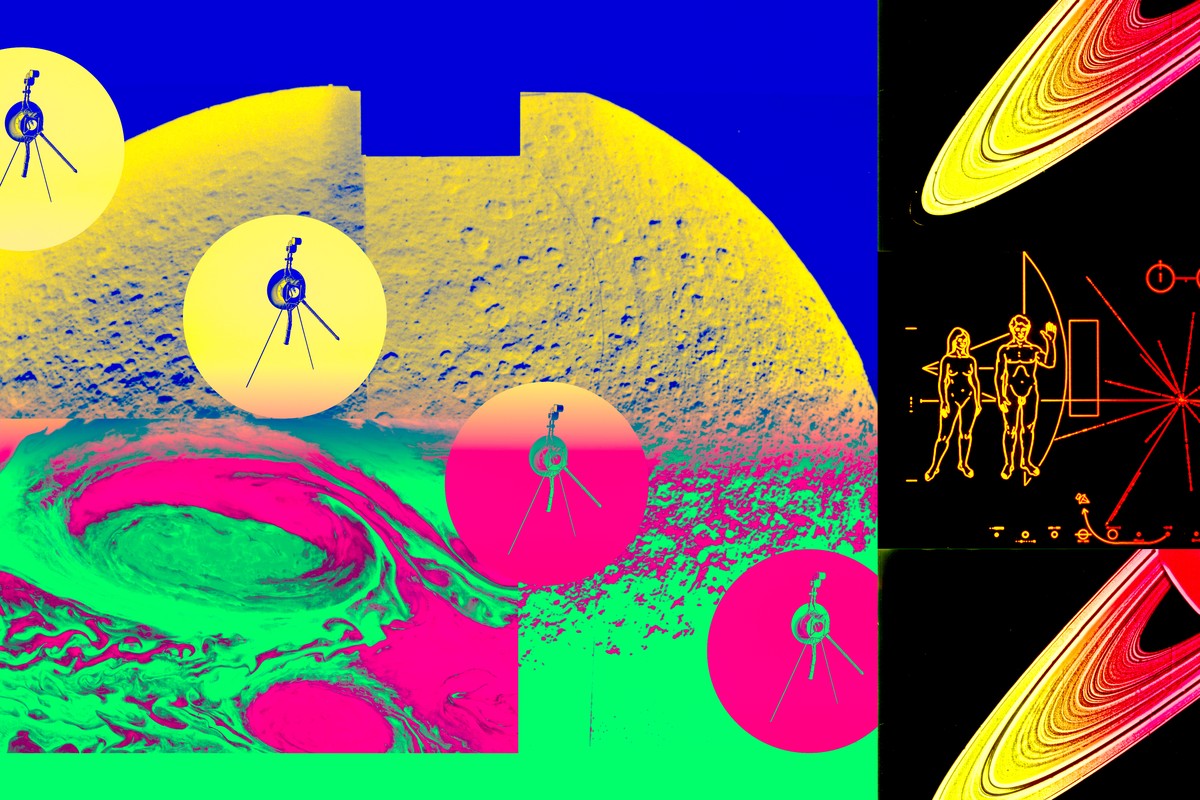
“旅行者1号”花了近50年才飞越这段距离,约合160亿英里。1977年,美国宇航局发射了这艘飞船及其姊妹飞船“旅行者2号”,以完成对外太阳系的“大巡游”,当时外太阳系基本上仍未被探索。“旅行者”号探测器传回的关于木星、土星、天王星和海王星的图像具有开创性意义。但要让“旅行者”号飞那么远,就意味着它们永远无法返回,只能踏上进入星际空间的无尽旅程。
Voyager 1 took nearly 50 years to cover that distance, which is about 16 billion miles. NASA launched the craft and its twin, Voyager 2, in 1977 to complete a “Grand Tour” of the outer solar system, which was at that point largely unexplored. The images the Voyager probes sent back of Jupiter, Saturn, Uranus, and Neptune were groundbreaking. But getting the Voyagers out that far meant that they could never come back and would instead embark on an endless journey into interstellar space.
万一有人偶然遇到这两艘孤独的飞船,每艘都携带了“金唱片”,一张刻有地球声音的金属唱片,其中包括55种语言的问候语和查克·贝里的《Johnny B. Goode》。“旅行者”号探测器正飞往太阳系之外,在那里,天文学家以光——宇宙中速度最快的东西——在给定时间内传播的距离来衡量距离。例如,到其他恒星的距离以光年计算,每一光年近6万亿英里。
In case anyone ever came across the lonely crafts, each one carried the “Golden Record,” a metal LP inscribed with sounds from Earth, including greetings in 55 languages and Chuck Berry’s “Johnny B. Goode.”Outside the solar system, where the Voyager probes are headed, astronomers measure distance in terms of how far light—the fastest thing in the universe—travels in a given interval. The distance to other stars, for example, is measured in light-years, each of which is almost 6 trillion miles.
面对这样的数字,人的头脑会变得迟钝;一光年相当于绕地球飞行2亿多次。然而,真正令人惊叹的是:从宇宙尺度上说,一光年甚至无法让你到达我们的近邻。最近的恒星半人马座阿尔法星距离我们约4.5光年。在我们称之为银河系的这座巨大星城中,大多数其他太阳距离我们自己的太阳有数百、数千甚至数十万光年。
The mind withers before such numbers; a light-year represents more than 200 million flights around the Earth. Here, however, is the real kicker: One light-year doesn’t get you to even our next-door neighbor, cosmically speaking. The closest star, Alpha Centauri, is about four-and-a-half light-years away. Most other suns in the vast city of stars we call the Milky Way are hundreds, thousands, or even hundreds of thousands of light-years from our own.
科学家和科普作家有时会说,旅行者1号(它比旅行者2号稍微领先)是第一个离开太阳系的太空探测器,但按最严格的标准衡量,一光日的距离仍远在地球家园的边界之内。早在2012年,旅行者1号就穿越了日球层顶,那是所谓的太阳风——从太阳表面流出的粒子流——与太阳系正飞行穿越的星际气体原子之间的边界。这是一个重要的边界,但并非真正的太阳系尽头。
Scientists and science writers sometimes say that Voyager 1 (which travels slightly ahead of Voyager 2) is the first space probe to leave the solar system, but by the strictest measure, one light-day is still well within the boundaries of Earth’s home. Back in 2012, Voyager 1 crossed the heliopause, the boundary between the so-called solar wind of particles streaming off the sun’s surface and the interstellar gas atoms the solar system is flying through. It’s an important boundary, but not really the end of the solar system.
这一荣誉属于奥尔特云,它是由冻结的彗星核组成的球壳,界定了太阳引力帝国真正的外部疆域。视测量方式而定,奥尔特云始于距地球约20光日处,外缘延伸至近600光日。在此背景下,旅行者1号刚刚勉强走到我们宇宙家园的门口。
That honor rests with the Oort cloud, a shell of frozen comet hearts that defines the true outer wards of the sun’s gravitational empire. Depending on how you measure it, the Oort cloud begins at about 20 light-days from Earth and extends to almost 600 light-days at its outer reaches. In this context, Voyager 1 has barely made it to the front door of our cosmic house.
但仅盯着距离看,会遮蔽旅行者1号旅程的真正意义。请想一想:自最早的生物约35亿至40亿年前出现以来,地球上的每一个细胞都源于它之前的另一个细胞。我们星球上的生命形成了一条不间断的谱系,一个细胞将其活力与生存本领传递给下一个。我们人类喜欢为自己的聪明才智自鸣得意。我们探究了原子,发现了生命的蓝图,制造出能够摆脱地球引力暴政、最终连太阳引力也能摆脱的机器。
But focusing on distance alone obscures the real significance of Voyager 1’s journey. Consider that, ever since the very first organism appeared some 3.5 billion to 4 billion years ago, every cell on Earth has come from another cell before it. Life on our planet forms an unbroken lineage, one cell passing its vitality and know-how on to the next. We humans like to congratulate ourselves on how smart we are. We’ve probed the atom, discovered the blueprint for life, built machines that can escape not only Earth’s gravitational tyranny but, eventually, the sun’s too.
但这一切都要归功于我们之前那些无名的微小团块、爬行的海洋生物、以及巨大的毛茸茸的什么东西,它们每一个的存在都要归功于古老的太空碎片。
But we owe it all to the many nameless microscopic blobs, crawling sea things, and giant, furry whatevers that came before us, each of which owed its own existence to ancient space debris.
这意味着,旅行者1号跨越的每一个门槛,不仅是人类的成就,也是整个有生命星球数十亿年进程的成果。扭转物质向地球聚集的向下流动,并以微弱的向外推力回馈星际空间,可以看作是地球生物圈向宇宙发出的呼唤。如果生命在星光的海洋中普遍存在,那么或许许多生命实例都经历过属于它们自己的“旅行者1号时刻”,将各自的希望与感激符号发送至一光日之外。在这种情况下,旅行者1号的一光日旅程,或许能成为地球已准备好加入宇宙中其他智慧与感知群落的信号。
That means that every threshold Voyager 1 crosses is not just a human achievement but also the multibillion-year project of the entire living planet. Reversing the downward flow of accretion onto Earth and offering in return a small outward push toward the stars can be seen as Earth’s biosphere calling out to the universe. If life is common out there among the oceans of starlight, then perhaps many of its instantiations have had their own version of this Voyager 1 milestone, sending symbols of their own hope and gratitude a light-day away. In that case, Voyager 1’s light-day journey could serve as a signal that Earth is ready to join the universe’s other communities of sentience and wisdom.
在不到一个世纪的时间里,人类开启了希望漫长的向外拓展时代。作为一个物种,也是地球集体生命的代表,我们被驱使着去寻找家园星球之外的智慧,并将其传播至我们自身疆域之外。这或许是地球能向那个花费数十亿年滋养它的宇宙,献上的最伟大谢意。
In the span of less than a century, humans have initiated what will hopefully be a long era of expansion outward. As a species and as representatives of Earth’s collective life, we have been driven to search for sentience beyond our home planet and to spread it beyond our own borders. It is, perhaps, the greatest thanks Earth can offer to the universe that has spent so many billions of years nurturing it.