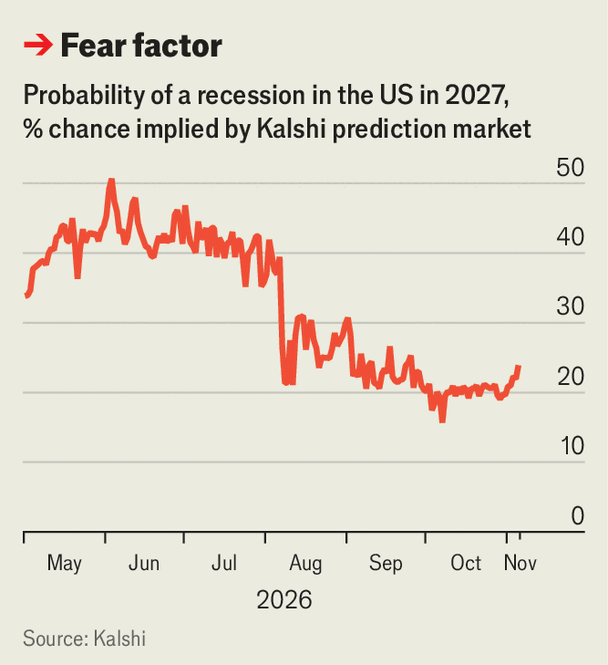
随着世界迈向2027年,市场观察人士比往常更加担忧。在任何一年,经济衰退的概率约为15%。但预测市场Kalshi认为,未来一年美国陷入衰退的可能性接近25%,而美国衰退可能拖累全球经济一同下滑。这可信吗?下一场危机又可能以何种形式出现?
As the world heads into 2027 market-watchers are more worried than usual. In any given year the chances of a recession are around 15%. But Kalshi, a prediction market, puts the chance in the coming year of a recession in America, which could take the global economy tumbling down with it, at nearly 25%. Is that plausible? And what form might the next crash take?
不妨先想想哪些因素可能不会引发下一场危机。近年来,一波又一波的冲击重创全球经济,但增长并未骤降。这表明下一场危机不会源自能源冲击:2026年霍尔木兹海峡关闭是自1970年代以来最大的此类冲击之一,却几乎没有影响全球增长。看来,各经济体如今对石油的依赖程度降低,也更加灵活。
Start by considering what probably won’t cause the next crisis. In recent years shock upon shock has battered the global economy. But growth has not nosedived. That suggests the next crash won’t be from an energy shock: the closure of the Strait of Hormuz in 2026 was one of the biggest such shocks since the 1970s, yet it barely affected global growth. Economies, it seems, are now less oil-dependent and more flexible.
贸易战可能也不会奏效。自2025年4月“解放日”大规模加征贸易壁垒以来,唐纳德·特朗普对关税的热情几乎未曾消退。当时,预测人士认为美国即将陷入衰退的概率高达三分之二。但结果,美国和全球GDP几乎完全延续了此前的趋势。随着特朗普的总统任期进入跛脚鸭阶段,他无论再征收什么新关税,大概都不会对全球经济造成更大震动。
A trade war probably won’t do the trick, either. Donald Trump’s enthusiasm for tariffs has hardly dimmed since his blitz of trade barriers on “Liberation Day” in April 2025. At the time, forecasters put the odds of an imminent recession in America as high as two-thirds. But in the event, American and global GDP stayed pretty much exactly on their earlier trend. Whatever new levies Mr Trump imposes as his presidency enters its lame-duck phase probably will not shake up the global economy much more.
即便是高利率这一经济衰退的长期诱因,看起来也不特别具有威胁性。经济学家鲁迪·多恩布什曾打趣说,美国的经济扩张不会因年迈而自然死亡,而是被美联储谋杀——手段就是加息。按此逻辑,美联储2022年和2023年的大幅加息,以及世界各地的类似举措,本应引发一场崩盘。但并没有,或许是因为对利率最敏感的部门(如制造业)在富裕世界经济中的重要性已大不如前。因此,2027年预计较为温和的加息不太可能对增长造成严重问题。
Even high interest rates, that perennial cause of recessions, do not look especially threatening. Rudi Dornbusch, an economist, once quipped that America’s economic expansions don’t die of old age, but are murdered by the Federal Reserve—with raised interest rates. On that basis, the Fed’s huge rate increases in 2022 and 2023, and similar moves around the world, ought to have caused a crash. But they did not, perhaps because the most interest-rate-sensitive sectors, such as manufacturing, are no longer so important to rich-world economies. So the more modest rate increases on the cards for 2027 are unlikely to cause serious problems for growth.
那还剩下什么?当今最大的经济风险大概是政府债务和人工智能。债务危机更为人们所熟悉。新兴市场多年来一直在应对这类危机。但富裕国家的政府,尤其是美国政府,如今借债规模惊人——相对于其经济规模而言,超过了战时或经济衰退前后以外的任何时期。一场波及美国国债的债务危机将产生巨大影响,而美国国债仍是全球的安全资产。富裕国家的债务水平已经让债券市场感到不适。
What does that leave? Today’s biggest economic risks are probably government debt and artificial intelligence. A debt crisis would be more familiar. Emerging markets have dealt with them for years. But rich-world governments, especially America, are now borrowing astonishing amounts—more, relative to the size of their economies, than at any point outside wartime or around recessions. The repercussions of a debt crisis embroiling American Treasuries, which remain the world’s safe asset, would be vast. Rich countries’ debt levels are already giving bond markets indigestion.
市场大多仍预计各国政府会自行解决问题并偿还债务(而不是通过通胀稀释债务或实施金融抑制)。但如果这一假设受到严重挑战,真正的问题就会开始——或许是因为选出了一个特别不负责任的政府,或者是因为债务堆积过多,偿债将变得过于痛苦。2027年的一个潜在催化剂可能是法国大选,目前民粹主义右翼在民调中领先。
Markets mostly still expect governments to sort themselves out and pay back their debts (and not by inflating them away or imposing financial repression). But real problems would start if that assumption were seriously challenged—perhaps if a particularly irresponsible government were elected, or if debts piled up so much that repayment would simply be too painful. One catalyst in 2027 might be France’s election, where the populist right is in the lead.
人工智能公司之间的融资联系正变得越来越循环、越来越复杂。那么人工智能呢?尽管这项技术是新的,但经济史提供了教训。一种情形是1987年,当时新颖的计算机化交易技术引发了一场剧烈、出人意料且全球性的股市崩盘。随着人工智能代理开始大规模交易,且方式混乱、可能难以解读,历史有可能重演。
The financing links between AI firms are getting ever more circular and complex What about AI? Although the technology is new, economic history offers lessons. One scenario is 1987, when then-novel computerised trading techniques spurred a sharp, unexpected and global stock-market crash. As AI agents start trading at scale, in chaotic and potentially uninterpretable ways, a reprise is possible.
另一个令人担忧的先例是2000年。从铁路到网站,革命性技术常常让市场陷入狂热。千禧年之交科技泡沫破裂时,暴跌的股市也拖累了更广泛的经济。与那个时期不同的是,人工智能公司的盈利正在激增,而不仅仅是估值越来越乐观。但如果竞争压缩利润率,或者人工智能的推广比预期更坎坷,这些盈利可能会回落。
Another worrying precedent is 2000. From railways to websites, revolutionary technologies often push markets into a tizzy. When the tech bubble burst at the turn of the millennium, plunging stocks dragged the wider economy down, too. In contrast to that period, AI firms have surging earnings, not just ever-more-optimistic valuations. But those earnings could return to earth if competition reduces profit margins, or if the AI roll-out proves bumpier than expected.
随后是 2008 年。起初,科技巨头利用其巨额收益和现金储备为 AI 提供资金。如今,它们转向了债务融资。尤其是“新云”企业,这些初创公司借入巨额资金为数据中心提供资金。AI 企业之间的融资联系变得愈发循环且复杂。这种建立在摇摇欲坠的债务之上的金融复杂化模式,在近 20 年前引发全球金融危机的抵押贷款市场麻烦中有着清晰的先例。
Then there is 2008. At first, technology giants funded AI from their vast earnings and cash piles. Now they have turned to debt. Especially leveraged are the “neoclouds”, upstarts borrowing huge sums to fund data centres. The financing links between AI firms are getting ever more circular and complex. That pattern of financial sophistication, built atop rickety debt, has a clear precedent in the mortgage-market troubles that helped kick off the global financial crisis nearly 20 years ago.
如果整个大厦所依赖的预期 AI 收入未能实现,或比预期晚到来,一些风险较高的借款人可能难以偿还债务。这反过来又可能冲击为它们提供融资的其他 AI 企业的资产负债表。混乱很容易像滚雪球一样蔓延。
If anticipated AI revenues that the whole edifice is relying on fail to materialise, or show up later than expected, some of those riskier borrowers may struggle to pay their debts. That, in turn, could hit the balance-sheets of other AI firms that are financing them. Chaos could easily snowball.
尽管如此,未来总有办法让人惊讶。下一次崩盘——无论它发生在 2027 年还是更晚,无论它与以往有何种家族相似之处——极有可能是完全不同的产物。■
Still, the future has a way of surprising. The chances are that the next crash—whether it comes in 2027 or later, and whatever family resemblances it shares—will be its own creature entirely. ■