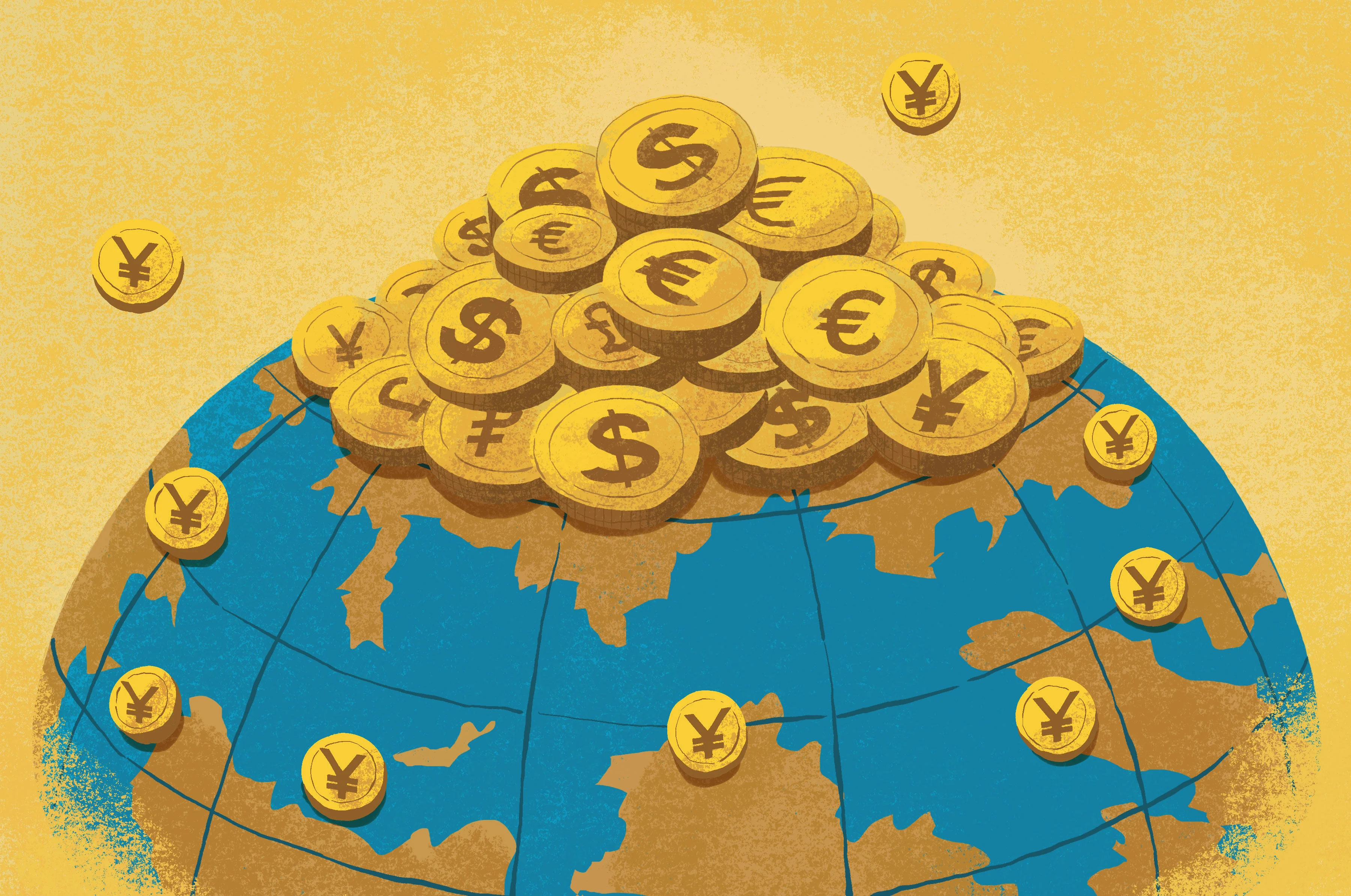
中国目前以人民币结算的贸易占比已接近30%,这既是北京方面的推动,也是基层贸易商主动增加使用该货币的结果。插图:Brian Wang会计师邵波(音)近日造访上海一家俄罗斯VTB银行分行时,惊讶地发现大厅里挤满了来自中国各地的出口商代表。
China now settles nearly 30 per cent of its trade in yuan as both Beijing and grass-roots traders push to increase use of the currency. Illustration: Brian Wang When accountant Shao Bo visited a branch of Russia’s VTB Bank in Shanghai recently, she was surprised to find the place was packed with representatives of exporters from all over China.
“大家都为了同一个目的:开设账户,以便接受俄罗斯买家的人民币付款,”她说。
“Everyone was there for the same purpose: setting up accounts to accept yuan payments from Russian buyers,” she said.
这“大家”里也包括邵波。她所在的上海公司生产并出口拉链,客户遍布亚洲各地的时装和服装企业。去年,公司新增了两家俄罗斯买家,并急于停止以卢布结算交易。
That “everyone” includes Shao. The company she works for in Shanghai produces and exports zips to fashion and apparel companies across Asia. The firm had started working with two new Russian buyers last year, and it was keen to stop settling transactions in roubles.
“几个月前,我们向俄罗斯客户提议改用人民币而非卢布付款,”她说。“我原以为还得经过一番谈判,但他们几乎没怎么推辞就同意使用人民币了。”
“Several months back, we proposed to our Russian clients that they pay in yuan rather than roubles,” she said. “I thought we might have some negotiations ahead, but they agreed to use yuan without much pushback.”
世界各地的企业都在做同样的转换,中国人民币正悄然却迅速地成为全球支付的热门货币。
Companies across the world are making the same switch, as the Chinese yuan quietly but rapidly emerges as a popular currency for global payments.
据中国社会科学院数据,五年前,中俄贸易仅有17%以人民币结算。到今年6月,这一比例已跃升至62%。
Five years ago, only 17 per cent of China-Russia trade was settled in yuan, according to data from the Chinese Academy of Social Sciences. By June this year, that figure had jumped to 62 per cent.
受美国制裁拖累的俄罗斯,在拥抱人民币方面走在前列。但人民币也在全面获得普及。
Russia, hobbled by US sanctions, is an outrider when it comes to embracing the yuan. But the Chinese currency is also gaining ground across the board.
据中国人民银行数据,今年上半年,中国跨境货物贸易近30%以人民币结算——比十年前的占比高出18个百分点以上。
Nearly 30 per cent of China’s cross-border goods trade was settled in yuan during the first half of the year, according to the People’s Bank of China – more than 18 percentage points higher than its share a decade ago.
是什么在推动这一增长?这一转变部分源于像邵波公司这样的中国基层出口商的主动推动,他们渴望规避外汇损失。
What is driving the increase? The shift is partly being driven by grass-roots Chinese exporters like Shao’s company, which are eager to avoid foreign exchange losses.
近几个月,离岸人民币对美元汇率稳步升值,十月份创下多项四年新高。上周,人民币兑美元约为6.65。
The onshore yuan has been steadily appreciating in recent months, notching several four-year highs against the US dollar in October. Last week, it was trading at about 6.65 per dollar.
“看来人民币可能会继续走强,使用人民币结算对我们的业务来说是自然的选择。”——上海一家出口公司员工邵波
It looks like the yuan will probably keep strengthening, so using yuan for settlement is a natural call for our businessShao Bo, employee at Shanghai-based export company
对于以美元或其他外币收款的中国出口商而言,人民币走强可能成为重大问题——在国内经济放缓、许多企业已面临严峻压力的情况下,利润空间被进一步压缩。
For Chinese exporters who are paid in US dollars or other foreign currencies, a stronger yuan can be a major problem – squeezing their margins at a time when many are already under severe pressure amid a domestic economic slowdown.
邵说:“客户不会弥补我们的外汇损失。看来人民币可能会继续走强,使用人民币结算因此成为我们业务的自然选择。”
“Clients won’t make up for our foreign exchange losses,” Shao said. “It looks to me like the yuan will probably keep strengthening. Using yuan for settlement is therefore a natural call for our business.”
这在邵所在的服装行业尤为明显。今年迄今为止,人民币已升值约4.6%,这一比例超过了该行业许多出口商的净利润率。
That is especially true in the apparel industry, where Shao’s firm operates. The yuan has gained about 4.6 per cent so far this year – a figure that exceeds the net profit margins for many exporters in the industry.
中国纺织服装协会数据显示,针织业2023年前九个月的平均利润率仅为3.58%。
The average profit margin in the knitwear sector, for example, was just 3.58 per cent in the first nine months of last year, according to the China National Textile and Apparel Council.
邵说:“纺织出口市场竞争激烈、残酷,这正是我们必须尽力防范外汇损失的原因。”
“Textile export markets are plagued by fierce, cutthroat competition,” Shao said. “That is why we need to try our best to guard against foreign exchange losses.”
与此同时,随着中国出口商在全球市场影响力提升,海外买家对以人民币付款的接受度也在提升。
Overseas buyers, meanwhile, are becoming more willing to accept demands to pay in yuan as China’s exporters gain greater influence in the global market.
张斌是上海固体器具有限公司的总经理,该公司设计、制造并出口不锈钢饮具,客户主要分布在欧洲。数十年来,欧元或美元结算是常态,但张最近实现了一个里程碑。
Zhang Bin is the general manager of Solidware, a Shanghai-based firm that designs, manufactures and exports stainless steel drinkware. Most of its customers are based in Europe. For decades, euro or US dollar settlement was the norm, but Zhang recently achieved a milestone.
“今年瑞典和奥地利的两名买家接受了人民币结算,”张说。“打动他们的是我们的产品:我们供应的产品拥有自主专利和独特设计。
[embedded media] “Two buyers in Sweden and Austria accepted yuan settlement this year,” Zhang said. “What won them over was our products – we own proprietary patents and unique designs for the items we supply.
“我们的技术优势和合理的定价,自然让我们在谈判桌上处于更有利的议价地位,”他补充说。
“Our technical edge and reasonable pricing naturally put us in a stronger bargaining position at the negotiating table,” he added.
邵也持同样看法。“就我们的俄罗斯客户而言,他们很难在价格和质量两方面找到比我们更有竞争力的供应商,”她说。
Shao echoed that view. “When it comes to our Russian clients, they struggle to find more competitive suppliers than us on both pricing and quality,” she said.
这一来自企业层面的趋势,与北京长期推动人民币国际化的努力相契合。
This ground-level trend dovetails with a long-term push by Beijing to internationalise the yuan.
据上海高级金融学院教授、东南亚中心执行主任胡捷介绍,中国一直在奉行“农村包围城市”的政策战略。
China has been following a policy strategy of “encircling cities from the countryside”, according to Hu Jie, professor and executive director of the Southeast Asia Centre at the Shanghai Advanced Institute of Finance.
在中国内战期间,共产党专注于在中央政府控制薄弱的地区建立农村根据地,积聚自身力量,然后才包围并夺取主要城市的控制权。
During the Chinese Civil War, the Communist Party focused on building rural bases in areas with weak central state control, consolidating their strength, and only then surrounding and seizing control of major cities.
胡捷认为,北京在推动人民币的全球使用上也采取类似路径:首先加强与全球南方各国的金融联系。
According to Hu, Beijing is following a similar approach in boosting global use of the yuan: first moving to strengthen financial linkages with countries across the Global South.
“归根结底还是经济实力,”胡捷说。“顺序是先从不那么发达的经济体以及与中国贸易联系紧密的国家开始,然后再转向发达国家。”
“This boils down to economic clout,” Hu said. “The sequence starts with less developed economies and countries with strong trade links to China, before moving on to developed ones.”A major target of China’s efforts has been the Association of Southeast Asian Nations (Asean) – China’s largest regional export market.
中国这一努力的一大重点目标是东南亚国家联盟(东盟),它是中国最大的区域出口市场。
[embedded media] “China and Asean rank as each other’s top trading partners, laying a foundation for financial connectivity,” Hu said.
胡杰表示,在广泛走访东南亚并与当地官员交流后,另一个推动关系深化的因素是:当地对中国的看法总体保持乐观,这与欧洲的情绪形成鲜明对比。
“Cross-border people flows are frequent, too. Put plainly, that creates another avenue for them to spend or even invest the yuan they hold.”Having travelled extensively across Southeast Asia and spoken with local officials, Hu said another factor was driving the deepening ties: local views of China remained broadly optimistic, a marked contrast to sentiment in Europe.
多个东盟经济体已将人民币纳入其官方外汇储备组合。与此同时,中国金融机构正在扩大在该地区的业务版图。
Several Asean economies have already incorporated the yuan into their official foreign reserve portfolios. Meanwhile, Chinese financial institutions are expanding their footprints in the region.
据官方数据,已有超过140家东盟机构接入中国的跨境银行间支付系统(CIPS),该系统使银行能直接以人民币清算和结算跨境支付。中国银行在每个东盟成员国都活跃开展业务。
More than 140 Asean institutions have connected to China’s Cross-border Interbank Payment System (CIPS), which enables banks to clear and settle cross-border payments directly in yuan, according to official data. Chinese banks are active in every Asean member nation.
北京中国银河证券首席经济学家张军表示,他预计人民币国际化将在该地区继续获得动力。
Zhang Jun, chief economist at Beijing-based China Galaxy Securities, said he expected yuan internationalisation to continue gaining traction within the region.
他指出:“随着全球地缘政治风险的溢出效应和贸易保护主义抬头,中国—东盟经贸合作的战略价值正在被重新定义。”
“With spillover effects from global geopolitical risks and mounting trade protectionism, the strategic value of China-Asean economic and trade cooperation is being redefined,” he noted.
人民币能走多远?中国人民银行行长潘功胜在10月中旬表示,结合CIPS和环球同业银行金融电讯协会(SWIFT)支付系统的数据,目前全球支付中有6%至7%以人民币结算——这使得中国货币成为全球第三大最受欢迎货币。
How far can the yuan go? Pan Gongsheng, governor of the People’s Bank of China, said in mid-October that 6 to 7 per cent of global payments are now settled in yuan – making the Chinese currency the third most popular worldwide – when figures from the CIPS and Swift (Society for Worldwide Interbank Financial Telecommunication) payment systems are taken together.
即便如此,分析人士警告称,人民币在贸易结算中的增长可能会触顶。
Even so, analysts cautioned that the yuan’s growth in trade settlement could hit a ceiling.
饮具出口商张军亲身体会到,该货币对某些买家的吸引力有限。他曾取得突破,说服奥地利和瑞典的客户以人民币付款,但此后未能延续这一势头。
Zhang, the drinkware exporter, has first-hand experience of the currency’s limited appeal for some buyers. He made a breakthrough by convincing clients in Austria and Sweden to pay in yuan, but he has since been unable to build on that momentum.
“要让更多发达经济体采用人民币,中国必须开放更多投资渠道。”上海高级金融学院胡杰说。
For more developed economies to adopt the yuan, China has to open up more investment avenuesHu Jie, Shanghai Advanced Institute of Finance
“一位欧洲买家告诉我,他拒绝了人民币结算,因为这种货币对他毫无用处,”张某说。“他不关注中国的金融开放或金融框架,觉得那太复杂了。
“One European buyer told me he turned down yuan settlement because the currency serves little purpose for him,” Zhang said. “He does not keep track of China’s financial opening-up or the financial framework, which he finds overly complicated.
“更重要的是,他在欧洲的最终客户也没有对人民币的需求,”他补充道。
“More importantly, his own end customers in Europe have no demand for yuan either,” he added.
据上海高级金融学院的胡某介绍,中国必须为外国投资者创造更多部署人民币资本的渠道,才能让他们更愿意接受这种货币。
According to Hu at the Shanghai Advanced Institute of Finance, China must create more channels for foreign investors to deploy yuan capital to make them more willing to accept the currency.
内地金融监管部门认识到这一动态,并已在2026年加大了主权债券发行力度。全年计划发行的国债供给已达840亿元人民币,比上年高出24%。
Mainland financial regulators recognise this dynamic and have ramped up sovereign bond issuance in 2026. The planned treasury bond supply for the year has reached 84 billion yuan, 24 per cent higher than a year earlier.
中国财政部本月还在加拿大发行了人民币绿色主权债券,标志着人民币计价主权债券首次在北美发行。然而,当人民币跨境流动时,根本性问题依然存在。
China’s Ministry of Finance also issued yuan green sovereign bonds in Canada this month, marking the first issuance of yuan-denominated sovereign bonds in North America. Yet, fundamental issues still arise when yuan flows across borders.
虽然海外投资者可以利用沪深港通和合格境外机构投资者(QFII)等渠道,但据胡某称,这些安排依然“繁琐”。它们受到“交易限额、投资工具种类狭窄以及对投资者可部署策略的限制”拖累。
While overseas investors can use channels such as the Stock Connect and qualified foreign institutional investor schemes, these arrangements remain “cumbersome”, according to Hu. They are held back by “trading limits, a narrow set of investment instruments and restrictions” on the strategies investors may deploy.
“人民币在国际贸易结算中的份额将继续上升,但存在上限,”胡某说。“核心制约在于货币尚未完全自由兑换。
“The yuan’s share in international trade settlement will continue to climb, yet there is an upper bound,” Hu said. “The core constraint is that the currency is not fully freely convertible.
“要让更多发达经济体采用人民币,中国必须开放更多投资渠道,”他说。“资本账户自由化仍未完成。”
“For more developed economies to adopt the yuan, China has to open up more investment avenues,” he said. “Capital-account liberalisation is still incomplete.”
板块:经济 / 中国经济 / 全球经济 | 话题:人民币、货币、中国、外汇市场、银行与金融、中国经济、中国贸易、贸易、货币战、深度关注、俄罗斯、全球南方、潘功胜短链接: 阅读《南华早报》原文
Sections: Economy / China Economy / Global Economy | Topics: Yuan, Currencies, China, Foreign exchange market, Banking & finance, China economy, China trade, Trade, Currency war, In Focus, Russia, Global South, Pan Gongsheng Short link: https://sc.mp/rysjr Read the original article on SCMP