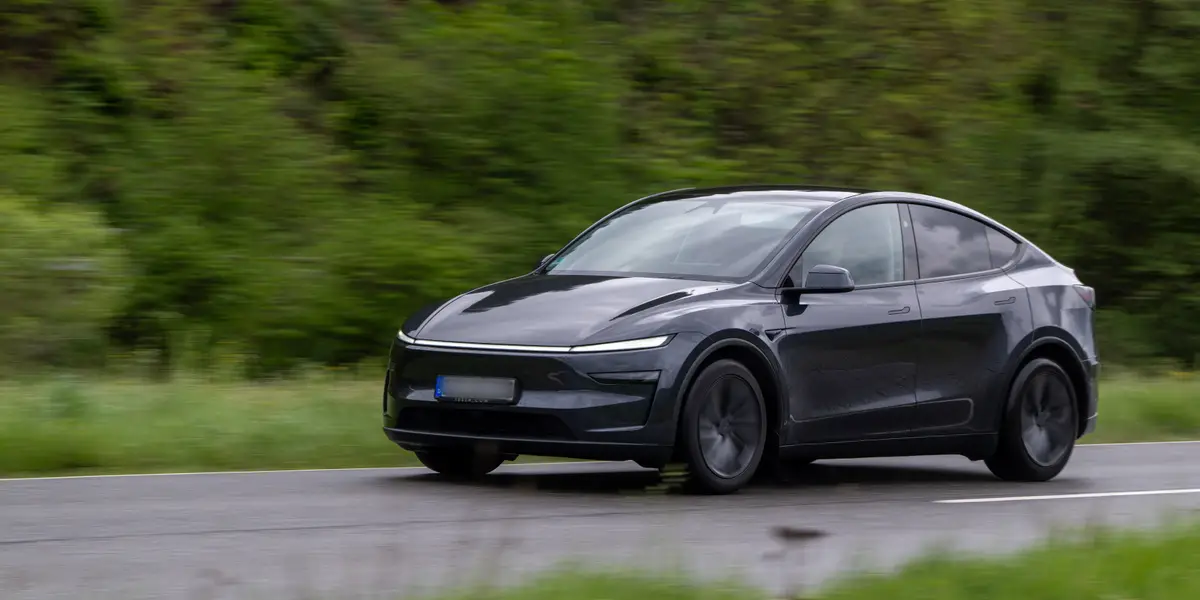
马斯克表示特斯拉将打造无方向盘的 Model Y 特斯拉标志(公共领域)来自 Wikimedia Commons 该计划将把 Cybercab 的无控制装置设计延伸至特斯拉现有的某款车型上 埃隆·马斯克表示,特斯拉将制造一款没有方向盘的自动驾驶 Model Y。
Musk says Tesla will build a Model Y with no steering wheel Tesla logo (public domain) via Wikimedia Commons The plan would carry the Cybercab's no-controls design over to one of Tesla's existing nameplates Elon Musk says Tesla will make an autonomous Model Y without a steering wheel.
从一款人们已经熟知的车型上移除方向盘,表明特斯拉希望无人驾驶设计能远远超越单一的小众产品。公司已经围绕这一理念打造过一款车型。马斯克现在将同一概念指向一个熟悉的车型名称。
Removing the steering wheel from a car people already know signals that Tesla wants driverless design to reach well beyond a single niche product. The company has already built one vehicle around that idea. Musk is now pointing the same concept at a familiar nameplate.
马斯克的表述 马斯克的表述很简短。特斯拉将生产一款自动驾驶版 Model Y,且该车将没有方向盘。
What Musk said Musk’s statement was brief. Tesla will produce a self-driving version of the Model Y, and it will have no steering wheel.
他并未给出上市日期、价格或生产基地。目前,自动驾驶版 Model Y 只是一个既定计划,而非拥有规格表的产品。
He did not attach a launch date, a price, or a production site to the claim. For now, the autonomous Model Y is a stated plan, not a product with a spec sheet.
Cybercab 先行 特斯拉已经尝试过一次。2024 年 10 月,公司发布了 Cybercab,这是一款没有方向盘和踏板的双座自动驾驶电动汽车。
The Cybercab came first Tesla has tried this once already. In October 2024, the company unveiled the Cybercab, a two-seat autonomous electric vehicle built without a steering wheel or pedals.
特斯拉将 Cybercab 定位为专用出租车。其定价被描述为约 3 万美元,公司设定的目标是利用纯视觉版的“完全自动驾驶”(FSD)系统实现无人监管自动驾驶。
Tesla presented the Cybercab as a purpose-built taxi. Its pricing has been described as roughly $30,000, and the company set a goal of unsupervised autonomy using a vision-only version of its Full Self-Driving (FSD) system.
Cybercab 的设计极简。它拥有双人座舱、一块中控触摸屏和向上开启的车门。它还被设计为仅在围栏区域内运行,即特斯拉已绘制地图并批准可行驶的区域。
The Cybercab’s design is minimal. It has a two-passenger cabin, a central touchscreen, and doors that open upward. It is also built to operate only inside geofenced areas, meaning zones Tesla has mapped and approved for driving.
特斯拉制定了分阶段推出计划。初期生产定于 2026 年初在得克萨斯州超级工厂开始。测试车辆预计于 2026 年 6 月在奥斯汀道路上行驶,有限度的 Robotaxi 服务预计于 2026 年 9 月启动。
Tesla set out a staged rollout. Initial production was slated to begin in early 2026 at Gigafactory Texas. Test units were expected on Austin roads by June 2026, and a limited robotaxi service was anticipated to start in September 2026.
部分受邀客户可按 29,990 美元购买 Cybercab,交付预计在 2026 年 12 月。
Select customers have been invited to buy Cybercab units at $29,990, with deliveries expected in December 2026.
购买车辆只是第一笔付款。运营车辆需要每月 299 美元的“Autonomy 订阅费”。还有一个主要限制条件。该订阅和车辆的运营尚待与其设计相关的监管批准。
Buying the car is only the first payment. Operating it requires a $299 monthly “Autonomy Subscription.”One major caveat remains. The subscription and the car’s operation are pending regulatory approvals tied to its design.
无方向盘 Model Y 为何重要 Cybercab 是一款拥有新名称、用途狭窄的新产品。无方向盘的 Model Y 则是另一种主张。
Why a steering-wheel-free Model Y matters The Cybercab is a new product with a new name and a narrow purpose. A Model Y without a steering wheel is a different proposition.
从一款成熟车型上移除控制装置,表明特斯拉将无人驾驶设计视为其产品阵容的核心部分,而非边缘实验。这将概念从双座出租车推向了一款已拥有广泛客户群的车型。
Taking the controls out of an established model suggests Tesla sees driverless design as a core part of its lineup, not a side experiment. It moves the idea from a two-seat taxi toward a car that already has a broad customer base.
这也扩大了特斯拉订阅模式的覆盖面。如果无方向盘 Model Y 沿用 Cybercab 的路径,自动驾驶软件将成为产品,车辆则成为交付机制。每卖出一辆车,就意味着又一笔月费收入。
It also widens the reach of Tesla’s subscription model. If a wheel-free Model Y follows the Cybercab’s approach, the autonomy software becomes the product, and the vehicle becomes the delivery mechanism. Every car sold would mean another monthly fee.
对买家而言,没有方向盘的车没有手动备选方案。如果软件无法应对某条道路、恶劣天气或其地理围栏以外的区域,乘客无法直接接管驾驶。监管高墙 最大的障碍不是工程技术,而是许可。
For buyers, a car with no steering wheel has no manual fallback. If the software cannot handle a road, a storm, or an area outside its geofence, the passenger cannot simply take over. The regulatory wall The biggest obstacle is not engineering. It is permission.
Cybercab 已经取决于与其设计相关的监管批准。以相同方式制造的 Model Y 将面临同样的审查,甚至可能更严格,考虑到其目标受众范围广得多。
The Cybercab already depends on regulatory approvals related to its design. A Model Y built the same way would face the same scrutiny, and possibly more, given how much wider its intended audience is.
地理围栏方法显示了特斯拉如何试图管控这种风险。将车辆限制在获批区域内,能让问题变得更小。但这也限制了车辆的行驶范围,这对人们可能期望能开往任何地方的车辆而言至关重要。值得关注的三点 有三件事值得追踪。
The geofencing approach shows how Tesla is trying to manage that risk. Restricting a vehicle to approved zones makes the problem smaller. It also limits where the car can go, which matters a great deal for a vehicle people might expect to drive anywhere. What to watch There are three things to track.
第一,Cybercab 的真实世界表现。其在奥斯汀的测试和有限的 Robotaxi 投放,是检验特斯拉纯视觉、无方向盘方案能否在演示之外站得住脚的最清晰早期测试。
First, the Cybercab’s real-world performance. Its Austin testing and limited robotaxi rollout are the clearest early test of whether Tesla’s vision-only, wheel-free approach holds up outside a demo.
第二,监管决定。Cybercab 的批准状态将显示特斯拉将该设计延伸至其他车型有多大空间。
Second, regulatory decisions. The Cybercab’s approval status will indicate how much room Tesla has to extend the design to other models.
第三,订阅制。每月 299 美元的费用是特斯拉自动驾驶战略背后的商业引擎。有多少 Cybercab 客户接受这一模式,将显示一款无方向盘的 Model Y 能否依赖同一模式。披露:本文由 Diego Almada Lopez 编辑。有关我们如何创作和审核内容的更多信息,请参阅我们的编辑政策。
Third, the subscription. The $299 monthly fee is the commercial engine behind Tesla’s autonomy strategy. How many customers accept it on the Cybercab will show whether a wheel-free Model Y could rely on the same model. Disclosure: This article was edited by Diego Almada Lopez. For more information on how we create and review content, see our Editorial Policy