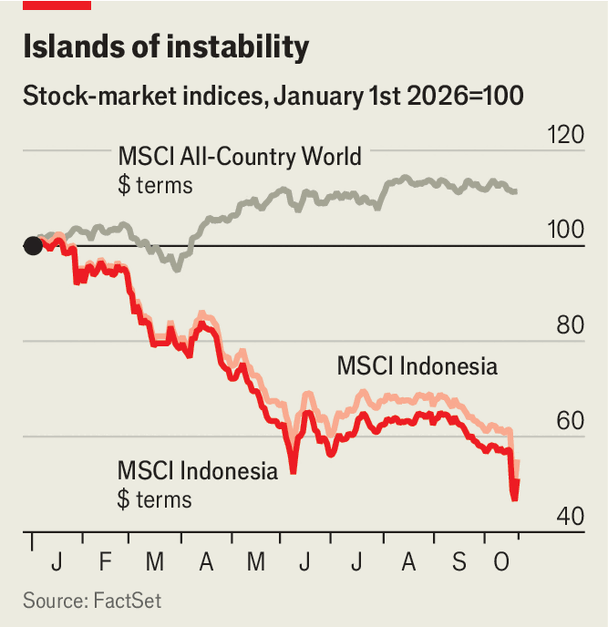
乌克兰和巴勒斯坦显然都不是什么有吸引力的投资市场;然而,印度尼西亚的市场状况可能很快就会变成这样。10月15日,指数提供商MSCI威胁要将印度尼西亚股市重新分类为“独立市场”(即低于“新兴市场”这一级别的市场)。MSCI指出,印度尼西亚股市存在信息披露不透明、以及涉嫌“拉高出货”(即通过虚假炒作来操纵股价)的违法行为,导致投资者纷纷撤离。以美元计价,印度尼西亚股市在2026年的市值缩水了一半,成为全球表现最差的市场(见图表)。
Ukraine and Palestine are no one’s idea of attractive markets. Yet that is the company Indonesia may soon keep. On October 15th MSCI, an index provider, threatened to reclassify it as a “standalone” market, two notches below its current status as an ”emerging” one. MSCI blamed a stock market plagued by opaque listings and suspected pump-and-dump schemes. Investors have been fleeing. In dollar terms Indonesian stocks have lost half their value in 2026, rendering it the world’s worst-performing market (see chart).
印度尼西亚股市的糟糕状况,恰恰反映了该国商业环境在普拉博沃·苏比安托总统执政期间的恶化:任内裙带关系盛行,政府干预市场行为的程度也日益加剧。这种糟糕的营商环境让许多跨国企业感到不安——这些企业都对印度尼西亚丰富的自然资源和庞大的消费者群体充满兴趣。
The sorry state of the bourse is emblematic of the deeper decay in Indonesia’s business environment during the presidency of Prabowo Subianto, under whom cronyism has grown rampant and the government has become increasingly meddlesome. His reign has unsettled multinational businesses, many of which covet Indonesia’s bountiful natural resources and vast population of consumers.
今年早些时候,印度尼西亚中国商会曾发布一封公开信,抱怨其会员企业面临“过于严格的监管、过度执法,甚至腐败和敲诈勒索”等问题。类似的情况在其他西方企业在印度尼西亚的运营中也普遍存在。一位来自西方商会的代表表示:“如果把信的抬头换成我们的,这封信完全也可以代表我们。”如果印度尼西亚总统不加以重视,越来越多的跨国企业可能会选择缩减在印度的业务规模。
Earlier this year the China Chamber of Commerce in Indonesia, a business association, circulated a letter complaining that its members faced “excessively stringent regulation, over-enforcement, and even corruption and extortion” by authorities. Their plight is not unique. “If you swapped out the letterhead, it could have been written by us,” says someone from a similar Western association in Indonesia. If Indonesia’s president is not careful, the ranks of multinationals scaling back their presence in his country will grow.
问题的根源之一在于普拉博沃先生的经济民族主义立场。这种立场实际上逆转了印度尼西亚自1997-1998年亚洲金融危机以来所取得的缓慢发展成果。普拉博沃的前任佐科·维多多曾提拔了一批具有商业头脑的官员,其中包括煤炭行业的大亨卢胡特·潘贾伊坦(Luhut Pandjaitan);这些官员帮助外国企业突破了印度尼西亚混乱且腐败的官僚体系,吸引了像中国矿业公司青山集团(Tsingshan)和韩国电池制造商LG Energy Solution(LGES)这样的企业入驻印度尼西亚。
Part of the problem is Mr Prabowo’s economic nationalism. It represents a reversal of the progress that has slowly been made in Indonesia since the Asian financial crisis of 1997-98. Mr Prabowo’s predecessor, Joko Widodo, elevated a business-minded coterie of fixers, including Luhut Pandjaitan, a coal baron. They let foreign businesses cut through Indonesia’s disorganised, corrupt bureaucracy, luring in firms such as Tsingshan, a Chinese miner, and LG Energy Solution (LGES), a South Korean battery-maker.
虽然许多人怀疑佐科·维多多的亲信们从中牟取了私利,但这些政策确实为外国企业在印度尼西亚的运营创造了便利条件。
Few doubted that Mr Widodo’s inner circle enriched themselves. But for foreign businesses, they made Indonesia a simpler place to operate.
相比之下,普拉博沃则抨击那些“不负责任的力量”正在“窃取”印度的资源,并任命了一批对经济战略毫无兴趣的亲信。咨询公司Vriens & Partners的布拉苏克拉·苏贾纳(Brasukra Sudjana)指出:“在普拉博沃的政府中,没有任何一个人能够像卢胡特那样发挥关键作用。”
Mr Prabowo, by contrast, rails against “irresponsible powers” that are “stealing” Indonesia’s resources, and has installed a new cohort of cronies with little interest in economic strategy. “No single person is playing the Luhut role in the Prabowo administration,” says Brasukra Sudjana of Vriens & Partners, a consultancy.
这种做法严重损害了跨国公司的信心。在普拉博沃执政的2024年最后一个季度,印度尼西亚吸引的新外国直接投资额达到了160亿美元,是四年前的两倍多;但此后投资额便陷入了停滞状态。由中国太阳能电池板制造商新益集团(Xinyi)支持的、耗资120亿美元建设“生态城市”的项目也失去了推进动力;LGES也放弃了其耗资80亿美元的电池生产计划。
That has damaged confidence among multinationals. In the final quarter of 2024, during which Mr Prabowo took power, inflows of new foreign direct investment hit $16bn, more than double the level of four years earlier. They have since stagnated. A $12bn scheme backed by Xinyi, a Chinese solar-panel producer, to build an “eco-city” has lost momentum. LGES has dropped plans for an $8bn battery project.
最严重的情况发生在商品行业:针对矿业企业的法规(如严格的产量配额)不断变化,企业普遍抱怨受到敲诈勒索。去年苏门答腊岛西部发生洪水灾害后,政府将灾祸归咎于矿业企业对森林资源的破坏;随后政府试图将由香港企业Jardine Matheson控制的Martabe金矿收归国有,但最终放弃了这一计划。
The biggest deterioration in conditions has come in the commodities sector. Rules for miners, such as stringent quotas on production, are in constant flux. Businesses complain of shakedowns. After floods devastated the western island of Sumatra last year, the government blamed miners’ abuse of forest land. It then attempted to nationalise Martabe, a gold mine controlled by Jardine Matheson, a conglomerate operating from Hong Kong, though it later backed down.
美国矿企自由港麦克莫兰去年被迫剥离其印尼子公司12%的股份,而该公司此前已有51%的股份为国有(它几乎一无所获)。印尼国防部长、普拉博沃最亲密的亲信之一沙弗里·沙姆苏丁监督了对林业的大规模整顿。全国三分之一的棕榈油种植园土地被征收。
Freeport-McMoRan, an American miner, was bullied into divesting a 12% share of its Indonesian arm last year, which had already been 51% owned by the state (it received next to nothing in return). Sjafrie Sjamsoeddin, Indonesia’s defence minister and one of Mr Prabowo’s closest confidants, has overseen a sweeping crackdown on forestry. A third of all palm-oil plantation land has been expropriated.
今年5月,普拉博沃突然宣布,新设的国家机构“达南塔拉印尼资源公司”(DSI)将统一管理棕榈油、煤炭和镍铁的出口。官员们声称它仅充当监督机构,但普拉博沃继续搅浑水。他在8月表示:“想象一下,未来当我们的所有出口商品都由DSI监督和控制时,我们将节省多少。”
In May Mr Prabowo announced abruptly that a new state agency, Danantara Sumberdaya Indonesia (DSI), would centralise exports of palm oil, coal and ferro-nickel. Officials claim it will act merely as a monitoring agency, but Mr Prabowo continues to muddy the waters. “Imagine in future how much we will save when all our export commodities will be monitored and controlled by DSI,” he said in August.
监管的绳索在其他领域也在收紧。以盐和糖为例,推动自给自足的努力限制了进口许可证的发放。印尼的原糖产量有限,食品制造商抱怨当地盐的质量太低,不适合他们使用。进口许可证的问题导致饮料巨头可口可乐和百事公司的供应链出现混乱。过去,受阻的企业可能会与官员达成交易,或聘请有政治人脉的律师。
The regulatory leash is also tightening elsewhere. Take salt and sugar, where a push for self-sufficiency has curbed import licences. Indonesia has limited raw-sugar production, and food-makers complain that the quality of local salt is too low for them. Troubles with import licences have led to supply-chain snarls for Coca-Cola and PepsiCo, two drinks giants. In the past, stymied firms might have cut deals with officials or hired politically connected lawyers.
维多多政府时期的贸易部长汤米·伦邦说:“现在(我的联系人)说,企业只是被挤压,情况完全不明朗。”(伦邦曾因一起涉及非法糖进口许可证的可疑贪腐案面临牢狱之灾,直到去年普拉博沃赦免了他。)更多负担正在增加:10月18日,印尼对在境内销售的多种消费品(包括化妆品和补充剂)实施了新的清真认证规定,尽管政府随后将部分类别的实施时间推迟到2028年。
“Now [my contacts] say companies are simply being squeezed with no clarity whatsoever,” says Tom Lembong, a trade minister under Mr Widodo (who faced jail in a dubious graft case related to illegal sugar-import permits, until Mr Prabowo pardoned him last year). Further burdens are being added: on October 18th new Halal-certification rules were put in place on various consumer goods sold in Indonesia, including cosmetics and supplements, though the government subsequently delayed the implementation for some categories to 2028.
以印尼消费者为目标市场的跨国公司也遭遇了消费停滞。尽管官方GDP增长率很少低于5%,但印尼中产阶级(按官方定义)劳动者占比已从十年前的16%降至去年的7%。这一问题在普拉博沃上任之前就已存在,但在他任内,更多印尼人正滑入低薪的非正规就业。技术工人的实际工资同样下降。数据提供商NielsenIQ最近的一项调查发现,仅9%的消费者感觉财务状况比一年前更好,低于2024年的54%。
Multinationals targeting Indonesia’s consumers have also encountered stagnant spending. Although official GDP growth is rarely lower than 5%, the share of workers in Indonesia’s middle class (as defined by authorities) has fallen from 16% a decade ago to 7% last year. The problem predates Mr Prabowo, but on his watch more Indonesians are slipping into low-paying informal jobs. Real wages have fallen for skilled workers, too. A recent survey by NielsenIQ, a data provider, found that only 9% of consumers felt financially better off than a year ago, down from 54% in 2024.
这种痛苦已在多个行业普遍显现。国内汽车销量仍低于2019年水平,令丰田等跨国公司受损——丰田是印尼第一大汽车品牌。外国包装消费品销售商不得不降价以吸引购物者,但NielsenIQ的Krisetiadi Purwanto指出,即便如此,“也未必转化为销量的成比例增长”。联合利华印尼分公司的销售额自2019年以来下降了五分之一,而营业利润已减半以上。
The pain has been felt across a wide range of industries. Domestic car sales remain shy of 2019 levels, hurting multinationals such as Toyota, the top auto brand in Indonesia. Foreign pedlars of packaged consumer goods have had to cut prices to attract shoppers—though even that is “not necessarily translating into proportional growth” in volumes, notes Krisetiadi Purwanto of NielsenIQ. At the Indonesian arm of Unilever sales have fallen by a fifth since 2019, while operating profit has more than halved. (A Gaza-related boycott, another risk in the Muslim-majority country, hasn’t helped.)
(与加沙相关的抵制——在这个穆斯林占多数的国家中的另一项风险——也雪上加霜。)今年1月,这家英国企业集团将其在印尼陷入困境的茶叶业务出售给一家本地竞争对手。在这个三分之二男性吸烟的国家,大型烟草公司面临销量下滑,因为消费者转向更便宜的烟,包括逃税的非法香烟。外国企业对印尼的梦想正面临化为泡影的风险。
In January the British conglomerate sold its struggling tea business in Indonesia to a local competitor. In a country where two-thirds of men puff, big tobacco has faced falling sales as consumers turn to cheaper sticks, including black-market ones that avoid taxes. Foreign firms’ dreams for Indonesia are at risk of going up in smoke.