
欧洲和东亚下周将遭遇寒潮,这是对受到高价和液化天然气货物竞争冲击的能源市场的一次早期考验。
Europe and East Asia are set to be hit by cold snaps next week, in an early test of energy markets rattled by high prices and competition for liquefied natural gas cargoes.
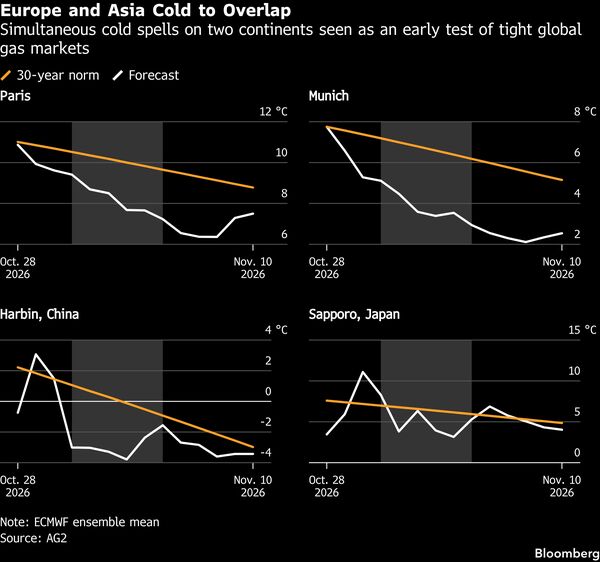
从本周末开始,欧洲大陆大片地区的平均气温将比正常水平低2至3摄氏度。与此同时,预计一股寒潮将席卷中国东北、日本和韩国,使一些地区的平均气温比正常水平低5摄氏度。
Average temperatures across a swath of continental Europe are set to sink 2C to 3C below normal from the weekend. At the same time, a cold wave is forecast to sweep across northeastern China, Japan and South Korea, pulling average temperatures 5C below the norm in some regions.
重叠的寒潮将是短暂的,但会对电力和能源市场构成早期压力测试。尽管强大的厄尔尼诺现象预计将整体上带来一个温和的北半球冬季,但它也表明,即使是短暂的寒潮也可能冲击价格。
The overlapping cold spells are set to be brief, but provide an early-season stress test of power and energy markets. While a powerful El Niño is expected to spur a mild Northern Hemisphere winter overall, it also shows how even fleeting cold snaps can jolt prices.
周一,欧洲基准天然气期货价格自2022年能源危机以来首次突破每兆瓦时97欧元,而该地区的天然气储存量仅为75%,而季节性正常水平为90%。
On Monday, European benchmark gas futures topped €97 per megawatt-hour for the first time since the 2022 energy crisis, while the region’s gas storages stand at just 75% full compared with a seasonal norm of 90%.
Atmospheric G2的气象学家安德鲁•佩德里尼表示,进入冬季,市场最担心的可能是“多个高能源需求地区同时出现寒冷天气”。
What markets likely fear the most going into winter is “joint cold across multiple high-energy-demand regions,” said Andrew Pedrini, a meteorologist at Atmospheric G2.
根据欧洲中期天气预报中心的模型以及政府和商业预报机构的分析,预计欧洲的降温将于本周中在法国和德国开始。地中海和巴尔干地区的天气已经异常寒冷。
The European cool-down is forecast to start mid-week in France and Germany, according to models from the European Centre for Medium-Range Weather Forecasts and analysis from government and commercial forecasters. Conditions across the Mediterranean and Balkans were already unseasonably cold.
ECMWF的数据显示,预计巴黎周六的气温将比正常水平低2.7摄氏度,最低气温将达到4摄氏度。慕尼黑的气温将略高于冰点。
Temperatures in Paris are forecast to fall 2.7C below normal on Saturday, with lows reaching 4C, ECMWF data show. Munich will be just above freezing.
根据MetDesk的气象模型和分析,预计欧洲西北部的风力发电将在本周中开始下降,分析显示发电量偏低将持续到下周。
Wind generation is forecast to start falling midweek across northwest Europe, according to MetDesk weather models and analysis, which show a lull in output lingering through next week.
据Atmospheric G2气象学家西川隆久(Takahisa Nishikawa)预测,亚洲最大的气温异常将出现在中国北方和日本北部,平均气温将比季节平均值低5摄氏度以上。他补充说,中国北方预计将出现大范围降雪,这可能会增加供暖需求,同时抑制太阳能发电量。
The largest anomalies in Asia are forecast for northern China and northern Japan, where average temperatures are set to fall more than 5C below seasonal averages, according to Takahisa Nishikawa, a meteorologist at Atmospheric G2. Widespread snowfall expected in northern China could raise heating demand while crimping solar power output, he added.
他说:“虽然预计这些冷空气爆发持续时间相对较短,但它们可能会对东亚的能源需求进行一次早期考验。”
“Although these cold surges are expected to be relatively brief, they could provide an early test of energy demand across East Asia,” he said.
这次寒潮来袭之际,中国煤炭价格处于三年高位,因5月发生一起致命事故后,关键产煤省份山西的采煤产量放缓。尽管如此,据国家能源局数据,得益于今年的天气情况,中国电力部门总体受益,因雨水和台风减少了夏季空调用电需求,住宅用电量今年前九个月罕见地出现同比下降。
The cold snap comes when coal prices in China are at a three-year high after a deadly accident in May slowed mining output in the key province of Shanxi. Still, China’s power sector has largely benefited from the weather this year, as residential electricity demand sees a rare year-to-date decline through September after rain and typhoons slashed summer air conditioning demand, according to the National Energy Administration.
即将到来的寒潮将由位于乌拉尔山脉上空的高压系统驱动,该系统导致急流南下,使寒冷空气流向东亚。
The coming cold snap will be driven by a high-pressure system sitting over the Ural Mountains, which causes the jet stream to dip south, allowing frigid air to flow into East Asia.
西川表示,虽然正在向纪录强度发展的厄尔尼诺现象预计将导致亚洲冬季相对温和,但严重且短暂的寒流风险依然存在。他指出,2023-24年强厄尔尼诺现象发展期间,日本曾多次出现异常低温天气。
While the El Niño that’s building toward record strength is expected to contribute to a relatively mild Asian winter, the risk of severe and short-lived cold blasts remains, Nishikawa said. He pointed to the development of a strong El Niño in 2023-24, during which Japan saw multiple bouts of anomalously cold temperatures.