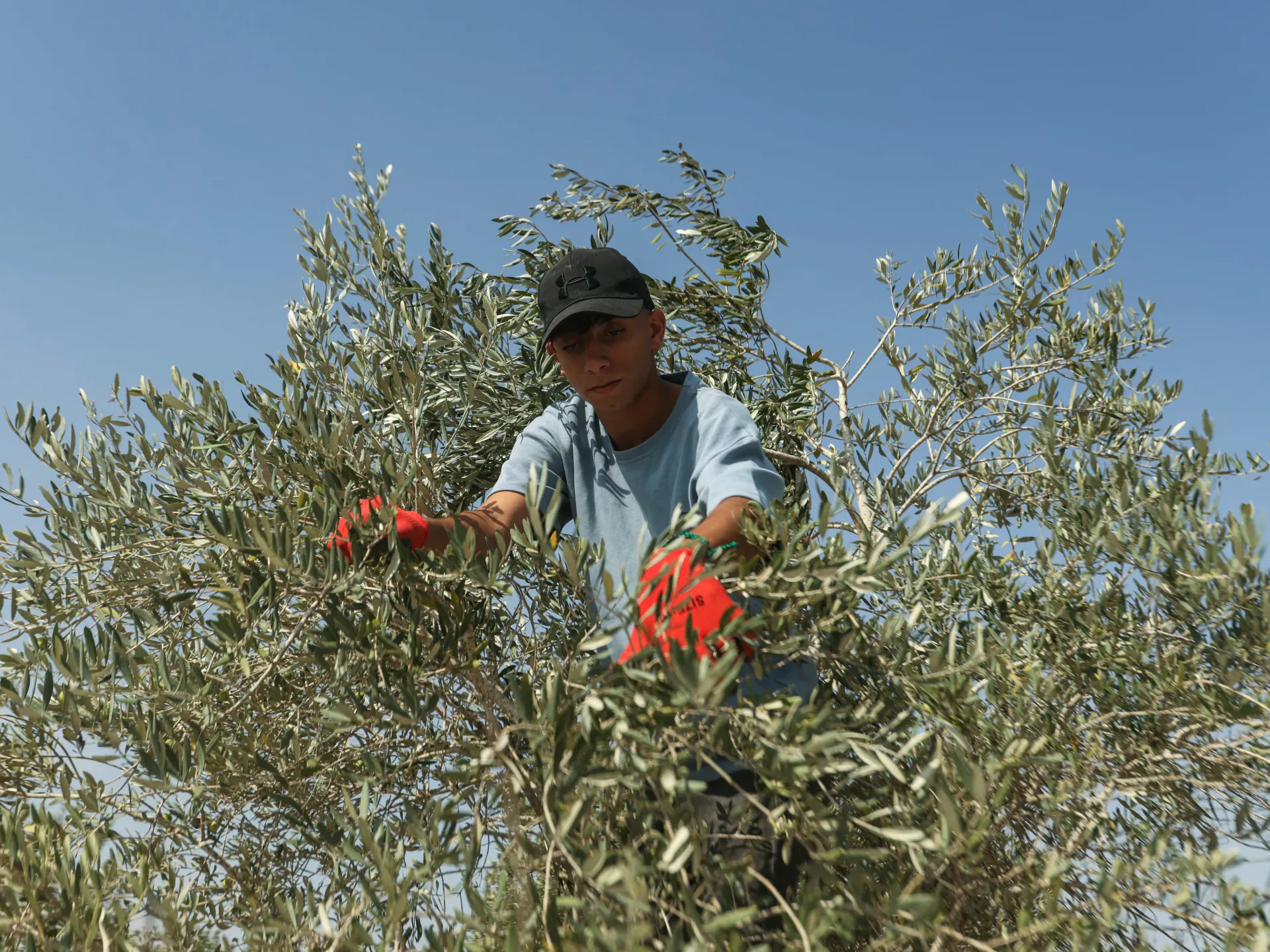
每年,哈立德·法尔哈特都会在南部村庄马吉德尔·塞勒姆照料他的橄榄树,年复一年,在战争的喧嚣中从事着这项工作。
– Every year, Khaled Farhat tends to his olive trees in the southern village of Majdel Selm, a task carried out year after year amid the din of war.
“我拥有一片约200棵树的橄榄园。只要学校不上班,我就会在业余时间去照料它们,”他在电话中告诉半岛电视台。
“I own an olive grove with about 200 trees. I tend to them in my spare time whenever I’m not on duty at the school,” he told Al Jazeera by phone.
今年,由于以色列持续占领黎巴嫩南部,前往他的橄榄园——距离以色列边境仅20分钟车程——变得更加复杂。他所在的小镇马吉德尔·塞勒姆位于以色列“黄线”以北,以色列军方正在该线以南拆除房屋和当地基础设施。
This year, reaching his olive grove, which is just a 20-minute drive from the border with Israel, is more complicated due to the ongoing Israeli occupation of southern Lebanon. His town of Majdel Selm lies just north of Israel’s “Yellow Line”, below which the Israeli military is demolishing homes and local infrastructure.
法尔哈特说,为了到达自己的土地,他不得不向当地市政府申请通行许可,市政府再将申请转交给黎巴嫩军队。军方随后与6月美国、以色列和黎巴嫩三方框架协议后建立的机制进行协调,为当地人争取照料橄榄园的许可。
To reach his land, Farhat said, he had to request access from his local municipality, which forwarded the request to the Lebanese Army. The army then coordinates with a mechanism established after June’s Tripartite Framework Agreement between the United States, Israel and Lebanon to get permits for locals to tend to their olive groves.
贝鲁特美国大学的拉米·祖拉伊克是一位专攻景观设计和生态系统管理的教授,他表示,黎巴嫩南部农场和建筑遭到大面积破坏,加上行动限制,是以色列试图使该地区“荒芜化”的手段。
American University of Beirut’s Ramy Zurayk, a professor specialising in landscape design and ecosystem management, said the widespread damage to farms and buildings in southern Lebanon, along with restrictions on movement, is an attempt by Israel to make the area “sterile”.
“以色列的计划是将人和生物从这片土地上清除,”祖拉伊克告诉半岛电视台。“他们通过多种方式实现这一目标,包括摧毁栖息地和维持生命的景观要素,从而破坏人与这片土地之间的关系。”边境地区的许多橄榄树已被以色列推土机烧毁或连根拔起。黎巴嫩环境部长塔玛拉·埃尔泽因表示,自2023年10月以色列开始轰炸并随后入侵黎巴嫩以来,已有超过1.6万公顷(约4万英亩)的土地被焚烧,其中包括使用白磷——一种高度易燃的物质。
“The Israeli project is to eliminate humans and living organisms from the land,” Zurayk told Al Jazeera. “They are doing this via a variety of methods, including destroying the habitat and the components of the landscape that provide life, which destroy the relationship between the people and this land.”Many of the border areas’ olive trees have been burned to the ground or uprooted by Israeli bulldozers. Lebanon’s Environment Minister Tamara Elzein said more than 16,000 hectares (about 40,000 acres) of land have been torched since Israel began bombing, and later invading, Lebanon in October 2023, including through the use of white phosphorus a highly flammable substance.
以色列仍占领着黎巴嫩南部近630平方公里(243平方英里)的土地,其中包括大片农田和数十个村庄。
Israel continues to occupy nearly 630sq km (243sq miles) of southern Lebanon, which includes swaths of farmland and dozens of villages.
在橄榄园尚且完好的地区,以色列的占领使本季的收成变得复杂。农民和土地所有者表示,他们劳作时头顶有以色列无人机盘旋,地面上还时刻担心未爆弹药。一小时前,一枚以色列炮弹落在法尔哈特附近。
In areas where the olive groves are still intact, Israel’s occupation has complicated this season’s harvest. Farmers and landowners say they work with Israeli drones flying overhead and live with the fear of unexploded ordnance on the ground. An hour earlier, an Israeli shell had landed near Farhat.
“无人机不断在天空中。你抬头一看,有时一架、两架、三架,就在那里来回飞,”法尔哈特说。“战机有时会飞过并在附近实施打击,给我们造成了心理和情感上的伤害。”进入自家土地的许可。以色列对黎巴嫩农民进入自己的土地施加了严格限制,这让他们损失了庄稼。法尔哈特说,他只获得了两周的时间来耕种自己的土地,而他的农田因疏于打理已经显而易见。
“Drones are constantly in the sky. You look up and see one, two, three of them sometimes just moving back and forth,” Farhat said. “Warplanes sometimes pass by and carry out strikes nearby, taking a toll on us psychologically and emotionally.”Permission to access own land Israel has placed tight restrictions on Lebanese farmers’ access to their land, which has cost them their crops. Farhat said he was given just a two-week window to work his land, and the neglect of his farmland is already evident.
“通常,地里不应该有杂草。但由于翻耕和清理土地的时间正好是在我们流离失所期间,我们无法清理。土地就那样保持着原样,因为我们无法到达那里,”他说。
“Usually, there shouldn’t be any weeds. But since the time for tilling and clearing the land happened during our displacement, we weren’t able to clear it. The land remained as it was because we couldn’t reach it,” he said.
“我们现在正处于收获季节。如果我们能在这段时间内直接从树上摘完所有果实,那就太好了。否则,剩下的就只能不收。”清理这些杂草所花的时间侵占了他本已有限的采摘橄榄的时间。但这些杂草也可能隐藏着致命的意外。农民和土地所有者表示,在南部耕种土地时,未爆弹药随处可见,包括集束炸弹留下的。
“We’re in the middle of the harvest now. If we manage to finish harvesting everything directly from the trees within this timeframe, then great. Otherwise, whatever remains will go unharvested.”The time spent clearing these weeds eats into the limited time he has to pick his olives. But they could also conceal a deadly surprise. Farmers and landowners said working their lands in the south is rife with unexploded ordnance, including from cluster bombs.
10月初,黎巴嫩南部的橄榄园中至少有两人丧生。一名退役士兵在宾特朱拜勒地区的亚特尔村被以色列炮火击毙。另一名担任工程师的年轻男子在宾特朱拜勒的弗鲁恩村收割橄榄时,因以色列弹药爆炸而丧生。一天后,黎巴嫩警察部队的一名成员在南部以基督徒为主的艾因埃贝尔村照料农田时,也在一次爆炸中丧生。
In early October, at least two people were killed in olive groves in south Lebanon. A retired soldier was killed in Yater village in the Bint Jbeil district by Israeli artillery fire. Another young man, who worked as an engineer, was killed when Israeli ordnance exploded while he was harvesting olives in the village of Froun also in Bint Jbeil. A day later, a member of Lebanon’s police force tending to farmland in the southern village of Ain Ebel, a predominantly Christian village, was also killed in an explosion.
“人们一直担心成为(以色列袭击的)目标,尤其是在袭击地点附近地区,以及遭遇集束炸弹或其他战争遗留物的风险,这些都对人的生命构成严重威胁,”来自黎巴嫩南部巴比利耶镇的记者兼橄榄种植者希沙姆·霍泰特告诉半岛电视台。
“There is a constant fear of being targeted [by Israeli attacks], especially in areas near the sites of attacks, as well as the risk of encountering cluster bombs or other remnants of war, which pose a grave danger to human life,” Hicham Hoteit, a journalist and olive farmer from Babliyeh town in south Lebanon, told Al Jazeera.
据人权观察组织的一份报告,自2006年战争最后几天以来,爆炸物一直是黎巴嫩南部农民反复面临的问题,当时以色列军队在该地区投下了含有260万至400万枚子弹药的集束炸弹。
Explosives have been a recurring problem for farmers in southern Lebanon since the final days of the 2006 war, when Israeli forces dumped cluster bombs containing between 2.6 and four million submunitions in the area, according to a Human Rights Watch report.
“自2006年战争以来,我们在黎巴嫩南部看到的最大挑战之一是,集束弹药在冲突发生很久之后仍会长期影响人们的生活,”地雷咨询小组(MAG)黎巴嫩项目经理希巴·甘杜尔告诉半岛电视台。该非政府组织致力于帮助受地雷、未爆弹药、小武器和轻武器影响的社区。
“One of the biggest challenges we’ve seen in southern Lebanon since the 2006 war is how long cluster munitions continue to affect people’s lives long after conflict has taken place,” Hiba Ghandour, Lebanon’s programme manager for the Mines Advisory Group (MAG), a nongovernmental organisation that aids communities affected by landmines, unexploded ordnance, small arms and light weapons, told Al Jazeera.
“数百万枚子母弹散落在该地区各处,包括农田,许多在撞击时未能爆炸。它们被遗留隐藏在田野、橄榄树林和果园中——其中许多我们至今仍在清理。”据黎巴嫩地雷行动中心(LMAC)2022年报告,政府宣布大部分受污染土地已完成清理。“黎巴嫩政府宣布,仅剩500万平方米土地仍受集束弹药污染[占待清理基线面积的18%],”甘杜尔援引该报告称。
“Millions of submunitions were scattered across the region, including farmland, and many failed to explode on impact. They were left hidden in fields, olive groves and orchards – many of which we are still clearing today.”According to a 2022 Lebanese Mine Action Center (LMAC) report, the government announced that much of the contaminated land had been cleared. “The Lebanese government announced that only 5 million square metres of land remained contaminated with cluster munitions [18 percent of the baseline to be cleared],” Ghandour said, citing the report.
“自2023年10月以来,局势变得更加复杂。最新的敌对行动增加了一层新的爆炸性危害。”甘杜尔表示,地雷咨询小组(MAG)已为农民确认了44.4万平方米的确定危险区域,但随着调查仍在进行,这一数字很可能会大幅上升。
“Since October 2023, the situation has become more complex. The latest hostilities have added a new layer of explosive hazards.”Ghandour said MAG had identified 444,000sq metres of confirmed hazardous areas for farmers, but with research still ongoing, this figure is likely to rise significantly.
尽管存在这些危险,黎巴嫩严峻的经济形势迫使许多黎巴嫩人出于必要不得不耕种土地。
Despite these dangers, Lebanon’s dire economic situation has pushed many Lebanese to work their lands out of necessity.
“根据我们的经验,清理农业用地尤具挑战性,因为污染可能隐藏在植被中或土壤之下,这使我们需要更长时间来清理,”甘杜尔说。
“In our experience, clearing agricultural land is especially challenging, as the contamination can be concealed within vegetation or beneath soil, which takes us longer to clear,” Ghandour said.
“当人们面临生计压力时,往往觉得别无选择,只能在土地确保安全前就返回耕作,这使清理工作更加艰巨。反复轰炸也破坏了农业用地,使我们的清理小组更难到达一些最需要帮助的社区。”政治分析人士巴塞尔·杜韦克对半岛电视台表示,许多黎巴嫩公民遭到以色列部队骚扰,并被禁止采收自家橄榄树。
“When people are under pressure to earn a living, they often feel they have no choice but to return to their land before it has been made safe, making clearance all the more challenging. Repeated bombardment has also damaged agricultural land and made it harder for our clearance teams to reach some of the communities most in need.”Political analyst Bassel Doueik told Al Jazeera that many Lebanese citizens have been harassed by Israeli forces and barred from harvesting their olive trees.
杜韦克以以逊尼派为主的边境村庄克法尔舒巴为例。他说,周一,约200名以色列士兵进入克法尔舒巴,搜查了多个街区的房屋,同时至少三辆梅卡瓦坦克和其他军用车辆渗透进该村周边区域。
Doueik used Kfarshouba, a predominantly Sunni border village, as an example. On Monday, he said, about 200 Israeli soldiers entered Kfarshouba and searched houses in several neighbourhoods, while at least three Merkava tanks and other military vehicles infiltrated the area around the village.
对更美好未来的期望 白磷的广泛使用导致一些黎巴嫩人不敢购买来自南部的农产品,担心这些产品可能接触过有害化学物质。
Hope for a better future The widespread use of white phosphorus has led some Lebanese to hesitate buying produce from the south over concerns that it could be exposed to hazardous chemicals.
美国贝鲁特大学的学者祖雷克在10月21日于其大学举办的一场座谈会上表示,这种恐慌是没有根据的,没有证据表明来自黎巴嫩南部的任何橄榄或其他农产品存在食用危险。
Zurayk, the AUB academic, said in a panel hosted at his university on October 21 that the panic was unfounded and there was no evidence that any of the olives or other produce from south Lebanon was dangerous to consume.
对黎巴嫩的许多人来说,包括南部以外地区的人,收割橄榄是一项严肃的工作,但也是家人或社区团聚的机会。
For many in Lebanon, including in areas beyond the south, harvesting olives is serious work but is also an opportunity for their families or communities to come together.
黎巴嫩南部许多拥有农田的人表示,今年由于以色列袭击的威胁,他们前往田地时会把孩子和其他亲属留在家里。回到迈杰德尔塞勒姆,法尔哈特说,这个收获季南部的危险显而易见。
Many people with farmland across south Lebanon have said this year, due to the threat of Israeli attacks, they will leave their children and other relatives behind when they head to their crops. Back in Majdel Selm, Farhat said the dangers are evident in the south this harvest season.
“人们听说局势很危险,听说有炮击,但对于真正身处炮击之中、或生活在炮击之下的人来说,那肯定是一种不同的体验,”他说。
“People hear that the situation is dangerous, they hear that there is shelling, but for someone who is actually in the midst of the shelling, or living under it, it is certainly a different experience,” he said.
“当地的现实完全是另一回事。不过,感谢上帝,希望这只是一个会过去的阶段。希望局势不会进一步升级,而是开始降级,朝着更好的方向发展。”
“The reality on the ground is something else entirely. Still, thank God, hopefully, this is just a phase that will pass. Hopefully, the situation will not escalate further and will begin to de-escalate and move towards something better.”