
日本央行已尝试了13年,试图将通胀率引导至2%的目标水平,以摆脱通货紧缩螺旋和数十年的经济停滞。在周五的日本央行政策会议上,植田和男行长的团队预计将最终宣布该目标已实现。
For 13 years, the Bank of Japan has tried to coax inflation higher toward 2% as it sought to shake off a deflationary spiral and decades of economic drift. At a Bank of Japan policy meeting on Friday, Governor Kazuo Ueda’s team is expected to finally declare the goal has been reached.
在一个消费者价格指数(CPI)连续四个财年(截至3月)均维持在2%以上的国家,这似乎有些奇怪。但日本央行透过不同的视角审视物价:核心通胀。这一指标本质上剔除了临时冲击带来的噪音。如果其增速令植田和男满意,将为进一步加息敞开大门。这将有助于日本央行满足美国财长贝森特的愿望,即看到日本利率更接近美联储的基准利率。简短的回答是:是的,而且不仅仅如此。
That might seem strange in a country where the consumer price index stayed above 2% for four straight fiscal years through March. But the BOJ looks at prices through a different lens: Underlying inflation. That measure essentially strips out noise from temporary shocks. If its pace now satisfies Ueda, it opens the door for more rate hikes. This would help the BOJ satisfy US Treasury Secretary Scott Bessent’s desire to see Japan’s rates move closer to the Federal Reserve’s benchmark. The short answer is, yes. And then some.
仅从官方CPI数据来看,受乌克兰战争引发的能源冲击推高物价,通胀率于2022年突破2%门槛。核心CPI指数在今年大部分时间跌破这一“黄金水平”,随后于9月回升至2.1%的增速。但这些数字并未讲完整个故事。一段时间以来,日本的消费者价格常因政府为抑制生活成本而采取的措施而出现常态性扭曲,这些措施包括涵盖燃料、水电费和幼儿托育等各项补贴。
Looking solely at official CPI data, inflation crossed the 2% threshold in 2022 after energy shocks from the Ukraine war pushed up prices. The core CPI index dipped below that golden level for much of this year before returning to 2.1% growth in September. But those numbers don’t tell the full story. For some time, Japan’s consumer prices have been distorted routinely by government steps to cap living costs with subsidies covering everything from fuel to water bills and early childcare.
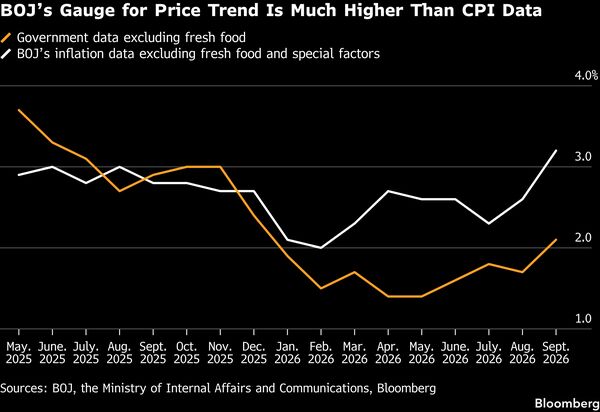
日本央行本周公布的数据凸显了这一影响:剔除生鲜食品及补贴等其他特殊因素后的消费者价格,9月同比上涨3.2%。这是三年来最快增速,且远高于政府一周前发布的9月CPI数据中2.1%的涨幅。
The BOJ underscored that effect with data this week showing that consumer prices excluding fresh food — and other special factors such as subsidies — rose 3.2% in September from a year earlier. It was the fastest pace in three years, and substantially quicker than the 2.1% gain reported for the same month in the government’s CPI data published just a week earlier.
综合这些数据来看,日本央行很可能已经知道有一段时间了,即潜在通胀已高于其目标。植田和男——这位谨慎的前学者——迄今仍未宣告胜利,一个可能的原因是他对2000年的记忆犹新:当时日本央行以加息方式结束零利率政策,结果反而加深了通货紧缩。植田当时是政策委员会委员,曾投反对票反对加息。
Taken together, the data show that the bank has likely known for some time that underlying inflation is above its target. It’s likely that one factor keeping Ueda — a cautious former academic — from declaring victory until now is his memory of the year 2000, when the BOJ ended its zero-interest-rate policy with a hike that wound up deepening deflation. Ueda, a member of the board at the time, voted against the increase.
潜在通胀不同于总务省每月发布的消费者价格指数(CPI),且没有单一、明确界定的指标。相反,日本央行基于一系列数据进行评估,其中包括预期调查和轶事信息。直到现在,日本央行坚持认为,即使总体通胀超过2%,潜在趋势仍低于2%。
Underlying inflation differs from the consumer price index released each month by the Ministry of Internal Affairs and Communications, and there is no single, clearly defined indicator for it. Instead, the BOJ makes an assessment based on a range of data that include surveys of expectations and anecdotal information. Until now, it’s maintained that even when headline inflation exceeded 2%, the underlying trend was below 2%.
原因很简单。标准CPI衡量日本家庭购买的一切商品,从食品杂货到汽油,但容易受到短期外部冲击的影响——例如中东战争。潜在通胀剔除临时性极端波动,理论上让日本央行能看到通胀真实、持久的趋势。
The reason for that is simple. Standard CPI measures everything a Japanese household buys from groceries to gasoline, but is vulnerable to short-term external shocks — such as a war in the Middle East. Underlying inflation strips out temporary extremes, in theory allowing the BOJ to see the true, persistent trend of inflation.
日本央行使用一套仪表盘指标,包括剔除波动项目的指数、去除极端价格变动的修剪指标、通胀预期以及基于模型的潜在通胀估算。
The BOJ uses a dashboard of measures, including indexes that exclude volatile items, trimmed measures that remove extreme price moves, inflation expectations and model-based estimates of underlying inflation.
日本并非唯一透过临时性价格波动看本质的央行。例如,美联储密切关注潜在通胀指标,包括核心PCE,尽管其2%目标是以总体PCE通胀来定义的。
Japan isn’t alone in looking through temporary price swings. The Federal Reserve, for example, closely monitors measures of underlying inflation, including core PCE, even though its 2% target is defined in terms of headline PCE inflation.
价格通常由供需平衡决定。随着经济好转、需求增加,企业预计在销售更多商品和服务时会提高价格,从而推高通胀。
Prices are normally determined by the balance between supply and demand. As the economy improves and demand increases, companies are expected to raise prices as they sell more goods and services, pushing inflation higher.
临时性因素可能会干扰这一进程。唐纳德·特朗普去年发动的全面关税战,以及因中东局势恶化而激增的原材料成本,均推高了全球物价。首相高市早苗于2025年底废除了汽油临时税率,并补贴电费和燃气费,以刺激家庭消费。
Temporary factors can disrupt that process. Donald Trump’s sweeping tariff war last year and surging raw-material costs stemming from worsening tensions in the Middle East both pushed up global prices. Prime Minister Sanae Takaichi abolished the provisional gasoline tax rate at the end of 2025 and has subsidized electricity and gas bills to get households spending.
为在剔除这些干扰后准确判断物价趋势,日本央行数年前开始在内部核算自身的消费者物价指标。自2026年3月起,央行开始公布该指标,推出另一工具助经济学家评估潜在通胀。该指标显示9月读数为3.2%。
To accurately gauge price trends without that noise, the BOJ began calculating internally its own consumer-price measures some years back. It began publishing the gauge starting in March 2026, unveiling another tool to help economists assess underlying inflation. That’s the gauge that showed the 3.2% reading for September.
这指的是人们预期物价将上涨多少。且因文化差异,各国情况可能大相径庭。以此为例:自2000年以来,美国和德国的通胀预期大体维持在2%至3%左右。即使实际通胀一度逼近10%,通胀预期仍保持稳定——用央行行话即“锚定”在该水平——因企业和消费者相信涨幅只是暂时的。
This refers to how much people prices to rise. And it can vary wildly across countries due to cultural differences. Consider this: Inflation expectations in the US and Germany have generally remained around 2% to 3% since 2000. Even when actual inflation briefly approached 10%, inflation expectations remained stable — or “anchored,” in central bank parlance — as businesses and consumers believed the spike would be temporary.
日本则截然不同,从20世纪90年代末至2013年引入大规模货币宽松前,通胀预期长期维持在0%至1%左右。这反映出日本顽固的“物价不会上涨”认知。但2022年情况发生变化,通胀预期开始上升,目前处于1.5%至2%左右。
Japan, by contrast, saw inflation expectations remain largely around 0% to 1% from the late 1990s until 2013, when large-scale monetary easing was introduced. That reflected stubborn perceptions in Japan that prices wouldn’t rise. But in 2022, that changed. Inflation expectations began rising and currently stand at around 1.5% to 2%.
植田和男去年表示,通胀预期与潜在通胀密切相关,因预期会塑造影响物价走势的消费模式。他还反复称,预期“尚未达到锚定在2%的状态”。这种情况可能在本周五的货币政策会议上发生改变。
Ueda last year said expectations were closely related to underlying inflation, as expectations help shape spending patterns that affect price trends. He also claimed repeatedly that they had “not yet reached a state where they were anchored at 2%.”That could change at the policy meeting this Friday.
植田和男关于潜在通胀的表述正在演变。2025年6月,他表示日本距离2%“仍有一定距离”。一年后,在日本央行将政策利率上调至1%后,他认为该指标“正在接近2%”。到10月中旬——在利率升至1.25%之后——他更进一步,宣称其已“相当接近2%”。这为植田宣布目标已实现奠定了基础,新的优先任务变为维持这一水平——为货币政策的新阶段铺平了道路。
Ueda’s language on underlying inflation is evolving. In June 2025, he said Japan was “still some distance from 2%.”One year later, after the BOJ raised its policy rate to 1%, he saw that measure “approaching 2%.”By mid-October — after the rate was raised to 1.25% — he went a step further, declaring it had “come quite close to 2%.”That’s set the stage for Ueda to declare that the target has been reached, with the new priority being to keep it there — clearing a path for a new phase in monetary policy.