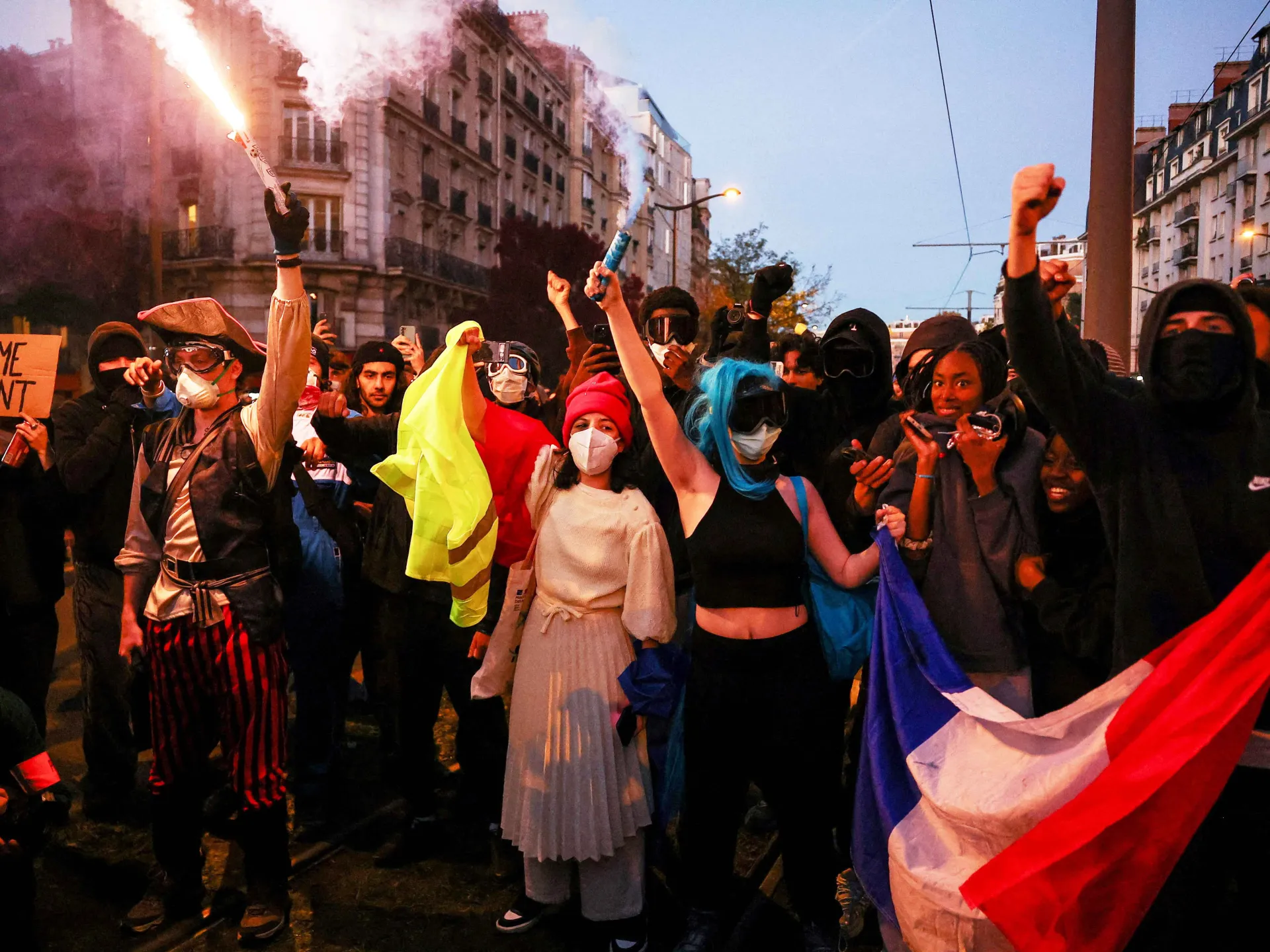
在过去的几个星期里,燃烧的建筑和满目疮痍的商业街的画面主导了国际媒体对法国的报道。“法国在燃烧”、“陷入动荡的法国”、“法国陷入混乱”,各大媒体纷纷打出这样的标题,将聚焦点放在了一场本是以和平为主、诉求改善教育条件的学生运动中的暴力元素上。
For the past few weeks, images of burning buildings and devastated shopping streets have dominated international media coverage of France. “France is burning”, “France in turmoil”, “Chaos in France”, the headlines have declared, focusing on the violent element of an otherwise peaceful student movement demanding better conditions for education.
为了理解为什么过去会发生这种情况以及今天为何正在发生,让我们从审视“暴力”这个词开始。在今天的语境中,它被不加区分地用来指代被砸碎的店铺玻璃、警察致伤示威者、被纵火焚烧的汽车,或是向无武装的人群开枪。
To understand why this has happened in the past and is happening today, let us start by examining the word “violence”. In today’s context, it is used indiscriminately to refer to a broken shop window, a police officer injuring a demonstrator, a car set on fire, or shots fired at an unarmed crowd.
这种混淆往往不准确地将物质损害与人身攻击、叛乱与其镇压置于同一层面。
This confusion tends to inaccurately place material damage and attacks on people, revolt and its repression, on the same level.
巴西大主教多姆·埃尔德尔·卡马拉是解放神学的倡导者,他将暴力区分为三种类型:第一种是压迫性的不公;第二种是它所引发的叛乱;第三种是镇压。
Brazilian archbishop Dom Helder Camara, an advocate of liberation theology, distinguished between three types of violence: the first, that of injustice that oppresses; the second, that of the revolt it provokes; and the third, that of repression.
我要再加上另一种形式的暴力:即不平等、歧视、社会羞辱和动荡的生活。一个社会秩序即使在其表面的平静中也可能是暴力的。
I would add one more form of violence: that of inequality, discrimination, social humiliation and precarious life. A social order can be violent even in its apparent tranquillity.
法国历史提醒我们,叛乱、助长叛乱的不公以及作为回应的镇压,往往是紧密交织在一起的。
French history reminds us how often revolts, the injustices that fuel them and the repressions that answer them are closely intertwined.
1789年7月14日法国大革命爆发前夕攻占巴士底狱,便是其中一个著名的事件。这是革命者的一次武装起义,他们拒绝压迫性的专制君主制,并将这座监狱视为其滥用权力的象征。
The storming of the Bastille on July 14, 1789, in the lead-up to the outbreak of the French Revolution, is one famous event. It was an act of armed insurrection by revolutionaries who rejected an oppressive absolute monarchy and saw the prison as a symbol of its abuses.
这座堡垒的防御者向攻击者开火,造成大约100人死亡。在他们投降后,巴士底狱长伯纳德-勒内·茹尔当·德洛内被杀,他的头颅被插在长矛上在街头游行。
The defenders of the fortress fired on the assailants, killing about 100 people. After their capitulation, the Bastille governor, Bernard-Rene Jourdan de Launay, was killed, and his head impaled on a pike and paraded in the streets.
在随后的几周里,农民开始侵占贵族的财产,洗劫一空,并焚烧记录封建权利的地契。这些文件体现了农民所遭受的封建统治。
In the following weeks, peasants started invading properties of the aristocracy, ransacking them and burning property deeds that recorded feudal rights. These documents embodied the feudal domination peasants were subjected to.
三年后,即1792年8月10日,革命者冲击杜伊勒里宫这一皇家住所,导致数百名瑞士卫兵丧生。9月,在面对外国入侵的恐慌氛围中,武装团体处决了1000多名囚犯,其中包括天主教神职人员和因普通刑事犯罪被捕的罪犯。
Three years later, on August 10, 1792, revolutionaries stormed the royal residenceod the Tuileries Palace, which led to the deaths of hundreds of Swiss Guards. In September, in a climate of panic in the face of foreign invasion, armed groups executed more than 1,000 prisoners, among them Catholic priests and criminals arrested for common crimes.
这些民众愤怒的爆发植根于旧制度的系统性暴力:出身特权、封建压迫、税收不平等、武力使用和镇压的任意性。民众暴力无法与建立在统治之上的社会秩序的暴力割裂开来。
These outbursts of popular anger were rooted in the systemic violence of the ancien regime: privileges of birth, feudal oppression, tax inequalities, arbitrariness in the use of force and repression. Popular violence cannot be separated from that of a social order founded on domination.
整个19世纪,同样的驱动力量——对掌权者的恐惧和愤怒——持续助长集体暴力。1831年2月,一群反教权主义者洗劫了巴黎大主教宫并毁坏了其陈设,从而打击了与被废黜君主联系在一起的教会。
Throughout the 19th century, the same driving forces — fear and anger against those in power — continued to fuel collective violence. In February 1831, an anticlerical crowd sacked the archbishop’s palace in Paris and destroyed its furnishings, thus striking at a Church associated with the deposed monarch.
1871年,在法普战争中法国战败后,数千名不满的巴黎人起义并建立了巴黎公社。他们扣押人质,试图迫使凡尔赛政府停止炮击。人质最终在“血腥周”期间被杀害,当时凡尔赛军队屠杀了数千名巴黎人。
In 1871, following France’s defeat in the Franco-Prussian War, thousands of disaffected Parisians rebelled and established the Paris Commune. They took hostages in an attempt to persuade the government in Versailles to stop bombarding them. The killing of the hostages ultimately took place during “Bloody Week”, as the Versailles army massacred Parisians by the thousands.
然而,社会暴力并不总是采取起义及其镇压这种壮观的形式。它也以劳工动员以及针对工厂、机器和雇主代表的形式表现出来。
Social violence, however, has not always taken the spectacular form of insurrection and its suppression. It has also been expressed in the form of labour mobilisation and the targeting of factories, machines and representatives of the employers.
1886年1月26日,在德卡兹维尔,当地矿山副总工程师儒勒·瓦特兰被一群因恶劣工作条件而愤怒的矿工殴打、从窗户扔出并致死。他的名字衍生出了新词“瓦特兰式暴行”——指杀害经理或老板的行为。
On January 26, 1886, in Decazeville, engineer Jules Watrin, deputy director of the local mines, was beaten, thrown from a window, and killed by a crowd of miners angered by bad working conditions. His name gave rise to the neologism “watrinade” – the killing of a manager or a boss.
1903年,在阿尔芒蒂耶尔,一场纺织罢工演变为洗劫商店。三年后,在利摩日,示威者强行冲开工厂大门,并在一家工厂内毁坏瓷器。两家枪店被洗劫,一枚爆炸装置在一名厂长住宅外引爆。
In Armentieres, in 1903, a textile strike degenerated into the ransacking of shops. In Limoges, three years later, demonstrators forced open the gates of factories and destroyed porcelain in one plant. Two gun shops were looted and an explosive device set off outside a director’s home.
1968年,一场由学生发起、要求改善大学条件的抗议引发了全社会动员,数百万工人加入罢工。巴黎拉丁区的街垒伴随着被推翻或焚烧的汽车、铺路石投掷和燃烧瓶的使用。在南特,南方航空公司厂长在工厂内被扣留数日。
In 1968, a student-led protest for better university conditions triggered a society-wide mobilisation, drawing in millions of workers who went on strike. The barricades in the Latin Quarter of Paris were accompanied by overturned or torched cars, the throwing of cobblestones and the use of Molotov cocktails. In Nantes, the director of Sud Aviation was held captive in his factory for several days.
随后几年,去工业化进程再次让工人陷入不稳定境地,并引发了另一波劳工抗议。
In the following years, the process of deindustrialisation put workers yet again in a precarious situation and drove yet another wave of labour protests.
1979年,隆维和德南的钢铁工人面临大规模裁员,参与了动员活动,留下了布里耶副省府被砸毁的大门和散落的档案、被焚烧的车辆以及被砸碎的商店橱窗。
In 1979, the steelworkers of Longwy and Denain, faced with massive job cuts, took part in mobilisations that left behind broken doors and scattered files at the subprefecture of Briey, vehicles set on fire and shop windows smashed.
2009年,克莱鲁瓦大陆集团工厂宣布关闭后,员工洗劫了贡比涅副省府。2015年,在法航,两名高管在反对裁员的示威中遭到袭击。
In 2009, after the announcement of the closure of the Continental plant in Clairoix, employees ransacked the subprefecture of Compiegne. In 2015, at Air France, two executives were attacked during a demonstration against job cuts.
2016年,在抗议劳工法改革的示威活动期间——该改革允许雇主更轻松地解雇工人,店面遭到砸毁,警车遭到袭击。两年后,关于经济不满情绪的“黄马衣”示威活动,让此类行动达到了空前的显眼程度。2018年12月,凯旋门被污损,商店被洗劫。然而,这场运动也因执法人员对许多抗议者造成严重伤害而引人注目。
In 2016, during the protests against the labour law reforms, which allowed employers to fire workers more easily, storefronts were smashed and police vehicles were attacked. Two years later, the demonstrations of the “yellow vests” over economic grievances brought an unprecedented level of visibility to such actions. In December 2018, the Arc de Triomphe was defaced and shops were looted. Yet, this movement was also notable for the serious injuries inflicted upon many protesters by law enforcement.
农民和渔民的动员也引发了引人注目的抗议行动,其目标特别是国家代表和公共建筑。1994年,渔民为抗议其行业危机而举行的示威活动演变成与执法人员的冲突,并引发了一场大火,摧毁了布列塔尼议会大楼。1999年,农民洗劫了环境部长多米尼克·瓦内特的办公室。
Mobilisations by farmers and fishermen have also led to spectacular protest actions, targeting in particular representatives of the state and public buildings. In 1994, a demonstration by fishermen protesting against the crisis in their sector turned into clashes with law enforcement and caused a fire that devastated the Parliament of Brittany. In 1999, farmers ransacked the office of Environment Minister Dominique Voynet.
但并非所有的集体暴力都属于有组织的抗议运动。有些暴力事件爆发于悲剧事件之后,凝聚了积聚的愤怒和社会紧张局势。2005年,在齐耶德·贝纳和布纳·特拉奥雷身亡之后,巴黎工人阶级社区的抗议活动导致数千辆汽车被纵火焚烧以及公共建筑遭到袭击。在一种令人沮丧的呼应中,18年后的纳代尔·梅尔祖克在巴黎郊区楠泰尔被一名警察打死之后,汽车和商店再次遭到袭击。
But not all collective violence falls within organised protest movements. Some erupt in the aftermath of tragic events, crystallising accumulated anger and social tensions. In 2005, after the deaths of Zyed Benna and Bouna Traore protests in working-class neighbourhoods of Paris resulted in thousands of vehicles being set on fire and attacks on public buildings. In a grim echo, 18 years later, after the death of Nahel Merzouk killed by a police officer in Nanterre, a suburb of Paris, vehicles and shops were attacked.
这段悠久的历史告诉我们,民众暴力既不新鲜,也并非千篇一律。从焚烧封建财产档案到破坏工厂机器,再到洗劫警察局或放火烧毁商店,暴力行为可以有不同的目的。但物质破坏往往构成了针对被认为充耳不闻或不公正的权力象征的一种政治语言。
This long history teaches us that popular violence is neither new nor uniform. From burning feudal property archives to sabotaging a factory machine, to ransacking a police prefecture, or setting fire to a shop, acts of violence can have different aims. But material destruction often constitutes a political language directed at the symbols of a power deemed deaf or unjust.
最壮观的行为往往由少数人实施,其本身并不能定义绝大多数保持和平的动员活动。此外,示威者的做法不应掩盖贯穿于整个社会的暴力。
The most spectacular acts are often carried out by a minority and cannot by themselves define mobilisations that are largely peaceful. Moreover, the practices of demonstrators should not obscure the violence that runs through society.
因此,声称暴力如今在一个原本和平的法国突然爆发,是对这段政治和社会历史中至关重要的一部分的误解。
Therefore, to claim that violence today suddenly erupted in a formerly peaceful France is to misunderstand an essential part of this political and social history.