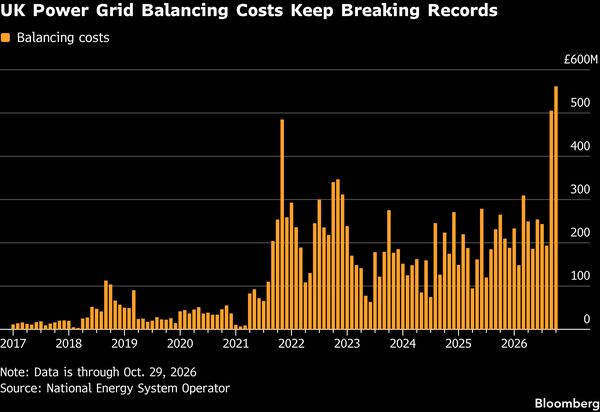
英国10月为平衡电网花费超过5.61亿英镑(7.53亿美元),原因是天然气价格飙升以及该国老化的网络瓶颈推高了维持供电的成本。
The UK spent more than £561 million ($753 million) to balance the power grid in October, as soaring gas prices and bottlenecks in the country’s aging network pushed up the cost of keeping the lights on.
这一创纪录的账单凸显了英国能源转型中一个日益昂贵的缺陷。该国新增风电装机容量的速度,超过了电网将电力输送到需要之处的速度。
The record bill highlights an increasingly expensive flaw in Britain’s energy transition. The nation is adding wind capacity faster than the grid can move the power to where it’s needed.
有时,如果风太大,系统运营商被迫一方面付钱让风电场停机,另一方面付钱让更靠近大城市的燃气电厂开机替代。最终,这些成本助推了进入冬季之际账单的飙升。
At times, the system operator is forced to both pay wind parks to turn off if it’s too windy and gas plants nearer to big cities to turn on instead. Ultimately those costs help to drive a spike in bills heading into winter.
根据彭博社汇编的电网运营商国家能源系统运营商(NESO)的数据,10月是连续第二个月创下平衡成本纪录,今年秋季的总成本飙升至10亿英镑以上。根据NESO公布的预测,2026年全年的成本可能接近40亿英镑。
October was the second straight month of record balancing costs, with the total for this autumn soaring above £1 billion, according to data from grid operator National Energy System Operator compiled by Bloomberg. The cost for 2026 overall could near £4 billion based on forecasts published by NESO.
“一直多风,而我们没有认真增加输电容量,并且由于天然气价格,替代能源的成本已经上升,”能源咨询公司Waters Wye Associates董事莉萨·沃特斯说。“为增加容量而进行的输电投资,未能跟上接入系统的风电数量。”英国正受到两条战线的挤压。天然气价格已飙升至2022年能源危机以来的最高水平,这使得市场运营商在需要额外发电时调用燃气电厂变得更加昂贵。
“It’s been windy and we haven’t seriously increased transmission capacity and the cost of replacement energy has gone up because of the gas price,” said Lisa Waters, director at energy consultant Waters Wye Associates. “Transmission investment to increase capacity hasn’t kept pace with the quantity of wind connecting to the system.”Britain is being squeezed on two fronts. Natural gas prices have surged to their highest since the 2022 energy crisis, making it more expensive for the market operator to call on gas-fired plants when it needs additional generation.
与此同时,输电网络关键节点的停运和阻塞限制了从苏格兰和英格兰北部风电场流向需求高得多的更南部地区的电量。
At the same time, outages and constraints at key points in the transmission grid have limited the amount of electricity that can flow from wind parks in Scotland and northern England to areas further south where demand is much higher.
一个关键问题是利物浦附近所谓的GMSNOW边界,从9月下旬到10月初,其运行容量低至14%。在苏格兰,B4/B5边界在整个9月和10月的平均运行率约为43%,而去年同期为55%。
One key issue is the so-called GMSNOW boundary near Liverpool that operated at as little as 14% of its capacity from late September into early October. In Scotland, the B4/B5 boundary operated at about 43% on average throughout September and October, compared to 55% during the same period last year.
这种低效正成为一个政治难题。尽管政府誓言可再生能源的蓬勃发展是使国家摆脱昂贵的进口天然气的关键,但其领导人越来越意识到该国电网代价高昂的局限性。财政大臣约翰·希利誓言,在即将举行的支持新可再生能源项目的政府拍卖中,他们只会支持那些能降低账单的项目。
That inefficiency is becoming a political headache. While the government has vowed that a boom in renewables is key to freeing the country from expensive, imported natural gas, its leaders are increasingly aware of the costly limits of the country’s grid. Chancellor John Healey vowed that in an upcoming government auction to support new renewable power projects they will only back projects that lower bills.
希利在《泰晤士报》上写道:“建设无法接入的电力,然后再花钱把它关掉,这毫无意义。”
“There’s no sense building power that can’t connect and then paying to switch it off,” Healey wrote in The Times newspaper.