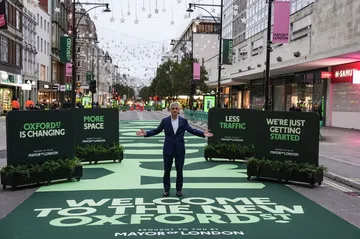
伦敦的圣诞购物将不再相同。牛津街一段长达1公里的路段已永久禁止车辆通行,伦敦市长将此描述为一个具有里程碑意义的时刻,使英国最著名的零售大道与纽约时代广场、巴黎香榭丽舍大街和巴塞罗那兰布拉大道齐名。禁行交通并非能为全国其他陷入困境的商业主干道提供灵丹妙药。尽管如此,这一历史性变革仍蕴含着更广泛的启示。
Christmas shopping in London will never be the same. Oxford Street has become permanently vehicle-free along a 1-kilometer stretch, in what the city’s mayor describes as a momentous occasion that puts the UK’s most famous retail thoroughfare on par with New York’s Times Square, the Champs-Elysees in Paris and Barcelona’s La Rambla. Banning traffic offers no magic elixir for the rest of the country’s struggling high streets. There are wider lessons in this historic transformation nonetheless.
首先,感受这份喜悦。商店的集中度和多样性曾使得圣诞前夕前往牛津街,对伦敦及周边地区数百万人来说几乎成了一种义务。这通常意味着要在拥挤不堪的人行道上,艰难地挤过人山人海。本文作者上周在禁令生效的第二天前往实地探访时,无人遭遇推挤。这种节日般的氛围和宽敞感还需要一些时间来适应。走在尚未重新划线的路面标记上,每当听到附近有喇叭声,我都会下意识缩一下脖子,以为身后会冒出一辆公交车。
First, feel the joy. The concentration and variety of shops once made a pre-Christmas outing to Oxford Street almost obligatory for millions of people in London and surrounding areas. This usually meant a grim struggle through a melee of bodies on an overcrowded pavement. When this writer visited last week on the second day of the ban, no one was getting jostled. The festival-like feeling and sense of space will take some getting used to. Walking over road markings that have yet to be repainted, I flinched every time I heard a nearby horn, expecting a bus to appear behind me.
牛津街虽享誉全球,但近年已失去魅力,受制于网络零售的崛起,以及提供购物、娱乐和餐饮一体化、且可避风挡雨的大型购物中心的竞争。这条城市大道至少还拥有历史底蕴。它修长笔直,沿袭了罗马人修建的一条通往西方的道路,通向入侵者所谓的“隆迪尼姆”。中世纪时,它被称为“泰伯恩路”,是死刑犯从新盖特监狱被押往公开处刑地的最后一程,处刑地靠近如今位于牛津街西端的大理石拱门。
Oxford Street may be world-renowned but it has lost its cachet in recent years, assailed by the rise of online retailing and competition from giant malls that offer shopping, entertainment and food-and-drink outlets all under one roof, sheltered from the elements. The urban thoroughfare at least has history on its side. Long and straight, it traces the route of a road built by the Romans that led west out of what the invaders called Londinium. In medieval times, it was known as Tyburn Road and was the final journey for the condemned being taken from Newgate Prison to public executions in an area close to what is now Marble Arch, at the western end of Oxford Street.
这个现代名称反映了它位于通往牛津市的路线上,可追溯至18世纪。那时,皮货商、珠宝商和家庭用品商等商人开始在该街道经营。百货公司则在19世纪随之而来。1864年,布商约翰·刘易斯在该街道开设了第一家店铺。1909年,美国企业家哈里·戈登·塞尔弗里奇紧随其后,在一座拥有柱廊式新古典主义风格立面的宏伟商场里,将现代美国百货公司经营模式带到了伦敦。
The modern name, which acknowledges its place on the route to the city of Oxford, dates from the 1700s. That’s when merchants such as furriers, jewelers and household-goods dealers started to operate from the street. Department stores followed in the 19th century. John Lewis, a draper, opened his first shop on the street in 1864. American entrepreneur Harry Gordon Selfridge followed in 1909, bringing modern US department-store methods to London in a grand emporium with a colonnaded Beaux Arts-style facade.
它们至今仍是牛津街的主要核心店铺:约翰·刘易斯合伙人有限公司现为英国最大的员工持股企业,而塞尔弗里奇百货公司则由泰国的中央集团和沙特阿拉伯的公共投资基金所有。
They remain Oxford Street’s principal anchor stores: John Lewis Partnership Plc is now the UK’s largest employee-owned business, while Selfridges is owned by Thailand’s Central Group and Saudi Arabia’s Public Investment Fund.
牛津街演变的最新一步早已过期。疫情进一步削弱了这条大街的吸引力,空置率飙升,纪念品店和糖果店等低质量租户搬了进来——其中一些可能与洗钱有关。威斯敏斯特市议会在2023年的一份报告中干巴巴地指出:“我们认为,极不可能有足够的经济利益支撑这么多美国糖果店在如此小的地理区域内生存。”租户往往是没有资产的空壳公司,当市议会追讨拖欠的商业税率时,这些公司便解散了,留下数百万英镑的未付账单。
The latest step in Oxford Street’s evolution was long overdue. The pandemic further diminished the thoroughfare’s appeal, as vacancy rates shot up and lower-quality tenants such as souvenir shops and candy stores moved in — some of which may have been connected with money laundering. “It was our view that it is highly unlikely that there was enough economic interest in American candy to sustain so many stores in such a small geography,” Westminster City Council noted drily in a 2023 report. Occupiers were often shell companies with no assets, which dissolved when the council pursued them for overdue business rates, leaving millions of pounds in unpaid bills.
危机期已过,游客数量已反弹。据伦敦市政厅称,2022年该区域为伦敦经济贡献了约250亿英镑(330亿美元),相当于首都增加总值的5%。但牛津街的复苏滞毗邻的摄政街和邦德街,后者因所有权碎片化程度较低,使房东能够对租户组合采取更具战略性的眼光。截至2024年11月,牛津街的客流量仅为2006年水平的57%,而摄政街为83%,邦德街为98%。
The crisis period has passed and visitor numbers have rebounded. The area contributed an estimated £25 billion ($33 billion) to London’s economy in 2022, equivalent to 5% of the capital’s gross value added, according to City Hall. But Oxford Street has lagged the recovery in adjoining Regent Street and Bond Street, where a less fragmented ownership enabled landlords to take a more strategic view of the tenant mix. As of November 2024, Oxford Street’s foot traffic was at 57% of its 2006 level, compared with 83% for Regent Street and 98% for Bond Street.
牛津街依然拥有全球知名的旅游形象,每年吸引1.2亿人次到访,其中85%的游客乘坐公共交通工具抵达。但这条全长2公里的街道上咖啡馆和餐饮店稀缺,急需一个让购物者驻足停留的理由。按伦敦市长萨迪克·汗的计划,移除车辆、增设树木、长椅和公共空间将有所帮助。之后就要看市场如何反应了。
Oxford Street still has a global tourist profile and attracts 120 million visits a year, with 85% of people arriving by public transport. But with a dearth of cafes and food outlets along its full 2-km span, the street urgently needs a reason for shoppers to linger. Removing vehicles and adding more trees, benches and public spaces, as London Mayor Sadiq Khan plans to do, will help. It will then be up to the market to respond.
市长的计划正分阶段推进,第一阶段仅将半条街道步行化,仍允许车辆在若干路口通行。这让设计师能够观察公众反应并做出调整,遵循了哥本哈根、维也纳和纽约等城市过往成功项目的模式。(伦敦市长团队曾与珍妮特·萨迪克-汗密切合作,后者曾任纽约市交通局局长,在时任市长迈克尔·布隆伯格领导下主导了时代广场的步行化改造;布隆伯格是彭博有限合伙企业的创始人兼所有者。萨迪克-汗现为彭博咨询公司合伙人,该慈善咨询机构为全球城市提供建议。)
The mayor’s plan is proceeding incrementally, with only half the street pedestrianized in the first phase and vehicles still allowed to cross at several intersections. This allows designers to gauge public reaction and make adjustments, following the model of past successful programs in cities including Copenhagen, Vienna and New York. (The London mayor’s team has worked closely with Janette Sadik-Khan, who as New York transport commissioner led the pedestrianization of Times Square under then-Mayor Michael Bloomberg, the founder and owner of Bloomberg LP. Sadik-Khan is a principal at Bloomberg Associates, a philanthropic consultancy that advises cities around the world.)
这并非为英国更广泛的商业街复兴提供了模板。与许多商业街不同,牛津街最初并未衰败。英国许多城镇已尝试过禁行机动车,结果好坏参半。步行化可能锦上添花,却无法创造繁荣,后者取决于包括区域独特性和交通连接在内的众多其他因素。
There’s no template here for a broader revival of Britain’s high streets. Unlike many of them, Oxford Street wasn’t dying to begin with. And banning traffic has already been tried in many UK towns, with mixed results. Pedestrianization may enhance but can’t create prosperity, which depends on a plethora of other factors including the area’s distinctiveness and transport links.
对英国经济真正的启示在于这一变革是如何实现的。事实上,牛津街步行化是显而易见的选择;私家车早在半个多世纪前就已被禁行,道路主要留给公共汽车、出租车、自行车和送货车辆。汗本人的计划可追溯至2016年他就任市长之时。威斯敏斯特市议会的反对曾阻碍其早日落地。
The real takeaway for the UK economy is in how the change got done. In truth, pedestrianizing Oxford Street was an obvious choice; private cars were banned more than half a century ago, leaving the road largely to buses, taxis, cyclists and delivery vehicles. Khan’s own plan dates back to when he became mayor in 2016. Opposition from Westminster City Council prevented it from happening earlier.
最终打破僵局的是设立市长开发公司,该机构将规划权从地方政府手中收回。此举被批评为不民主,这点见仁见智。担心交通分流带来干扰的当地居民反对此类提案,以及对选民负责的威斯敏斯特市代表支持这些提案,都是合乎情理的。但当你住在国家资产旁边时,更广泛的社区也拥有利益相关权。去年一次咨询显示,十分之七的伦敦人支持步行化改造。
What finally broke the deadlock was the creation of a mayoral development corporation, which took planning powers out of the hands of the local authority. That’s been criticized as undemocratic, which is debatable. It’s rational for local residents who fear the disruption of displaced traffic to oppose such proposals — and for Westminster city representatives, who are accountable to their voters, to support them. But when you live beside a national asset, the broader community has a stake. Seven out of 10 Londoners supported pedestrianization in a consultation last year.
这件事的影响远超零售业,直指英国未能建设许多所需设施(尤其是住房)的核心症结。开发公司能够打破阻碍变革的僵化机制和“邻避效应”(NIMBYism)。英国应更多地运用这一工具:牛津街刚刚为其做了一次橱窗展示。
This has far wider implications than retailing and goes to the heart of Britain’s failure to build many of the things it needs, particularly housing. Development corporations can cut through the sclerosis and NIMBYism that frustrate change. The country should make more use of this tool: Oxford Street just put it in the shop window.