在周二的民主党大获全胜中,选民对唐纳德·特朗普总统的否定之强烈,为几十年来任何一位总统所罕见。
In Tuesday’s emphatic Democratic sweep, voters repudiated President Donald Trump as resoundingly as any president in decades.
这一结果将共和党的希望化为泡影——他们曾希望特朗普打造出一场政治重组,其基础是扩大在工薪阶层少数族裔选民中的支持。这场惨败还暴露出,自2016年以来一直支撑特朗普的“让美国再次伟大”(MAGA)核心联盟——由未上过大学的白人和农村选民组成——出现了一些裂痕。特朗普如何回应,可能不仅影响共和党未来两年的命运,还会影响2028年接替他之位的选举。
The results reduced to rubble Republican hopes that Trump had engineered a political realignment grounded in expanded support from working-class minority voters. The drubbing also exposed some cracks in the core MAGA coalition of non-college White and rural voters that has sustained Trump since 2016. How Trump responds could shape the GOP’s fate not only over the next two years, but the 2028 election to succeed him.
特朗普恳求选民假装他也在选票上,出口民调显示选民确实这样做了。在为多家新闻机构联合进行的全国选民民调中,仅有38%的选民认可特朗普的执政表现,62%不认可,远弱于他在2018年的支持率。调查中近三分之二的选民表示,关税以及特朗普的整体议程损害了经济。大约五分之三的选民表示,特朗普将个人经济利益置于国家利益之上,且高物价是其政策的直接结果,而非他无法控制的因素所致。
Trump begged voters to pretend he was on the ballot, and exit polls suggest they did. In the national Voter Poll conducted for a consortium of news organizations, just 38% of voters approved of Trump’s job performance while 62% disapproved, much weaker than his standing in 2018. Nearly two-thirds of voters in the survey said tariffs, and Trump’s overall agenda, had hurt the economy. Roughly three-fifths said Trump prioritized his own financial interests over the country’s, and that high prices were a direct result of his policies, rather than factors outside of his control.
在特朗普的第一个任期内,对他的反对更多集中在他本人身上,而非其政策上;如今,他更多具体的政策选择面临广泛反对。
In Trump’s first term, opposition to him centered more on than ; now, far more of his specific policy choices face broad opposition.
特朗普支持率下滑的深度固然重要,其广度同样重要。2018年,特朗普在大多数偏红州的认可率仍高于50%,这使得共和党得以在北达科他州、密苏里州、印第安纳州和佛罗里达州击败民主党参议员。然而这一次,即便在两年前他曾以55%或更高得票率获胜的州——包括俄亥俄州、得克萨斯州、南卡罗来纳州、艾奥瓦州和堪萨斯州——特朗普也面临多数不认可。甚至在关键州,约半数没有大学学位的白人选民——特朗普的核心群体——也不认可他的表现。
As important as the depth of Trump’s decline was its breadth. In 2018, Trump’s approval remained above 50% in most red-leaning states, which allowed Republicans to oust Democratic senators in North Dakota, Missouri, Indiana and Florida. This time, however, Trump faced majority disapproval even in states where he had won 55% of the vote or more two years ago, including Ohio, Texas, South Carolina, Iowa and Kansas. Even about half of White voters without a college degree — Trump’s core group — disapproved of his performance in crucial states.
关键的摇摆选民群体,包括独立选民和受过大学教育的白人男性,周二再次倾向于民主党。尤其在中部和锈带州,民主党也在白人蓝领选民中夺回了一些支持。但对两党权力平衡具有最长远影响的转变,是共和党在特朗普2024年获得最大增长的群体中的退步。
Key swing groups in the electorate, including independents and college-educated White men, tilted back toward Democrats on Tuesday. Especially in heartland and Rust Belt states, Democrats also clawed back some ground with working-class White voters. But the shift with the greatest long-term implications for the balance of power between the parties was the GOP’s retreat among the groups where Trump made his greatest gains in 2024.
在2024年选举中,特朗普在非白人且未受过大学教育的选民中扩大了共和党的影响力,根据非党派皮尤研究中心的Validated Voters研究,这一群体的支持率几乎翻倍,达到五分之二。增长在拉美裔和亚裔美国人(男女皆有)以及黑人男性中尤为显著。这些收获至关重要,因为它们为共和党摆脱人口结构压缩提供了出路——其最忠诚的群体——福音派白人基督徒和未受大学教育的白人选民的人口在下降。
In the 2024 election, Trump expanded the GOP’s reach among non-White voters without a college education, nearly doubling his 2016 share with this group to two-fifths, according to the Validated Voters studies by the non-partisan Pew Research Center. The increase was particularly pronounced among Latinos and Asian Americans of both genders, as well as Black men. Those gains were vital because they mapped a way out for Republicans from the demographic squeeze created by the decline in the population of their most loyal groups — evangelical White Christians and White voters without a college degree.
共和党策略家曾欣喜地预测,特朗普通过打造所谓的“多族裔蓝领联盟”,已经建立了持久的共和优势。但周二的结果显示,这些预测为时过早。
Republican strategists exuberantly predicted that Trump had built a durable Republican advantage by forging what they called a “multiracial working-class coalition.”But Tuesday’s results showed that those predictions were wildly premature.
在全国针对众议院投票方式的出口民调中,民主党周二获得了61%的拉美裔、69%的亚裔美国人、88%的黑人选民(其中包括83%的黑人男性)以及71%的18至29岁成年人支持。更广泛的所有未受大学教育的非白人选民中,民主党以67比29的比例领先,这一比例远好于2024年的表现,出口民调显示。这些数据使民主党在这些群体中的支持回到2020年领先的水平,实际上抹去了特朗普在2024年取得的几乎所有增幅。
In the national exit polls measuring how people voted for the House of Representatives, Democrats on Tuesday carried 61% of Latinos, 69% of Asian Americans, 88% of Black voters (including 83% of Black men) and 71% of adults aged 18–29. The broader group of all non-White voters without a college degree preferred Democrats by a 67-29 margin, much better than in 2024, the exit poll found. Those showings brought Democrats back within range of their lead with those groups in 2020, in effect erasing almost all the gains Trump recorded in 2024.
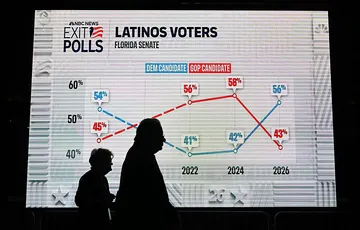
选情结果证实了这些趋势。特朗普2024年拉美裔选民支持率上升的核心地区是得克萨斯州与墨西哥边境的里奥格兰德河谷县。但民主党在那里守住了两名共和党试图通过选区划分将其赶下台的现任议员,并在南得克萨斯州一个共和党持有的席位上,凭借特哈诺歌手鲍比·普利多的支持实现了翻盘。2024年,特朗普在希达尔戈县和卡梅伦县取得巨大进展,赢下这两个县(此前他在2016年两个县都输了至少30个百分点);周二,民主党参议院候选人詹姆斯·塔拉里科在两个县都取得了决定性胜利,最终击败肯·帕克斯顿。
Results on the ground confirmed these trends. The epicenter of Trump’s 2024 Latino gains were the Rio Grande Valley counties along the Texas- Mexico border. But Democrats defended two incumbents there that Republicans tried to oust through their gerrymander and flipped a GOP-held South Texas seat behind Tejano singer Bobby Pulido. In 2024, Trump made massive gains in Hidalgo and Cameron counties, carrying each of them (after losing both by at least 30 points in 2016); on Tuesday, Democratic Senate candidate James Talarico won each decisively en route to his victory over Ken Paxton.
尽管如此,几乎没有证据表明少数族裔选民已像奥巴马时期那样可靠地回归民主党阵营。尽管民主党在少数族裔中的支持率恢复到了2020年的水平,但选民民调仍显示该党获得的支持率低于2018年及更早时期。相反,共和党的损失表明,非白人选民——尤其是拉美裔——已成为美国最大的摇摆选民群体,双方都有可能吸引他们。
Nevertheless, there was little evidence minority voters have returned as reliably to the Democratic camp as during the Barack Obama years. Although Democrats restored their support among them to 2020 levels, the Voter poll still found the party attracting less support than in 2018 and earlier. Instead, the GOP losses point toward non-White voters — especially Latinos — as the nation’s largest bloc of swing voters that either side can attract.
即使像民主党周二取得的那样规模的中期选举大胜,也不能保证该党在下一届总统选举中获胜。但同样真实的是,自1900年以来,每当一位总统离任时的不受欢迎程度像特朗普现在这样时,继任总统选举中白宫控制权都会易手给另一党派。(想想:伍德罗·威尔逊在1920年,哈里·杜鲁门在1952年,林登·约翰逊在1968年,小乔治·布什在2008年,乔·拜登在2024年。)
Even sweeping midterm gains of the sort Democrats notched Tuesday don’t guarantee a party victory in the next presidential race. But it’s also true that since 1900 every time a president has left office as unpopular as Trump is now, control of the White House has flipped to the other party in the election to succeed him. (Think: Woodrow Wilson in 1920, Harry Truman in 1952, Lyndon Johnson in 1968, George W. Bush in 2008 and Joe Biden in 2024.)
长期民主党民调专家塞琳达·莱克今年秋天早些时候告诉我,特朗普正面临“她职业生涯中所见过的总统失败感最广泛的情况”。“这比他在2018年,甚至比小乔治·布什在2006年时都要广泛。”周二的选举结果大多验证了她的评估。
Celinda Lake, a longtime Democratic pollster, told me earlier this fall that Trump is facing “the broadest sense we’ve had that a president has failed” that she has seen in her career. “It is broader than it was in 2018 for him, or even for George W. Bush in 2006.”Tuesday’s results mostly validated her assessment.
如果特朗普不能至少挽回一部分他已失去的支持,这段历史表明,民主党将在2028年总统竞选中占据优势。对于在废墟中茫然翻找的共和党人来说,这或许是最令人沮丧的一点:他们意识到,自己在下一场选举中的命运,同样可能取决于唐纳德·特朗普是否回应这一片强烈的拒绝之声。
If Trump doesn’t recover at least some of the support he’s squandered, that history suggests Democrats will be favored in the 2028 presidential race. For dazed Republicans picking through the rubble, that may be the most discouraging part: recognizing that their fate in the next election, too, could hinge on whether Donald Trump responds to this roar of rejection.