阿廖娜在家乡克拉马托尔斯克破水时,该地距离前线仅10公里。该市没有正常运作的产科病房,一辆救护车将她送往斯拉维扬斯,车程很短,沿途有反无人机网覆盖。随后并发症迫使她进行了数小时的长途跋涉前往哈尔科夫,并于10月8日在那里生下一名儿子。那家医院也有危险:空袭期间,母亲和新生儿会被紧急转移到地下掩体。但那里比克拉马托尔斯克更安全,同一天,一枚俄罗斯炸弹在克拉马托尔斯克造成30人死亡。
Alyona’s waters broke in her hometown of Kramatorsk, 10km from the front line. The city has no functioning maternity ward, so an ambulance took her to Sloviansk, a short drive under a canopy of anti-drone netting. Complications then forced her to make an hours-long trip to Kharkiv, where on October 8th she gave birth to a son. That hospital had its dangers too: during air raids mothers and newborns are rushed to a bunker. But it was safer than Kramatorsk, where on the same day a Russian bomb killed 30 people.
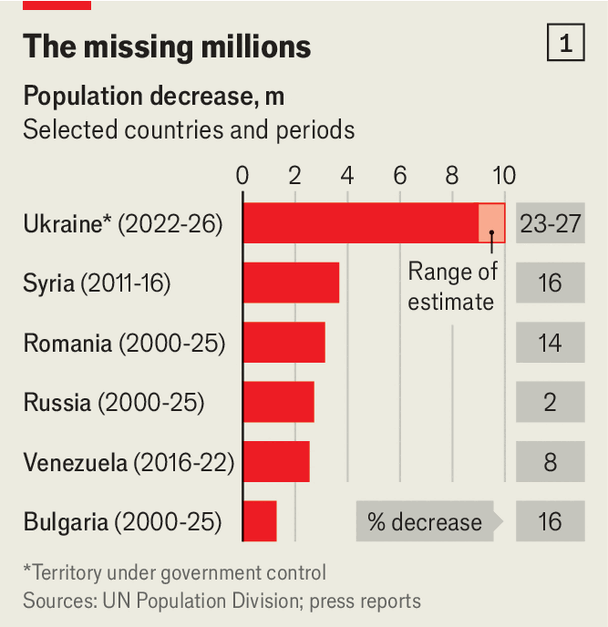
阿廖娜是少数人之一。乌克兰的出生率正在下降,部分原因是成年人减少了。自2022年俄罗斯全面入侵以来,政府控制领土内的人口已从约3700万降至2700万至2800万(见图1)。目前约有300万至500万乌克兰人生活在俄罗斯占领下,还有数百万人移民。乌克兰总统弗拉基米尔·泽连斯基将战斗死亡人数定为超过5万人;独立估计则接近15万人。数千名平民被杀害,俄罗斯已将超过2万名儿童驱逐,试图将其俄化。
Alyona is one of the few. Births in Ukraine are falling, in part because there are fewer adults. Since Russia’s full-scale invasion in 2022 the population inside government-controlled territory has fallen from about 37m to 27m-28m (see chart 1). Around 3m-5m Ukrainians now live under Russian occupation, and millions more have emigrated. Ukraine’s president, Volodymyr Zelensky, puts combat deaths at over 50,000; an independent estimate is closer to 150,000. Thousands of civilians have been killed, and Russia has deported over 20,000 children to Russify them.
此外,战时并不适合组建家庭。生育率已从2020年每名妇女1.2名儿童降至0.8至0.9,低于除韩国外的任何大国。维持人口稳定所需的更替生育率为2.1。在2026年上半年,死亡人数超过出生人数超过三倍。
Wartime, moreover, is not good for starting families. The fertility rate has dropped from 1.2 children per woman in 2020 to 0.8-0.9, lower than any big country but South Korea. The replacement rate, needed to keep the population stable, is 2.1. In the first half of 2026 deaths outnumbered births by more than three to one.
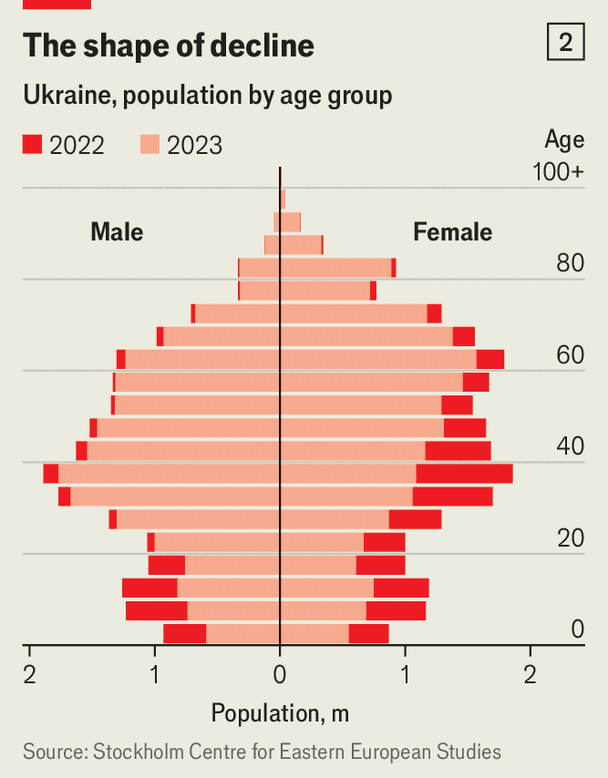
自1991年独立以来,乌克兰的出生率每年都落后于死亡率,当时该国(包括克里米亚和顿巴斯)约有5200万居民。战争将这一差距变成了鸿沟。俄罗斯的人口也在减少,但乌克兰的困境远为严重。对于一个受其帝国邻国攻击的国家来说,人口崩溃是一个生存性忧虑(见图2)。
Ukraine’s birth rate has lagged behind the mortality rate every year since independence in 1991, when the country (including Crimea and Donbas) had about 52m inhabitants. The war has turned that gap into a chasm. Russia’s population is getting smaller too, but Ukraine’s predicament is far worse. For a country under attack by its imperial neighbour, a demographic collapse is an existential worry (see chart 2).
难民外流导致人口下降幅度最大。超过500万乌克兰人生活在国外,大多在欧洲。俄罗斯今冬加强的无人机和导弹袭击可能迫使更多成千上万的人离开。更糟糕的是,越来越少的难民表示计划回国。据基辅的经济战略中心(ces)称,这一比例已从2022年底的74%降至43%。大多数难民是儿童和44岁以下的妇女,这加剧了损失。“我们也在失去未来,”基辅米哈伊洛·普图哈人口学研究所所长埃拉·利巴诺娃说。
The refugee exodus accounts for the largest decline. Over 5m Ukrainians live abroad, mostly in Europe. Russia’s redoubled drone and missile attacks this winter could drive thousands more to leave. Worse, fewer refugees now say they plan to come home. The share has fallen from 74% in late 2022 to 43%, according to the Centre for Economic Strategy (ces) in Kyiv. Most refugees are children and women under 44, compounding the damage. “We are also losing our future,” says Ella Libanova, director of the Mykhaylo Ptoukha Institute for Demography in Kyiv.
在国内,动员、战斗伤亡和战时不确定性正在缩小潜在父母的群体。另一位人口学家斯维特拉娜·阿克肖诺娃表示,大多数乌克兰夫妇都在推迟生育,她补充道:“推迟生育的时间越长,孩子可能永远不会出生的风险就越大。”乌克兰免除25岁以下男子服兵役的初衷是为了缓解人口下降。但数十万年轻男子已前往国外;自2025年8月起,乌克兰允许23岁以下男子出国。许多留下的人无意组建家庭。
At home, mobilisation, combat casualties and wartime uncertainty are shrinking the pool of prospective fathers and mothers. Most Ukrainian couples are putting off childbearing, says Svetlana Aksyonova, another demographer, adding: “The longer you postpone having children, the greater the risk the child will never be born.”Ukraine’s exemption of men under 25 from conscription was intended to cushion the demographic decline. But hundreds of thousands of young men have gone abroad; since August 2025 Ukraine has allowed men under 23 to do so. Many who remain have no intention of starting a family.
最近的预测显示,最好的情况也只是下降速度放缓——前提是战争在几年内结束。1990年代和2000年代出生的一代是乌克兰现代史上最小的一代,因此不能期待战后的“生育高峰”,乌克兰智库前沿研究所的奥尔加·杜赫尼奇说。政府两年前采纳的人口战略曾预计到2030年人口将小幅回升。但该战略也预计2026年实现和平并回归1991年边界,而这已不再可能。
Recent projections see at best a slower decline—assuming the war ends within a few years. The generation born in the 1990s and 2000s is Ukraine’s smallest in modern history, so it cannot expect a post-war “baby boom”, says Olga Dukhnich of the Frontier Institute, a Ukrainian think-tank. The government’s demographic strategy, adopted two years ago, envisaged a slight population rebound by 2030. But it also envisaged peace in 2026 and returning to 1991 borders, which no longer looks possible.
联合国的一个更现实的情景预测,未来几十年每年将下降0.7%至0.9%。这将使乌克兰在2040年只剩下约2500万人,前提是被占领领土不得以收复。如果战争拖入2030年代,将加剧危机,导致数百万在1990年代出生的人完全放弃生育。阿克肖诺娃女士表示,生育率可能降至每名妇女0.6个孩子,且大部分出生发生在该国相对安全的西部地区。前线地区将走向人口锐减的道路。
A more realistic scenario from the United Nations projects an annual decline of 0.7-0.9% for the next couple of decades. That would leave Ukraine with about 25m people in 2040, assuming no recovery of occupied territory. If war stretches into the 2030s it would exacerbate the crisis, leading millions born in the 1990s to forgo having kids altogether. The fertility rate could go as low as 0.6 children per woman, says Ms Aksyonova, with most births in the country’s safer west. Frontline areas would be on a path towards depopulation.
为减缓下降,乌克兰正在提供激励措施。一项新法律规定,每名新生儿给予父母50000格里夫纳(约合1100美元),第一年每月再发放7000格里夫纳。其他项目帮助支付托儿费用。自2024年起,乌克兰为女性提供不孕症治疗。士兵可以免费冷冻卵子或精子。但专家表示,即使在和平时期,补贴对出生率的影响也有限,更何况是在战争中。“在这样的条件下,如何鼓励生育?”利巴诺娃女士问道。
To slow the decline, Ukraine is offering incentives. A new law pays parents 50,000 hryvnia ($1,100) per newborn, plus 7,000 hryvnia per month for the first year. Other programmes help pay for child care. Since 2024 Ukraine has covered infertility treatment for women. Soldiers can freeze their eggs or sperm free of charge. Yet subsidies have a limited effect on birth rates even in peacetime, experts say, let alone in war. “How can you encourage having children in such conditions?” asks Ms Libanova.
俄罗斯正在庆祝乌克兰的人口下降。“这不仅是一场危机,”俄罗斯安全委员会副主席德米特里·梅德韦杰夫去年5月表示,“而且是一个民族生物学死亡的证据。”弗拉基米尔·普京的顾问安东·科比亚科夫主张,像18世纪叶卡捷琳娜大帝那样,在乌克兰安置俄罗斯人。“[乌克兰]所剩无几的只是灭绝,只有俄罗斯能拯救这个国家,”他去年9月表示。这是胡说;乌克兰可以作为一个较小的国家生存下来。但此类言论表明,俄罗斯开始将人口锐减视为一项战争目标。
Russia is celebrating Ukraine’s decline. “This is not just a crisis,” Dmitry Medvedev, deputy chairman of Russia’s Security Council, said in May, “but evidence of the biological death of a nation.”Anton Kobyakov, an adviser to Vladimir Putin, advocates settling Russians in Ukraine as Catherine the Great did in the 18th century. “All that remains [for Ukraine] is extinction, and only Russia can save the country,” he said in September. That is nonsense; Ukraine can survive as a smaller country. But such remarks suggest Russia is starting to view depopulation as a war objective.
战争最终结束时,移民或许能提供帮助。乌克兰的经济已经面临劳动力短缺。欧洲复兴开发银行表示,该国面临250万人的劳动力缺口。乌克兰注册的移民工人仅约9500人,而渴望雇佣外国人的公司抱怨官僚障碍。但政府更倾向于在国内寻找新劳动力,即妇女、退伍军人和流离失所者。
When the war finally ends, immigration could help. Ukraine’s economy is already starved of workers. The country faces a labour shortage of 2.5m people, says the European Bank for Reconstruction and Development. Only about 9,500 migrant workers are registered in Ukraine, and companies keen to hire foreigners complain of bureaucratic obstacles. But the government prefers to seek new workers at home, among women, war veterans and displaced persons.
这很困难。退伍军人难以找到工作,尽管战时数据不可用,专家认为女性劳动参与率并未大幅上升。有限的托儿服务似乎是主要障碍。尽管如此,移民仍被视为最后的选择。乌克兰经济部副部长达里娅·马尔恰克表示,只有在“充分挖掘”乌克兰国内和海外乌克兰人的潜力之后,才会向外国工人开放。但CES的赫利布·维什林斯基表示,战后重建国家所需的人力将远远不足。
That is difficult. Veterans struggle to find work, and though wartime data are unavailable, experts think female labour participation has not risen much. Limited child care appears to be the main barrier. Still, immigration is seen as a last resort. Ukraine would open up to foreign workers “only after we fully explore the potential” of Ukrainians at home and abroad, says Dariia Marchak, the deputy economy minister. But there will be too few of them to rebuild the country after the war, says Hlib Vyshlinsky of CES.
“我百分之百确定乌克兰将需要外国工人。”一些乌克兰人正在克服生育障碍。达里娅在哈尔科夫市中心的公园里与男友散步,她说她刚从敖德萨搬到这座城市,准备组建家庭。(听到这话,她的男友看起来既感动又惊讶。)其他人则走得更远。东乌克兰第聂伯罗附近一名30多岁的女兵柳德米拉说,她去年开始冷冻卵子。
“I’m a hundred percent sure Ukraine will need foreign workers.”Some Ukrainians are defying the obstacles to having children. Daria, strolling with her boyfriend in a park in central Kharkiv, says she has just moved to the city from Odessa to start a family. (Her boyfriend looks both touched and surprised to hear it.) Others are going to greater lengths. Liudmyla, a soldier in her late 30s near Dnipro, in eastern Ukraine, says she started freezing her eggs last year.
战前她梦想生两个孩子,但现在她想生三个。“一个是为了死者,”她引用乌克兰民族诗人塔拉斯·舍甫琴科的话说,“一个是为了生者,还有一个是为了尚未出生的人。”
Before the war she dreamed of two children, but now she wants three. “One for the dead,” she says, paraphrasing Taras Shevchenko, Ukraine’s national poet, “one for the living, and one for the yet to be born.