
新西兰大选结果依然难以预测,但选民已对主要政党做出了明确裁决,让较小的竞争对手取得了有史以来最好的成绩,重塑了该国的政治版图。
New Zealand’s election remains too close to call, but voters have already delivered a decisive verdict on the major parties, handing smaller rivals their best-ever results and reshaping the country’s political landscape.
选举委员会预测,由中右翼国家党、自由意志主义行动党和民族主义新西兰优先党组成的右倾阵营,将在扩大后的131席议会中获得67个席位。随着特别选票的计数,最终的力量对比仍可能发生变化。
The Electoral Commission projects the right-leaning bloc — made up of the center-right National Party, libertarian ACT party and nationalist New Zealand First — will secure 67 seats in an expanded 131-seat parliament. The final balance may still shift as special votes are counted.
这一不明朗的结果——要几周后才会最终确定——让政客、专家和评论员都感到困惑。
The unclear result — which won’t be finalized for weeks — has confounded politicians, experts and pundits alike.
“我一直在与该领域的其他学者、评论员、前政客、现任政客交谈,大家都很困惑,因为目前没有人获胜,”惠灵顿维多利亚大学政治学副教授拉拉·格里夫斯说。
“I’ve been talking to other academics in the field, commentators, former politicians, current politicians and everyone is confused, because no one’s won at this point,” said Lara Greaves, associate professor in politics at Victoria University of Wellington.
“看起来肯定是偏向右翼,”她补充道,并表示“围绕合法性和授权也会有很多问题。”
“It definitely looks like it’s leaning right,” she said, adding there would be “a lot of questions around legitimacy and mandate as well.”
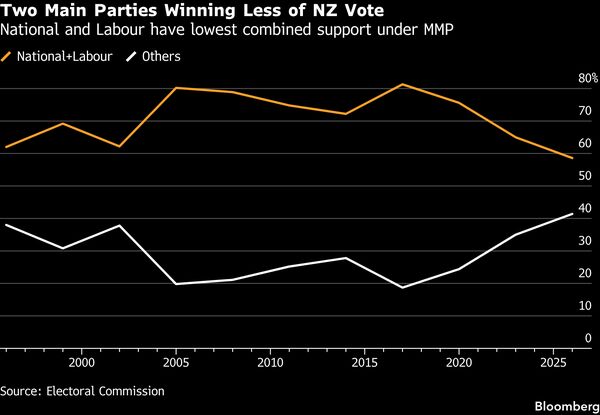
曾任国家党政府新闻秘书、现为政治评论员和公关顾问的本·托马斯将其描述为“我们历史上最奇怪的选举结果之一。”在所有常规选票计数完毕后,国家党和中左翼工党各自获得略高于29%的选票。这对国家党来说是一个陡峭的下滑,该党在2023年大选中获得了38%的最终得票率;而对工党而言则是适度上升,该党上次获得的选票略低于27%。
Ben Thomas, a former National government press secretary who now works as a political commentator and public relations consultant, described it as “one of the strangest election results in our history.”With all regular votes counted, National and the center-left Labour Party each captured just over 29% of the vote. That’s a steep decline for National, which got 38% of the final vote in 2023, and a modest uptick for Labour, which got just under 27% of votes.
这些预测显示,由工党、绿党和毛利党组成的中左翼阵营持有57个席位,但如果中间派机会党选择加入该阵营,席位可能增至64个。机会党将首次进入议会,预计获得七个席位。
Those projections show the center-left — consisting of the Labour Party, the Green Party and Te Pāti Māori —holding 57 seats but that could grow to 64 if the centrist Opportunity Party, which is set to enter parliament for the first time with seven seats, chose to join the bloc.
机会党领袖齐奥拉·王表示,她将首先与议会最大党谈论合作事宜。此前大选期间多次排除与机会党合作的总理克里斯托弗·拉克森周日对这一前景表现出更开放的态度。
Opportunity leader Qiulae Wong has said she would talk about collaboration with the largest party in parliament first. Prime Minister Christopher Luxon, who repeatedly ruled out working with Opportunity before the election, appeared more open to that prospect on Sunday.
“就目前的情况而言,我们不需要机会党来组建政府,”他对记者说。“无论特别票计入后数字如何,我认为与齐奥拉及机会党建立关系完全合适。”在小党中,绿党取得了有史以来最好的大选成绩,而行动党和新西兰优先党获得的选票比例均高于上届大选。
“As we currently stand today, we don’t need Opportunity to form a government,” he told reporters. “Regardless of what numbers are when the special votes come in, I do think it’s entirely appropriate to build a relationship with Qiulae and with Opportunity.”Among the minor parties, the Green Party posted its best ever election result, while ACT and New Zealand First both received higher percentages of the vote than in the last election.
这一结果反映出全球其他大选中也出现的选民分化现象,在生活成本危机和动荡不安的背景下,对主要政党感到失望的选民正在寻求替代选择。在澳大利亚,由保琳·汉森领导的极右翼“一个国家党”在民意调查中的支持率飙升至约30%,超越了主要政党;而在英国,奈杰尔·法拉奇领导的“改革英国党”在民调中的平均支持率约为22%。
The result reflects a splintering of voters witnessed in other elections globally, where voters disenchanted with major parties amid a cost of living crisis and instability seek alternatives. In Australia, the far-right One Nation party, led by Pauline Hanson, has surged to about 30% in opinion polls, eclipsing the major parties, while Nigel Farage’s Reform UK party is averaging roughly 22% in British polling.
新西兰1996年引入的混合成员比例代表制(MMP)投票制度,为对主要政党不满的选民提供了一个渠道,让他们可以投票给小党,而不必担心选票被浪费。投给无法进入议会的政党的选票不足1%,而2023年这一比例接近5%。
New Zealand’s mixed-member-proportional (MMP) voting system, introduced in 1996, provides a channel for people who are dissatisfied with the major parties to vote for minor parties without the concern that it will be wasted. Less than 1% of votes went to parties that won’t be in parliament compared to almost 5% in 2023.
最终的得票分配要等到11月27日才能揭晓,届时关键的最终特别选票结果将公布,各党关于联合组阁的谈判才能真正开始。
The final split of votes will not be known until Nov. 27, when the results of the crucial final special ballots will be announced, allowing party negotiations regarding coalitions to begin in earnest.
根据选举委员会的数据,特别选票是指在投票期间身在海外或不在其本选区的选民所投的票,此类选票近40万张有待统计。
Special votes are those cast by people overseas or otherwise outside their home electorate during the polling period, and there are nearly 400,000 of them to tally, according to the Electoral Commission.
政治评论员、惠灵顿民调公司Curia Market Research创始人David Farrar表示,工党执政的可能性“非常小”。
David Farrar, a political commentator and founder of Wellington-based polling firm Curia Market Research, said it’s “very unlikely” Labour can take power.
他说:“从数学上讲,工党组建政府是可能的,但这需要很多因素都向有利于他们的方向发展。”
“Mathematically it’s possible Labour could form a government, but it would require a lot to fall their way,” he said.
他认为,国家党及其盟友保持多数席位,或者出现悬浮议会的可能性更大。
He said it was more likely that National and its allies retain a majority, or there was a hung parliament.
他说:“在这种情况下,机会党无法让工党组建政府,但国家党将不得不与他们达成协议以打破僵局。”Farrar补充道,即使国家党保持多数席位,也可能决定主动接触机会党,“基于公众希望看到他们能否寻找到一些共同点”。
“In that situation, Opportunity couldn’t put Labour into government, but National would have to do a deal with them to break the deadlock,” he said. National may decide to reach out to Opportunity even if it retains a majority “on the basis that the public would want them to see whether they can find some common ground,” Farrar added.
新西兰议会通常有120名议员,但根据目前的预测,这次大选因预期会出现“超额席位”,议员人数将增至131人。
New Zealand’s parliament usually has 120 lawmakers, but this election is complicated by a predicted “overhang” that, on current projections, would swell their number to 131.
超额席位是该国混合成员比例代表制投票制度的一个特点。每位选民有两票——一票投给当地选区候选人,另一票投给政党。当一个政党赢得的选区席位多于其按政党票比例应得的席位数时,就会出现超额席位。
An overhang is a quirk of the nation’s mixed-member proportional voting system. Each voter has two votes — one for a local electorate candidate and another for a party. An overhang occurs when a party wins more electorate seats than the number it would otherwise be entitled to based on its share of the party vote.
国家党和毛利党都因赢得的选区席位多于其政党票比例应得的席位,而产生了超额席位。
Both National and Te Pāti Māori have produced overhangs by winning more electorates than their share of the party vote would otherwise entitle them to.