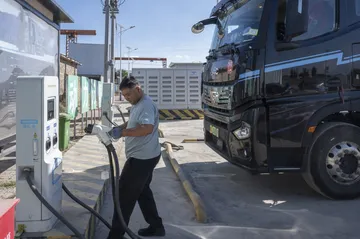
人们普遍认为,2026年,一家石油公司的首席执行官大概正为今年将售出2100万辆插电式汽车而夜不能寐。几十万辆电动卡车和公交车?呃——影响没那么大。
It is a truth universally acknowledged that a chief executive of an oil company in 2026 is probably losing sleep about the 21 million plug-in cars that will be sold this year. A few hundred thousand electric trucks and buses? Ehhh — not so much.
这可能是一个代价高昂的错误。电动卡车相对而言还是新鲜事物。尤其是更重的铰接式车型,我们很多人从未在现实中见过。从绝对数量上看,与比亚迪和特斯拉席卷全球道路的浪潮相比,它们只是小小涟漪。
That could be a costly mistake. E-trucks are a relative novelty. Especially when it comes to their heavier, articulated variants, many of us have never seen one in the wild. In terms of sheer numbers, they’re a ripple, next to the tidal wave of BYDs and Teslas swamping the world’s roads.
然而,从石油消费的角度来看,它们是势不可挡的力量。事实上,其年销量可能已经在以与每一辆下线的电动汽车一样快的速度消除原油需求。
Look at them through the prism of oil consumption, however, and they’re a juggernaut. Indeed, annual sales may already be eliminating crude demand as rapidly as every electric car coming off production lines.
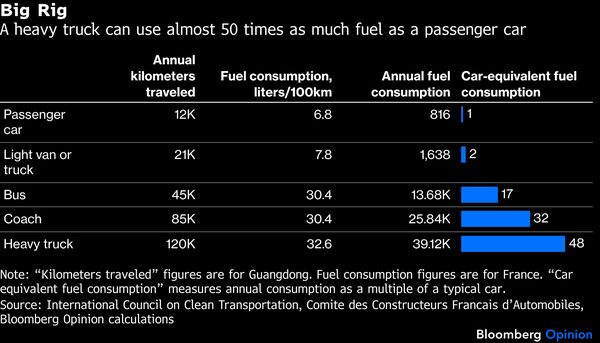
这是它们使用强度高得多的数学结果。典型乘用车每年行驶约1.2万公里(7500英里)。重型铰接式卡车可能行驶10倍甚至更远。其发动机也更耗油:一辆公交车或重型卡车每公里消耗的柴油通常约为五辆汽车的水平。
That’s a mathematical consequence of the far more intensive way they’re used. A typical passenger vehicle gets driven about 12,000 kilometers (7,500 miles) per year. A heavy articulated truck might go 10 times further, or more. Its engine is also far more thirsty: A single bus or heavy truck typically consumes about as much diesel per kilometer as five cars.
把这两个数字相乘,你会发现一个惊人的事实:新兴的电动卡车销量可能已经对石油需求造成了与电动汽车热潮同样大的冲击,而后者今年可能占全球汽车销量的三成。如果一辆卡车每年消耗的原油是汽车的50倍,那么你只需售出30万辆卡车,就能替代2026年将购买的大约1500万辆纯电动汽车所替代的原油量。仅中国到9月底就注册了22.64万辆此类重型卡车,我们可能眼下正越过那个临界点。
Multiply those two numbers together, and you’ll notice a striking fact: Nascent electric truck sales may already be doing as much damage to oil demand as an EV boom that is likely to account for three out of 10 cars sold worldwide this year. If a truck uses 50 times as much crude each year, then you only need to sell 300,000 of them to displace as much crude as the roughly 15 million battery-only cars that will be bought in 2026. With China alone registering 226,400 such heavy rigs by the end of September, it’s possible we’re passing that tipping point right about now.
真正的答案会比这个简化模型复杂得多。轿车和卡车的使用情况,以及长途重型车辆与城市小型配送货车之间的比例,在各国之间差异极大。在美国,汽车行驶里程比法国同类车辆高出约50%,而美国牵引挂车的行驶里程是欧洲同类车辆的两倍。
The real answer will be a lot more messy than that simplified model. Usage of cars and trucks, and the split between long-distance heavy vehicles and smaller urban delivery vans, differs vastly from one country to another. In America, cars drive about 50% further than their French equivalents, while US tractor trailers go twice as far as European ones.
迄今为止售出的电动卡车中,约90%在中国,而中国的车辆使用和燃料消耗数据可能尤其零散。这使得得出确凿的数字变得困难。如果电动卡车行驶距离更短、载重更轻,或者替代的是异常高效的柴油车型,那么50倍的倍数可能降至20倍甚至更低。
About 90% of the electric trucks sold to date have been in China, where data on vehicle usage and fuel consumption can be particularly spotty. That makes it difficult to work out hard-and-fast figures. If electric trucks are being driven shorter distances, carrying lighter loads, or replacing unusually efficient diesel models, that 50-times multiple could fall to 20 or less.
即便如此,合理的假设表明,电动商用车对石油需求的影响已经与乘用车大致相当。根据2024年的一项研究,广东的重型卡车行驶里程约为轿车的10倍,因此燃料消耗50倍的倍数与实际情况相符。
Even so, reasonable assumptions suggest the impact to oil demand from electric commercial vehicles is already in the same ballpark as passenger cars. Heavy trucks in Guangdong drive about 10 times as far as cars, according to a 2024 study, so the 50-times multiple for fuel consumption tracks real-world usage.
这也与实地燃料消耗数据吻合。截至9月的九个月内,中国柴油产量下降了1255万吨,而通常用于轿车的汽油产量下降了876万吨。两种燃料的产量均比2025年同期低约8%。追踪排放的“全球碳预算”项目称,电动卡车约占中国交通领域避免排放量的一半。该项目预计今年温室气体污染将下降0.4%。
That matches fuel-consumption data on the ground, too. China’s diesel production fell by 12.55 million metric tons in the nine months through September, compared to a 8.76 million-ton drop in the gasoline that’s generally used in cars. Each fuel came in about 8% below the same period in 2025. Electric trucks account for about half of China’s avoided emissions from transportation, according to Global Carbon Budget, a project tracking emissions that expects a 0.4% decline in greenhouse pollution this year.
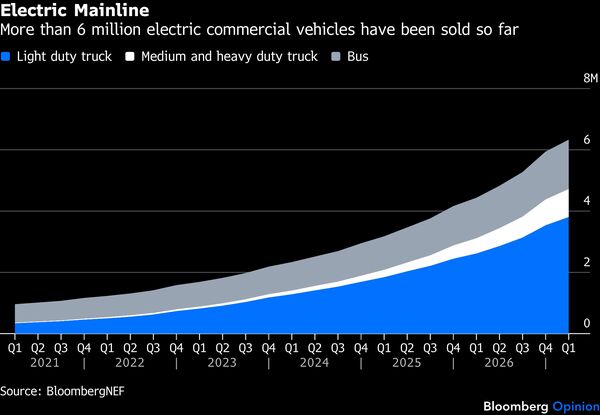
让那位彻夜难眠的石油公司高管感到警觉的是,特斯拉首款Roadster向公众亮相已是二十多年前的事,而眼下所有这些颠覆性变化发生之际,电动卡车革命才刚刚起步。全球中型和重型电动卡车的销量直到2021年才突破1%的市场份额,但近几个季度已突破10%,今年上半年同比增长75%。
The alarming thing for that sleepless oil executive is that, while Tesla’s original Roadster was unveiled to the public more than two decades ago, all this disruption is happening at a time when the e-truck revolution is only just getting started. Global sales of medium- and heavy-duty electric trucks didn’t cross a 1% market share until 2021, but have breached 10% in recent quarters and rose 75% from a year earlier in the first half of this year.
虽然电动重卡在中国最为领先,但随着积极进取的中国制造商瞄准出口市场,这种电池驱动的重型卡车正开始出现在五大洲。三一重工一直在阿联酋、南美和欧洲交付电动卡车,而道路货运甚至还不是全部。徐工机械的装载机正在几内亚一座大型铁矿作业,而三一仅在8月就向矿业客户交付了600台装载机和自卸卡车。如果全年都保持这一速度,仅三一的矿用车辆所减少的石油需求,就可能与宝马汽车2025年售出的45万辆电动汽车相当。
While they’re most advanced in China, battery big rigs are starting to show up on five continents, as aggressive Chinese manufacturers target export markets. Sany Heavy Industry Co. has been delivering e-trucks in the United Arab Emirates, South America and Europe, and road freight isn’t even the whole story. XCMG Construction Machinery Co. loaders are operating at a giant iron ore mine in Guinea, while Sany delivered 600 loaders and dump trucks to mining customers just in August. If that pace is matched across the year, Sany’s mining vehicles alone could displace about as much oil demand as the 450,000 battery-powered cars BMW AG sold in 2025.
电动重卡一度被认为极不现实,以至于国际能源署2017年一项关于卡车运输未来的调查假定,即便到2050年,其影响也微不足道。九年后,它们已占最大市场中国的50%,在欧洲则逼近10%。霍尔木兹海峡冲突引发的柴油价格飙升,固然是极好的推销理由,但即便油价回归正常,电力驱动的效率和简洁性也将使其在多数市场的成本远低于竞争对手。
Battery big rigs were once regarded as so wildly implausible that a 2017 International Energy Agency survey on the future of trucking assumed their impact would be negligible even in 2050. Nine years later, they’re making up 50% of the largest market, China, and closing in on 10% in Europe. The spike in diesel from the conflict in the Strait of Hormuz certainly makes for a great sales pitch, but even if oil prices return to normal the efficiency and simplicity of electric traction will offer costs drastically lower than the competition in most markets.
正因如此,比起经销商展厅里开出的崭新汽车,更值得关注的是在你所在街道上安静驶过的电动公交车或厢式货车。长期以来,我们一直用汽车销量来衡量电动汽车革命。未来则将取决于卡车,以及那数百万桶从未被燃烧的石油。
That’s reason to care more about the electric buses or delivery vans humming down your street than the shiny new cars leaving dealers’ showrooms. For too long, we’ve been measuring the EV revolution in terms of cars sold. The future will instead be about trucks, and the millions of barrels of oil that never got burned.