唐纳德·特朗普于2025年1月开启第二任期以来,访美国际游客人数下降超过6%。6月和7月男子足球世界杯期间曾出现适度回升,但美国国际贸易管理局的8月完整数据和9月部分数据显示,降势已恢复。
Donald Trump started his second term as president in January 2025, international visits to the US have fallen more than 6%. There was a modest uptick during the men’s soccer World Cup in June and July, but full numbers for August and partial ones for September from the US International Trade Administration show a resumption of the decline.
访美游客下降是全球性异常现象,联合国报告称,2025年和2026年上半年国际游客人数均有所上升。这并非由汇率驱动,因为过去21个月美元兑其他主要货币走弱,正常情况下会刺激赴美旅游。由此看来,白宫的关税战、吞并加拿大和格陵兰的威胁、暴力驱逐行动,以及对外国游客政治观点的笨拙审查,是国际游客望而却步最合理的解释。干得漂亮,特朗普总统!
The drop in visitors to the US is a global outlier, with the United Nations reporting that international tourist numbers rose in 2025 and the first half of 2026. It’s not driven by exchange rates, as the dollar has weakened relative to other major currencies over the past 21 months, which would normally boost visits to the US. That leaves the White House’s tariff wars, threats to annex Canada and Greenland, violent deportation campaign and ham-handed scrutiny of foreign visitors’ political views as the most reasonable explanations for why international visitors are staying away. Heckuva job, President Trump!
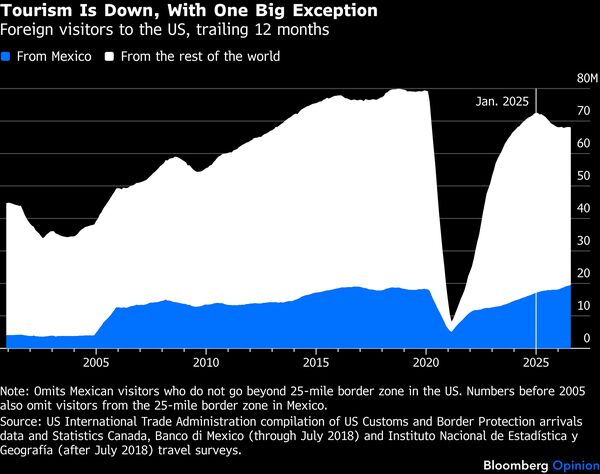
这并不令人意外。或许令人意外的是,是什么防止了国际旅游低迷进一步恶化。自2025年1月以来,墨西哥赴美游客激增近14%,屡创新高,而世界其他地区赴美游客下降超过12%。(文中图表及全文均采用过去12个月滚动访客总数,因月度数据受季节性波动影响较大。)2015年6月特朗普乘坐特朗普大厦电梯下楼宣布参选时,墨西哥人是其排外辱骂的主要目标,但他们似乎已释怀。
None of this is too surprising. What is perhaps surprising is what’s been keeping the international tourism downturn from being much worse. Visits to the US from Mexico are up almost 14% since January 2025 and are setting records, while visits from the rest of the world are down more than 12%. (In the chart and throughout this column, I use trailing-12-month visitor totals because the monthly numbers are subject to big seasonal fluctuations.) Mexicans were the chief target of the president’s xenophobic invective when he descended the Trump Tower escalator to announce his candidacy in June 2015, but they seem to have gotten over it.
汇率无疑是墨西哥游客激增的一个因素,“超级比索”从特朗普第二次就职到9月初兑美元升值22%(目前升幅略低于11%)。不过,许多货币都对美元升值,却未能阻止赴美游客人数下降。
Exchange rates are surely a factor in the Mexican visitor boom, with the “superpeso” up 22% against the dollar from Trump’s second inauguration through early September (it’s now up a little less than 11%). Lots of currencies have appreciated against the dollar, though, and that hasn’t stopped visitor numbers from falling.
一个更令人信服、尽管不可避免带有推测性质的解释是,墨西哥与美国在经济和社会层面已如此紧密交织,以至于墨西哥人无法直接停止前往美国。到现在,他们或许也已习惯了美国恶劣的政治言辞,以及有时不太友好的接待。不难想象,如果美国去年没有将墨西哥人的签证处理费从185美元提高一倍多至435美元,赴美人数会更高。
A more convincing if inevitably speculative explanation is that Mexico and the US have become so entwined economically and socially that Mexicans can’t just stop coming to America. They may also have become accustomed by this point to nasty US political rhetoric and a sometimes less-than-friendly reception. One has to imagine that if the US hadn’t more than doubled visa-processing fees for Mexicans last year, from $185 to $435, the numbers would be even higher.
与北方邻国形成鲜明对比的是,加拿大人因特朗普对部分加拿大商品征收高额关税,以及将加拿大变为“第51个州”的言论,而深感震惊和愤慨,这种对比颇具启示意义。2025年,来自墨西哥的访客数量超过了来自加拿大的访客数量,这可能是有史以来首次出现这种情况(如果你好奇2010年代中期发生了什么,加元兑美元汇率从2014年初到2016年初贬值了27%)。
The contrast with our neighbors to the north, who were deeply shocked and offended by Trump’s imposition of sky-high tariffs on some Canadian goods and talk of making Canada the 51st state, is instructive. In 2025 the number of visitors from Mexico surpassed the number from Canada for what may have been the first time ever (if you’re wondering what happened in the mid-2010s, the Canadian dollar lost 27% of its value relative to the US dollar from early 2014 to early 2016).
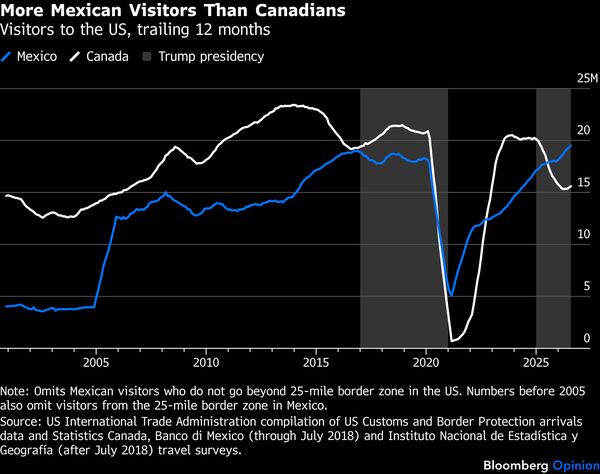
诚然,来自加拿大的访客数量已开始缓慢回升,这表明加拿大在经济和社会层面或许也与美国紧密交织,难以真正“脱钩”。对于世界其他地区,情况则不尽相同,过去几年或许最重要的旅游相关发展是,美国在旅行服务贸易上不再保持顺差。
To be sure, the number of visitors from Canada has begun creeping upward, an indication that Canada may also be so entwined economically and socially with the US that it can’t really quit us. This less true for other parts of the world, and perhaps the most significant tourism-related development of the past few years is that the US has ceased running a trade surplus in travel services.
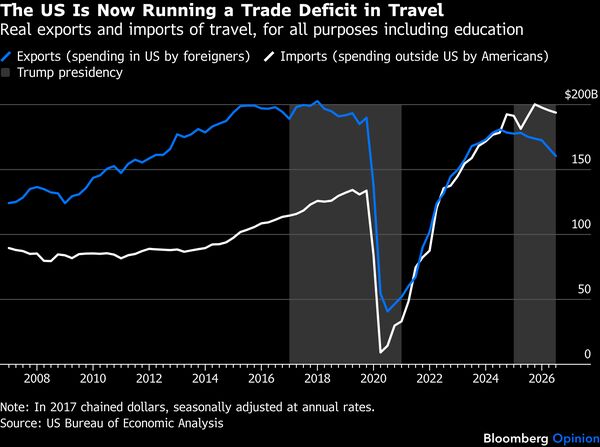
一位痴迷于消除贸易逆差的总统,却在任内见证了新逆差的出现,这当然充满讽刺意味;不过,旅行进口在特朗普重返白宫之际刚好超过旅行出口,这表明不能将责任完全归咎于他。2024年第四季度外国游客在美国的支出下降,部分原因可能在于当年11月的大选结果,但美国人境外支出的大幅增加,似乎不太可能由此导致。聚焦旅游支出(即经济分析局统计的、因非医疗或非教育原因进行的个人旅行支出),显而易见,疫情以来美国人的此类支出远超以往。
That a man obsessed with getting rid of trade deficits has presided over the creation of a new one is certainly ironic, although the fact that travel imports started to exceed travel exports just Trump returned to office is an indication that it can’t be pinned entirely on him. Some of the fourth-quarter 2024 decline in spending by foreign travelers in the US may well be attributable to that November’s election results, but it seems quite unlikely that the sharp increase in spending by Americans abroad was. Focus in on tourism spending (or, as the Bureau of Economic Analysis tracks it, spending on personal travel for reasons unrelated to healthcare or education), and it’s clear that since the pandemic Americans have been doing much more of it than they used to.
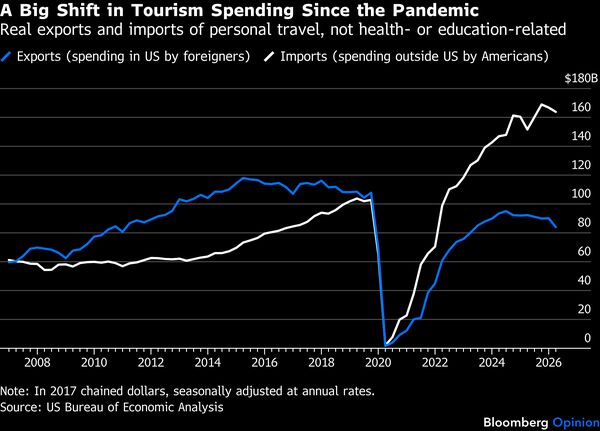
一种解释是,自2010年代末以来,美国实际收入增速快于其他富裕国家。另一种解释是,美国人对国际旅行越来越适应。2025年,有效美国护照数量首次超过美国人口的50%,尽管这不等于说50%的美国人持有护照(护照本和护照卡分别计数,许多人两者皆有),但与25年前仅18%的水平相比,这一增长似乎颇具意义。
One explanation here is that since the late 2010s real incomes have grown faster in the US than in other affluent countries. Another is that Americans have been getting more comfortable with international travel. The number of valid US passports in circulation passed 50% of the US population for the first time in 2025, and although that’s not the same as saying 50% of Americans have passports (passport books and passport cards are counted separately and many people have both), the increase from just 18% a quarter century ago does seem significant.
这两点均属积极发展。而外国游客在美国支出的下降则不然。即便以墨西哥为例,美国也已从2021年至2023年保持巨额旅行支出贸易顺差(即墨西哥人在美国的支出远超美国人在墨西哥的支出),转为近期几乎不再有顺差。
These are both positive developments. The drop in US spending by travelers from overseas isn’t. Even with Mexico, the US has gone from running large travel-spending trade surpluses from 2021 through 2023 (that is, Mexicans were spending a lot more in the US than Americans in Mexico) to barely any surplus at all recently.
就当前经济产出而言,自2024年底以来外国游客在美国的实际支出下降并非什么大事,仅占国内生产总值的0.1%以下。但作为美国吸引力下降和软实力衰退的迹象,这令人担忧。如果只有隔壁邻居还来拜访,你大概率是做错了什么。
In terms of current economic output the decline since late 2024 in real spending by foreign travelers in the US isn’t that big a deal, amounting to less than 0.1% of gross domestic product. But as an indication of the diminished attractiveness and dwindling soft power of the US, it’s worrying. If only your next-door neighbors come over to visit anymore, you’re probably doing something wrong.