
每当欧洲传来好消息——是的,是欧洲——总让人感觉像是矩阵出现了故障。上周英国经济公布的向好增长数据,得益于人工智能和政府支出的推动,促使德意志银行宏观研究主管吉姆·里德指出:“全球对英国的看法似乎总是比现实悲观得多。”我最近在法国也有过类似经历:在一连串危机——以及关门歇业的店铺——之中,国家统计局披露第三季度失业率意外小幅下降。
Whenever good news arrives from Europe — yes, Europe — it can feel like a glitch in the matrix. Last week’s upbeat growth figure for the British economy, driven by artificial intelligence and government spending, caused Deutsche Bank Head of Macro Research Jim Reid to flag that the “global view of the UK invariably seems much more bearish than the reality.”I had a similar experience recently in France, where amid a string of crises — and boarded-up storefronts — the national statistics agency disclosed that the unemployment rate had unexpectedly edged down in the third quarter.
一位当时正在巴黎访问的美国投资者对我说,尽管欧洲出了不少问题,但社交媒体将该地区描绘成无药可救的形象,已变得既过度又让人上瘾,尤其是对他的那些大洋彼岸的金融同行而言。
A US-based investor visiting Paris at the time told me that for all the things going wrong with Europe, the social-media-driven portrayal of the region as a lost cause was getting both excessive and addictive, especially for his fellow financiers across the pond.
这种悲观看法——这位投资者称之为“算法”——在过去两年里有了自己的生命力,因为美国科技精英的逐利动机与白宫散发的敌意产生了重叠。SpaceX老板埃隆·马斯克抨击欧洲领导人是暴君,Palantir公司的亚历克斯·卡普警告街头治安不靠,Meta Platforms公司首席执行官马克·扎克伯格则谈论扼杀言论自由的创新荒漠。
That gloomy view, which this investor has dubbed “the Algorithm,” has taken on a life of its own over the past two years as the profit motive of the US tech elite overlaps with the hostility emanating from the White House. SpaceX boss Elon Musk has attacked European leaders as tyrants, Palantir Inc.’s Alex Karp has warned of insecurity on the streets and Meta Platforms Inc. Chief Executive Officer Mark Zuckerberg has talked of an innovation backwater that strangles free speech.
这些攻击吸引了大批投资界人士,并成为X平台上“网络喷子大军”更广泛动员的一部分,将“让美国再次伟大”(MAGA)运动与德国“选择党”(AfD)等极右翼政党的支持者联合在一起(马斯克曾支持后者)。
These barbs have drawn in swaths of the investment community and become part of a broader mobilization of troll armies on X uniting MAGA with supporters of far-right parties like Germany’s AfD (which Musk has backed).
当然,欧洲确实存在问题——而且是大问题。马里奥·德拉吉2024年警告欧盟,如果不进行深度竞争力改革,将面临“缓慢的痛苦”,他这样做并非为了增加粉丝数量。正如德意志银行的里德也指出的,英国也犯下了一些重大的战略自摆乌龙。
Of course, Europe does have problems — big ones. When Mario Draghi warned the European Union in 2024 that it faced “slow agony” without a deep competitiveness overhaul, he wasn’t doing it to boost his follower count. And as Deutsche Bank’s Reid also noted, the UK, too, has scored some big strategic own goals.
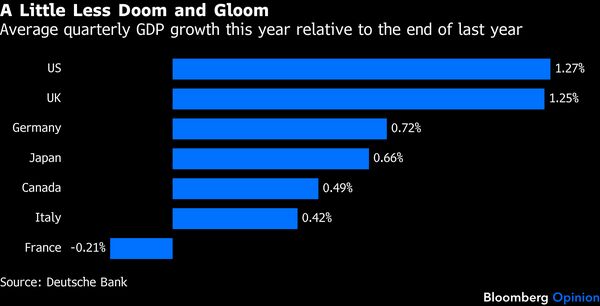
但即使出于让领导人摆脱自满的良好初衷,欧洲人也面临着将彻头彻尾的虚假网络叙事内化并加以回响的风险。例如:伦敦和巴黎比美国城市更危险(美国的情况糟糕得多,看看枪支犯罪),欧洲相对警力不足(并非如此),美国监管机构一贯采取轻触式监管(不对),如果不先去美国,就不可能为本地市场打造大型项目(Spotify Technology SA?Revolut Ltd.?)。
But even with the best intentions of shaking leaders out of complacency, Europeans can run the risk of internalizing and echoing blatantly false online narratives. For example: London and Paris are more dangerous than American cities (the US is much worse, look at gun crime), Europe is relatively under-policed (it isn’t), US regulators are always light-touch (nope) and it’s impossible to build anything big for the local market without heading to America first (Spotify Technology SA? Revolut Ltd.?).
这不能当作梗图里的段子一笑了之。科技圈大佬的错误信息(在弗拉基米尔·普京的网络水军乐意配合下)可能已经对经济和投资者信心产生了影响,而即便在债券投资者开始数贴胶合板的窗户和警察人数、以衡量法国抗议活动的影响之前,投资者信心就已处于脆弱状态。我们知道社交媒体驱动投资决策:富达国际对1000名英国散户投资者的民调发现,过去两年中,超过一半的人曾利用社交媒体为财务决策提供参考。
This is not to be laughed off as the stuff of memes. The tech bros’ misinformation (happily supported by Vladimir Putin’s troll army) may already be having an impact on the economy and investor confidence, which was in a fragile state even before bond investors began counting plywood-covered windows and police presence to gauge the impact of protests in France. We know that social media drives investment decisions: A Fidelity International poll of 1,000 UK retail investors found that more than half had used social media to inform a financial decision in the past two years.
我们也知道,全球新闻情绪的变化对股票回报的影响,比特定国家的本地新闻大得多、持久得多。
We also know that shifts in global news sentiment have a much larger and longer-lasting effect on equity returns than country-specific local news.
因此,设想边缘性的就业或资本投入岌岌可危并非牵强附会,尤其是当决策中心远隔重洋时。“从中长期来看,那些不再相信欧洲是创业或投资之地的人——推测将会——把重心完全转移到美国和其他地方,”Form Ventures的Patrick Newton在2025年警告说。自那以后,我们看到创业加速器Entrepreneurs First取消了在法国和德国的项目,风投巨头红杉资本关闭了伦敦办事处。虽然这些举动不一定代表对该地区看衰,但它们因强化了欧洲生态系统疲弱的叙事而受到批评。
So it’s not a stretch to imagine marginal job or capital commitments hanging in the balance, especially if decision-making centers are an ocean away. “In the medium term, those that no longer believe in Europe as a place to found a business or invest will — presumably — move to focus exclusively on the US and elsewhere,” warned Form Ventures’ Patrick Newton in 2025. Since then, we’ve seen startup accelerator Entrepreneurs First scrap schemes in France and Germany and venture capital powerhouse Sequoia Capital close its London office. While not an expression of bearishness on the region per se, these moves have been criticized for reinforcing the narrative that Europe’s ecosystem is weak.
荷兰国际集团(ING)首席经济学家玛丽克·布洛姆表示,过度悲观会带来经济成本。她指出,家庭减少支出意愿、企业投资意愿下降,以及在投入资本前普遍倾向于等待利好证据。她还警告,这种情绪可能导致政客在寻找对策时变得更不勇敢,而非更勇敢。毕竟,布鲁塞尔目前的氛围似乎是主权意识与窘迫感的混合体:虽然有一些减少欧盟对美国技术依赖的积极举措,但也存在一种忍气吞声的态度,导致欧洲领导人接受特朗普式贸易条款的强加,并在没有明确政策方向的情况下削弱气候规则。
Excessive pessimism carries an economic cost, says ING Chief Economist Marieke Blom. She cites households becoming less willing to spend, companies growing more reluctant to invest and a general tendency to wait for evidence of upside before committing capital. And she also warns that it could condition politicians to become less, not more, courageous when casting about for a cure. After all, the current mood in Brussels seems to be a mix of sovereignty and sheepishness: While there are some encouraging moves underway to reduce EU dependency on US technology, there’s also a grin-and-bear-it attitude to the bullying that results in European leaders accepting the dictation of Trumpian trade terms and watering down their climate rules without a clear policy direction.
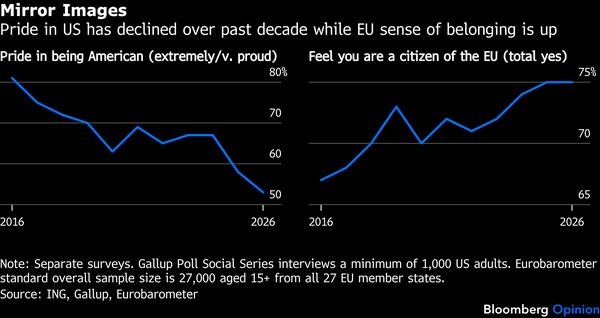
显然,欧盟还有大量实务工作要做,以使其市场更具吸引力,并通过国内投资适应地缘政治风险更高的世界。然而,既然认知也很重要,看到布洛姆发布了一份她称为“欧洲推介手册”的反向叙事报告,令人鼓舞。这本质上是一系列关于欧洲经济的报告,将广为人知的优势与令人惊讶的事实结合起来——例如,欧洲人的归属感正在上升,而美国人的民族自豪感却在下降。这是欧洲人不再甘愿做叙事“沙袋”的几个迹象之一。思维定势难以摆脱,但值得一试。
Obviously, the EU has plenty of real work ahead to make its market more attractive and to invest domestically to adapt to a riskier geopolitical world. Yet given that perceptions also matter, it’s encouraging to see ING’s Blom publishing a bit of counter-programming she calls “Europe’s Pitch Book.”Essentially a series of reports on Europe’s economy that combines well-known strengths with surprising facts — for instance, that Europeans’ sense of belonging is on the rise even as Americans’ national pride is flagging. It’s one of several signs that Europeans are no longer willing to be a narrative punching bag. The matrix is hard to escape, but it’s worth trying.