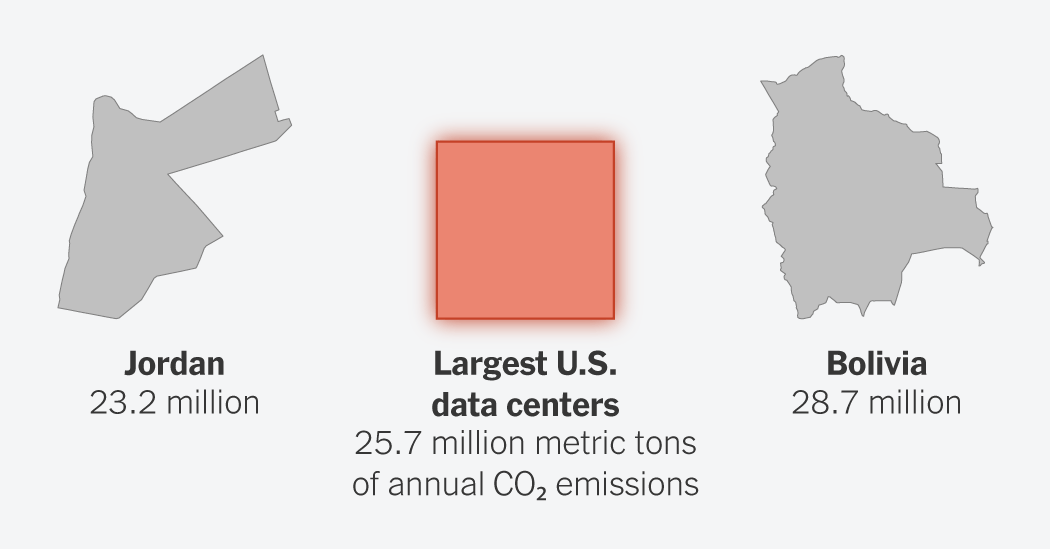
根据最新研究,美国最大的数据中心每年排放的二氧化碳估计达 2570 万公吨,几乎相当于玻利维亚或丹麦等整个国家的排放量。
The largest data centers in the United States are responsible for an estimated 25.7 million metric tons of carbon dioxide emissions annually — almost as much as entire countries like Bolivia or Denmark — according to new research.
该研究于周一发表在《自然·可持续性》期刊上,提供了人工智能热潮兴起以来,美国最大数据中心二氧化碳排放量的首份同行评审估算。由哈佛大学研究人员领导的团队考察了 403 个数据中心在 2024 年 5 月至 2025 年 4 月期间的用电量和碳排放。
The study, published Monday in the journal Nature Sustainability, delivers the first peer-reviewed estimates of carbon dioxide emissions from the country’s biggest data centers since the start of the artificial intelligence boom. Its authors, a team led by researchers from Harvard University, examined the electricity consumption and carbon emissions of 403 data centers from May 2024 to April 2025.
总体而言,这些数据中心消耗了美国近 2% 的电力,超过纽约市和洛杉矶市用电量之和,占美国二氧化碳排放总量的约 0.5%。二氧化碳是导致全球变暖的主要温室气体。
All told, those data centers used almost 2 percent of U.S. electricity, more than New York City and Los Angeles combined, and represented about 0.5 percent of U.S. carbon dioxide emissions. Carbon dioxide is the primary greenhouse gas driving global warming.
弗吉尼亚州、爱荷华州和俄亥俄州这三个州的数据中心,占研究估算排放量的约一半。研究发现,在俄勒冈州等州,数据中心每消耗单位电力排放的二氧化碳较少,因为这些州更大比例的电力来自非化石燃料发电。
Data centers in just three states, Virginia, Iowa and Ohio, accounted for about half of the emissions estimated in the study. In states like Oregon, data centers are responsible for emitting less carbon dioxide per unit of electricity consumed because a larger share of their power is generated without fossil fuels, the study found.
在所有 403 个设施中,54% 的电力来自燃烧化石燃料,主要是天然气和煤炭。
Across all 403 facilities, 54 percent of the electricity came from burning fossil fuels, mostly natural gas and coal.
研究中的大量分析属于侦查性工作,凸显了人工智能公司在高度保密环境下获准运营的现状。由于缺乏公开的数据中心名单,研究人员最初参考了一个商业数据集,其许可规则禁止他们——以及《纽约时报》——公布设施的地址、名称和所有者。
Much of the analysis in the study amounted to detective work, underscoring the secrecy under which A.I. companies have been allowed to operate. Without a public list of data centers to work with, the researchers began by consulting a commercial dataset whose licensing rules prevented them — and The New York Times — from publishing facilities’ addresses, names and owners.
研究人员花费数小时研究建筑轮廓和卫星图像,以确认数据中心的位置和规模,估算其用电量,并根据为各区域电网供电的发电厂组合计算其排放量。
The researchers spent hours studying building footprints and satellite imagery to confirm the location and size of data centers, estimated how much electricity they could use and then calculated their emissions based on the mix of power plants supplying each regional electricity grid.
“我们不得不经历如此大规模的重建过程,仅仅为了弄清基础设施在哪里、有多大,这本身就说明了该行业缺乏透明度,”领导该研究团队的哈佛大学科学家吉安卢卡·古迪(Gianluca Guidi)说。
“The fact that we had to go through such an extensive reconstruction process just to understand where the infrastructure is and how large it is tells you something about the lack of transparency itself in the industry,” said Gianluca Guidi, the Harvard scientist who led the research team.
经营能源数据公司 Cleanview 的迈克尔·托马斯(Michael Thomas)未参与这项研究。他将数据中心与发电厂进行了对比,后者必须公开报告其运营对环境影响的各种详情。而收集数据中心运营细节则需要从分散在县、州和联邦数据库中的数百万份文件中筛选。
Michael Thomas, who runs the energy data company Cleanview and was not involved with the study, drew a contrast between data centers and power plants, which are required to publicly report all sorts of details about the environmental effects of their operations. Collecting the details of data center operations, on the other hand, requires sifting through millions of documents scattered across county, state and federal databases.
“我们已经有六七位参议员联系我们了,”托马斯说,“他们说:‘到底有多少数据中心?我们想起草法案。’”他补充道,“为什么参议院要来找我,而不是找美国能源信息署(E.I.A.)或联邦能源监管委员会(FERC)?”
“We’ve had, like, a half dozen senators reach out to us. They’re like, ‘How many data centers are there? We’re trying to write a bill,’” Mr. Thomas said. “Why is the Senate reaching out to me and not E.I.A. or FERC?” he added, using abbreviations for the U.S. Energy Information Administration and the Federal Energy Regulatory Commission.
虽然弗吉尼亚州和俄亥俄州等州已开始推动更严格的监管,但古迪博士表示,联邦政府应要求大型数据中心运营商公开披露其用电量和排放量。
While states like Virginia and Ohio have begun moving toward stricter oversight, Dr. Guidi said the federal government should require the operators of large data centers to publicly disclose their electricity use and emissions.
“社区不应该需要一支哈佛研究团队来分析卫星图像,才能了解其环境影响,”他说。
“Communities shouldn’t need a team of Harvard researchers to analyze satellite images to understand their environmental impact,” he said.
数据中心开发商手中掌握多种工具,可用于掩盖其项目的碳排放和能源影响。这些层层保密已成为全美范围内反对数据中心项目浪潮中一个主要关切点。在本月的中期选举中,41 项相关的地方投票倡议里,有 40 项由选民投票决定限制或阻止数据中心开发。
Data center developers have multiple tools at their disposal to obfuscate the carbon and energy effects of their projects. Those layers of secrecy have emerged as a major point of concern in the growing resistance to data center projects nationwide. Voters opted to limit or prevent data center development in 40 of 41 relevant local ballot initiatives in this month’s midterm elections.
气候与能源咨询公司 Relae 近期发布的一份报告指出:“保密协议、隐匿的最终用户以及闭门谈判,比任何其他担忧更一致地构成了反对叙事的框架。”
“Non-disclosure agreements, hidden end users, and closed-door negotiations frame opposition narratives more consistently than any other concern,” according to a recent report by Relae, a climate and energy consultancy.
根据 Relae 的研究,2024 年 3 月至 2026 年 11 月初期间,地方反对力量已在 25 个州阻止或延缓了至少 70 个 AI 数据中心项目,涉及估计投资额达 2710 亿美元。
Between March 2024 and early November 2026, local opposition has blocked or delayed at least 70 A.I. data center projects across 25 states, representing an estimated $271 billion in investment, according to Relae’s research.
其中 14 个项目位于弗吉尼亚州,该州是数据中心繁荣的核心地带。弗吉尼亚州的数据中心占研究中估算排放量的四分之一以上。在服务弗吉尼亚州的区域电网运营商 PJM Interconnection 中,为数据中心供电的电力约有 60% 来自化石燃料。
Fourteen of those projects were in Virginia, the heart of the data center boom. Virginia’s data centers accounted for more than a quarter of the emissions estimated in the study. In PJM Interconnection, the regional grid operator serving Virginia, about 60 percent of the electricity powering data centers is produced by fossil fuels.
研究中的数据可能低估了美国所有数据中心的排放量,因为研究所考察的设施清单并不代表完整的清单。该清单排除了数百个研究人员无法充分验证的可能数据中心,以及那些绕过电网、从现场发电机获取电力的设施。
The figures in the study likely underestimate all U.S. data center emissions because the list of facilities it examined does not represent a complete inventory. It excludes hundreds of possible data centers the researchers could not sufficiently verify, as well as facilities that bypass the grid by drawing power from on-site generators.
这也是一个以惊人速度增长的行业的快照。研究中的平均设施电力容量约为 40 兆瓦,而即将推出的项目,如 Meta 在路易斯安那州的 5 吉瓦 Hyperion 园区,其容量将超过这一数值的 100 倍。
It is also a snapshot of an industry growing at breakneck speed. The average facility in the study had an electrical capacity of about 40 megawatts, whereas upcoming projects, such as Meta’s 5-gigawatt Hyperion campus in Louisiana, will have more than 100 times that capacity.
尽管如此,外部研究人员表示,该研究为理解 AI 建设扩张的气候变化影响提供了关键基准。
Still, outside researchers said the study provides a crucial baseline for understanding the climate change implications of the A.I. buildout.
“这重置了我们对已在运行的这些大型数据中心的认知,即它们使用的电力可能更多,排放的温室气体可能比我们原本认为的更多,”加州大学圣塔芭芭拉分校研究新兴环境技术的埃里克·马萨内特(Eric Masanet)说。
“It resets our understanding of these large data centers that are already operating, that they use maybe more power and emit more greenhouse gas emissions than we had thought,” said Eric Masanet, who researches emerging environmental technologies at the University of California, Santa Barbara.
独立研究员安迪·马斯利(Andy Masley)分析数据中心的环境影响,他说,数据中心不断增长的温室气体排放是否代表可接受的环境成本,应取决于人工智能被证明有多大用处。
Whether data centers’ growing greenhouse gas emissions represent an acceptable environmental cost should hinge on how useful A.I. proves to be, said Andy Masley, an independent researcher who analyzes the environmental effects of data centers.
“我不太认为光看着一个行业就说‘哦,因为它在增长,将占美国排放量的有意义百分比,那它肯定是坏的’讲得通,”马斯利先生说。“它们排放这么多的部分原因仅仅是因为有这么多人在使用它们。”随着用户数量增长,碳足迹也将随之增长。虽然这项研究代表了迄今为止对数据中心排放和用电情况最彻底的核算,但它也已经过时了:根据Cleanview的数据,自研究期于2025年5月1日结束以来,至少又有250座数据中心投入运行。
“I don’t really think it makes sense to look at an industry and just say, ‘Oh, because it’s growing and it’s going to make up a meaningful percentage share of American emissions, that must mean it’s bad,’” Mr. Masley said. “Part of the reason they’re emitting so much is just that they’re being used by so many people.”As the number of users grows, so will the carbon footprint. While the study represents the most thorough accounting to date of data centers’ emissions and electricity consumption, it is also already outdated: Since the study period ended on May 1, 2025, at least 250 more data centers have come online, according to Cleanview’s data.