在本月选举中翻转数个关键州议会和州长席位后,民主党现在有了一条途径,来废除美国选举中一项已使该党在本世纪至少输掉两场总统竞选的制度:选举人团。
After flipping several key state legislatures and gubernatorial seats in this month’s elections , Democrats now have a path to nullify an institution of U.S. elections that has cost the party at least two presidential contests so far this century: the Electoral College.
要正式废除这一长期存在的制度——总统由代表各州的选举人团选出,而非通过直接普选——需要宪法修正案。但如果足够多的州加入一项被称为“全国普选州际协定”的承诺,该制度实际上可以被中和。
Officially abolishing that longstanding system , in which presidents are selected via slates of electors representing each state rather than by a direct popular vote, would require a constitutional amendment. But it could effectively be neutralized if enough states join a pledge known as the National Popular Vote Interstate Compact .
要实现这一点,协定成员州需要拥有至少270张选举人票,即赢得总统职位所需的多数票。过去二十年来,18个由民主党领导的州以及哥伦比亚特区,合计代表222张选举人票,已经加入。而民主党在中期选举中赢得了足够多的额外州的控制权,使得270票的门槛触手可及——只要他们选择这么做。
For this to be achieved, the compact’s member-states would need to account for at least 270 electoral votes, the majority needed to secure the presidency. Over the past two decades, 18 Democratic-led states and the District of Columbia, collectively representing 222 electoral votes, have already signed on. And Democrats won control in enough additional states in the midterms to put the 270-vote threshold within reach—if they choose to go for it.
以下是关于该协定的相关信息,以及如果它生效,可能如何改变美国选举的未来。
Here’s what to know about the compact, and how it could change the future of U.S. elections if it goes into effect.
什么是全国普选州际协定?全国普选州际协定是各州之间的一项协议,各州承诺将其选举人票投给赢得全国普选的总统候选人。
What is the National Popular Vote Interstate Compact? The National Popular Vote Interstate Compact is an agreement among states to assign their electoral votes to the presidential candidate who wins the national popular vote.
这将标志着现行选举制度的重大变化。目前,几乎每个美国州都将其所有选举人票分配给在该州获得最多选票的候选人。
This would mark a significant change in the current electoral system. Presently, almost every U.S. state allocates all of its electors to the candidate who wins the most votes in that state.
由于这种“赢家通吃”方式以及各州在全国选民和选举人票中所占份额的差异,候选人即使输掉全国普选,也能赢得总统职位。美国历史上这种情况发生过五次,最近一次是2016年,当时唐纳德·特朗普在普选中输给希拉里·克林顿,但赢得了选举人团。本世纪初的另一次发生在2000年,当时乔治·W·布什赢得总统职位,但在普选中输给阿尔·戈尔。相比之下,该协议旨在确保全国得票最多的人也能赢得白宫。
As a result of that “winner take all” approach and the disparity between states’ shares of the nation’s voters and electoral votes, a candidate is able to win the presidency even if they have lost the nationwide popular vote. This has happened five times in U.S. history, most recently when Donald Trump lost the popular vote to Hillary Clinton but won the Electoral College in 2016. Another instance occurred earlier this century, in 2000, when George W. Bush won the presidency but lost the popular vote to Al Gore. The compact, in contrast, aims to ensure that whoever wins the most votes across the country also wins the White House.
各州协调起来绕过选举人团、采用全国普选制度的想法,源于那场有争议的2000年大选之后。2001年,耶鲁法学院教授阿希尔·阿马和加州大学戴维斯法学院教授维克拉姆·阿马两兄弟撰写了一篇文章,提出了与全国普选州际协议类似的构想,该协议大约五年后,即2006年成立。
The idea for states to coordinate to circumvent the Electoral College and adopt a national popular vote system in such a way arose in the aftermath of that contentious 2000 election. In 2001, brothers Akhil Amar, a professor at Yale Law School, and Vikram Amar, a professor at the University of California Davis Law School, wrote an article that laid out something similar to the National Popular Vote Interstate Compact , which was created roughly five years later, in 2006.
自那时起,包括加利福尼亚州、科罗拉多州、康涅狄格州、特拉华州、夏威夷州、伊利诺伊州、缅因州、马里兰州、马萨诸塞州、明尼苏达州、新泽西州、新墨西哥州、纽约州、俄勒冈州、罗德岛州、佛蒙特州、弗吉尼亚州和华盛顿州在内的18个州,以及华盛顿特区,已同意加入该协议。
Eighteen states—including California, Colorado, Connecticut, Delaware, Hawaii, Illinois, Maine, Maryland, Massachusetts, Minnesota, New Jersey, New Mexico, New York, Oregon, Rhode Island, Vermont, Virginia, and Washington—have since agreed to join the compact, as well as Washington D.C.
这些协议成员加起来拥有222张选举人票,距离选举总统所需的270张选举人票多数还有差距。该协议只有在其成员总数共同达到270张选举人票时才会生效。
Together, these pact members make up 222 of the 270 electoral vote majority needed to elect a president. The compact will take effect only if its membership collectively reaches that 270-vote mark.
州要加入该协议,需要通过其立法机构两院的立法。随后,州长需要签署该立法使其成为法律;如果州长拒绝签署,则州立法机构需要动员超级多数票推翻州长的否决,并使该法案生效。
In order for a state to join the compact, it needs to pass legislation through both chambers of its legislature. The governor then needs to sign the legislation for it to become law—or, if they refuse to do so, the state legislature needs to marshal a supermajority to overturn a gubernatorial veto and enact the measure.
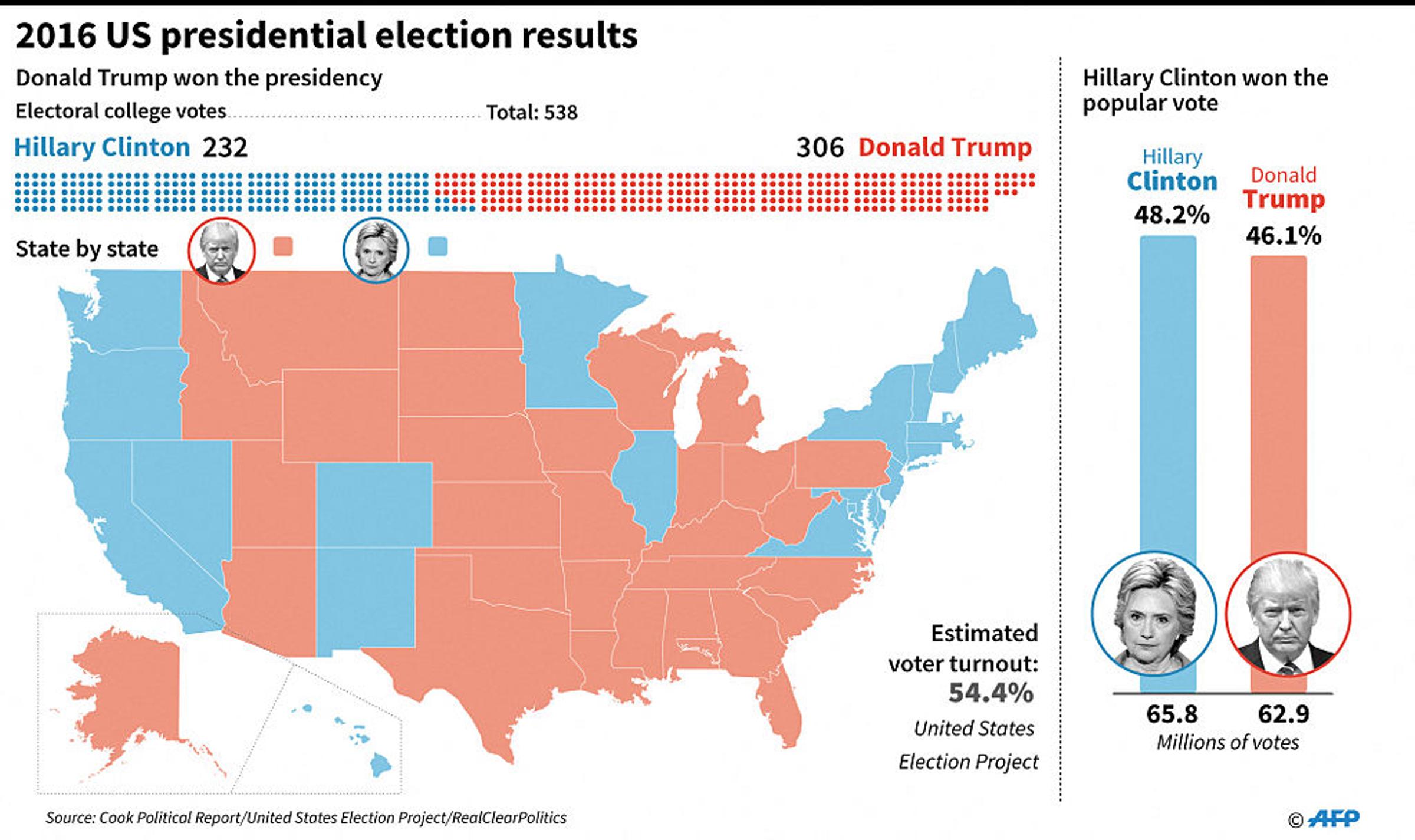
一张展示2016年美国总统选举按选举人团和普选票结果的图表。—法新社/盖蒂图片社
Graphic showing results of the 2016 US presidential election by Electoral College and popular vote. —AFP/Getty Images ## How Democrats’ midterms wins could enable them to circumvent the Electoral College
民主党中期选举胜利或助其绕过选举人团本月早些时候的中期选举中,民主党在五个额外州获得所谓的“三控”状态——即单一政党同时控制州立法机构两院和州长职位,这五个州分别是宾夕法尼亚州、密歇根州、亚利桑那州、威斯康星州和内华达州。
In the midterm elections earlier this month, Democrats gained so-called “trifectas”—in which a single party controls both chambers of the state legislature and the governorship—in five additional states: Pennsylvania, Michigan, Arizona, Wisconsin, and Nevada.
这五个州合计拥有61张选举人票,若它们同意加入,将足以让协议超过生效所需的门槛。
Together, those states account for 61 electoral votes, which would be more than enough to put the compact over the required threshold for it to take effect if they agree to sign on.
事实上,即使只有其中四个州加入,该承诺也可能达到所需的选举人票多数——只要宾夕法尼亚州(19张选举人票)和密歇根州(15张选举人票)在四个州之中。
In fact, the pledge could reach the required majority of electoral votes even if just four of those five states join—as long as Pennsylvania, with 19 electoral votes, and Michigan—with 15—are among the four.
宾夕法尼亚州州长乔什·夏皮罗本月在“拯救美国”播客节目中表示,“全国普选很有道理”,并补充说他将“与立法者合作,找出推进该事项的正确机制”。
Pennsylvania Gov. Josh Shapiro said “the national popular vote makes sense” while speaking on the “Pod Save America” podcast this month, and added that he would “work with lawmakers to figure out what the right mechanism is for moving forward on that.”
与此同时,即将就任的密歇根州参议院多数党领袖达林·卡米勒里告诉《政治新闻》网站,他愿意采用全国普选制度,但承认实施该制度将引发共和党的法律反击。
Incoming Michigan Senate Majority Leader Darrin Camilleri meanwhile told POLITICO that he is open to adopting a national popular vote system, but acknowledged that enacting it would lead to legal GOP pushback.
“其他已经这样做的州不会是决定胜负的州。我们很可能就是其中一个决定胜负的州,因此我希望确保所有人都在同一页面上,”卡米勒里说。紧凑型宪法是否合宪?
“Other states that have done this are not going to be the tipping-point states. We very well could be one of those tipping point-states, and so I want to ensure that everybody is on the same page,” Camilleri said. ## Is the compact constitutional?
全国普选州际协定的合宪性存在争议,法律专家告诉《时代》周刊,如果该协定生效,可能会面临法律挑战。
The constitutionality of the National Popular Vote Interstate Compact is a matter of contention, and if enacted, it would likely face legal challenges, legal experts tell TIME.
哈佛法学院教授劳伦斯·莱西格表示,该协定在宪法下“明确允许”,他断言宪法“明确意图赋予州立法机构决定如何分配其选举人的权力”。
Lawrence Lessig, a professor at Harvard Law School, says that the compact is “clearly permissible” under the Constitution, which he asserts “plainly meant to give to state legislatures the power to decide how to allocate their electors.”
然而,该协定的反对者认为,它违反了宪法中被称为“协定条款”的另一部分,科罗拉多大学博尔德分校法学教授珍妮弗·亨德里克斯解释道。她说,该条款旨在防止“各州以威胁联邦政府至高地位的方式联合起来”。
Opponents of the compact, however, believe that it violates another part of the Constitution called the “compact clause,” explains Jennifer Hendricks, a law professor at the University of Colorado Boulder. That clause, she says, was designed to prevent “states getting together in a way that threatens the supremacy of the federal government.”
但与莱西格一样,亨德里克斯本人也不认为该协定达到了违宪挑战联邦政府权威的标准。
But like Lessig, Hendricks herself does not believe the compact meets the bar for unconstitutionally challenging the federal government’s authority.
“这里不是问题,因为根据宪法,这显然是各州的事务,”亨德里克斯告诉《时代》周刊。“联邦政府不参与决定如何选举人团的选举人。”
“That's not a problem here, because this is clearly a matter for the states under the Constitution,” Hendricks tells TIME. “The federal government is not involved in deciding how to pick electors for the Electoral College.”
该协定将如何影响总统选举?如果生效,该协定将使全国普选在总统选举中具有决定性。但专家告诉《时代》周刊,这一变化的影响将超越最终加冕胜选人的行为。
How would the compact impact presidential elections? If it were to take effect, the compact would make the nationwide popular vote decisive in presidential elections. But the impact of that change would go beyond the final act of crowning a winner, experts tell TIME.
莱西格表示,转向普选制度将“从根本上改变竞选总统的动态”,因为它将使每个州的竞争环境趋于公平。
Shifting to a popular vote system would “fundamentally change the dynamic of running for president” by leveling the playing field of every state, Lessig says.
他说,目前,“每一次选举,候选人都关注摇摆州,而不关注国家其他地区,这是不公正的。”相比之下,如果该协定被采纳,“你将从九州策略转变为51个司法管辖区策略。”
Currently, “every single election, candidates are focused on the swing states and not focused on the rest of the country, and that's an injustice,” he says. If the compact were adopted, in contrast, “you would go from a nine state strategy to a 51 jurisdiction strategy.”
“之所以这是个好主意,”他补充道,“是因为这意味着国家的每个部分对总统都很重要,”他主张,这将“极大地有助于让这个民主制度更具代表性。”
“The reason why this is a good idea,” he adds, “is that it means that every part of the country matters to the president,” which he contends would be “enormously beneficial to making this a much more representative democracy.”
不过,他也认为,战略转变将使竞选成本呈指数级上升,因为总统候选人将需要赢得全国各地选民的支持,而不仅仅是那些传统上决定谁赢得选举人团的摇摆州——例如威斯康星州、密歇根州和宾夕法尼亚州。
He also posits, however, that the shift in strategy would make campaigning exponentially more expensive, since presidential candidates would be required to win over voters all across the country, not just in the purple states—such as Wisconsin, Michigan, and Pennsylvania—that have traditionally been decisive in determining who wins the Electoral College.
“最大的优点是,它旨在维护平等的理念:一人一票,”阿基尔·阿马尔谈到《全国普选州际协定》时说。“缺点是,可能会出现一些严重的实施问题,其中一些问题实际上可能是灾难性的,因为这是一个从未投入运行的新方案。”他对《时代》杂志表示,有许多场景可能威胁该协定的稳定性。
“The big pro is that it aims to vindicate the idea of equality: one person, one vote,” Akhil Amar says of the National Popular Vote Interstate Compact. “The cons are that there are some serious issues of implementation that could arise, and some of them actually could be catastrophic because it's a new scheme that has never been put into operation.”He tells TIME that there are a number of scenarios in which the stability of the compact could be threatened.
他说,各州可能会试图“操纵系统”,例如,改变谁有资格投票的参数,以增加或降低对特定候选人的有利程度。
States would likely “try to game the system,” he says, by changing, for instance, the parameters around who is eligible to vote to increase or decrease their favorability for specific candidates.
他补充说,如果出现需要重新计票的接近选举,各州——尤其是不属于该协定的州——如果其选票计数不接近且不愿支付重新计票的费用,可能会拒绝进行重新计票。协定成员州也可能试图退出。
If there were ever a close election that required a recount, he adds that states, especially those who are not part of the compact, may refuse to carry one out, if their vote counts weren’t close and they did not want to pay to count them again. Members of the compact could also attempt to drop out.
“你不能基于一个只有一个政党喜欢的方案来选举我们的总统,”阿马尔说,强调该协定的党派性质是其最大缺陷。“因为除非两个政党都支持,否则一个政党将有动机将其搞砸。”
“You cannot pick our president on the basis of a scheme that only one party likes,” Amar says, stressing that the partisan nature of the compact is its biggest flaw. “Because unless both parties buy in, one party will have an incentive to torpedo it.”
维克拉姆·阿马尔对《时代》杂志表示,协定支持中的党派失衡可能通过推迟协定的实施来解决。
Vikram Amar tells TIME that the partisan imbalance in the compact’s support could potentially be resolved by delaying the implementation of the compact.
“到2044年,无法知道哪个政党会在选举人团制度中占优势,哪个政党会在全国普选中占优势,所以如果我们原则上同意,这是一种更公平、更合理的总统选举方式,那么现在就承诺,但推迟或延迟其实施,”他说。“这可以克服当今的一些党派因素。”
“There's no way to know in 2044 which party is going to be favored in the Electoral College versus a national popular vote, so if we if we agree as a matter of principle that this is a fairer and saner way to elect a president, then just commit to it now, but defer or delay its implementation,” he says. “That can overcome some of the partisan dimensions to it today.”
维克拉姆·阿马尔表示,对协定某一版本的两党支持,最终可能会促使国会支持修宪的努力。
Vikram Amar says that bipartisan support for a version of the compact could eventually lead to Congress rallying behind an effort to amend the Constitution.
“如果在2030年代或2040年代,[协定]运行了几个选举周期,看起来运行得相当不错,人们也习惯了,”他说,“这可能会为修宪废除选举人团制度创造动力,铺平道路。”
“If you had a few election cycles where [the compact] was up and operating in the 2030s or 2040s, and it seemed to work reasonably well, and people got used to it,” he says, “that might grease the skids to to create momentum for a constitutional amendment to to abolish the Electoral College.”