“除了美国,我们绝不允许任何人拥有它们,”唐纳德·特朗普去年宣称,指的是英伟达最先进的芯片——在开发超强人工智能的竞赛中必不可少的工具。为兑现这一承诺,其政府维持了限制某些类型半导体销售的规则。一位共和党众议员表示,任何低于此标准的做法,都如同把武器级铀交给伊朗一样鲁莽。
“WE WILL NOT let anybody have them other than the United States,” declared Donald Trump last year of Nvidia’s most advanced chips—an essential tool in the race to develop superpowered AI. To enforce the pledge, his administration maintained rules restricting sales of certain types of semiconductor. Anything less, a Republican congressmen said, would be as foolhardy as handing Iran weapons-grade uranium.
然而结果表明,与此同时,大量英伟达最顶尖的芯片正源源不断地流向中国,或流向使其可供中国人工智能公司使用的中间商。尽管美国现在正试图堵住漏洞,但中国通过其他途径获取最新技术的努力仍在继续。更有甚者,中国自身的芯片制造业进步如此之快,可能很快就会让美国的管控失去意义。
Yet all the while, it turns out, a torrent of Nvidia’s nattiest chips was flowing to China or to middlemen who made them available to Chinese AI firms. Although America is now trying to plug the sieve of leaks, China’s efforts to obtain the latest technology are continuing by other means. What is more, China’s own chipmaking industry is advancing so fast that it may soon render America’s controls moot.
泄露的规模因英伟达掌门人黄仁勋的丑闻而曝光。在他与一名名为爱丽丝·黄的疑似中国特工有染期间,她所在的公司 Megaspeed 成为了英伟达芯片在东南亚最大的买家。其中许多芯片似乎最终流入了中国,违反了美国的法规;其他芯片则为该地区中国客户使用的数据中心提供动力——这种安排原本是合法的,尽管本周美国官员匆忙修订规则以加以遏制。中国科技巨头阿里巴巴是 Megaspeed 最大的客户,也是其最大的债权人之一。
The scale of the leakage has been revealed by the downfall of Jensen Huang, Nvidia’s boss. While he was having an affair with a suspected Chinese agent named Alice Huang, the firm she worked at, Megaspeed, became the biggest buyer of Nvidia’s chips in South-East Asia. Many of these seem to have ended up in China, in breach of America’s regulations; others power data centres in the region used by Chinese clients—a set-up that had been legal, although this week American officials hastily revised their rules to curb it. Alibaba, a Chinese tech giant, is Megaspeed’s biggest customer and one of its biggest creditors.
自美国2020年首次限制先进芯片出口以来,中国企业想出了一套不断变化的变通办法来获取“算力”(处理能力)。那一年,中国科技巨头华为被美国制裁单独点名,切断了其获得台湾最大芯片制造商台积电组件的渠道。然而,当研究机构TechInsights拆解华为的一款Ascend 910B处理器(旨在用于AI)时,发现其中使用了台积电制造的芯片。
Since America first started restricting the export of advanced chips in 2020, Chinese firms have devised an ever-shifting set of workarounds to access “compute” (processing power). Huawei, a Chinese tech giant, was singled out by American sanctions that year, cutting it off from components made by TSMC, Taiwan’s biggest chipmaker. Yet when TechInsights, a research firm, dissected one of Huawei’s Ascend 910B processors, which are intended for use in AI, they found chips made by TSMC.
据咨询公司SemiAnalysis称,华为通过中国芯片设计公司Sophgo购买了价值约5亿美元的先进台积电芯片。(Sophgo称其与华为没有任何业务往来。)当限制范围扩大到所有中国企业后,许多企业诉诸走私。2024年,《华尔街日报》详细披露了一个“几乎不加掩饰”的芯片走私网络,其中包括一名学生获得600美元报酬,将英伟达芯片藏在行李箱中偷运入中国。
According to SemiAnalysis, a consultancy, Huawei bought some $500m-worth of advanced TSMC chips through Sophgo, a Chinese chip-designer. (Sophgo says it had no dealings with Huawei.) When the restrictions were broadened to all Chinese firms, many resorted to smuggling. In 2024 the Wall Street Journal detailed a “barely concealed” chip-trafficking network, including a student paid $600 to sneak Nvidia chips into China in his suitcase.
但这不仅仅是小规模的私贩倒卖。美国司声称,美国服务器制造商超微电脑的一位联合创始人和另外两名男子合谋,在2024年至2025年间将价值数十亿美元的AI设备偷运入中国(该联合创始人予以否认)。据指控,这三人通过一家东南亚空壳公司订购芯片,然后将其重新包装进无标识箱子运往中国。监控录像显示,其中一人将假设备放入原包装,以制造芯片从未离开东南亚的假象,从而欺骗超微电脑的合规人员和美国官员。
But it was not just small-time bootlegging. America’s Department of Justice claims a co-founder of Supermicro, an American server-maker, and two other men conspired to sneak billions-worth of AI kit into China between 2024 and 2025 (the co-founder denies it). The trio allegedly ordered chips through a South-East Asian shell company, then repackaged them into unmarked boxes that were sent on to China. Security footage shows one of them placing fake equipment in the original packaging to make it seem like the chips had never left South-East Asia, to trick both compliance staff at Supermicro and American officials.
没有人确切知道走私规模有多大。SemiAnalysis认为,大约有1.5吉瓦的算力——相当于约100万枚受限制的英伟达芯片——流入了中国。中央情报局一名前中国问题分析师指出,这批库存对中国企业尤其有用,因为获取这些芯片的渠道“无法被切断”。但其规模不足以满足中国对算力日益增长的需求。智库进步研究所(IFP)称,走私芯片约占中国AI数据中心算力的22%。
No one is quite sure how much smuggling there has been. SemiAnalysis thinks roughly 1.5 gigawatts of compute, which is equivalent to about 1m restricted Nvidia chips, have ended up in China. This stockpile is especially useful for Chinese firms since access to it “can’t be cut off”, notes a former China analyst at the CIA. But it is not big enough to satisfy China’s ever greater hunger for compute. Smuggled chips provide around 22% of its AI data-centre capacity, according to the Institute for Progress (IFP), a think-tank.
此外,走私路线正变得不便。马来西亚官员坚称,自去年马来西亚收紧高端半导体出货的许可规定以来,走私到中国的芯片数量骤降。
Moreover, smuggling routes are becoming inconvenient. Since Malaysia tightened permitting rules for high-end semiconductor shipments last year, smuggling to China plummeted, Malaysian officials insist.
另一种变通办法是钻规则漏洞。AI处理器依赖高带宽内存(HBM),即堆叠式内存芯片,而中国目前尚无法大量生产。SemiAnalysis估计,在美国于2024年底禁止向中国出售HBM之前,华为囤积了约1300万组HBM堆栈,足以用于其160万枚先进AI芯片。该公司称,此后华为一直通过将HBM芯片嫁接到其他过时芯片上来维持供应。组合后的产品未超过美国规则规定的技术门槛,因此可以合法运往中国,然后再拆解以取出HBM芯片。
An alternative workaround is to exploit loopholes in the rules. AI processors depend on high-bandwidth memory (HBM), stacks of memory chips that China cannot yet make in large numbers. Before America banned their sale to China in late 2024, Huawei stockpiled some 13m HBM stacks, enough for 1.6m of its advanced AI chips, reckons SemiAnalysis. Since then, it says, Huawei has kept up supplies by getting HBM chips grafted onto other, outmoded chips. The combined product does not exceed the technical thresholds specified in America’s rules and so can be shipped to China legally, where it is disassembled again to get at the HBM chips.
一个更大的漏洞在于租用算力,而非购买算力。中国企业没有试图把受限芯片偷偷运过边境,而是直接在远处使用这些芯片。IFP估计,远程获取的算力占中国AI总算力的四分之一。这部分同样流经东南亚。新加坡因缺乏空间和电力而限制数据中心建设后,相关项目转向马来西亚,过去五年马来西亚的数据中心容量增长了100倍。
An even bigger loophole has involved renting, rather than buying, computing power. Instead of trying to spirit restricted chips across borders, Chinese firms have simply been making use of them from afar. Remotely accessed capacity makes up a quarter of China’s total AI compute, estimates IFP. This, too, flows through South-East Asia. After Singapore limited data-centre construction for lack of space and power, projects gravitated to Malaysia, where data-centre capacity has grown 100-fold in the past five years.
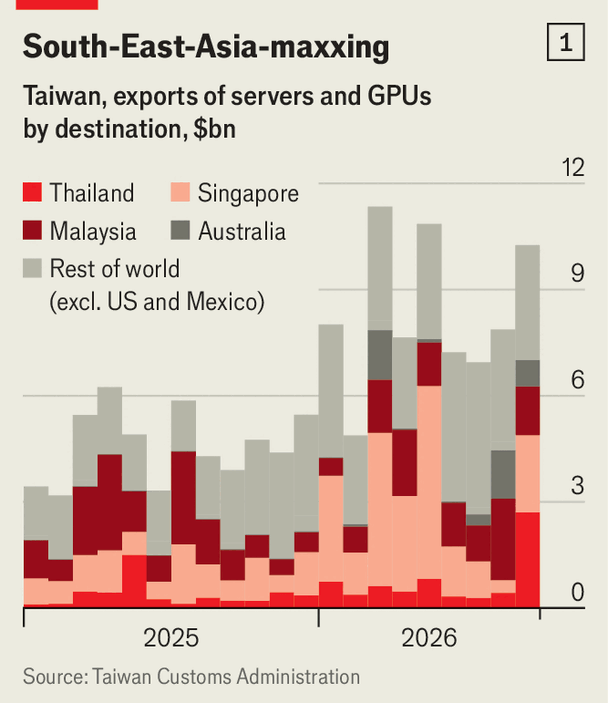
该国目前拥有55个大型数据中心,另有62个正在建设中。台湾是全球大多数高端芯片的来源地,其中大部分出口到美国和墨西哥(在那里被组装成销往美国的商品)。排除这两个国家,马来西亚、新加坡和泰国吸收了其余芯片的一半以上(见图1),这一占全球需求的比例令人吃惊,显然并非仅仅服务于国内消费者。
It now boasts 55 big data centres, with another 62 in the pipeline. Taiwan, the source of most of the world’s high-end chips, exports a majority of them to America and Mexico (where they are assembled into goods bound for America). Exclude those two countries, and Malaysia, Singapore and Thailand absorb more than half of the rest (see chart 1), an astonishing share of global demand that is clearly not catering simply to domestic consumers.
例如,美国云计算公司甲骨文在东南亚运营数据中心,这些数据中心与TikTok的中国所有者字节跳动合作,后者还拥有一个先进的人工智能实验室。一批鲜为人知的数据中心公司如雨后春笋般涌现,向中国客户出售远程访问服务。当局此前并不觉得有紧迫性去阻止它们。马来西亚国家安全总监拉贾·努希尔万·扎纳尔·阿比丁表示:“根据马来西亚法律,仅仅引进和使用英伟达芯片并不违法。”
Oracle, an American cloud-computing firm, for instance, runs data centres in South-East Asia that work with ByteDance, the Chinese owner of TikTok, which also owns an advanced AI lab. A cottage industry of lesser-known data-centre firms has sprung up to sell remote access to Chinese customers. Authorities had felt little urgency to stop them. “Just the act of bringing in and using Nvidia chips is not illegal under Malaysian law,” says Raja Nushirwan Zainal Abidin, Malaysia’s director general of national security.
许多东南亚官员曾认为,美国当局知晓规则正在大规模被规避。毕竟,另一位马来西亚官员表示,是美国科技公司提供了算力:“大家都以为美国对此很满意。”新加坡对黄女士和Megaspeed展开调查,但称几乎未获得美国当局的配合。美国财政部长斯科特·贝森特曾表示,商务部阻挠了禁止Megaspeed购买芯片的努力。即使在英伟达去年停止向Megaspeed销售芯片后,一位英伟达发言人称,该公司仍获得了商务部的“明确许可”,继续为Megaspeed提供维修备件。
Many South-East Asian officials had believed the American authorities were aware that the rules were being skirted on a giant scale. After all, says another Malaysian official, it was American tech firms that were providing the computing power: “Everyone assumed the US was happy with it.”Singapore launched a probe into Ms Huang and Megaspeed, but says it got little co-operation from the American authorities. America’s own treasury secretary, Scott Bessent, has stated that the Department of Commerce stymied efforts to ban Megaspeed from buying chips. Even after Nvidia stopped selling Megaspeed chips last year, it received “explicit permission” from the department to continue providing Megaspeed spare parts for repairs, an Nvidia spokesperson says.
政府内部多位人士长期主张,实施过度严格的管控只会刺激中国本土芯片产业的发展,导致美国的杠杆作用减弱。
Several figures within the administration have long argued that imposing overly strict controls simply spurs the development of China’s indigenous chip industry, leaving America with diminished leverage.
如果特朗普政府的意图是放缓中国芯片制造业的发展,那么它并未奏效。事实上,中国为获取自主制造芯片的条件所付出的努力,不亚于获取先进外国芯片。
If the Trump administration’s intention was to slow down the Chinese chipmaking industry, it has not worked. Indeed, China has worked just as hard if not harder to gain access to the wherewithal to make chips at home as it has to get hold of fancy foreign chips.
这始于对熟练工程师的搜寻。台湾不仅制造芯片,还拥有庞大的芯片设计产业。2014年中国设立大型投资基金以培育芯片制造业后,大陆企业开出的薪资是台湾的两三倍,有时还包学费、供补贴住房。据台湾经济研究院统计,到2019年,约有3000名台湾工程师受雇于大陆,占台湾半导体劳动力的近十分之一。
It started with a hunt for skilled engineers. Taiwan not only makes chips, but also has a big chip-design industry. After China launched a big investment fund to foster a chipmaking industry in 2014, mainland firms dangled salaries two or three times those in Taiwan, sometimes with school fees and subsidised flats thrown in. By 2019 some 3,000 Taiwanese engineers, nearly a tenth of the island’s semiconductor workforce, were employed on the mainland, according to the Taiwan Institute of Economic Research.
许多人在新冠疫情封控期间开始陆续回流。2022年后,美国限制向大多数中国企业出口芯片和芯片制造设备,在大陆找工作开始显得像是一种职业风险。智库科技法律研究所的施平安表示,被中国大陆企业裁员的人发现“几乎不可能”在台湾找到工作。
Many began drifting home during China’s covid-19 lockdowns. After 2022, when America limited exports of chips and chipmaking tools to most Chinese firms, a job on the mainland began to look like a career risk. Those laid off by Chinese firms found it “really impossible” to get work in Taiwan, says Shih Ping-an of the Science & Technology Law Institute, a think-tank.
但中国大陆企业早已找到绕过工程师不愿移居的办法:在台湾秘密雇佣他们。台湾智库国防安全研究院的蒋旻彦称之为“远程挖角”。大陆企业在岛上经营或招聘需要台湾政府批准,因此它们躲在本地代理人背后。施平安说,通常由一家空壳公司雇佣一名工程师,然后要求这名工程师说服同事一起跳槽。有时整个研发团队会一次性出走。
But Chinese firms had already found a way round engineers’ reluctance to emigrate: employing them secretly in Taiwan. Chiang Min-yen of DSET, a Taiwanese think-tank, calls it “remote poaching”. Firms from the mainland need the Taiwanese government’s approval to operate or recruit on the island, so they hide behind local fronts. Typically, says Ms Shih, a shell company hires a single engineer, who is then asked to persuade colleagues to jump ship too. Sometimes an entire R&D team walks out at once.
总部位于北京的加密货币挖矿芯片制造商比特大陆是先行者。检方后来指控,从2018年起,它秘密运营两家公司:位于台湾芯片产业中心新竹的IC Link,以及位于台北附近的WiseCore。这两家公司隐瞒了中国大陆背景,从联发科等本地芯片设计公司挖走100多名工程师,部分人薪资是原薪的两倍。检方称,目的是积累AI芯片专业知识。2021年,四名高管认罪并被罚款。但这种模式蔓延开来。
Bitmain, a maker of chips for crypto-mining based in Beijing, was a pioneer. From 2018, prosecutors later alleged, it secretly ran two firms, IC Link in Hsinchu, the centre of Taiwan’s chip industry, and WiseCore near Taipei. The pair hid their Chinese ownership and hired more than 100 engineers from local chip-designers such as MediaTek, some at double their previous pay. The aim, prosecutors said, was to build expertise in AI chips. In 2021 four executives admitted wrongdoing and were fined. But the model spread.
据科技媒体Rest of World报道,台湾法务部调查局(一个执法机构)自2020年以来已完成166起非法大陆运营和人才挖角案件的调查。所有经审查的36起案件均以定罪告终,其中33起涉及芯片设计或研究。被指控者包括中国大陆领先芯片制造商中芯国际,据称其运营一家台湾子公司,伪装成萨摩亚公司。8月,调查人员搜查64处地点,并在17家更多大陆资金支持的公司对114人进行询问。
Taiwan’s Ministry of Justice Investigation Bureau, a law-enforcement agency, has completed 166 investigations into illegal Chinese operations and talent-poaching since 2020, according to Rest of World, a tech publication. All 36 of the cases reviewed ended in convictions, of which 33 involved chip design or research. Among those accused is SMIC, China’s leading chipmaker, which is alleged to have run a Taiwanese subsidiary disguised as a company from Samoa. In August agents searched 64 sites and questioned 114 people at 17 more Chinese-funded firms.
民进党立法委员陈冠廷认为,如今挖角已经难得多。本地企业薪酬优厚。想移民的工程师更感兴趣的是去美国,而不是大陆。江先生则不那么确定。他认为,中国企业并没有放弃:“他们正花更多力气隐藏身份。”运营制造尖端芯片的工厂也需要熟练的工程师。数十年试错积累的技术诀窍,与先进的设备同样重要。台湾一家大型芯片公司的一位高管说,年轻工程师掌握的工艺知识,在他或她工作的晶圆厂(芯片制造厂)之外用处可能有限。
Chen Kuan-ting, a legislator from the ruling Democratic Progressive Party, reckons poaching is now much harder. Local firms pay well. Engineers who want to emigrate are more interested in moving to America than the mainland. Mr Chiang is less sure. Chinese firms, he believes, have not given up: “They are taking more effort to hide their identity.”Running factories that make cutting-edge chips also requires skilled engineers. Know-how stemming from decades of trial and error is as important as whizzy equipment. A young engineer’s knowledge of processes can be of limited use outside the fab (chipmaking plant) where he or she works, says a senior executive at a big Taiwanese chip company.
相比之下,资深人士了解全局,一旦被挖走,“有能力造成真正的损害”。他们的人数也很少。美国智库外交关系委员会的克里斯·麦圭尔说,“台积电大概有30到50人”掌握着别人不知道的东西。
Senior people, in contrast, understand the bigger picture and are “capable of creating real damage” if poached. They are also few in number. Chris McGuire of the Council on Foreign Relations, an American think-tank, says there are “probably 30 to 50 people at TSMC” who know things no one else does.
从韩国的一起案件可以清楚看出,少数资深人士能造成多大的损害。2016年,韩国最大芯片制造商三星的一名28年资历的老员工加入了长鑫存储,后者当时是中国一家内存芯片初创企业。检方称,他和另外几名前三星员工交出了该公司制造DRAM(一种内存芯片)的配方。其中一名跳槽者用手把数百道工序抄进笔记本,以躲避三星对电子通信的内部监控。
Just how much damage a handful of veterans can do is clear from a case in South Korea. In 2016 a 28-year veteran of Samsung, South Korea’s biggest chipmaker, joined CXMT, then a Chinese memory-chip startup. Prosecutors said he and other former Samsung staff handed over the firm’s recipe for making DRAM, a type of memory chip. One of the defectors copied hundreds of steps by hand into notebooks to dodge Samsung’s internal monitoring of electronic communications.
2019年,长鑫存储成为首家量产DRAM的中国企业。今年4月,韩国一家法院判处这名老员工七年监禁。今年早些时候长鑫存储在上海股市上市时,成为中国市值最高的公司之一。
In 2019 CXMT became the first Chinese firm to mass produce DRAM. In April a South Korean court jailed the veteran for seven years. When CXMT floated on Shanghai’s stock market earlier this year it became one of China’s most valuable firms.
台积电同样也是目标,而且据台湾检方称,针对它的正是中国国家层面。今年7月,检方起诉了台积电一名前副经理。检方称,此人经中间人介绍,被中国公民丁晓虎招募,而丁晓虎是受中国中央军事委员会指示行事。2023年至2024年间,两人涉嫌策划在中国大陆设立一家芯片材料公司。这名走上歧途的经理起草了一份招揽台湾人才的计划。他被指控复制了21份含商业秘密的文件并带回家中。不过,台积电自己的调查人员发现了他;检方称,所有文件都在任何技术外流之前被追回。
TSMC, too, has been a target, of the Chinese state specifically according to Taiwanese prosecutors. In July they indicted a former deputy manager at the firm. They say he was recruited, through a go-between, by Ding Xiaohu, a Chinese national acting on instructions from China’s Central Military Commission. Between 2023 and 2024 the pair allegedly planned a chip-materials company on the mainland. The wayward manager drafted a plan to woo Taiwanese talent. He is accused of copying 21 documents containing trade secrets and taking them home. TSMC’s own investigators caught him, however, and prosecutors say all the files were recovered before any technology changed hands.
中国也在搜寻芯片制造设备,尤其是极紫外(EUV)光刻设备。全世界只有一家公司生产这种设备,就是总部位于荷兰的阿斯麦。自2019年起,美国禁止向中国出售这类设备。没有EUV,中国的晶圆厂难以稳定地制造7纳米以下的先进处理器。今年6月,美国商务部长霍华德·卢特尼克告诉阿斯麦高管,可能有一台这种设备或其中部分部件流入了中国。阿斯麦对此予以否认,称公司知道自己造过的每一台EUV设备的下落。
China is also on the hunt for chipmaking machines and especially extreme ultraviolet (EUV) lithography devices. Only one firm in the world makes them, ASML, which is based in the Netherlands. Since 2019 America has banned the sale of them to China. Without EUV, Chinese fabs struggle to make cutting-edge processors, smaller than seven nanometres, reliably. In June Howard Lutnick, America’s commerce secretary, told ASML’s bosses that one of the machines, or parts of one, may have reached China. ASML denies this, saying it knows the location of every EUV machine it has ever built.
外界一直有传言称中国正在自研此类设备。去年12月,路透社报道称,中国一个包括前阿斯麦工程师在内的团队已完成了一台原型机。但要造出一台能快速、低缺陷率地量产芯片的设备,难度要大得多。分析人士认为,中国需要10到15年才能掌握这项技术。
Rumours persist that China is building its own. In December Reuters, a news agency, reported that a team in China including former ASML engineers had completed a prototype. But making a machine that can churn out chips quickly, with few defects, is far harder. Analysts think China will need 10-15 years to master that.
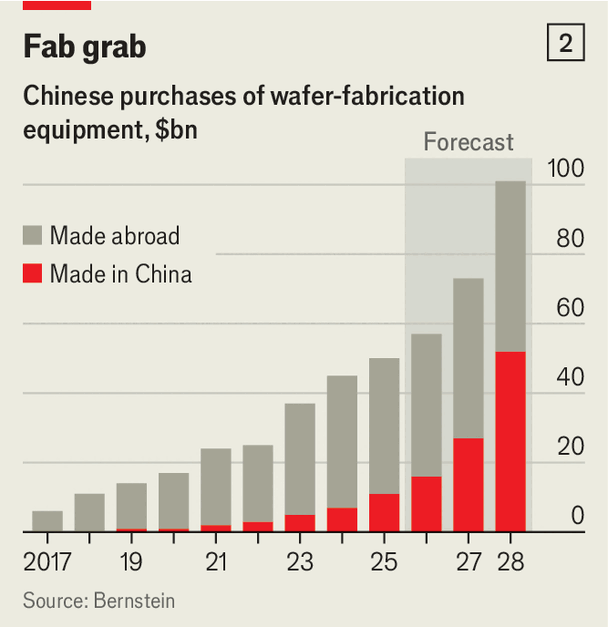
即便没有EUV,中国的芯片制造商也已取得长足进步。2021年,中国企业供应的芯片制造设备还不到中国采购量的十分之一。研究公司伯恩斯坦的数据显示,今年这一比例将超过四分之一,价值约160亿美元(见图2)。在最关键的环节光刻上,中国晶圆厂仍依赖阿斯麦较旧的深紫外(DUV)设备,并且一直在大量采购。
Even without EUV, China’s chipmakers have come a long way. In 2021 Chinese firms supplied less than a tenth of the chipmaking equipment bought in China. This year they will supply more than a quarter, worth some $16bn, according to Bernstein, a research firm (see chart 2). For the most critical step, lithography, Chinese fabs still rely on ASML’s older deep ultraviolet (DUV) tools, and they have been buying them in bulk.
美国智库科技与国家治理中心估计,到2026年初,中资晶圆厂已获得约340台阿斯麦DUV设备,其中仅2024年和2025年就超过180台。借助这些设备,中国晶圆厂可以制造七纳米及略低于七纳米的芯片,但缺陷更多、成本更高。
By early 2026 Chinese-owned fabs had acquired some 340 of ASML’s DUV machines, estimates the Centre for Technology & Statecraft, an American think-tank, more than 180 of them in 2024 and 2025 alone. With these tools Chinese fabs can make chips of seven nanometres and a little below, but with more defects and at a higher cost.
尽管有这些挑剔之处,中国的芯片产业显然在快速进步。据报道,中国领先的人工智能实验室深度求索计划在华为的芯片上预训练其下一代模型V5。如果成功,那将是最清晰的证据,表明美国对华芯片出口管制是一项正在贬值的资产。
Such cavils notwithstanding, China’s chip industry is clearly progressing rapidly. DeepSeek, China’s leading AI lab, reportedly plans to pre-train its next model, V5, on Huawei’s chips. If it succeeds, that would be the clearest proof yet that America’s controls on chip exports to China are a wasting asset.
对于中国坚持不懈地追求自立自强,美国的回应反复无常、含糊其辞且争吵不断。特朗普的前任乔·拜登稳步收紧了对芯片出口的限制。对华销售的全面管制于2022年出台。一年后,规则进一步收紧,以阻止英伟达专为规避早先限制而设计的芯片。随后在2024年,高带宽内存(HBM)芯片被列入清单。拜登离任前几天,其团队试图进一步拧紧螺丝,公布了一项“人工智能扩散”规则,将世界划分为不同层级,每个层级对美国芯片的获取权限各不相同。
America has responded to China’s dogged pursuit of self-reliance with inconsistency, prevarication and bickering. Joe Biden, Mr Trump’s predecessor, steadily tightened restrictions on chip exports. The sweeping controls on sales to China came in 2022. A year later the rules were tightened to block chips that Nvidia had designed specifically to escape the earlier limits. Then in 2024 HBM chips were added to the list. Days before Mr Biden left office, his team tried to tighten the screws yet further, unveiling an “AI diffusion” rule that sorted the world into tiers, each with different access to American chips.
特朗普的态度则宽松得多。他的政府在该规则生效前就将其废除。去年,政府告知英伟达,向中国市场销售的H20芯片需要许可证,但几个月后又同意发放许可证,以换取一部分收入分成。去年12月,政府进一步批准出口英伟达性能强得多的H200,尽管中国一直不愿让本国企业购买,因为它想鼓励使用国产芯片。
Mr Trump has been far more relaxed. His administration scrapped the diffusion rule before it took effect. Last year it told Nvidia it needed a licence to sell the H20, a chip made for the Chinese market, before agreeing a few months later to grant licences in exchange for a share of the revenue. In December it went further, approving exports of Nvidia’s far more powerful H200, though China has been reluctant to let its firms buy it, since it wants to encourage use of domestic chips.
11月16日,钟摆又摆了回来。美国商务部宣布新规,阻止中国使用“基于美国技术的先进算力”,包括通过远程访问的方式。将芯片运入马来西亚、新加坡和泰国(以及巴西和印度尼西亚)以及在这些国家境内转移,将需要额外的许可证。东南亚一些人士担心,切断中国对远程访问的需求可能成为该地区数据中心繁荣的“游戏结束”时刻,使昂贵的投资搁浅,并引发痛苦的萧条。
On November 16th the pendulum swung back. The Commerce Department announced new rules to stop China using “advanced computing power based on US technology”, including through remote access. Additional licences will be needed to move chips into and within Malaysia, Singapore and Thailand (and Brazil and Indonesia as well). Some in South-East Asia worry that cutting off Chinese demand for remote access could be a “game-over” moment for the region’s data-centre boom, stranding expensive investments and precipitating a painful bust.
国会正在审议的多项法案将进一步收紧规则。其中一项将赋予议员对商务部AI芯片许可证决定的监督权。另一项将要求芯片制造商确保其芯片不被转移。第三项将把对EUV设备的管制扩大到DUV设备,进一步阻碍中国的芯片制造。
Various bills before Congress would tighten the rules more. One would give lawmakers oversight of the Commerce Department’s decisions on licences for AI chips. Another would require chipmakers to make sure their chips are not diverted. A third would extend controls on EUV machines to DUV ones, too, further hampering Chinese chipmaking.
然而,打击远程访问说起来容易做起来难,尤其是因为中国企业善于躲在空壳公司背后。马来西亚前贸易部副部长王建明表示,新规更可能不是突然叫停,而是根据每个数据中心运营商愿意承受多少法律风险来分割市场。
Clamping down on remote access is easier said than done, however, not least because Chinese firms are adept at hiding behind shell companies. Rather than a sudden stop, the new rules are more likely to split the market according to how much legal risk each data-centre operator will tolerate, says Ong Kian Ming, a former Malaysian deputy minister of trade.
消除走私则更加困难。大部分监管工作落在了企业自身身上——它们表示,这比听起来要难。英伟达和另一家大型芯片制造商AMD主要通过戴尔、超微等服务器制造商销售,而这些服务器制造商又转售给云服务公司和其他中间商。出于商业原因,客户对站点和计划讳莫如深。拒绝向可疑客户出售可能招致反竞争行为的投诉。
Eliminating smuggling is harder still. Much of the policing falls to the firms themselves—something they say is harder than it sounds. Nvidia and AMD, another big chipmaker, sell mostly through server-makers such as Dell and Supermicro, which in turn sell to cloud firms and other middlemen. Customers are cagey about sites and plans for commercial reasons. Refusing to sell to suspect ones can invite complaints of anti-competitive behaviour.
此外,阻止走私和远程访问对减缓中国本土产业的发展作用甚微。华盛顿智库布鲁金斯学会的陈凯尔(Kyle Chan)认为,进一步的管制将带来递减的回报。美国的限制已经刺激了中国追求自给自足的动力。“那匹马已经差不多跑出马厩了,”他说。但这并不意味着一切都已无望:他认为,要建立尖端产业,中国需要掌握制造和运行最关键部件技术的人才。归根结底,一切都在于人才。芯片战的前线可能不在硅谷,也不在新加坡,而在新竹。■
Moreover, impeding smuggling and remote access will do little to slow the development of China’s indigenous industry. Kyle Chan of the Brookings Institution, a think-tank in Washington, thinks further controls will yield diminishing returns. American restrictions have already spurred a drive for self-sufficiency. “That horse is sort of out of the barn,” he says. But that does not mean that all is lost: to build a cutting-edge industry, he argues, China needs people with the know-how to make and run the most critical components. In the end, it is all about talent. The front line of the chip wars may lie not in Silicon Valley or in Singapore, but in Hsinchu. ■