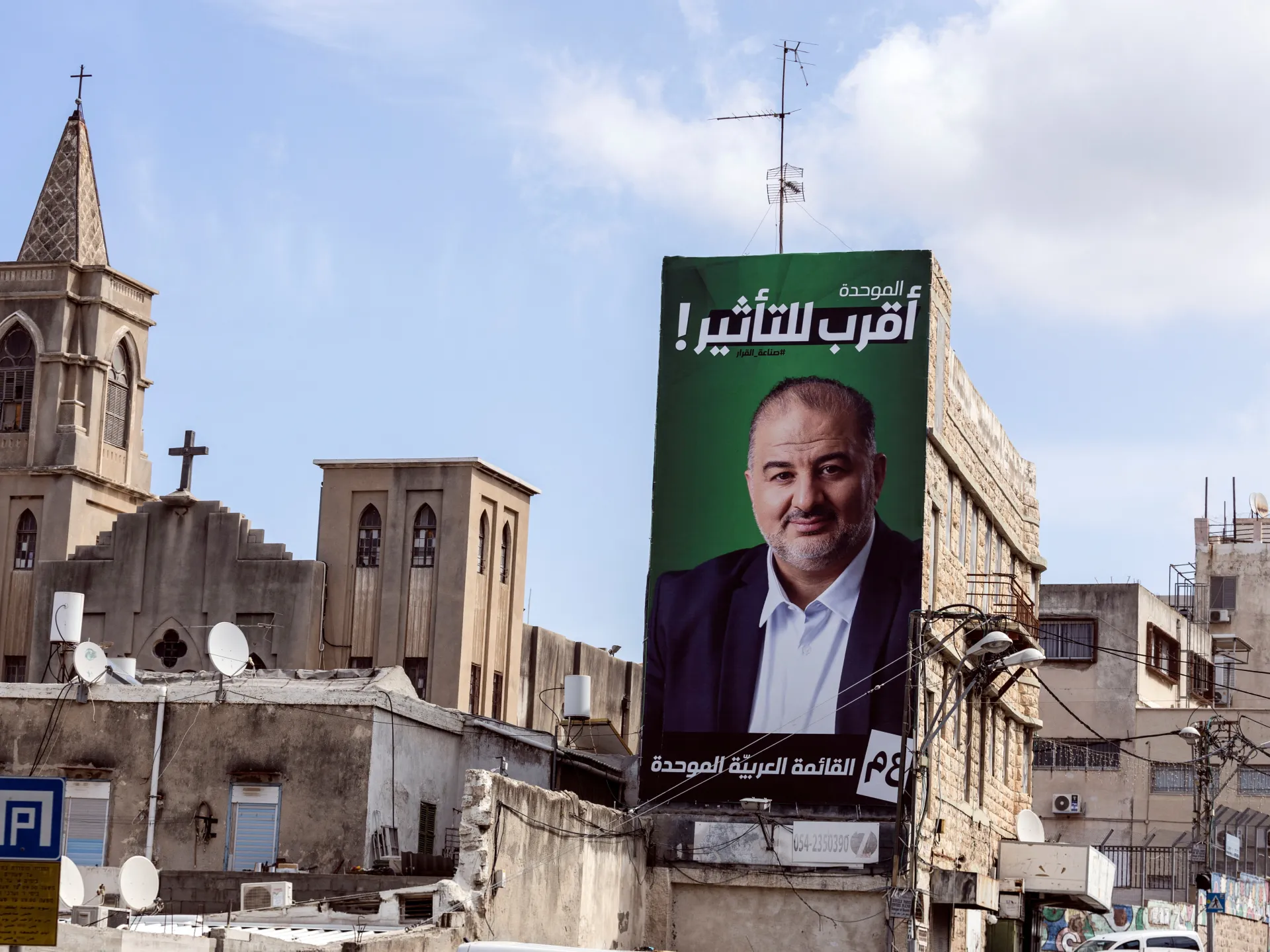
对于大多数以色列人来说,10月27日的大选是在总理本雅明·内塔尼亚胡和由前将军加迪·艾森科特领导的反对力量之间做选择。但对于占人口20%的以色列巴勒斯坦公民而言,即将到来的投票却呈现出另一种困境。
For the majority of Israelis, the general election on October 27 is a choice between Prime Minister Benjamin Netanyahu and the forces that oppose him, led by former general Gadi Eisenkot. But for the Palestinian citizens of Israel, who make up 20 percent of the population, the upcoming polls present a different dilemma.
随着以色列政治主流持续向极右转移,巴勒斯坦公民面临着政治权利和集体权利日益增长的威胁。以色列境内的巴勒斯坦社区经历着暴力事件增加,而定居者正在侵蚀他们的边界。近期推动扩大警务和将平民生活军事化,是巴勒斯坦民众焦虑感日益加剧的另一个根源。
As the political mainstream in Israel continues to shift to the far right, Palestinian citizens face growing threats to their political and collective rights. Palestinian communities in Israel experience increased violence, while settlers are encroaching on their boundaries. The recent push to expand policing and militarisation of civilian life is another source of growing anxiety within the Palestinian population.
在此背景下,反内塔尼亚胡阵营似乎并不提供政策逆转或改变的前景。因此,许多巴勒斯坦人心中的问题是,参加以色列大选究竟能否产生任何实质性影响。
In this context, the anti-Netanyahu bloc does not seem to offer the prospect of policy reversal or change. Therefore, the question on many Palestinian minds is whether voting in the Israeli elections can make any difference at all.
1948年巴勒斯坦的再殖民化 自1948年“大灾难”以来,设法留在被宣布为新成立的以色列国领土内的家园里的巴勒斯坦人,其命运与约旦河西岸和加沙的巴勒斯坦人截然不同。1952年,他们获得了以色列公民身份,1966年,他们被迫生活其下的军事管制被解除。
Recolonisation of 1948 Palestine Since the Nakba of 1948, the Palestinians who managed to remain in their homes in what was declared as territory of the new State of Israel have had a different fate than the Palestinians in the West Bank and Gaza. In 1952, they were granted Israeli citizenship, and in 1966, the martial law under which they were forced to live was lifted.
尽管以色列巴勒斯坦公民拥有投票权和参政权,但公民身份并未能保护他们免受更广泛的剥夺体系以及重塑其巴勒斯坦身份和民族归属感的企图之害。
Although Palestinian citizens of Israel have the right to vote and participate in politics, citizenship has not shielded them from the broader system of dispossession and attempts to reshape their Palestinian identity and national belonging.
通过土地没收以及对教育和文化的管控,以色列国家试图将巴勒斯坦人与其历史根源和集体过去割裂开来,转而推行一种“阿拉伯裔以色列人”模式,即其身份独立于巴勒斯坦和阿拉伯民族语境之外的公民。
Through land confiscation and the regulation of education and culture, the Israeli state has sought to detach Palestinians from their historical roots and collective past, promoting instead a model of the “Arab Israeli” as a citizen whose identity is separate from its Palestinian and Arab national context.
正式公民身份并未为巴勒斯坦人带来实质平等,他们面临歧视性法律、基本服务长期资金不足,以及政治和社会经济层面的边缘化。
Formal citizenship has not secured substantive equality for Palestinians as they face discriminatory laws, systemic underfunding of basic services, and political and socioeconomic marginalisation.
以色列没有像在约旦河西岸和加沙那样直接对巴勒斯坦公民实施暴力,而是将暴行“外包”给犯罪网络。
Instead of engaging in direct violence towards Palestinian citizens – as it has done in the West Bank and Gaza – the Israeli state has instead “outsourced” brutality to criminal networks.
结果,巴勒斯坦社区遭遇杀戮、枪击、爆炸和纵火,而以色列执法部门对此基本置之不理。最近这一问题进一步升级,有组织犯罪集团获取了先进武器,据报这些武器是从以色列军队军火库偷窃或走私入境的。有组织犯罪的这种日益军事化已夺去数百条生命。
As a result, Palestinian communities have faced killings, shootings, bombings and arson while Israeli law enforcement has largely ignored the problem. More recently, this problem has escalated, as organised crime groups obtained advanced weapons reportedly stolen from Israeli army stockpiles or smuggled across borders. This growing militarisation of organised crime has claimed hundreds of lives.
与此同时,巴勒斯坦社区周边的以色列定居点不断扩张,伴随着加速夺取土地。这一“再殖民化”进程始于混合城市,如雅法和洛德,宗教民族主义定居者团体于2021年开始在巴勒斯坦社区站稳脚跟。
In parallel, Israeli settlements next to Palestinian communities have expanded, accompanied by accelerated seizure of land. This process of “recolonisation” began in mixed cities, such as Jaffa and Lydd, where religious-nationalist settler groups started establishing themselves in Palestinian neighbourhoods in 2021.
自2023年10月以来,这一进程加速。8月,以色列财政部长贝扎莱尔·斯莫特里奇公布了其政党“犹太化”内盖夫和以色列北部的计划。他提议在这两个地区增加100万犹太居民,建立40个新定居点和数十个农场,扩建现有定居点,并创造数十万个新住房单元。
Since October 2023, this process has accelerated. In August, Israel’s Finance Minister Bezalel Smotrich unveiled his party’s plan to “Judaise” the Naqab and northern Israel. He proposes to add one million Jewish residents to the two regions, establishing 40 new settlements and dozens of farms, expanding existing settlements, and creating hundreds of thousands of new housing units.
其意图是将被占约旦河西岸的领土控制模式延伸至内盖夫和以色列北部,那里集中居住着巴勒斯坦社区。
The idea is to extend the model of territorial control from the occupied West Bank into the Naqab and northern Israel, where Palestinian communities are concentrated.
还有迹象表明,对巴勒斯坦城镇和村庄的警务工作可能越来越多地落入国家安全部长伊塔马尔·本-格维尔设立的国民警卫队手中。
There are also indications that the policing of Palestinian towns and villages could increasingly fall under the National Guard, established under National Security Minister Itamar Ben-Gvir.
成立该部队的想法源于2021年5月的抗议活动,即所谓的“尊严起义”,该起义蔓延至利德、海法、乌姆法赫姆以及数十个其他城镇和村庄的巴勒斯坦社区。
The idea of creating the force was prompted by the May 2021 protests, known as the Dignity Uprising, which spread across Palestinian communities in Lydd, Haifa, Umm al-Fahm, and dozens of other towns and villages.
本-格维尔一直主张扩大国家镇压此类动荡的能力。尽管国民警卫队的确切角色和作战框架仍在制定中,但其可能被部署用于对抗大规模抗议,这引发了关于抗议权利和民主自由保护的严重担忧。
Ben-Gvir has advocated expanding the state’s capacity to suppress such unrest. Although the National Guard’s precise role and operational framework remain under development, its potential deployment against mass protests raises serious concerns about the right to protest and the protection of democratic freedoms.
政府加强了定居者安保小分队,并将其纳入更广泛的安全框架,引发了人们对武装平民团体在对巴勒斯坦社区实施控制中扮演角色日益增强的担忧。
The government has strengthened settler security squads and integrated them into a broader security framework, raising concerns about the growing role of armed civilian groups in enforcing control over Palestinian communities.
与此同时,本-格维尔扩大了个人持枪准入,自上任以来已发放30万张枪支许可证。
At the same time, Ben-Gvir has widened access to personal firearms, issuing 300,000 gun licences since taking office.
这些措施共同使平民执法常态化,加深了日常生活的军事化,强化了在一个建立在剥夺和从属巴勒斯坦人基础上的社会中强制权力的不平等分配。
Together, these measures normalise civilian policing and deepen the militarisation of everyday life, reinforcing the unequal distribution of coercive power in a society structured on the dispossession and subordination of Palestinians.
巴勒斯坦方面的回应 寻求代表以色列巴勒斯坦公民的政党,如由曼苏尔·阿巴斯领导的统一阿拉伯名单(拉姆),长期以来一直主张,议会参与和支持反内塔尼亚胡阵营有助于将极右翼赶下台,并阻止其定居者殖民议程。但该党自身的记录证明这一前提是错误的。
The Palestinian response Parties seeking to represent Palestinian citizens of Israel, such as the United Arab List (Ra’am), led by Mansour Abbas, have long argued that parliamentary participation and support for the anti-Netanyahu camp can help remove the far right from power and halt its settler-colonial agenda. But the party’s own track record proves this premise wrong.
拉姆加入了2021年大选后组建的、排除了内塔尼亚胡的联合政府,但未能给巴勒斯坦公民的状况带来根本性改变。该联合政府脆弱不堪,常因深刻的意识形态矛盾而动荡不安。
Ra’am joined the coalition government formed after the elections in 2021, which excluded Netanyahu, but it failed to bring about fundamental changes in the conditions of Palestinian citizens. The coalition was fragile and often rocked by deep ideological contradictions.
2022年,统一阿拉伯名单(Ra’am)成员马赞·格奈姆(Mazen Ghnaim)公开承认,尽管他的政党是执政联盟的一部分,且曾有承诺称相关政策将被采纳,但他无法推动有利于巴勒斯坦人口的政策落实。他还感叹,每当他走访巴勒斯坦社区时,都会面临沉重的批评。
In 2022, Mazen Ghnaim, a member of Ra’am, publicly acknowledged that he could not push through policies that would benefit the Palestinian population, despite his party being part of the ruling coalition and despite promises being made that such policies would be accepted. He also lamented the heavy criticism he faced whenever he was visiting Palestinian communities.
统一阿拉伯名单在该联盟中的经历,凸显了在一个其他成员党派坚持排他性民族主义政策的政府中,维持巴勒斯坦政治参与的挑战。
Ra’am’s experience in that coalition illustrated the challenge of sustaining Palestinian political participation in a government whose other constituent parties uphold exclusionary nationalist policies.
因此,问题远不止内塔尼亚胡个人:巴勒斯坦人对反内塔尼亚胡阵营的支持,无法转化为有意义的政策,以挑战以色列巴勒斯坦公民面临的更广泛的歧视和剥夺结构。
The problem, therefore, extends beyond Netanyahu himself: Palestinian support for the anti-Netanyahu camp cannot translate into meaningful policies that challenge the broader structures of discrimination and dispossession Palestinian citizens of Israel face.
投票或许提供了一种减缓这一进程的方式,但无法扭转以色列社会内部正在发生的更深层变革。向法西斯主义的文化转向已超越政府及其政治领导层,日益植根于社会态度和日常生活之中。
Voting may offer a way to slow down this project, but it cannot reverse the deeper transformation taking place within Israeli society. The cultural shift towards fascism extends beyond the government and its political leadership, becoming increasingly embedded in social attitudes and everyday life.
话虽如此,我认为再有四年极右翼统治,将对巴勒斯坦社区及其权利构成直接威胁。因此,我将在周二的选举中投票。
That said, I believe another four years of far-right rule would pose an immediate threat to Palestinian communities and their rights. Therefore, I will vote in Tuesday’s election.
但巴勒斯坦人需要认识到,选举参与必须伴随更激进的政治回应,方能直面推动这一变革的结构和意识形态。这其中要求,除其他外,改革以色列阿拉伯公民高级跟进委员会,并通过民众委员会和基层组织,使其更扎根于巴勒斯坦社会。
But Palestinians need to recognise that electoral participation must be accompanied by a more radical political response capable of confronting the structures and ideologies driving this transformation. This requires, among other things, reforming the High Follow-Up Committee for Arab Citizens of Israel and rooting it more firmly in Palestinian society through popular committees and grassroots organising.
这也要求在历史上的巴勒斯坦全境,对民主化和去锡安化做出更广泛的承诺,作为一项旨在通过替代性制度、机制和集体行动形式,构建不同未来的更大政治项目的一部分。
It also demands a broader commitment to democratisation and de-Zionisation across historic Palestine, as part of a larger political project aimed at building a different future through alternative institutions, mechanisms, and forms of collective action.
无论以色列国家如何声称,以色列境内巴勒斯坦公民的命运都与巴勒斯坦其他人口的命运紧密相连。巴勒斯坦政治领导人最终必须接受这一现实。
Whatever the Israeli state might claim, the fate of the Palestinian citizens of Israel is tied to the fate of the rest of the Palestinian population. That is a realisation that Palestinian political leaders must finally embrace.