十年前,《巴黎协定》正式生效,将几乎所有国家约束在一个共同目标之下:将全球变暖幅度控制在比工业化前水平高出2摄氏度(3.6华氏度)以内,并努力将升温幅度限制在1.5摄氏度(2.7华氏度)以内。
Ten years ago, the Paris Agreement entered into force, binding nearly every country to a shared goal: to hold global warming well below 2 degrees Celsius (3.6 degrees Fahrenheit) above preindustrial levels and pursue efforts to limit it to 1.5C (2.7F).
十年过去,该协定推动了更强有力的气候政策和清洁能源的快速扩张。但排放量仍维持在接近历史高位,气温持续攀升,各国距离将1.5摄氏度升温目标控制在可触及范围内所需的减排幅度依然遥远。
A decade on, the deal has helped drive stronger climate policies and a rapid expansion of clean energy. But emissions remain near record highs, temperatures keep climbing and countries are still far from the cuts needed to keep a 1.5C limit within reach.
在本期图解报道中,半岛电视台回顾《巴黎协定》旨在达成何种目标、全球气温自那时起上升了多少,以及哪些国家正在推高排放量。什么是《巴黎协定》?
In this visual explainer, Al Jazeera looks at what the Paris Agreement set out to do, how far global temperatures have risen since and which countries are driving emissions. What is the Paris Agreement?
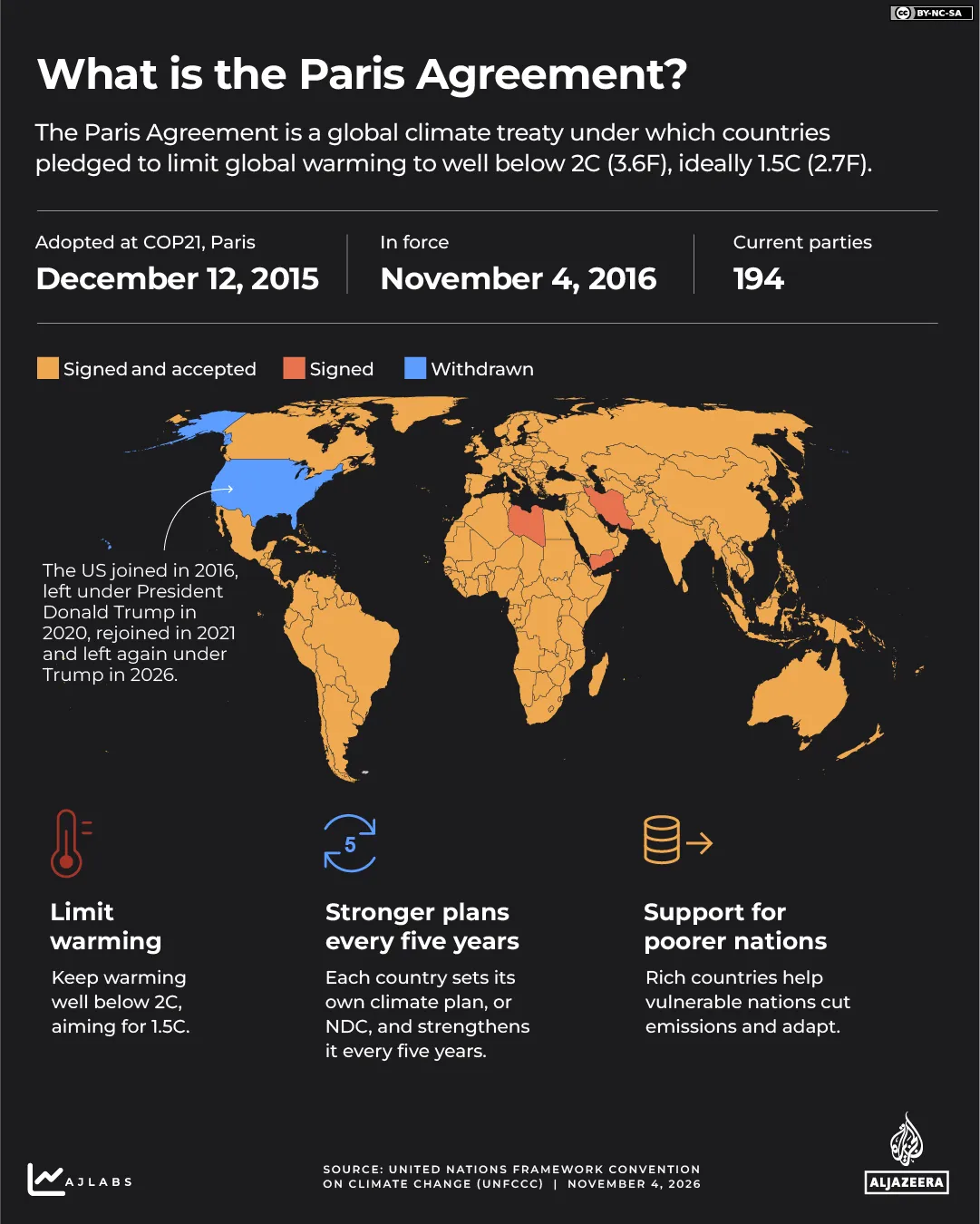
《巴黎协定》是一项具有法律约束力的气候条约,由196个缔约方于2015年12月12日在联合国巴黎气候峰会(即COP21)上通过。该协定于2016年11月4日正式生效。
The Paris Agreement is a legally binding climate treaty adopted by 196 parties at the United Nations climate summit in Paris, also known as COP21, on December 12, 2015. It entered into force on November 4, 2016.
美国是仅次于中国的世界第二大温室气体排放国,曾两度加入又两度退出该协定。唐纳德·特朗普总统下令了这两次退出。第一次退出于2020年11月生效,乔·拜登总统于2021年2月带领美国重新加入。美国今年1月再次退出,这是特朗普下令第二次退出满12个月后生效的。如今,共有194个缔约方(193个国家和欧盟)属于该协定。
The United States, the world’s second-largest greenhouse gas emitter after China, has joined and left the agreement twice. President Donald Trump ordered both withdrawals. The first took effect in November 2020, and President Joe Biden rejoined in February 2021. The US left again in January this year, 12 months after Trump ordered its exit for a second time. Today, 194 parties, 193 countries and the European Union, belong to the agreement.
协定并未对所有国家强加统一的减排幅度,而是要求各国政府通过“国家自主贡献”(NDC)设定自己的目标,概述其将如何削减排放并适应气候变化。
Rather than imposing the same cuts on everyone, the agreement asks each government to set its own targets through nationally determined contributions, or NDCs, outlining how it will cut emissions and adapt to climate change.
各国每五年提交一份更具雄心的NDC,并按同一周期进行“全球盘点”以评估集体进展。协定还涵盖报告机制、气候融资以及对发展中国家的支持。
Countries submit a new, more ambitious NDC every five years, and a Global Stocktake assesses collective progress on the same cycle. The agreement also covers reporting, climate finance and support for developing countries.
协定并不强制各国必须达成其目标,而是依靠透明度和国际压力来提升雄心。世界离突破1.5摄氏度限制还有多远?自该协议通过以来,气温持续上升。
The agreement does not force countries to meet their targets. It relies on transparency and international pressure to raise ambition. How close is the world to breaking the 1.5C limit? Temperatures have kept rising since the deal was adopted.
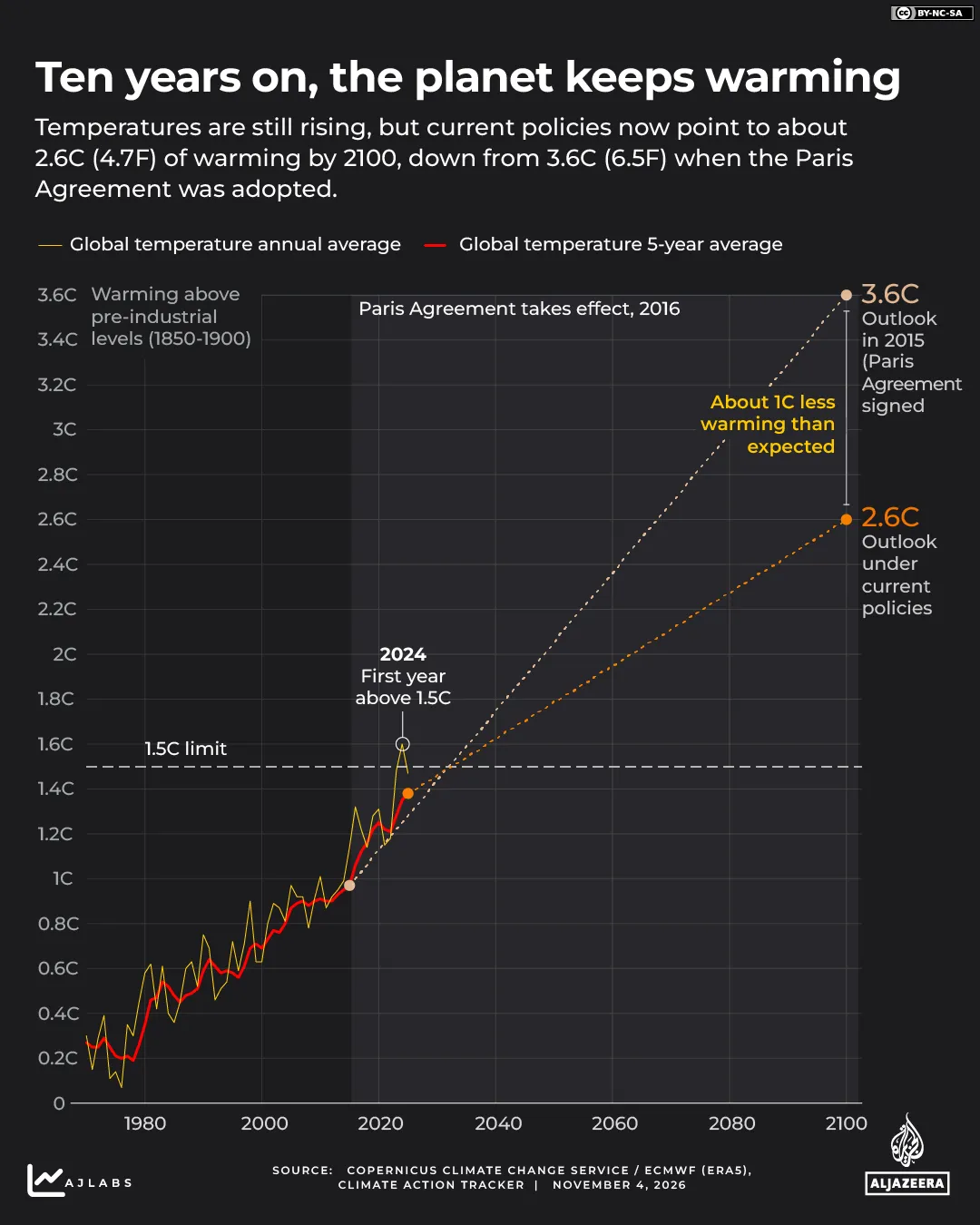
2024年,地球首次在整个日历年内比工业化前水平高出1.5摄氏度以上。
In 2024, the planet was more than 1.5C warmer than preindustrial levels across a full calendar year for the first time.
过去三年,即2023年至2025年,是有记录以来最热的三年,也是首个三年平均升温超过1.5摄氏度的时期。
The past three years, 2023 to 2025, were the hottest on record and the first three-year period to average more than 1.5C of warming.
长期升温平均水平目前约为1.4摄氏度,科学家预计将在本世纪末前超过1.5摄氏度。
The long-term warming average now stands at about 1.4C, and scientists expect it to surpass 1.5C around the end of this decade.
10月,联合国环境规划署(UNEP)表示,在不超出1.5摄氏度的情况下将升温控制在1.5摄氏度的机会已经失去。
In October, the UN Environment Programme (UNEP) said the chance of keeping warming to 1.5C without overshooting it has been lost.
“每多出一分摄氏度和每多出一年的1.5摄氏度以上升温,都会增加气候影响和风险,例如今年困扰许多国家的致命洪水、热浪和野火,”联合国环境规划署执行主任英格·安德森说。不过,前景比2015年时要乐观一些。
“Every additional fraction of a degree and additional year of warming above 1.5C increases climate impacts and risks, such as the deadly floods, heatwaves and wildfires that have plagued many nations this year,” UNEP Executive Director Inger Andersen said. Still, the outlook is less bleak than it was in 2015.
《巴黎协定》签署时,现有政策使世界在2100年前将升温约3.6摄氏度。根据气候行动追踪组织的数据,随着各国采取气候政策和清洁能源扩张,这一预测已降至约2.6摄氏度。
When the Paris Agreement was signed, existing policies put the world on course for about 3.6C of warming by 2100. According to the Climate Action Tracker that projection has since fallen to about 2.6C as countries adopted climate policies and clean energy expanded.
然而,自2021年以来进展停滞,当前政策仍指向远高于协议承诺的升温幅度。哪些国家排放最多?
Progress has stalled since 2021, however, and current policies still point to far more warming than the agreement promised. Which countries emit the most?
二氧化碳是升温的主要驱动因素,主要来自燃烧煤炭、石油和天然气,而森林砍伐则移除了曾经吸收二氧化碳的树木。
Carbon dioxide, the main driver of warming, comes mostly from burning coal, oil and natural gas while deforestation removes trees that once absorbed it.
中国、美国和印度目前产生了全球一半以上的年度排放量。仅中国的排放量就超过美国、印度、俄罗斯和日本的总和,尽管美国历史上排放的碳排放量最多。
China, the US and India now produce more than half of the world’s annual emissions. China alone emits more than the US, India, Russia and Japan combined although the US has released the most carbon emissions historically.
清洁能源投资现在几乎是化石燃料投资的两倍,但减排速度太慢,无法将1.5摄氏度的目标保持在可触及范围内。
Investments in clean energy are now almost double those in fossil fuels, but emission cuts have been too slow to keep 1.5C within reach.
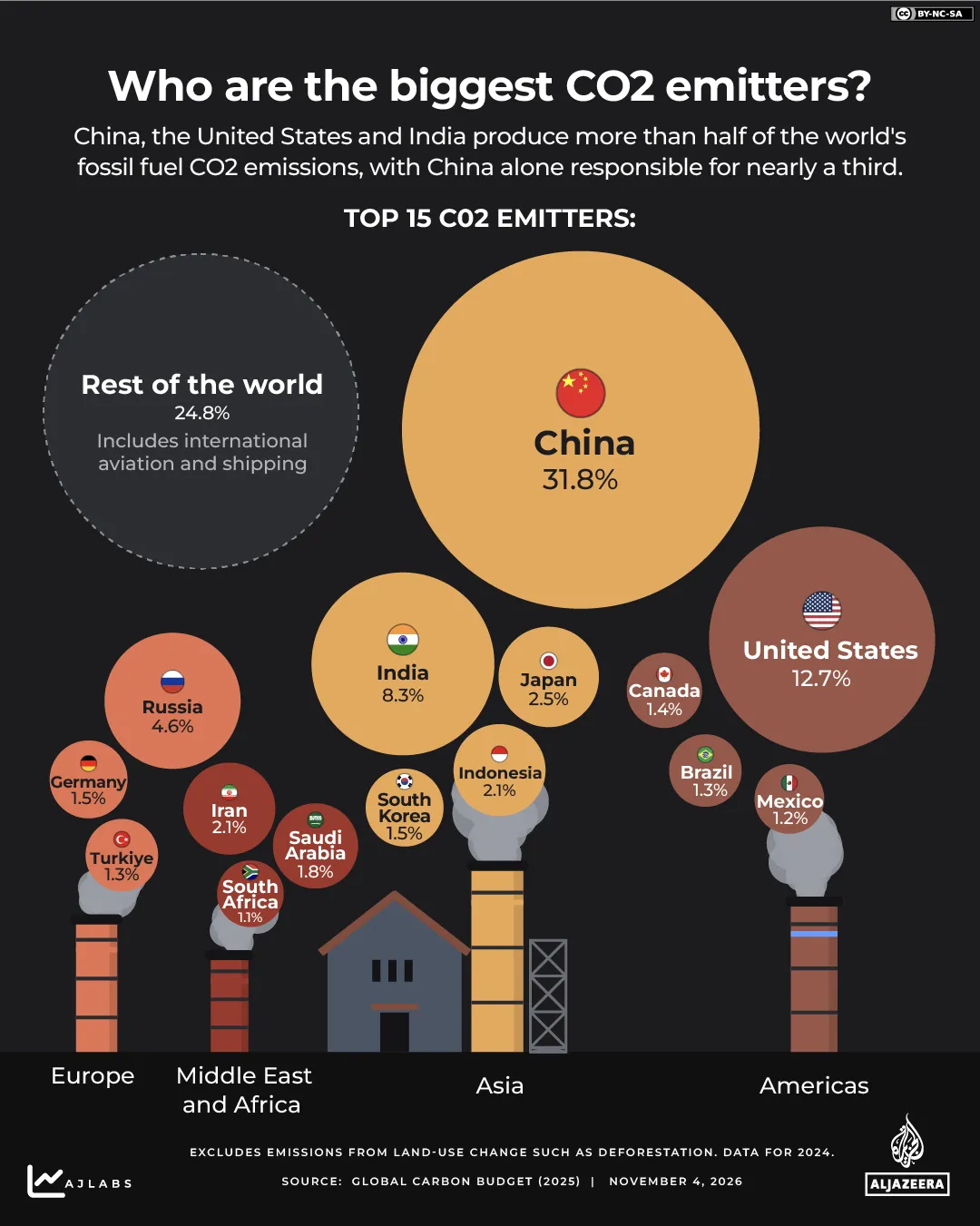
下方图表列出了2024年最大的排放国,并显示其排放量自2016年协议生效以来的变化情况。
The graphic below ranks the biggest emitters in 2024 and shows how their emissions have changed since the agreement took effect in 2016.
中国仍然是远远排在首位的污染国,其排放量与印度和印度尼西亚的排放量一道持续上升,因为这些快速增长的经济体燃烧更多煤炭以满足飙升的电力需求。印度尼西亚已跻身前十,取代了加拿大。
China remains by far the largest polluter, and its emissions have kept rising alongside those of India and Indonesia as these fast-growing economies burn more coal to meet soaring power demand. Indonesia has climbed into the top 10, replacing Canada.
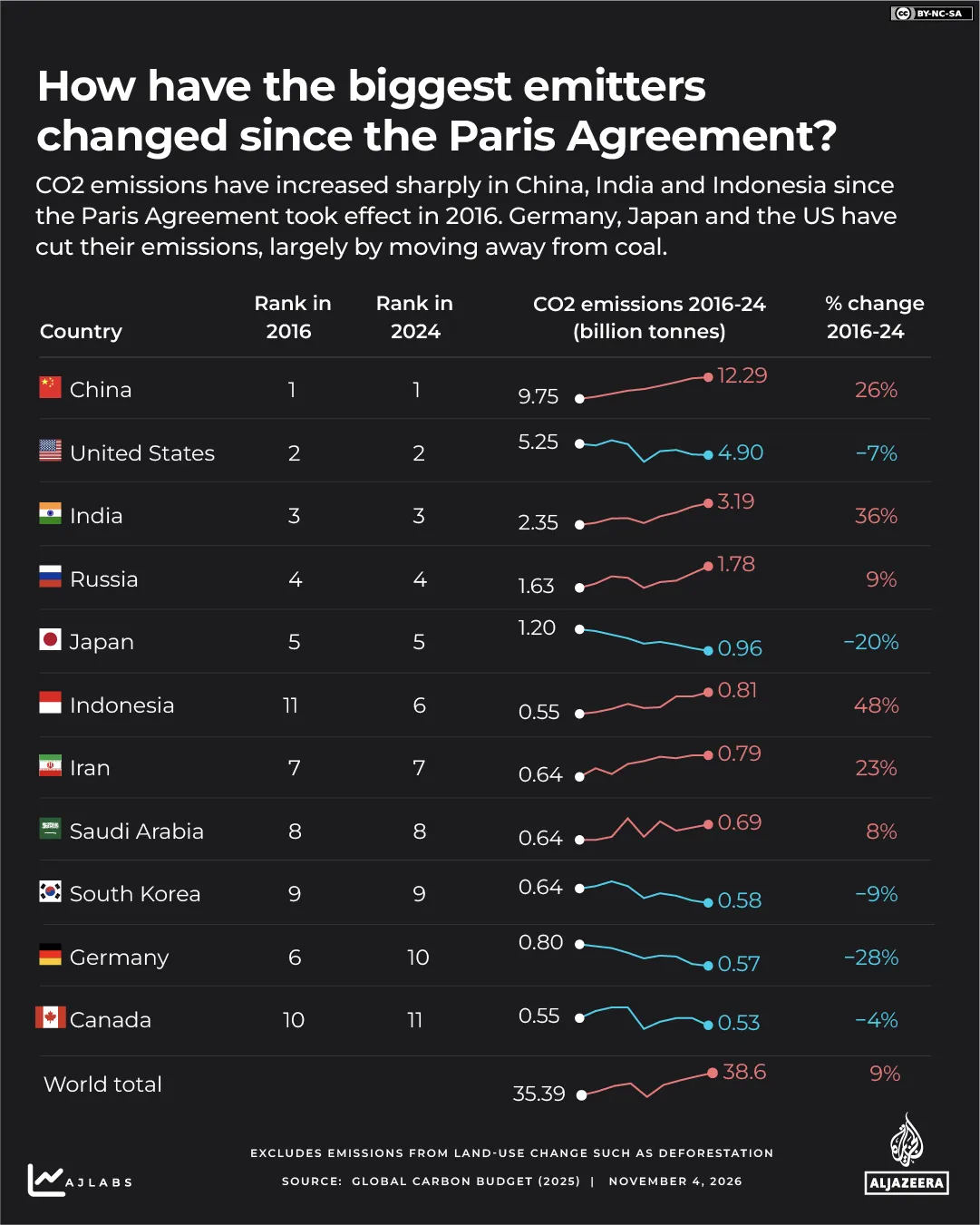
德国、日本和美国已削减排放,主要是用可再生能源和天然气替代煤炭。但其他地方的增长抵消了这些削减,全球排放量比2016年高出9%。
Germany, Japan and the US have cut their emissions, largely by replacing coal with renewables and gas. But growth elsewhere has outweighed those cuts, and global emissions are 9 percent higher than in 2016.