有时,变化来得如此之快,以至于你忘了为自己取得的成就庆贺。以世界电网从化石燃料向清洁能源的转型为例。能源经济学家瓦茨拉夫·斯米尔曾在 2014 年写道,向可再生能源的转型将“需要数代人的坚持”,且将比以往木材、煤炭、石油和天然气之间的转换更为艰难,那些转换耗时半个世纪甚至更久。次年,斯米尔的追随者比尔·盖茨警告称,利用现有技术减排的成本将“高得惊人”。
Sometimes, change comes at you so fast that you forget to congratulate yourself on what you’ve achieved. Take the switch of the world’s electricity grids from fossil fuels to clean power. The transition to renewables will “require generations of perseverance” and be harder than previous shifts between wood, coal, oil and gas, which took half a century or more, energy economist Vaclav Smil wrote in 2014. The costs of reducing emissions using existing technologies would be “beyond astronomical,” Smil’s acolyte Bill Gates warned the following year.
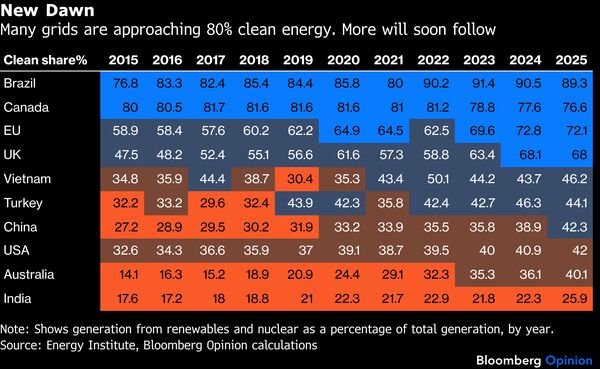
然而在实践中,我们在短短十年内攻克了最大的一块难题。去年,清洁能源发电量大致相当于 1996 年全球用电总量。其中约一半来自风能和太阳能。随着目前在建的风电和光伏项目在未来两三年内相继完工,英国和欧盟有望加入以水电为主的巴西和加拿大行列,成为罕见的非排放电源占比约 80% 的电力市场。
In practice, we cracked the biggest chunk of the problem in a decade. Last year, clean energy sources generated about as much electricity as the entire world consumed as recently as 1996. About half came from wind and solar power. Once the current pipeline of wind and solar projects is completed in the next two to three years, the UK and European Union are likely to join hydro-dominated Brazil and Canada as rare markets where about 80% of electricity comes from non-emitting sources.
澳大利亚有望在 2030 年左右达到这一水平,土耳其和巴基斯坦可能在 2035 年左右跟进。即便是最大排放国中国,也可能不会落后太远:今年上半年,煤电占比跌破 50%;一项最新研究推算,若可再生能源建设大致按现有目标推进,中国最早可在 2035 年实现 80% 清洁电力。
Australia looks on track to join them around 2030, and Turkey and Pakistan may reach the same point around 2035. Even China, the biggest emitter, may not be far behind: Coal fell below 50% of generation in the first half of this year, and a recent study reckoned the country could be as much as 80% clean by 2035, if renewables are built roughly in line with current targets.
各国本周齐聚土耳其城市安塔利亚,出席联合国第 31 届气候变化大会(COP31),这些里程碑理应引发庆祝,更应促使我们重新审视。清理全球电网将被证明是能源转型中相对容易的部分。如何让电力成为现代工业社会中为其他一切提供动力的默认方式,才是更艰巨的挑战。
As nations gather in the Turkish city of Antalya for the United Nations COP31 climate conference this week, those milestones should prompt celebration, but also a reset. Cleaning up the world’s grids is going to prove the easy part of the energy transition. Turning that electricity into the default way to power everything else in our modern industrial societies will be harder.
令人惊讶的是,已经取得了如此成就。2000年代和2010年代那场伟大的能源之战——可再生能源发电是否能凭自身条件与化石燃料竞争——已以能源转型的胜利告终。自2021年以来,电力产量的增量中约有82%来自零碳能源。
It’s astonishing what has already been achieved. The great energy battle of the 2000s and 2010s — whether renewable electricity could ever compete on its own terms with fossil fuels — has been settled in the transition’s favor. Some 82% of the increase in electricity production since 2021 has been zero-carbon.
按各种可想象的成本指标衡量,清洁电力现在在全球大部分地区都更便宜。在沙特阿拉伯——联合国气候大会上的长期阻挠者——数十吉瓦的太阳能项目现已签约,以前所未有的低价出售电力,远低于每千瓦时两美分。印度预计将在未来十年排放增量最大,现在能提供光伏-风电-储能组合电力,其全天候性能可媲美化石燃料发电机组,成本却比燃煤发电低10%。
On every imaginable cost metric, clean power is now cheaper across most of the planet. In Saudi Arabia — a perennial obstructionist at UN climate conferences — tens of gigawatts of solar projects have now signed contracts to sell electricity at never-seen-before low prices, well below two cents per kilowatt-hour . India, projected to have the biggest increase in emissions over the coming decade, can now provide solar-wind-battery power that matches the 24-7 performance of fossil generators at a 10% discount to coal.
在许多亚洲和欧洲国家,新建配套电池储能的太阳能和风电场,成本比单纯继续运行一座已完全折旧的燃气电厂还要低。煤电在许多地方也走向相同命运。在土耳其,可再生能源成本于2023年跌至煤电机组运营成本之下,即便其主要固体燃料供应国俄罗斯和哥伦比亚的矿山正处于亏损运营状态。
Building brand-new solar and wind farms backed up by batteries is cheaper in many Asian and European countries than just continuing to run an existing, fully-depreciated gas plant. Coal is heading in the same direction in many places. In Turkey, renewables fell below the operating costs of coal generators in 2023, even as its main solid fuel suppliers in Russia and Colombia operate mines at a loss.
然而,这种成功引发了一整套新问题。欧盟和英国许多最激进的脱碳国家之所以目前在电力系统方面陷入如此焦虑,原因之一是它们正遭遇一种帕累托原则式的困境:80%的问题可追溯到20%的因素。清洗掉最后20%发电量中的化石燃料,将比清除前80%中的化石燃料困难得多。
That success prompts a whole new set of problems, however. One reason many of the most aggressive decarbonizers in the EU and the UK are suffering such angst around their electricity systems right now is that they’re running up against a version of the Pareto principle, whereby 80% of problems can be traced back to 20% of factors. Decarbonizing the last 20% of generation will be far more difficult than flushing fossil fuels out of the first 80%.
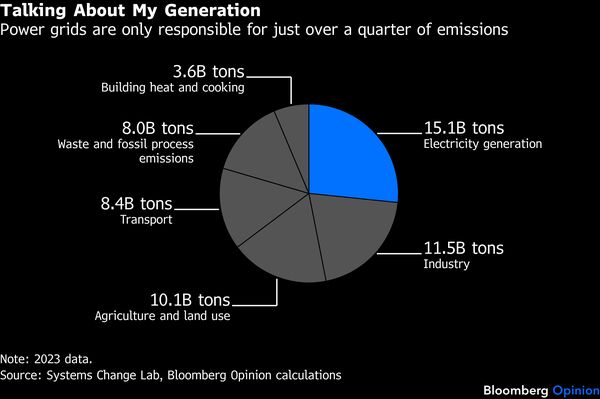
这要求我们重新审视自身在能源转型中的位置。电网是碳污染的最大来源,但仍仅占所有排放量的约四分之一。因此,2030年代的优先事项应与2010年代有所不同。政府不应专注于从电力部门挤压出最后几吨碳排放,而应让丰富的清洁电力变得足够便宜,以将化石燃料从其他所有领域挤出去——特别是电动汽车和卡车、家庭供暖系统,以及食品和造纸制造业所用的那类低温热能。
That requires a rethinking of where we stand in the energy transition. Power grids are the biggest slice of carbon pollution, but still only make up about a quarter of all emissions. As a result, the priority for the 2030s should be different from the 2010s. Instead of concentrating on squeezing the final tons of carbon from electricity, governments need to make abundant clean power cheap enough to drive fossil fuels out of everything else — in particular, electric cars and trucks, home heating systems, and the sort of low-temperature heat used in food and paper manufacturing.
电力本身如今已成为这方面最大的障碍之一。在许多国家,2000年代的绿色政策试验将一堆遗留费用转嫁到了居民和工业电费账单上,导致插电用电对消费者而言悖论般地昂贵,即使发电成本很低。大多数欧洲工业中最绿色的部门——电网,却是承担最高碳价的部门。根据今年一项研究,在德国和奥地利,改变这一监管框架本可以在2022年能源危机期间将成本降低25%至30%。
Electricity itself is now one of the biggest hurdles on that front. In many countries, the green policy experimentation of the 2000s dumped a pile of legacy charges onto household and industrial bills, making plug power paradoxically costly to consumers, even when it’s cheap to generate. The greenest sector of most European industries, the grid, is the one that pays the highest carbon prices . In Germany and Austria, changing this regulatory set-up could have cut costs by 25% to 30% during the 2022 energy crisis, according to one study this year.
解决这些问题至关重要——尤其是因为我们需要电网电力更便宜,它才能完成清理我们工业社会其余部分的任务。这将要求我们用电动机和热泵取代燃油车辆发动机、燃气锅炉和燃煤炉。
Fixing those problems is essential — not least because we need grid power to be cheaper if it’s to do its job of cleaning up the rest of our industrial society. That will require us to replace fossil-fired vehicle engines, gas boilers and coal furnaces with electric motors and heat pumps instead.
建设清洁电网本应耗时数代人。我们却在不到一代人的时间里做到了。现在迎来了更艰巨的任务:让其他一切也都靠电力运行。
Building clean power grids was supposed to take generations. We’re doing it in less than one. Now comes the harder task: running everything else on electricity, too.