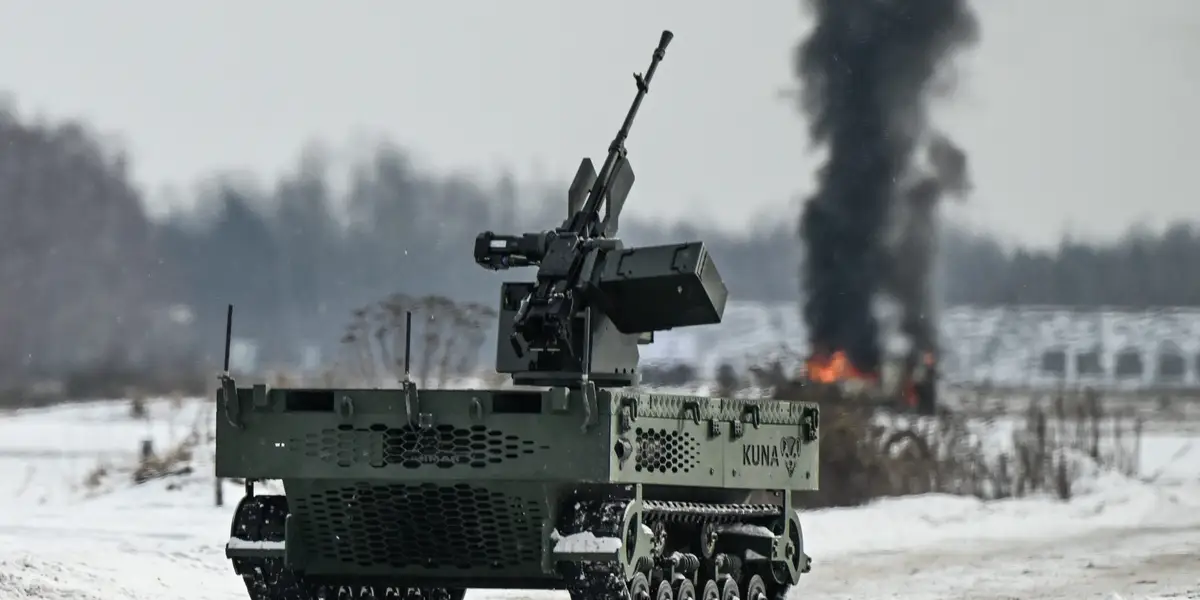
乌克兰的机器人正日益具备击落空中无人机的能力,这一能力最终可能有助于士兵在战争中一些最危险的区域移动和战斗。乌克兰的天空布满了侦察和打击无人机,使得人员流动充满风险,特别是前线周围的死亡地带。乌克兰部队正越来越多地尝试在那里使用机器人代替人类,而各公司也正在赋予机器人击落无人机的新能力。
Ukraine's robots are increasingly able to down aerial drones, a capability that could eventually help soldiers move and fight in some of the war's most dangerous areas. The skies in Ukraine are full of surveillance and strike drones that make movement risky, particularly in the kill zone surrounding the front lines. Ukrainian units are increasingly trying to use robots there instead of humans, and companies are giving robots new abilities to take down drones.
乌克兰知名军事单位“达芬奇狼”营的机器人系统负责人亚历山大·亚布昌卡(Oleksandr Yabchanka)对《商业内参》表示,俄罗斯无人机是战场上“的关键挑战”之一,“我相信地面机器人系统在解决这个问题上可以发挥重要作用”。他表示,有了针对这些无人机的有效保护,“接触线沿线作战行动的性质可能会发生实质性变化”。
Oleksandr Yabchanka, head of robotic systems for Ukraine's Da Vinci Wolves Battalion, a prominent Ukrainian military unit, told Business Insider that Russian drones are one of "the key challenges" on the battlefield, and "I believe that ground-based robotic systems can play a significant role in addressing this issue. " With effective protection against those drones, he said, "the nature of combat operations along the line of contact could change substantially."
他称通过对抗敌方无人机来保卫“低空”是地面机器人的一个有前景的角色。除了领导前线操作员外,亚布昌卡还是非营利组织“乌克兰国防机器人”(Defence Robotics UA)的共同创始人,该组织帮助乌克兰部队采用机器人技术。“我对使用地面机器人系统保卫低空空域抱有特别高的期望,”他说。
He called defending the "low sky" by countering enemy drones a promising role for ground robots. Beyond leading front-line operators, Yabchanka also co-founded Defence Robotics UA, a non-profit that helps Ukrainian units adopt robotic technologies. "I have particularly high hopes for the use of ground-based robotic systems in defending the low-altitude airspace," he said.
在死亡地带内,无人机使人员流动变得复杂,因此机器人正在承担物流、伤员疏散等新角色。其中一些系统配备了武器和干扰设备,以击落敌方无人机。配备反无人机任务的机器人可以减少对短程防空部队的需求,这些部队在死亡地带为进出的步兵提供掩护。目前,这些部队面临着巨大的危险,并面临被困在内部的风险。随着俄罗斯越来越多地将目标对准这些机器人,它们也可以进行自卫。
Inside the kill zone, drones complicate movement, so robots are taking on new roles in logistics, casualty evacuation, and more. Some of these systems are equipped with weaponry and jamming equipment to take down hostile drones. Robots equipped for counter-drone missions could reduce the demand for short-range air defense units, which provide cover for infantry moving in and out, in the kill zone. Right now, these units face great danger and risk getting pinned down inside. These robots could also defend themselves as Russia increasingly targets them.
乌克兰机器人和技术公司“前线机器人”(Frontline Robotics)的首席业务发展官米基塔·罗日科夫(Mykyta Rozhkov)对《商业内参》表示,机器人正“成为俄罗斯的主要目标”,如果没有额外的保护,它们将毫无防御能力。赋予机器人自卫能力可以提高它们的生存能力,同时将它们变成移动防空系统可以帮助保护部队。罗日科夫表示,制造商现在“正试图寻找一种能够防范第一视角(FPV)无人机的方法”。
Mykyta Rozhkov, chief business development officer at Ukrainian robotics and technology company Frontline Robotics, told Business Insider that robots are "becoming a main target" for Russia and are defenseless without added protections. Giving robots the ability to defend themselves could make them more survivable, while turning them into mobile air defenses could help protect troops. Rozhkov said makers are now "trying to find a way how we can defend against FPVs."
亚布昌卡表示,在改变死亡地带方面,“承诺这将在未来12个月内具体发生是不正确的”。但他表示,机器人已经成功阻止了一些无人机,“我相信这一领域有着伟大的未来”。
Yabchanka said that when it comes to changing the kill zone, "it would be incorrect to promise that this will happen specifically within the next 12 months." But he said robots have already successfully stopped some drones, and "I believe this field has a great future."
这一领域的绝大多数技术仍处于测试阶段或有限规模的使用中,主要用于保护机器人本身,而不是提供更广泛的防空保护。罗日科夫表示,虽然让无人地面车辆具备自卫能力至关重要,但他预计最终会看到无人地面车辆作为移动的短程防空系统运行,以试图清理天空。他的公司正与合作伙伴合作开发一种系统,该系统使用摄像头和传感器来寻找敌方无人机,然后用独立的功能与之交战。他没有透露该系统将如何与敌方无人机交战。
Most of the technology in this space is still being tested or used on a limited scale, primarily to protect the robots themselves rather than provide broader air defense. Rozhkov said that while it's key to have uncrewed ground vehicles be capable of defending themselves, he expects to eventually see UGVs functioning as a mobile, short-range air defense system to try to clear the skies. His company is working with a partner on a system that uses cameras and sensors to find hostile drones and then engages them with a separate capability. He didn't disclose how it would engage enemy drones.
其他乌克兰机器人制造商也在增加反无人机能力,其中一些涉及烟雾、网和杀伤碎片解决方案。机器人正越来越多地配备机枪等武器,一些公司表示这些武器可以阻止敌方无人机。例如,乌克兰公司UFORCE表示,它已经在伏击场景中摧毁了敌方无人机。该公司的人工智能辅助“捕食者”(Predator)武器站可以安装在机器人上,用于追踪和向无人机开火。
Other Ukrainian robot makers are also adding anti-drone capabilities, some involving smoke, nets, and shrapnel solutions. Robots are increasingly being fitted with weaponry like machine guns, and some companies have said that these weapons can stop enemy drones. Ukrainian company UFORCE, for instance, says it has destroyed enemy drones in ambush scenarios. The company's AI-assisted Predator weapons station can be mounted on robots to track and fire at drones.
第42独立机械化旅此前曾描述过安装在“柳特”(Liut)机器人上的机枪击落俄罗斯无人机的过程。罗弗科技(Rovertech)将自己宣传为制造“死亡地带机器人”的公司,目前正在开发一种系统,该系统使用传感器、人工智能辅助探测和网发射器来阻止来袭的无人机,而拉特尔机器人公司(Ratel Robotics)则开始在其机器人上批量生产包含网发射器的防护系统。
The 42nd Separate Mechanized Brigade previously described a machine gun mounted on a Liut robot shooting down Russian drones. Rovertech, which advertises itself as making "robots for the kill zone," is developing a system that uses sensors, AI-assisted detection, and a net launcher to stop incoming drones, while Ratel Robotics has started serial production on a protective system that includes net launchers on its robots.
乌克兰第100独立机械化旅上个月表示,它已经部署了使用网发射器的主动防护系统,并分享了一段视频,显示其一个机器人向正在接近的无人机发射了一张网,随后该无人机坠毁在地面上。
Ukraine's 100th Separate Mechanized Brigade said last month that it had deployed an active protection system using net launchers and shared a video showing one of its robots firing a net at an approaching drone, which then crashed to the ground.
一些乌克兰部队还驾驶着搭载电子战设备的机器人向前推进,以干扰俄罗斯的无人机,但这是一项新兴能力,尚未得到广泛使用。
Some Ukrainian units have also driven robots carrying electronic warfare equipment forward to jam Russia's drones, but it's an emerging capability that has yet to see widespread use.
乌克兰政府支持的创新平台Brave1表示,武装机器人正开始被用于对抗空中无人机,但它希望获得更多此类机器人,并将防空武器和防护描述为优先事项。
Brave1, Ukraine's state-backed innovation platform, says armed robots are starting to be used against aerial drones, but it wants more, describing anti-aircraft weaponry and protection as priorities.
罗日科夫表示,很快,乌克兰的机器人将拥有“越来越复杂的解决方案”来阻止无人机。他说,这是至关重要的,因为第一支弄清楚如何阻止小型第一视角无人机的队伍“将在战场上获得巨大的优势,并能创造出惊人的结果”。
Rozhkov said that soon, Ukraine's robots will have "more and more sophisticated solutions" to stop drones. He said it's essential because the first side that figures out how to stop small FPVs "will gain a huge advantage on the battlefield and can create dramatic results."