
在联合国年度气候大会于土耳其举行之际,有一点十分明确:随着气温上升和极端天气事件的增多,其对人类和经济的代价正在累积,而应对这一问题的政治意愿却在停滞。世界需要一种新方法。
By The Editors With the United Nations’ annual climate conference underway in Turkey, one thing is clear: The human and economic costs of rising temperatures and extreme weather events are mounting even as the political will to combat the problem has been stalling. The world needs a new approach.
十多年前,在巴黎,195个国家达成了共同使命:将全球平均气温升幅控制在比工业化前水平高出约2摄氏度以内——最好不超过1.5摄氏度。这已经超出了全新世时期(人类文明形成期间)地球所经历的最高温度上限。政府间气候变化专门委员会估计,进一步升温将带来极高风险,可能导致物种灭绝以及大范围同步的作物减产。
More than a decade ago, in Paris, 195 nations agreed on a common mission: Keep the global average temperature from rising by anywhere near 2C — and preferably no more than 1.5C — above pre-industrial levels. That’s already beyond the upper bound of temperatures the planet has experienced in the Holocene period, during which human civilization developed. Going further, in the estimation of the Intergovernmental Panel on Climate Change, entails a very high risk of repercussions ranging from species extinction to widespread simultaneous crop failure.
《巴黎协定》要求每个国家提交国家气候承诺,并每五年更新一次,以减少导致气候变化的碳排放。人们希望各国相互推动,取得更好进展。尽管取得了显著进展,但仍有大量工作待完成。
The Paris Agreement required that each country submit national climate commitments, updated every five years, to reduce the carbon emissions driving climate change. The hope was that they’d push each other to do better. Despite significant progress, there’s much work to be done.
美国于2025年退出该协定,留下其城市、州和企业自行弥补缺口。去年,美国、中国和印度尼西亚的排放量上升,而印度基本持平。除美国外,二十国集团的大部分成员排放已出现下降,但下降速度仍不够快。即便是最具雄心的主体——如欧盟和英国——也未能按计划在2050年前实现净零排放的承诺。
The US pulled out of the agreement in 2025, leaving its cities, states and businesses to try to pick up the slack. Last year, emissions rose there and in China and Indonesia, too, while staying roughly flat in India. In much of the rest of the Group of 20, they have declined, just not fast enough. Even the most ambitious parties — such as the European Union and the UK — aren’t on track to meet their pledge of reaching net zero emissions by 2050.
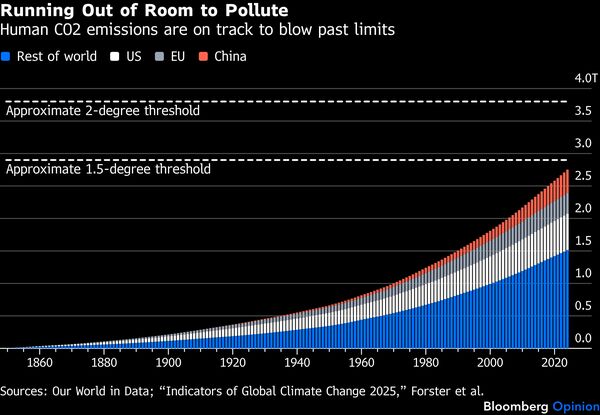
与此同时,地球持续升温。自1850年以来累计的人类二氧化碳排放约为2.8万亿吨。这大约占地球估算的“碳预算”的四分之三——即超过该预算后全球变暖可能超过2摄氏度的阈值。按当前趋势,世界可能在数十年内跨过这一阈值。
Meanwhile, the planet keeps warming. Cumulative human carbon dioxide emissions since 1850 add up to about 2.8 trillion tons. That’s about three-quarters of Earth’s estimated “carbon budget” — the amount beyond which global warming will probably exceed 2 degrees. On current trends, the world may cross that threshold within a few decades.
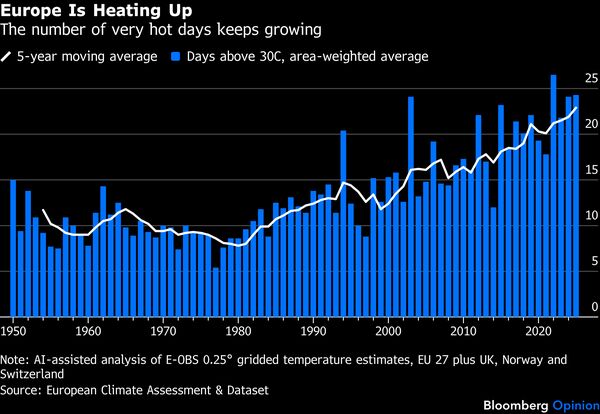
这不仅是后代面临的问题,当下已在影响人们的生活与生计。以欧洲为例,2026 年的酷热夏季——气温打破纪录、主要河流近乎干涸、野火吞噬法国和西班牙大片土地——绝非个例。截至 2025 年的五年间,该地区经历的区域加权平均高温天数(超过 30 摄氏度)达 20 天,是 1981 年至 1985 年的两倍多。一项近期的同行评审文章估计,2021 年至 2025 年间,欧洲城市因人为气候变化导致的热相关死亡人数超过 5.8 万。
This isn’t a problem only for future generations. It’s affecting lives and livelihoods now. Consider Europe. The brutal summer of 2026 — during which temperatures broke records, major rivers ran nearly dry, and wildfires consumed swathes of France and Spain — is hardly an outlier. In the five years through 2025, the region endured an area-weighted average of 20 days exceeding 30C, more than double the amount in 1981 to 1985. A recent peer-reviewed article estimated that in 2021 through 2025, European cities suffered more than 58,000 heat-related deaths attributable to human-caused climate change.
经济损失虽难以量化,但潜在规模巨大。在欧盟,极端天气事件在 2020 年至 2024 年间造成的年均直接损失达 450 亿欧元,是前四十年的三倍——尽管部分增幅反映了人口、开发程度和资产价值增长带来的风险敞口扩大。与此同时,更干燥的条件威胁着莱茵河、多瑙河和巴拿马运河等关键水运贸易通道。
The economic damage is harder to measure but potentially vast. In the European Union, extreme weather events incurred an annual average of €45 billion in direct losses from 2020 through 2024, triple the level of the previous four decades — although some of that increase reflects greater exposure as population, development and asset values have grown. Meanwhile, drier conditions threaten crucial waterborne trade routes, including the Rhine, the Danube and the Panama Canal.
此外,研究表明,气温超过 30 摄氏度时,工人生产率会大幅下降。经济合作与发展组织估计,2025 年与气候变化相关的总产出损失占全球国内生产总值的 1.75%(约 2 万亿美元),在其基准升温情景下,到 2100 年将升至 9%。
Beyond that, research suggests that worker productivity falls precipitously when temperatures exceed 30C. The Organization for Economic Cooperation and Development estimates the total output loss associated with climate change at 1.75% of global gross domestic product (or about $2 trillion) in 2025, rising to 9% in 2100 in its baseline warming scenario.
气候变化造成的损害正在加剧,而遏制它的政策却面临日益强劲的政治逆风。在美国和欧洲,右翼民粹主义者部分通过抨击绿色转型来争取选票。尽管对气候行动的总体支持率仍居高位,但一旦措施涉及成本、强制令或限制,支持率就会急剧下降。
The damage wrought by climate change is rising just as policies to stop it face increasing political headwinds. In the US and Europe, populists on the right are seeking votes in part by attacking the green transition. While overall support for climate action remains high, it declines sharply when measures entail costs, mandates or restrictions.
这不应被视为放弃的理由。相反,通过加强合作并借助技术,绿色转型可以实现盈利,且成本低得多。
This shouldn’t be seen as reason to give up. On the contrary, with greater cooperation and the help of technology, the green transition can be achieved profitably and at a much lower cost.