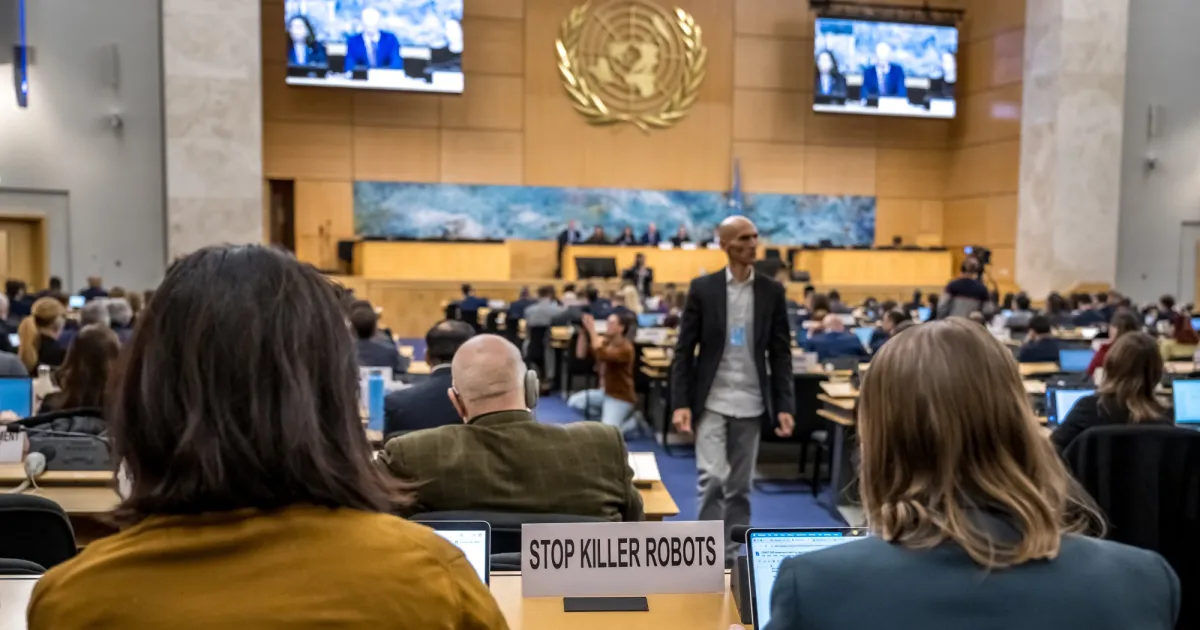
联合国本周在日内瓦举行的会议未能制定具有法律约束力的规则来管控自主武器的使用。各国反而选择推迟解决,同意再花两年时间提出监管提案,而这些提案最终可能只是可选的。
The United Nations failed to establish legally binding rules to regulate use of autonomous weapons at a conference in Geneva this week. Instead, countries are kicking the can down the road, agreeing to spend two more years coming up with proposals for regulations that could actually just be optional.
在上周一超过120个国家于日内瓦开始谈判前,人道主义援助组织国际红十字委员会表示,应在一年内起草具有约束力的规则。该组织还呼吁禁止将自主武器用于攻击人员,并将其使用限制在军事目标上。
Before negotiations among more than 120 countries began in Geneva last Monday, the International Committee of the Red Cross, a humanitarian aid organization, said that binding rules should be drafted within a year. The organization has also called for a ban on the use of autonomous weapons against people and for restricting their use to military objectives.
人工智能已在全球各地的战争中投入使用。根据联合国11月的一份报告,在苏丹,2026年上半年该国1390名平民伤亡中,超过80%是由无人机袭击造成的,其中包括半自主无人机的袭击。以色列军方从2023年10月7日至2025年底,利用人工智能实时探测了数十万个目标。俄乌战争中的许多无人机都配备了人工智能技术,在距离目标最后500米的末端制导阶段接管控制权。
AI is already being deployed in warfare across the world. In Sudan, more than 80 percent of the 1,390 civilian casualties in the country from the first six months of 2026 were caused by drone strikes, including strikes by semi-autonomous drones, according to a November UN report. The Israeli military used AI to detect hundreds of thousands of targets in real time from October 7, 2023, to the end of 2025. Many drones in the Ukraine-Russia war have AI tech that takes control during the last 500 meters of its targeted approach.
正如我的同事索菲·赫维茨所撰文,在美以对伊朗的战争中,五角大楼正在使用由人工智能驱动的武器和工具,如Anthropic公司的Claude。
And as my colleague Sophie Hurwitz has written, in the US-Israeli war against Iran, the Pentagon is using AI-powered weapons and tools such as Anthropic’s Claude.
近100个国家推动迅速通过具有法律约束力的规则,但生产武器的国家——包括美国、以色列和俄罗斯——表示反对,随后宣布延长两年。日内瓦公约要求所有成员国达成一致。尽管许多与会者希望会议能产生具有法律约束力的法规,但本周的讨论为各国提出具有约束力或不具约束力的自主武器规则留下了空间。
The two-year extension was announced after nearly 100 countries pushed for a quick adoption of legally binding rules, but arms-producing nations—including the US, Israel, and Russia—voiced opposition. The Geneva convention requires all member states to agree. Though many participants hoped that the conference would produce legally binding regulations, this week’s discussions left the door open for countries to propose either binding or non-binding rules for autonomous weapons.
据法新社报道,人权观察组织军备部门副主任维里蒂·考伊尔表示,该决定“未能提供达成新规则所需的紧急行动——但技术正在飞速发展。”
According to the news agency AFP, Verity Coyle, the deputy director for arms at Human Rights Watch, said the decision “does not provide the urgent action needed to agree new rules—but the technology is racing ahead.”
“我们很可能会看到这些系统扩散,”未来生命研究所军事人工智能治理专家安娜·海尔对美国国家公共电台表示。“存在易于购买甚至易于制造的自主武器,各类行为体——个人、非国家行为体、犯罪集团——都能获得。”
“We’re likely to see the systems proliferate,” Anna Hehir, an expert in military AI governance at the Future of Life Institute, told NPR. “There are autonomous weapons that are easy to purchase or even to create for all kinds of actors: individuals, nonstate actors, criminal groups.”