美国政客们有着宏大的目标。他们希望在超级智能竞赛中击败中国。他们希望让电网更加绿色。他们还希望振兴国内制造业,仅举几例。实现这些雄心将需要建设大量设施,从数据中心到输电线路。但开发商面临的繁文缛节极其繁多,仅仅获得开工许可往往就是一场持续数年的艰苦征程。
American politicians have big goals. They want to beat China in the race for superintelligence. They want to green the electricity grid. And they want to revive domestic manufacturing, to name just a few. Realising these ambitions will require building lots of stuff, from data centres to transmission lines. But the enormous amount of red tape faced by developers means that just getting permission to start building is often a multi-year slog.
一项正在国会推进的法案旨在通过简化基础设施项目的审批流程来改变这一现状。《两党美国可负担性和就业法案》(BAAJA)已通过参议院,并获得了唐纳德·特朗普的支持,但其在众议院的命运尚不确定。许多民主党人反对该法案。对他们来说,该法案可能成为检验其致力于促进增长和降低价格承诺的试金石,而这两项正是该党在中期选举竞选中的承诺。
A bill trundling through Congress aims to change that by streamlining the permitting process for infrastructure projects. The Bipartisan American Affordability and Jobs Act (BAAJA) has passed the Senate and won the backing of Donald Trump, but its fate in the House of Representatives is uncertain. Many Democrats are opposed. For them, the bill could prove a test of their commitment to promoting growth and lowering prices, two of the party’s promises during the midterm campaign.
大多数立法者都同意,在美国建设东西太难了。据一家名为麦肯锡的咨询公司于2025年发布的估计,获得采矿项目的联邦许可平均需要八到九年。石油和天然气管道的时间为六到七年;发电项目为五到六年;交通基础设施为四到五年;制造业项目为两到三年。难怪美国几乎没有建设高速铁路,电网的扩建也无法跟上不断增长的需求。
Most lawmakers agree that it is too hard to build things. According to estimates published in 2025 by McKinsey, a consultancy, securing federal permits for mining projects takes between eight and nine years, on average. For oil and gas pipelines the figure is six to seven years; for power generation, five to six; for transport infrastructure, four to five; and for manufacturing, two to three. No wonder, then, that America has built little high-speed rail or that expansion of the electricity grid is failing to keep pace with booming demand.
《BAAJA》将使各类基础设施的建设变得更加容易,从可能减少美国在关键矿产上对中国依赖的矿山,到提供制造业就业岗位的工厂。它将通过简化许可程序、对监管机构设定截止期限、改善跨机构协调以及限制可能拖延项目的法律挑战来实现这一点。特别是,它将削弱《国家环境政策法》(NEPA)的部分威力。该法要求对涉及联邦土地、资金或监管批准的项目进行环境审查,许多开发商视之为心头大患。
The BAAJA would make it easier to build infrastructure of all kinds, from mines that might reduce America’s dependence on China for critical minerals to factories that provide manufacturing jobs. It would do so by simplifying permitting procedures, imposing deadlines on regulators, improving co-ordination across agencies and limiting legal challenges that can hold up projects. In particular, it would take some of the sting out of the National Environmental Policy Act (NEPA), which mandates environmental reviews for projects involving federal land, funding or regulatory approval—and which many developers regard as the bane of their existence.
NEPA规定的最详尽审查通常需要四年以上。该法允许项目反对者以审查不充分为由提起诉讼阻止项目。为预先防范法律挑战,环境评估往往详尽无遗,常常长达数百页。尽管如此,诉讼仍很常见。一项研究发现,需要此类审查的项目中,约三分之二的光伏项目、一半的管道项目和三分之一的风电项目面临法律挑战。即便反对者败诉,诉讼平均也会让项目延误18个月。根据《BAAJA》,法院仅因审查不充分就取消项目的能力将受到限制;将有机会先补救这些缺陷。
The most extensive reviews under NEPA typically take more than four years. The act allows opponents of a project to sue to stop it on the grounds that a review was insufficient. To pre-empt legal challenges, environmental assessments are exhaustive, often running to hundreds of pages. Still, lawsuits are common. One study found that roughly two-thirds of solar projects, half of pipeline projects and a third of wind projects requiring such reviews faced legal challenges. Even when opponents lose, litigation adds 18 months on average to a project. Under the BAAJA, courts’ ability to cancel a project solely because a review was inadequate would be restricted; there would be an opportunity to remedy the shortcomings first.
许多环保主义者反对BAAJA。虽然他们接受许可制度改革的必要性,但认为该法案的权衡——包括对天然气管道更宽松的许可制度和较弱的司法监督——不值得。南方环境法律中心(Southern Environmental Law Centre)倡导组织的阿曼达·加西亚(Amanda Garcia)表示,BAAJA“与选民在选举中刚刚告诉我们的完全相反……他们希望在影响其日常生活的决策中拥有更多发言权、更多主导权”。
Many environmentalists oppose the BAAJA. Though they accept the need for permitting reform, they think the bill’s trade-offs—including an easier permitting regime for gas pipelines and weaker judicial oversight—are not worth it. Amanda Garcia of the Southern Environmental Law Centre, an advocacy group, says the BAAJA runs “completely contrary to what voters just told us in the election…which is that they want more input, more agency in decisions that are going to affect their everyday lives”.
在一次绿色运动人士的策略通话中,该通话录音被泄露给《Punchbowl News》,一位人士表示,该法案“不应仅根据净排放分析来评判”,还应根据“生态和社区价值”来评判。
On a strategy call among green campaigners, a recording of which was leaked to Punchbowl News, one said that the bill “should not be judged just based on a net-emissions analysis”, but also on “ecological and community values”.
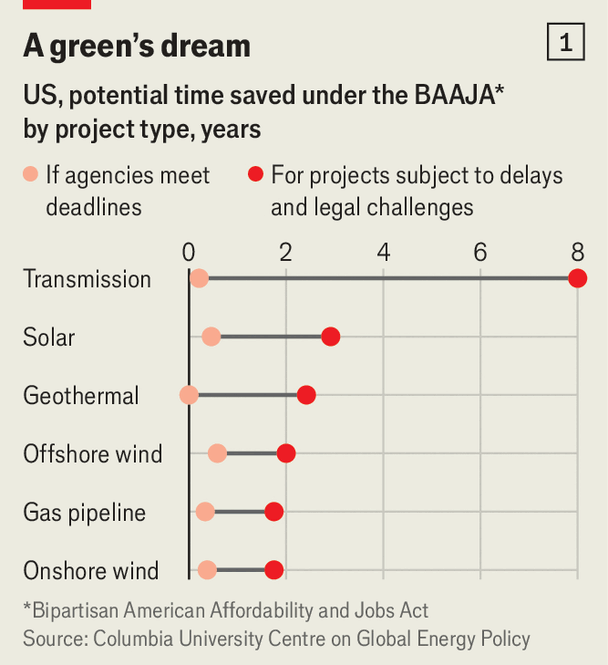
这种尴尬的定位可能反映了研究结果:BAAJA实际上可能有利于气候。许可瓶颈不成比例地阻碍清洁电力。可再生能源占等待接入拥堵电网项目的绝大部分。智库气候与能源解决方案中心(C2ES)的模型显示,在BAAJA下,未来十年新增的风能、太阳能和电池储能容量将比当前的许可制度多36%。等待时间将缩短(见图1)。研究公司罗迪姆集团(Rhodium Group)的一项独立研究显示,该法案可能使美国2040年的年度温室气体排放量比预计水平减少多达1.48亿吨,即4%。
Such awkward positioning may reflect findings that the BAAJA would actually benefit the climate. Permitting bottlenecks disproportionately hinder clean power. Renewables make up the vast majority of projects awaiting connection to a congested grid. Modelling by the Centre for Climate and Energy Solutions (C2ES), a think-tank, suggests that under the BAAJA 36% more wind, solar and battery-storage capacity would be added over the next decade than under today’s permitting regime. Waiting times would shrink (see chart 1). According to a separate study by Rhodium Group, a research firm, the bill could cut America’s annual greenhouse-gas emissions by as much as 148m tonnes, or 4%, in 2040 compared with their projected level.
BAAJA 还旨在让急需的电网升级变得更容易。美国实际上有三大主电网(或称“互联网络”)以及一套拼凑而成的区域电力市场。跨区域输电开发商 Grid United 的 Ashley Kang 表示,这些系统的运营商之间既不沟通,也不共同规划系统。该公司正在建设北平原连接线,这是一条连接蒙大拿州和北达科他州的 420 英里(约 676 公里)高压输电线路。它将连接两个电网、跨越三个电力市场,并涉及十家公用事业公司。该公司不得不分别接触每家公用事业公司以争取支持。
The BAAJA also aims to make much-needed upgrades to the power grid easier. America actually has three main grids (or “interconnections”) and a patchwork of regional electricity markets. The operators of these systems do not talk to each other or plan their systems together, says Ashley Kang of Grid United, a developer of interregional transmission. The firm is building the North Plains Connector, a 420-mile high-voltage line between Montana and North Dakota. It will connect two grids, span three electricity markets and involve ten utilities. The firm had to approach each utility separately to get buy-in.
根据 BAAJA,利益相关方将在一开始就被召集在一起,长距离输电线路的成本将根据谁受益最大来分摊。Kang 女士说:“目前没有任何流程。”该法案还将加强联邦监管机构的权力,使其能够推翻试图阻挠输电线路建设的州政府机构。环保人士也应为此感到欣慰。气候与能源解决中心(C2ES)估计,该法案将使跨区域输电容量翻倍以上,让更多清洁电力输送给远离风电场和光伏电场的消费者。
Under the BAAJA stakeholders would be brought together at the outset and the costs of long-distance lines allocated according to who benefits most. “Right now there’s no process,” says Ms Kang. The bill would also strengthen federal regulators’ power to override state authorities that seek to block transmission lines. Green types should be pleased by this, too. C2ES reckons the bill would more than double interregional transmission capacity, getting more clean electricity to consumers who live far from wind and solar farms.
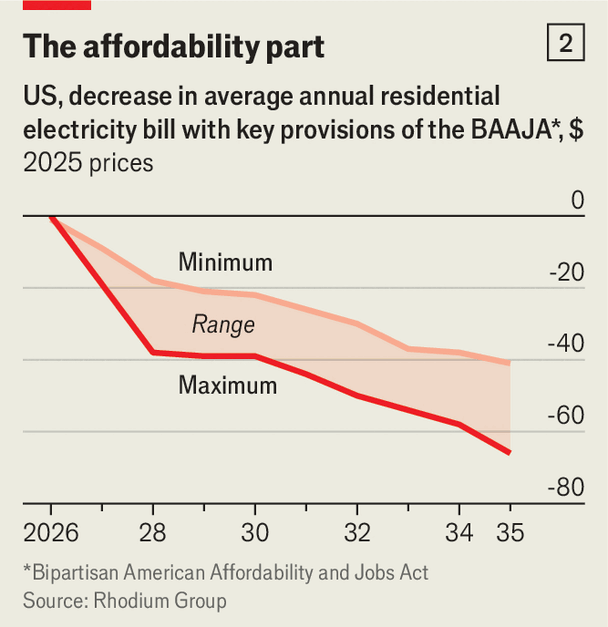
通过增加电力供应,并要求数据中心为电网升级支付超过其公平份额的费用,该法案应能降低电价。Rhodium Group(莱迪昂集团)表示,按实际价值计算,到 2035 年,居民电费可能比现行政策下低 3%-4%(见图表 2)。
By increasing the supply of electricity and obliging data centres to pay more than their fair share for grid upgrades, the bill should bring down prices. Residential electricity bills could be 3-4% lower in real terms in 2035 than under current policy, says Rhodium Group (see chart 2).
因此,民主党人必须决定他们的优先事项何在。党内许多人已拥抱“丰盛议程”,即认为美国需要加快建设以缓解短缺并降低成本。但也有人对放松监管持怀疑态度。接近 BAAJA 谈判的人士乐观地认为,将有足够多的民主党人加入共和党阵营共同支持该法案。但即使该法案成为法律,民主党内部的更广泛争论也远未尘埃落定。
Democrats, then, must decide where their priorities lie. Many in the party have embraced the “abundance agenda”, or the notion that America needs to build more quickly to alleviate shortages and bring down costs. Others, though, look askance at deregulation. People close to the talks over the BAAJA are optimistic that enough Democrats will join Republicans in backing it. But even if the bill becomes law, the broader argument within the Democratic Party will be far from settled.