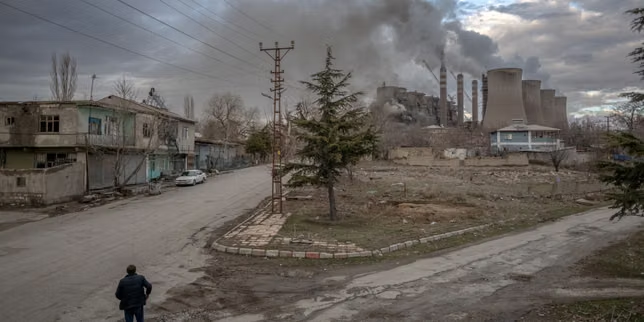
土耳其乔古尔汉村的夜空从未完全黑暗。它更像灰色,仿佛永远处于白昼。这种持续的光亮来自阿夫辛-埃尔比斯坦发电站——该电站以两个毗邻的城镇命名——其苍白的建筑体和高耸的烟囱每天24小时、每周7天喷出浓厚的灰烬,将广阔的安纳托利亚平原笼罩在一种近乎幽灵般的光线中。
The night sky never gets fully dark in the village of Çogulhan, Turkey. It's more gray, as if stuck in eternal daytime. The constant glow comes from the Afsin-Elbistan power plant – named after the two neighboring towns – whose pale blocks and tall chimneys spew thick ash 24 hours a day, 7 days a week, and bathe the vast Anatolian plain in an almost spectral light.
要到达这个村庄,需要从土耳其最南端的主要城市卡赫拉曼马拉什驱车两小时,沿着一条尘土飞扬的道路,穿过低矮的房屋、空置的仓库和方方正正的社会住房单元。
Reaching this hamlet requires a two-hour drive from Kahramanmaras, a major city in the southernmost reaches of Turkey, along a dusty road that passes through low houses, empty warehouses and blockish social housing units.
20世纪70年代,一支德国科学家团队在这里发现了该国最大的褐煤储量,也称“褐色煤”。尽管热值低、污染物多,但超过60亿公吨煤炭中约有一半通过露天开采相对容易开采。受矿藏规模和预期利润的诱惑,当局大规模征地并出租土地开采矿藏。20世纪80年代中期,伴随的混凝土巨型建筑群建成。此后,历届政府一直对其进行维护和扩建。2004年,一座名为B、规模相同的第二座发电站在乔古尔汉的另一端建成,将其夹在中间。
It was here in the 1970s that a team of German scientists discovered the country's largest reserve of lignite, also known as "brown coal." Despite being low in energy and high in pollutants, about half of the more than 6 billion metric tons of coal was fairly easy to extract through open-pit mining. Driven by the scale of the deposit and the lure of expected profits, authorities expropriated land and leased it on a massive scale to open the mines. In the mid-1980s, the accompanying concrete colossus was erected. Since then, successive governments have maintained and expanded it. A second power plant, called B and identical in size, was built at the other end of Çogulhan in 2004, pinning it in.
该电厂于2018年私有化,以造福于Çelikler Holding集团,该厂计划增设两台各688兆瓦的生产机组,使产能增加一半,尽管当地居民和气候倡导者持续谴责其造成的环境损害。7月份,一份2022年提交、2024年底经安卡拉当局批准的环境影响评估报告,因低估环境和健康风险而被法院推翻。土耳其环境与气候变化部对该判决提出上诉。该部部长穆拉特·库鲁姆目前正在主持COP31——联合国气候变化大会,该会议于11月9日在港口城市安塔利亚开幕,距离阿夫辛-埃尔比斯坦仅几小时车程。
Privatized in 2018 for the benefit of the Çelikler Holding group, the first plant intends to increase its capacity by half with two additional production units of 688 megawatts each, despite the environmental damage that residents and climate advocates have relentlessly denounced. In July, an impact assessment report, which had been filed in 2022 and approved at the end of 2024 by authorities in Ankara, was overturned in court for underestimating environmental and health risks. The Turkish Ministry of Environment and Climate Change appealed the verdict. This same ministry's head, Murat Kurum, is currently chairing the COP31 – the United Nations Climate Change Conference – which opened on November 9 in the port city of Antalya, just a few hours' drive from Afsin-Elbistan.