如果印尼总给人一种处于十字路口的感觉,部分原因在于好年景和坏年景很难分辨。在这两种情况下,经济增长都在5%左右缓慢前行,这得到了目前达2.89亿人口增长的支持。但在表面数字的背后,印尼经济在2026年陷入了困境。货币、外国投资和劳动力市场都表现疲软。民粹主义总统普拉博沃·苏比托上台后,这三者均有所减弱。如果这种局势在2027年持续下去,他将如何反应?
If Indonesia always seems to be at a crossroads, partly it is because a good year is hard to tell from a bad one. In both cases, economic growth trundles along at around 5%, supported by a growing population, now at 289m. But beneath the headline figures, Indonesia’s economy struggled in 2026. The currency, foreign investment and the labour market are limp. Under Prabowo Subianto, the populist president, all three have weakened. If this persists in 2027, how will he react?
以印尼货币印尼盾为例。在根据通货膨胀进行调整并按该国贸易伙伴的规模加权后,印尼盾正处于2007至2009年全球金融危机以来的最弱水平,自普拉博沃先生于2024年上台以来已下跌13%。股市信心的急剧丧失也无济于事。印尼有望成为2026年全球表现最差的市场。
Start with the rupiah, Indonesia’s currency. After adjusting for inflation and weighting by the size of the country’s trading partners, it is at its weakest point since the global financial crisis of 2007-09, having slipped by 13% since Mr Prabowo came to power in 2024. A drastic loss of confidence in the stock market has not helped. Indonesia is on track to be the world’s worst-performing market in 2026.
但最大的原因在于普拉博沃先生反复无常的治理风格,其特点是法治恶化、挥霍无度的计划以及混乱的决策。这些因素也对外国直接投资造成了拖累。在普拉博沃先生的前任佐科·维多多执政期间,随着企业试图利用印尼丰富的矿产资源,外资流入量曾急剧上升。自2024年以来,外资流入一直持平。
But the biggest cause has been Mr Prabowo’s erratic governance style, marked by the deteriorating rule of law, profligate programmes and incoherent policymaking. These have also weighed on foreign direct investment. Flows of FDI rose sharply under Mr Prabowo’s predecessor, Joko Widodo, as firms sought to capitalise on Indonesia’s vast mineral wealth. Since 2024, they have flatlined.
随着美国与伊朗的战争导致石油进口价格在2026年中期飙升,印尼的经济路线看起来难以为继。在压力之下,普拉博沃先生进行了一定程度的调整。他改组了内阁,并削减了他那些最挥霍无度的政策,包括一项全国学校供餐计划。
As America’s war with Iran sent the price of oil imports soaring in mid-2026, Indonesia’s economic course looked unsustainable. Under pressure, Mr Prabowo has adjusted somewhat. He has reshuffled his cabinet and trimmed his most spendthrift policies, including a national school-meals programme.
因此,印尼的财政赤字可能会保持在法律规定的占GDP 3%的上限之内,这可能会消除对印尼盾压力的一个来源。但在来年,普拉博沃先生面临的政治压力不会减弱。他的支持率已跌至历史低点。一些民调显示,由于对印尼经济的担忧,他的满意度已降至50%以下,低于2025年时超过80%的水平。
As a result, Indonesia’s fiscal deficit will probably stay within the 3%-of-GDP limit prescribed by the law, which could remove one source of strain on the rupiah. But the political pressure on Mr Prabowo will not relent in the coming year. His popularity has sagged to historic lows. Some polls put his approval rating below 50%, down from over 80% in 2025, primarily owing to concerns about Indonesia’s economy.
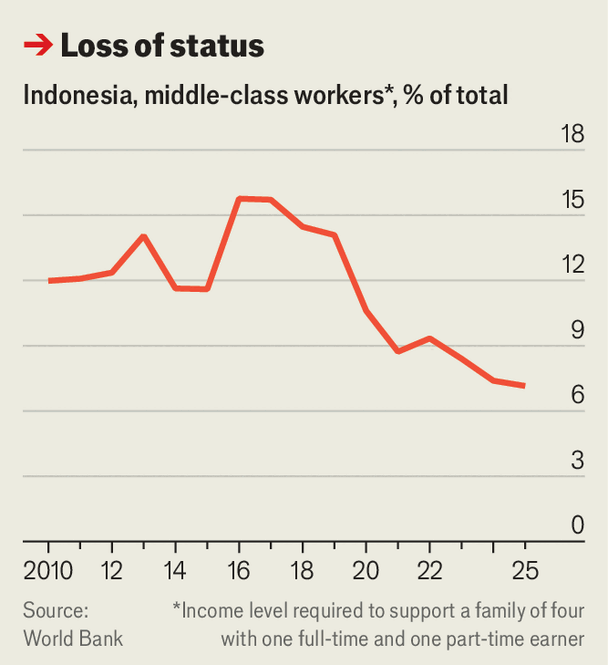
对普拉博沃先生不幸的是,这种担忧反映了现实。普通印尼人的生活并没有变得好过多少。最主要的原因是破碎的劳动力市场。世界银行计算得出,在2018年至2025年期间,中高级技能工人的实际工资(即扣除通货膨胀因素后)每年缩水1%至2%。这导致被印尼当局归类为中产阶级的工人比例减半(见图表)。
Unfortunately for Mr Prabowo, such concerns reflect reality. Life is not getting much better for the average Indonesian. The biggest reason is a broken labour market. Between 2018 and 2025 real wages (ie, after adjusting for inflation) for middle- and high-skilled workers shrank by 1-2% per year, the World Bank calculates. This has led the share of workers classified by Indonesian authorities as middle-class to fall by half (see chart).
衡量希望延长工作时间但未能如愿的劳动力比例的就业不足率估计为33%。对于印尼的根本病症,例如过早去工业化和庞大的非正规劳动力大军,普拉博沃先生没有提出任何解决方案。越来越多的印尼人(包括大学毕业生)正陷入低薪的非正规就业中。
The underemployment rate, which measures the share of labourers who would work more if they could, is estimated at 33%. For Indonesia’s underlying maladies, such as premature deindustrialisation and a vast informal workforce, Mr Prabowo has presented no solutions. More Indonesians, including graduates, are falling into low-paying informal employment.
内阁换新、支持率下降加上经济一团糟,你可能会认为2027年正是普拉博沃先生转变政策的时机。这似乎不太可能。普拉博沃先生的信念根深蒂固,包括认为外国人正在窃取印尼资源的观念。
With a refreshed cabinet, falling popularity and the economy a shambles, you might think the time is ripe for a Prabowo policy pivot in 2027. That seems improbable. Mr Prabowo’s convictions, including the notion that foreigners are stealing Indonesia’s resources, run deep.
他不会想要危及自己的民族主义资历,特别是考虑到2029年总统大选即将来临。包括维多多先生和西爪哇省省长德迪·穆利亚迪在内的竞争对手正在周围虎视眈眈。而政策的一百八十度大转弯可能会打破政治派系之间的微妙平衡。7月对印尼最高反腐检察官住所的突击搜查,暴露了警察阵营和军队阵营之间内斗的严重程度。
He will not want to jeopardise his nationalist bona fides, especially as a presidential election in 2029 looms. Rivals, including Mr Widodo and Dedi Mulyadi, the governor of West Java, are circling. And a volte-face might upset a delicate balance between political factions. A raid in July on the home of Indonesia’s most senior anti-corruption prosecutor revealed the extent of the infighting between police- and army-aligned camps.
相反,普拉博沃先生可能会在民粹主义道路上一条道走到黑。他的政府正准备在2027年初开始实施一项针对家庭的直接现金转账计划,价值高达100亿美元。更多的资源民族主义看起来也很有可能发生。
Instead, Mr Prabowo may double down on his populist approach. His government is preparing a programme of direct cash transfers to households beginning in early 2027, worth as much as $10bn. More resource nationalism looks likely, too.
一个考验将是定于1月1日起全面实施的新兴商品出口监督国家机构——印尼达南塔拉资源局(DSI)的全面运作。普拉博沃先生曾将其标榜为控制关键资源的中央机构,而官员们现在声称DSI将仅充当监督机构。从政策角度来看,这很明智,但对于坐立不安的普拉博沃先生来说,这可能还不够。■
One test will be the full implementation of Danantara Sumberdaya Indonesia (DSI), a new state agency overseeing commodity exports, set for January 1st. Once pitched by Mr Prabowo as a central body to control key resources, officials now claim DSI will act merely as a watchdog. As a matter of policy, that is sensible—but it may not be enough for the restless Mr Prabowo. ■