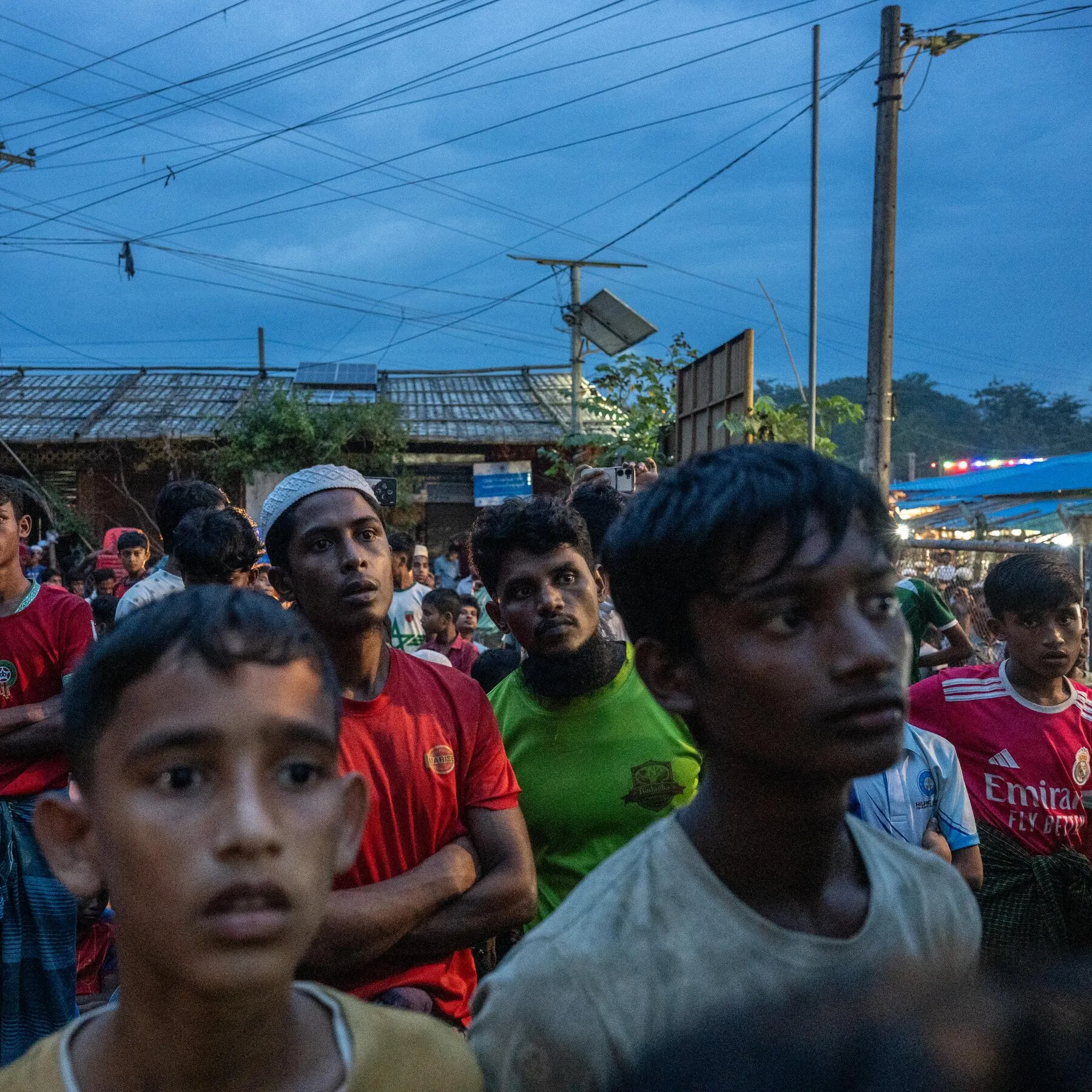
孟加拉国罗兴亚难民营周四下起了雨,这在一年中的这个时节并不常见。我报道2017年罗兴亚人从缅甸大逃亡时,印象最深的就是连绵不断的大雨,把丛林小道变成了泥泞的死路。
People gathered in the rain to hear the ruling on whether Myanmar had committed genocide, though they understood it might not change their lives anytime soon. It was raining in the Rohingya refugee camps in Bangladesh on Thursday, unusual for this time of year. One of my strongest memories of reporting on the 2017 exodus from Myanmar was the constant rain, turning jungle paths into muddy treachery.
但这毛毛雨没能阻挡数百名罗兴亚男子聚集在户外,面对一块屏幕,当地时间下午3点准时守候。他们戴着礼拜帽,穿着最体面的衣服,凑在一起聆听国际法院的判决——法院将就缅甸是否犯下种族灭绝罪作出裁决,并将他们认定为一个独特的族群,曾遭受最严重的暴行:杀戮、性侵、村庄被烧毁。
But the drizzle didn’t stop hundreds of Rohingya men from gathering outdoors in front of a screen at 3 p.m. local time. In prayer caps and their finest clothes, they leaned in close to hear the International Court of Justice, which was issuing its ruling on whether Myanmar had committed genocide, define them as a distinct ethnic group that had suffered the gravest of atrocities: killing, sexual assault, the incineration of their villages.
他们中很少有人懂英语,更别提从海牙传来的那些法律术语了。尽管如此,他们依然目不转睛地看着。
Few of them spoke English, much less the legalese emanating from The Hague. Nonetheless, they watched.
70岁的萨拉乌丁曾是实兑镇一所高中的校长,那里是缅甸安全部队制造最惨暴行的地点之一,他坐在最前排。“我自己就知道那是种族灭绝,我希望法庭也会这么说,”他说。
Salauddin, 70, once a principal of a high school in Maungdaw Township, the site of some of the worst violence unleashed by Myanmar security forces, sat in the front row. “I know it was genocide myself, and I hope that the court will say that,” he said.
随着法律程序拖沓进行,贾姆托利难民营的观看聚会上,男子们陆续离去前往清真寺。宣礼声响起。这种日常宗教仪式在罗兴亚人的故乡若开邦大部分地区被缅甸政府禁止,这是为抹除罗兴亚人身份而设计的诸多限制之一。
As the legal proceeding dragged on, men left the viewing party at Jamtoli camp for the mosque. The call to prayer echoed. Such daily rites were banned by the Myanmar government in much of Rakhine State, the Rohingya homeland, one of many limits designed to erase the Rohingya identity.
男子们又陆续走回来。法官们还在宣读。附近,小贩们兜售着花米和干鱼。随后直播画面中断,一条用罗兴亚语播报的通知过早地传来了消息:法院已认定缅甸对他们犯下了种族灭绝罪。欢呼声此起彼伏,堪比最大型的体育赛事。男子们落泪。似乎每个人都在自拍。直到最终判决书宣读完毕,前后耗时两个半小时。
The men wandered back. The judges were still talking. Nearby, vendors sold puffed rice and dried fish. Then the live broadcast cut off, and an announcement in the Rohingya language prematurely delivered the news: The court had recognized that Myanmar had committed a genocide against them. The explosion of cheers rivaled the biggest sporting match. Men wept. Everyone, it seemed, took selfies. It took two and a half hours until the final verdict was read out.
欢呼声此起彼伏,气氛热烈。主持人向所有人致谢:感谢孟加拉国政府收容约 120 万罗兴亚人,感谢包括马尔代夫和德国在内的 11 个国家对该案件表示支持,并特别感谢非洲国家冈比亚代表伊斯兰合作组织对缅甸提起种族灭绝诉讼。
The jubilation was electric. The announcer thanked everyone: the Bangladeshi government for hosting about 1.2 million Rohingya, 11 countries including the Maldives and Germany for adding their support to the case and, most of all, the African nation of Gambia that brought the genocide case against Myanmar on behalf of the Organization of Islamic Cooperation.
这是冈比亚的高光时刻。罗兴亚男孩和男子围成一圈,欢呼雀跃,齐声高呼一个词:“冈比亚。”我问一个男孩冈比亚在哪里。他说在欧洲,但又说不太确定。不管怎样,他说,那是个很棒的国家。
This was peak time to be Gambia. Rohingya boys and men gathered in a circle and jumped up and down, chanting in unison a single word: “Gambia.”I asked one boy where Gambia was. Europe, he answered, though he said he wasn’t exactly sure. Regardless, it was a wonderful country, he said.
人群渐渐散去。人们穿过泥泞的小巷,夜色掩盖了水坑,走回他们用防水布搭建的庇护所——这里是世界上最大的难民营。23 岁的穆罕默德·叶辛·祖哈尔怀着仅一个半月大的婴儿,说这项裁决让他充满喜悦,因为他的儿子或许不必在这些难民营、这些巨大的不安全地带长大。
The crowds thinned. People walked through muddy alleys, night obscuring puddles, on their way back to their tarpaulin shelters in what is the world’s largest refugee settlement. Mohammed Yeasin Zuhar, 23, cradled his baby boy, only a month-and-a-half old, and said the ruling filled him with joy because his son might not have to grow up in these camps, these vast zones of insecurity.
在这里,人口贩子绑架儿童,武装分子进行枪战。在宣判开始前一小时左右,我听到附近传来三声枪响。
Here, human traffickers kidnap children, and militants engage in running gun battles. An hour or so before the reading of the judgment began, I heard three gun shots pop nearby.
已过宵禁时间。我必须离开难民营。一群罗兴亚人提供安保,他们张开双臂形成一道人墙围住我,一名女子警惕地四处张望。
It was past curfew. I had to leave the camps. A group of Rohingya provided security, their arms spread to form a cordon around me, as a woman, their eyes searching for danger.
但难民们还是冲了进来,诉说他们的苦难——家人被杀,姐妹被强奸,孩子在从缅甸艰难逃亡的途中没能存活。这些悲剧在 2016 年和 2017 年之后仍在继续,国际法院裁定那些年发生了种族灭绝。
But refugees broke through anyway, with tales of woe — a family member killed, a sister raped, a child who didn’t survive the arduous escape from Myanmar. These tragedies continued after 2016 and 2017, the years ruled a genocide by the I.C.J.
我不知该说什么。我和他们一样明白,法院的裁决短期内可能无法改变他们的生活。罗兴亚人返回家园的希望渺茫。法院缺乏执行权力。不过,雨停了。
I did not know what to say. I understood, like they did, that the court ruling might not change their lives anytime soon. Chances of the Rohingya returning home are slim. The court lacks enforcement powers. The rain, though, had stopped.
Hannah Beech 是《纽约时报》驻曼谷记者,报道亚洲事务已超过 25 年。她专注于深度报道和调查性报道。
Hannah Beech is a Times reporter based in Bangkok who has been covering Asia for more than 25 years. She focuses on in-depth and investigative stories.